

Brian Blase, Ph.D., is the President of Paragon Health Institute. Brian was Special Assistant to the President for Economic Policy at the White House’s National Economic Council (NEC) from 2017-2019, where he coordinated the development and execution of numerous health policies and advised the President, NEC director, and senior officials. After leaving the White House, Brian founded Blase Policy Strategies and served as its CEO.
An Upcoming Paper and a Late Summer Recap
Much of Washington is taking this week off, so I thought it would be a good time to preview a forthcoming Paragon paper and recap Paragon’s key research papers, products, and events over the past six months. I hope you enjoy your last unofficial week of summer before life and work gets busy again after Labor Day.
Forthcoming Paragon Paper on Declining ACA Plan Quality
On September 4, Paragon will publish It’s Not Just the Prices: ACA Plans Have Declined in Quality Over the Past Decade, a paper from two health actuaries who are experts on the Affordable Care Act (ACA), Daniel Cruz and Greg Fann. This paper follows a KFF report released last week that showed how most doctors are not covered by ACA plans. Daniel and Greg explain why ACA plans are declining in quality over time. They make a series of recommendations for how to improve the ACA and the quality of health plans available to Americans.
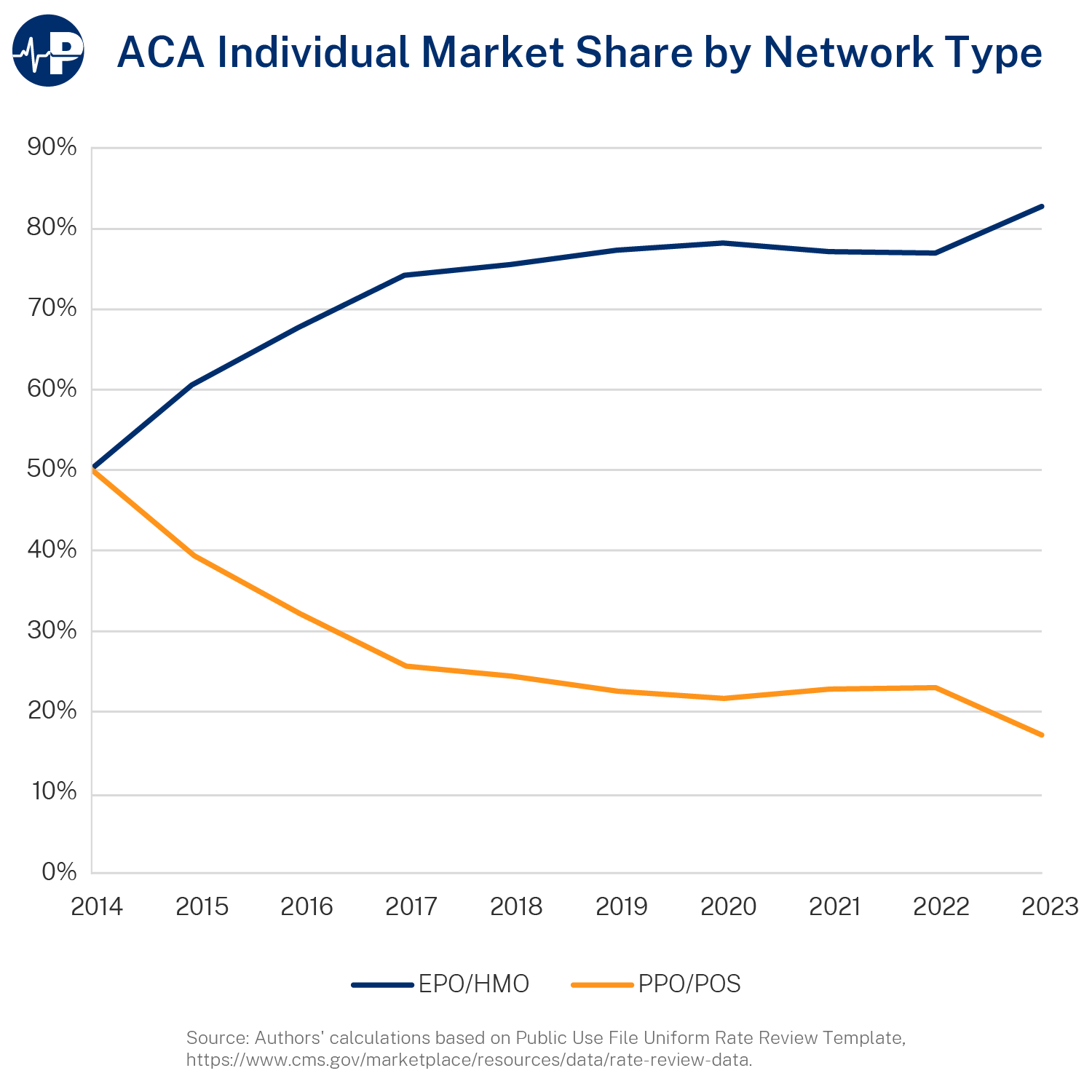
The type of provider network ranges from a health maintenance organization (HMO), which is generally more restrictive in terms of which providers are covered, to a preferred provider organization (PPO), which allows access to all providers but incentivizes using in-network providers.
This week’s Paragon Pic is from this forthcoming paper and shows the enrollment trends in insurance plans from 2014 to 2023. It shows that individual market enrollment has drastically shifted toward plans, particularly HMOs, that include fewer providers and facilities in their networks
.
Research Papers in 2024
Improving Medicare Through Medicare Advantage
by Joe Albanese
This paper reviews many of the benefits of MA over original Medicare, but also argues for a series of policy changes to improve MA coverage, advance regulatory parity with original Medicare, and yield estimated savings of $250 billion over ten years. These reforms include capping most MA benchmarks at 100 percent of original Medicare costs, ending quality bonuses, improving risk adjustment, and restricting first-dollar coverage of original Medicare cost-sharing by Medigap plans.
Follow the Money: How Tax Policy Shapes Health Care
by Theo Merkel and Brian Blase
This paper took an in-depth look at 10 significant tax provisions that apply to health care and health coverage, including an evaluation of the impact of each and their history. The paper provided six guiding principles for policy in this area and recommended ways to modify tax provisions to empower consumers and minimize distortions in the tax code that lead to wasteful health care expenditures. Our recommendations would result in people having more choice over their health insurance and greater access to health savings accounts. We would also place limits on distortionary subsidies by ending the enhanced Affordable Care Act (ACA) premium tax credits (PTCs), and capping PTC benchmarks and the tax exclusion for employer-sponsored health insurance at 125 percent of the national average.
The Great Obamacare Enrollment Fraud
by Brian Blase and Drew Gonshorowski
A combination of expanded PTCs and negligent Biden administration management of the federal exchanges created a wild west atmosphere that produces a massive amount of fraudulent enrollment and spending in the exchanges. This paper quantified the extent of the problem, and a follow-up paper I coauthored with Gabrielle Kalisz used broker and tax preparer public statements to further describe the problem and the lax Biden administration management. The main problem: there are large financial incentives for enrollees, brokers, and insurers for enrollees to misstate projected income and claim a greater subsidy than they are entitled to.
Overall, we estimate fraudulent enrollment between 4 to 5 million enrollees, with fraudulent spending between $15-$26 billion this year alone. We recommend six steps to reduce fraudulent exchange enrollment, including permitting the enhanced PTCs to expire after 2025, raising the subsidy recapture limits to reduce incentives for people to misestimate income, limiting automatic re-enrollment into exchange plans from one year to the next, and ending the continuous open-enrollment period for people who report they have income below 150 percent FPL.
Medicaid Financing Reform: Stopping Discrimination Against the Most Vulnerable and Reducing Bias Favoring Wealthy States
by Brian Blase and Drew Gonshorowski
The ACA significantly expanded Medicaid over the past decade with a new eligibility category—able-bodied, working-age adults. This expansion instituted federal discrimination against traditional Medicaid enrollees—children, pregnant women, seniors, and people with disabilities—by creating a much higher federal reimbursement rate of state spending for able-bodied adults than for traditional enrollees. The expansion diverted resources away from traditional Medicaid enrollees and reduced their access to health care services, quadrupled Medicaid’s improper payment rate, and led to a surge of wasteful spending that has significantly contributed to large and growing federal deficits. Status quo federal financing also advantages rich states over poorer states, leading to much greater federal Medicaid spending per person in poverty in rich states.
Paragon’s primary proposal would better protect services for traditional enrollees by phasing down the enhanced federal reimbursement rate for the ACA’s expansion population until it reaches parity with what states receive for traditional enrollees in 2034. States could keep Medicaid expansion for households below the poverty level, while households earning about the poverty level would be eligible for PTCs for exchange plans. This proposal would reduce federal deficits by more than $500 billion over a decade. A second proposal in the paper would reduce the disparity that favors rich states over poor states.
In addition to the above papers, Paragon has produced several other important research papers, including:
- Lowering Health Care Costs Through AI: The Possibilities and Barriers
- A Dozen Things to Know from CBO’s New Numbers
- Restoring Good Guidance Practices: How to restrain the administrative state and make government better
- Beyond Box-Checking: The Case for Dismantling Medicare’s Quality Bureaucracy
- Reducing Government Subsidies for Wealthier Medicare Enrollees
- Where Are Provider Shortages? Reassessing Outdated Methodologies
New Paragon Products
This year, we introduced a new bi-weekly analysis—the Paragon Prognosis. These pieces are quick-hitting analyses of important health policy developments, with recent pieces on Vice-President Harris’s price control agenda and the extralegal demonstration project the Biden administration is using to funnel billions of dollars to insurers so they don’t raise Part D premiums before the election. We also debuted the Paragon Pic, a weekly data visualization that illustrates health care trends and the facts that underlie our proposed reforms to government programs.
Paragon Events
In July, Paragon hosted an event with former Health and Human Services (HHS) secretaries Kathleen Sebelius and Alex Azar that made a strong bipartisan case for the Medicare program to stop overpaying for services in hospitals that can be delivered as safely and effectively in doctors’ offices or ambulatory surgical centers. I moderated a discussion with the secretaries, which was followed by policy experts from Paragon, the Brookings Institution, the American Enterprise Institute, and the Center for American Progress agreeing on the importance of ending Medicare’s excessive payments to hospitals.
In addition, we’ve hosted several virtual events throughout the year to highlight our research and policy work, which can be found here.
All the best,
Brian Blase
President
Paragon Health Institute
Recent Newsletters
Subscribe
Sign up now for your health policy updates.