1. Much Higher-Than-Expected Medicaid and ACA Expenditures
Federal spending is growing significantly—in part because of reckless fiscal policies from the Biden administration. CBO now projects federal deficits to be $2.5 trillion more from 2024 to 2035 than it projected in its February 2024 baseline. Nearly 25 percent of the increase is from much larger-than-projected spending in Medicaid and the ACA. CBO now expects federal Medicaid spending to be $47 billion more in 2024, $48 billion more in 2025, and $314 billion more from 2024 to 2035 than it expected in February. In 2024 and 2025, this represents a 9 percent surge from CBO’s February projection.
Figure 1 shows the explosive growth in federal Medicaid expenditures, comparing CBO’s baseline projections in 2020, 2023, and 2024. CBO attributes much of the higher-than-expected Medicaid expenditures to the growth of Medicaid state directed payments (item #3 in this brief) and slower unwinding of the program’s Covid-era continuous eligibility requirements (item #6).
Between CBO’s 2020 and 2023 estimates, actual and projected federal Medicaid spending increased by $323 billion over 2020 to 2030, or 5.2 percent. The escalation continues. Between last year’s report and this year’s, CBO projects higher federal Medicaid spending of $336 billion over 2023 to 2033, or 4.5 percent.
Figure 2 shows the explosive growth in the cost of ACA premium subsidies to health insurers, contrasting CBO’s projections before President Biden unleashed higher subsidies to insurers with CBO’s projections in 2023 and 2024. The subsidy cost increase is due to legislation that substantially increased the subsidies from 2021 to 2025, millions of people claiming subsidies well above what they are eligible for, significant financial gains to insurers and brokers when people claim more subsidy than they are eligible for, lax eligibility verification for broker-assisted applications in HealthCare.gov states, and numerous actions from the Biden administration that prioritize enrollment and distributing more subsidies to insurers over ensuring program integrity (see item #4). Between CBO’s September 2020 and 2023 estimates, projected subsidy spending increased by $279 billion over 2023 to 2030, or 54 percent. The escalation continues. Between last year’s report and this year’s, CBO projects higher subsidy spending of $263 billion over 2024 to 2033, or 25 percent.
2. High and Escalating Per Enrollee Costs of ACA Medicaid Expansion Enrollees
Able-bodied, working-age adults made eligible for Medicaid by the ACA are costing the federal government substantially more than previously projected. CBO now estimates that 2023 federal outlays for newly eligible adults reached $130 billion—37 percent more than CBO had forecast as recently as 2021. In 2034, federal spending on ACA expansion enrollees is expected to rise to $187 billion. This rapid growth in spending is partly because states contribute no more than 10 percent of the cost to insure this group. As a result, state administrators have little incentive to constrain spending or enforce eligibility requirements. Federal investigators have documented widespread fraud and abuse related to the newly eligible group:
Audits in four states at the start of the expansion indicate that up to 23 percent of enrollees in this group were ineligible for coverage, a percentage that almost certainly increased during the COVID public health emergency.
Moreover, the gap in per enrollee spending between newly eligible adults and traditionally eligible non-disabled, working-age adults (e.g., parents of eligible children) is large and will continue to widen over the coming decade, according to CBO. The federal government on average spent twice as much on newly eligible adults in 2023 than on traditionally eligible non-disabled, working-age adults despite early assurances that newly eligible adults would incur fewer medical expenses. By 2034, CBO expects that ratio to increase further, with $2.27 in federal dollars being spent on the average newly eligible adult for every $1 spent on the average traditionally eligible adult.
3. Growth of Shady Medicaid State-Directed Payments
About 30 percent of the increase in Medicaid spending between CBO’s February and June baselines—or about $90 billion—is rapid growth in Medicaid state-directed payments (SDPs). Through these payments, states direct Medicaid managed care organizations (MCOs) to make extra payments to health care providers. These payments lack transparency and are often ways for politicians to help politically favored hospitals. A main reason for the increase: In May 2024, the Biden administration finalized a rule to allow providers to receive average commercial rates (ACRs) rather than Medicare rates through SDPs.
SDPs, which did not exist prior to 2017, ballooned to $38.5 billion in 2022, according to the Government Accountability Office. As the Biden administration acknowledged, this new rule is “precedent-setting” because historically, MCOs had not been allowed to pay providers more than Medicare rates. By allowing MCOs to pay ACRs, this rule will substantially increase payments to providers. CBO previously found that commercial prices for hospital services are often twice as high as Medicare fee-for-service (FFS) prices. The Biden rule will likely raise prices in the private insurance markets by incentivizing hospitals to raise their commercial rates. As health care consultant Ann Kempski noted in April, “If you allow states to pay hospitals’ average commercial rates, you’ve just given [hospitals] another reason to keep raising their average commercial rates.”
4. CBO Acknowledges—but Underestimates—ACA Premium Tax Credit Fraud
In a Paragon report released on June 20, we find that nearly 5 million ACA enrollees who claim income between 100 percent and 150 percent of the federal poverty level (FPL) to access fully subsidized exchange plans do not have income in that range and are thus receiving far more than the lawful amounts they qualify for. We estimate that the cost for this fraudulent enrollment will be about $20 billion in 2024 alone. The surge in improper spending is a function of expanded subsidies that make coverage fully subsidized for enrollees who have income between 100 percent and 150 percent FPL through 2025, Biden administration actions to prioritize enrollment over program integrity, and huge financial gains for insurers and brokers from people misreporting income to receive fully subsidized plans. (Far more people enroll when the premium is fully subsidized than if they must pay even nominal premiums, so insurers and brokers collect much more revenue when the taxpayers pick up the entire cost of the premium.)
In its federal health coverage report, CBO acknowledges that “policies that allow people with incomes below 150 percent of the federal poverty level to enroll at any point during the year and policies that eliminate multiple income verification steps” are leading to higher exchange enrollment, which they estimate at between 0.5 million and 1.5 million enrollees. Although CBO acknowledges that people are gaining fully subsidized plans because of weaker verification rules, there are many other factors that contribute to the high level of fraudulent enrollment, and CBO does not include estimates of the number of people enrolled between 100 percent and 150 percent FPL who do not actually have such income.
5. The uninsured rate would only rise by one percentage point if the enhanced ACA subsidies expire
The biggest health policy issue facing Congress next year will be whether to permit the enhanced ACA subsidies to expire after 2025. For numerous reasons, including the significant fiscal cost, the large extent of fraud associated with the enhanced subsidies, the expansion of an inflationary premium structure that gives insurers’ pricing power, and the incentives for employers to drop workplace coverage, Congress should permit the enhanced subsidies to expire.
The new report provides information on CBO’s expectations of the subsidy expiration on coverage. From 2025 to 2028 (when the effect of the expanded subsidies is clear), CBO projects a decline in subsidized exchange enrollment from 21 million to 14 million people. During that time, CBO projects that employer coverage would increase by 4 million people and the number of unsubsidized individual market enrollees would increase by 1 million. Thus, CBO projects that the uninsured rate only increases from 7.9 percent to 9.2 percent from 2025 to 2028, which is partly because of higher projected immigration during this period (see item #11).
On June 24, 2024, CBO provided projections of the coverage and cost effects of continuing the expanded PTCs to House Budget Committee Chairman Jodey Arrington and House Ways and Means Committee Chairman Jason Smith. The cost of extending the enhanced PTCs would be $383 billion from 2025 to 2034. There would be a 3.5 million person reduction in employer coverage and a 1.1 million person reduction in unsubsidized individual market coverage. Overall, there would be about a 3.4 million decrease in the number of people without health insurance—or a cost of roughly $11,300 per person per year of reduced uninsurance—an amount well above the average value that people place on health insurance.
6. Higher COVID Medicaid Enrollment and Slower Medicaid Unwinding Than Expected
According to CBO, there are approximately 1.6 million more people enrolled in Medicaid and the Children’s Health Insurance Program (CHIP) in June 2024 than it expected last year. The number of people enrolled in Medicaid from the COVID-19 public health emergency continuous coverage requirements was higher than expected and the removal of ineligible Medicaid enrollees is going more slowly than expected after the end of the continuous coverage requirements. CBO highlights that, while the continuous eligibility provisions ended on April 1, 2023, most states did not start disenrollments until June 2023.
CBO does expect that Medicaid enrollment will decline considerably from 2023 to 2024—from 85 million people to 72 million people, with a decline of about 5 million children, 5 million ACA enrollees, and 4 million non-ACA expansion, non-disabled, working-age adults. Most enrollees who lose Medicaid are already covered by other types of insurance or will transition to such coverage once they lose Medicaid.
7. Number of People with Multiple Sources of Coverage Grows to 29 Million
In September 2023, CBO projected that 26.5 million people would have multiple sources of coverage in 2023. CBO now estimates that 28.7 million people had multiple sources of coverage in 2023. There are significant program integrity risks from such a high number of people with multiple sources of coverage, as taxpayers are likely on the hook for Medicaid and ACA subsidy expenditures that they should not be. The most common dual enrollment situation is coverage in Medicaid and an employer plan. The COVID continuous coverage requirements meant that many people who gained employer coverage remained on the Medicaid program. Since the vast majority of Medicaid beneficiaries are covered through managed care plans in which the government pays a fixed rate to insurance companies for each beneficiary regardless of their level of health care use, this duplication of coverage is costly to taxpayers. Paragon’s new report suggests that, in North Carolina alone, potentially hundreds of thousands of people are dually enrolled in Medicaid and exchange plans after North Carolina adopted the ACA Medicaid expansion in December 2023.
Figure 3 shows that CBO expects that about 11.6 million more people have multiple sources of coverage in 2023 than it projected in 2022—a sign that the COVID-19 Medicaid continuous coverage requirements lasted longer than CBO expected and that eligibility systems are working much more poorly than expected to remove ineligible enrollees from government health programs. Of note, CBO expects a substantial decline—by nearly 8 million people—in the number of people with multiple sources of coverage from 2023 to 2024, largely because of its projections around Medicaid unwinding. Importantly, CBO projects about 8 million more people will have multiple sources of coverage over the next decade than it projected just in its 2022 projections.
8. Counter to Trends, CBO Projects Few, If Any, Non-Medicaid Expansion States Will Expand Over the Next Decade
CBO does not expect significant growth in the number of ACA Medicaid expansion enrollees over time. As a result of Medicaid redeterminations and removals associated with the end of the COVID public health emergency continuous coverage requirements, CBO expects a decline from 18 million expansion enrollees in 2023 to 13 million in 2024. CBO projects that this will only grow by about one million additional people by the end of the budget window, and without explanation, CBO projects one million fewer expansion enrollees on average over the 2024-2034 period than it projected last year.
Particularly accounting for population growth, this means CBO expects few of the remaining non-expansion states, and none of the big ones like Texas or Florida, to adopt expansion. This projection by CBO is perplexing given that an average of 1.5 additional states have adopted expansion each year since 2014. Assuming the past pattern of state behavior and that no states that have adopted expansion have ended their expansion, CBO is almost certainly underestimating future ACA Medicaid expansion enrollees as well as expenditures.
9. Outpatient hospital expenditures are a significant driver of Medicare’s worsening fiscal situation
As in past years, CBO projects that Medicare is growing at an unsustainable pace. By 2034, annual spending will more than double to $2.2 trillion (nearly twice the projected amount of estimated defense spending). Some of this is due to the rapid growth of the program’s overall enrollment as the baby boom generation continues to retire. But health care costs per enrollee are also expected to significantly rise.
Figure 4 shows projected Medicare spending per enrollee, which will grow overall by 73 percent between 2023 and 2034 to reach nearly $27,000. CBO projects Medicare Advantage (MA) spending will grow by 70 percent to reach nearly $25,000 per enrollee in 2034, while FFS will grow at a steeper 82 percent to reach almost $30,000 per enrollee in 2034. According to CBO’s estimates, Medicare spending will outpace inflation by about 2.5 times between 2023 and 2034.
The faster growth in FFS per enrollee spending relative to MA is driven by a few factors, including higher-than-expected 2023 spending that caused CBO to raise its future projections of FFS outlays relative to its 2023 baseline. But specific categories of health care spending in FFS also spell trouble for Medicare’s finances. In particular, Figure 5 shows that outpatient hospital spending per enrollee in FFS will surge 155 percent over the projection period from just over $1,900 per enrollee in 2023 to almost $4,900 per enrollee in 2034.
The growth in outpatient hospital spending is notable not just because of its magnitude—it is the biggest driver of Medicare Part B spending growth in FFS—but because it is enabled by deeply misguided government policies. FFS pays for identical services at different rates depending on the type of facility where they are delivered. Hospitals usually command the highest rates, even for routine services that could be delivered in a physician’s office. This encourages hospitals to acquire independent physician practices, which they can rebrand as off-campus hospital outpatient departments. Equalizing payment rates across health care settings (known as site neutrality) is a sensible policy solution that would reduce costs for patients and taxpayers alike without compromising the quality of care.
10. Continued Growth of Medicare Advantage
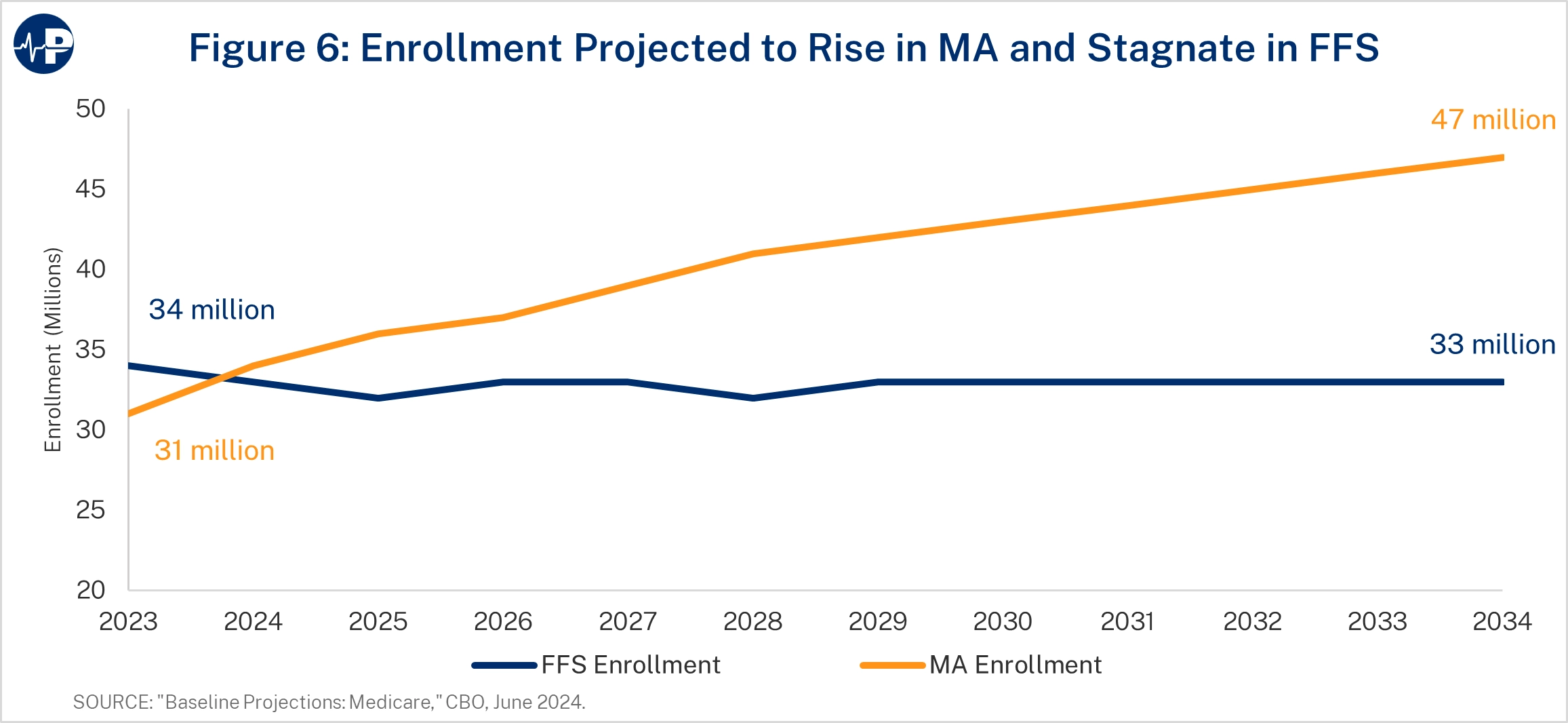
CBO estimates that the Medicare population will rise by roughly a quarter during the 2023-2034 period, reaching 80 million. As Figure 6 shows, projected growth will take place entirely within MA. Most Medicare enrollees are now in MA, and by 2034 almost 59 percent of program enrollees, or 47 million people, will be in MA. Meanwhile, enrollment in traditional FFS Medicare is projected to decline by 3 percent over the projection period to 33 million in 2034.
11. Unprecedented Immigration Surge Will Increase Government Health Spending and the Uninsured Rate
The number of immigrants, in large part due to a surge in migrant crossings of both illegal immigrants and asylum seekers, is estimated to be 8.7 million higher than expected between 2021 and 2026. Historically, CBO expects net immigration levels of roughly an additional 200,000 foreign nationals per year. This surge in immigration will have several effects on the U.S. health sector. According to CBO, immigrants in this surge are four times as likely to be uninsured than others, and thus the surge will increase the uninsured rate.
While CBO expects the immigration increase to lower the federal deficit by $897 billion overall during the 2024-2034 period (as is consistent with historical trends, due to increased economic activity and revenue from income and payroll taxes), it also expects spending on mandatory programs to increase $194 billion over the same 10-year period. CBO expects state and local costs to increase more than their revenues, though CBO does not specify exact figures. CBO projects that ACA subsidies make up the largest share of increased spending from the immigration surge, with $59 billion in increased outlays and $7 billion in reduced revenues over the 2024-2034 period. CBO projects Medicaid spending to increase by $29 billion, while CHIP spending will increase by $11 billion over the same period. CBO also expects the immigration surge to lead to higher Medicare outlays than otherwise would happen, though it did not specify the exact number, only lumping it together with increases totaling $35 billion for the Supplemental Nutrition Assistance Program, child nutrition programs, Supplemental Security Income, Social Security, and assistance for higher education.
12. Uninsured Rate Reached All-Time Low in 2023, in Part Due to Fraud in Government Programs
CBO estimates that only 7.2 percent of the U.S. population was uninsured in 2023 and forecasts that the uninsured rate will hover around 9 percent over the next decade. Much of the drop in the uninsured rate in recent years is attributable to fraudulent enrollment in Medicaid and the ACA’s taxpayer-subsidized exchange plans. State audits reveal that a large proportion of Medicaid recipients—commonly 15-25 percent, depending on the eligibility category, state, and year—are ineligible under program rules. Consistent with these findings, improper payments in Medicaid have soared with the ACA’s expansion of the program. Many of the new enrollees are likely not even aware they are covered, as a new survey shows that 30 percent of Medicaid enrollees did not know they were enrolled in the program. To make matters worse, a new Paragon analysis finds that millions of individuals are receiving fully subsidized health insurance plans that they are not eligible for, imposing an estimated $20 billion in improper costs on taxpayers in 2024.
Major Reforms Are Needed
Hopefully, CBO’s new reports will serve as a wake-up call to policymakers. CBO’s new numbers show costs rising throughout our government health programs, with sizeable short-term increases in Medicaid and the ACA subsidies. The policies of dramatically increasing subsidies to insurers for Medicaid managed care and ACA plans are particularly unwise and costly. And Medicare continues to be on an unsustainable trajectory, in need of reforms to put the program on sustainable footing.