
Reforming Government. Empowering Patients.
Navigation
The Great Obamacare Enrollment Fraud

The Paper
Executive Summary
What This Paper Covers
The Affordable Care Act (ACA) provided large subsidies for lower-income people to buy coverage in the exchanges. President Biden signed legislation that increased these subsidies through 2025, making plans fully-subsidized for enrollees with income between 100 percent and 150 percent of the federal poverty line (FPL). Enrollees in this income range also qualify for a cost-sharing reduction program that raises plan actuarial value to 94 percent with minimal deductibles and cost-sharing requirements. The Biden administration has also pursued administrative actions which have made this coverage more accessible for lower-income households and loosened eligibility reviews.
This paper describes the incentives for people to misestimate income to qualify for larger subsidies. By state, this paper shows the number of people claiming income between 100 percent to 150 percent FPL who sign-up for coverage with the likely number of people who are eligible for this coverage within that income grouping. Then, this paper discusses the problematic incentives facing brokers and insurers for improper enrollment. The paper concludes with a set of recommendations to minimize improper and fraudulent enrollment and spending.
What We Found & Why It Matters
Nearly half of exchange sign-ups during the 2024 open enrollment period reported income between 100 percent and 150 percent FPL, qualifying for fully-subsidized, 94 percent actuarial value plans. The percentage of people signing up who report income in this range has increased substantially since the enhanced subsidies took effect.
In nine states (Alabama, Florida, Georgia, Mississippi, North Carolina, South Carolina, Tennessee, Texas, and Utah), the number of sign-ups reporting income between 100 percent and 150 percent FPL exceed the number of potential enrollees. The problem is particularly acute in Florida, where we estimate there are four times as many enrollees reporting income in that range as meet legal requirements.
The problem of fraudulent exchange enrollment is much more severe in states that have not adopted the ACA’s Medicaid expansion as well as in states that use the federal exchange (HealthCare.gov). In states that use HealthCare.gov, 8.7 million sign-ups reported enrollment between 100 percent and 150 percent FPL compared to only 5.1 million people likely eligible for such coverage, or 1.7 sign-ups for every eligible person.
Overall, fraudulent exchange enrollment appears to be a significant problem in nearly half of states. We estimate that fraudulent enrollment at 100 percent to 150 percent FPL is likely upwards of four to five million people in 2024. We estimate, conservatively, that this cost will likely be upwards of $15 to $20 billion this year.
In all states, there is an incentive for people who have income between 200 and 400 percent of the FPL to report income between 100 and 150 percent of the FPL. They qualify for a larger advanced subsidy and a plan with much lower cost-sharing, and the Internal Revenue Service only recaptures a portion of the excess subsidy when they file their taxes.
In non-Medicaid-expansion states, there is a large incentive for people, particularly older people, to overestimate their income. These individuals do not need to repay any of the subsidy to which they were not entitled.
Controlling for Medicaid expansion demonstrates the problems with HealthCare.gov as the percent of people who report income between 100 percent to 150 percent of FPL as those who are potentially eligible is more than twice as high in states using HealthCare.gov as using a state-based exchange. Evidence suggests that part of the issue is that state-based exchanges have done a more thorough job of re-evaluating people for exchange coverage who were no longer eligible for Medicaid after the public health emergency unwinding than states that use HealthCare.gov.
Unscrupulous brokers are certainly contributing to fraudulent enrollment and the enhanced direct enrollment feature of HealthCare.gov appears to be a problem. Brokers just need a person’s name, date of birth, and address to enroll them in coverage, and reports indicate that many people have been recently removed from their plan and enrolled in another plan by brokers who earn commissions by doing so.
Health insurers are a primary beneficiary of the surge in improper enrollment from people misestimating income. The larger subsidies mean that consumers are less sensitive to prices of plans and are more likely to enroll, and it’s much easier for insurers to collect subsidies from the U.S. Treasury than customers.
What We Recommend
We recommend six steps to reduce fraudulent exchange enrollment:
- Congress should permit the enhanced subsidies to expire after 2025;
- Congress should raise subsidy recapture limits to reduce incentives for people to misestimate their income;
- Congress or the next administration should limit automatic re-enrollment into exchange plans and end it for people moving from or into fully-taxpayer subsidized plans;
- Congress should appropriate cost-sharing reduction payments and prohibit silver-loading;
- Congress should conduct aggressive oversight of the Biden administration’s management of HealthCare.gov, enhanced direct enrollment, and insurer and broker actions to take advantage of misestimating income;
- Congress or the next administration should reverse policies of the Biden administration that enabled such widespread fraudulent enrollment, particularly the continuous open-enrollment period for people who report they have income below 150 percent FPL.
Background
An analysis of Affordable Care Act (ACA) enrollment data, Census data, and U.S. Treasury data shows a widespread problem of people misestimating their income to maximize subsidies for exchange plans. We estimate upwards of four to five million fraudulently enrolled exchange sign-ups who will cost taxpayers north of $15 to $20 billion this year. We find that the issue is more severe in states that did not adopt the ACA’s Medicaid expansion (as there is a large incentive to overestimate income in those states) and states that are using the federal exchange platform for enrollment, HealthCare.gov.
Enrollment in the exchanges has grown substantially over the past few years, driven by increased subsidies. The subsidies, structured as premium tax credits (PTCs), reduce the percentage and amount of income that a person must pay for a benchmark plan—the second-lowest-cost silver plan1 available to them.
President Biden signed the American Rescue Plan Act of 2021 (ARPA) in March 2021 and the Inflation Reduction Act of 2022 (IRA) in August 2022, which increased the subsidies through 2025.2 As a result, people who claim that their income is between 100 percent and 150 percent3 of the federal poverty level (FPL) now pay $0 for benchmark plans, meaning that their coverage is fully paid by taxpayers. The ACA limited the PTCs to enrollees in households with income below 400 percent FPL, but the legislation signed by President Biden lifted that cap, extending the subsidies to households in the top two quintiles. Figure 1 shows the percentage of income that households at a given percentage of the FPL had to pay for benchmark plans under the original ACA and from 2021 to 2025 under the increased subsidies.

The ACA subsidies are generally payments directly from the U.S. Treasury to health insurers on behalf of enrollees who select plans in the exchanges. In official terminology, the subsidies are advance PTCs (APTCs), as they are credited to individuals based on their estimated household income and then sent to insurers. The PTCs are refundable4 and larger for lower-income enrollees, as they phase down as enrollee income increases. People with income below 200 percent FPL also qualify for a cost-sharing reduction (CSR) program that significantly reduces deductibles, cost-sharing amounts, and out-of-pocket limits.5 For someone with income between 100 percent and 150 percent FPL who selects a silver plan, the CSR program raises plan actuarial value—the average percentage of expenses paid by the plan—to 94 percent. For silver plan enrollees with income between 150 percent and 200 percent FPL, the CSR program raises the actuarial value to 87 percent.
The PTC structure, particularly after the enhancement, creates numerous problems, which we have explored in other papers.6 The focus of this piece, however, is to present data on how the PTC structure—particularly after President Biden signed legislation increasing the subsidies and making fully subsidized plans with very limited cost-sharing available to enrollees with income between 100 percent and 150 percent FPL—has led to far more people enrolling in the lowest income category than are eligible.
Figure 2 demonstrates the shift in overall enrollment to the lowest-income category in the states that use HealthCare.gov. In 2022, the fully subsidized plans were first readily available during that year’s open enrollment period. In 2024, 53 percent of people who signed up for coverage during open enrollment reported that their income was between 100 percent and 150 percent FPL. This figure shows only the federal exchange sign-ups, because not all states with state-based exchanges reported sign-ups by income grouping prior to 2022.

Overall, when including states with their own exchanges, 47 percent of people who selected plans during open enrollment reported income between 100 percent and 150 percent FPL in 2024. The reason for the decline when including states that established their own exchanges is that all those states expanded Medicaid under the ACA. In those states, the ACA requires that people with income between 100 percent and 138 percent FPL enroll in Medicaid and not in exchange-based plans
A Massive Incentive to Misestimate Income
During open enrollment (typically in November and December preceding the coverage year), enrollees sign up for exchange plans. During this period, they, likely with the assistance of brokers or navigators working with them on their applications, estimate their household income for the following year.
The APTC is a function of this estimated income, so people generally qualify for larger subsidies if they underestimate their income, although there is an incentive for some people in states that have not expanded Medicaid to overestimate income (see discussion below). When a person files his or her subsequent tax return (generally in April of the year after the coverage), the APTC amount gets reconciled with the amount of the PTC that person was entitled because of actual income. People who received excessive subsidies would owe the excess back when they file their taxes, subject to limits discussed below. Those who received subsidies that were too small would receive additional credit against their taxes when they file.
In Medicaid expansion states, able-bodied, working-age adults with income below 138 percent FPL are eligible for Medicaid. Therefore, in expansion states, only enrollees who estimate their income between 138 percent and 150 percent FPL are eligible for fully subsidized benchmark plans.
In states that have not expanded their Medicaid programs, enrollees with income between 100 percent and 150 percent FPL are eligible for fully subsidized benchmark plans, as able-bodied, working-age enrollees are generally not eligible for Medicaid in those states. If their income is below 100 percent FPL, they also are ineligible for PTCs. This creates an incentive for able-bodied adults with income below the poverty line to overestimate their earnings. By estimating that their earnings are between 100 percent and 150 percent FPL, such an individual can claim a PTC that now covers the entire premium for a benchmark plan that would also have a very low deductible, cost-sharing amounts, and out-of-pocket limit because of the CSR program. By misstating their income, these individuals get generous coverage at zero cost to them—instead of being ineligible for any subsidies at all.
The incentives to misstate income are magnified because the law limits the amount that people need to repay when they file their taxes. For 2024, the amount that single filers must pay back to the Internal Revenue Service (IRS) is capped at $375 for individuals between 100 percent and 200 percent FPL, $950 for those between 200 percent and 300 percent FPL, and $1,575 for those between 300 percent and 400 percent FPL.7 People with income above 400 percent FPL would need to fully reconcile the APTC amounts with the PTC amounts to which they were entitled.
Because of these relatively low recapture limits, many enrollees have an incentive to underestimate their income. For example, for a 40-year-old enrollee at 290 percent FPL, the incentive for estimating income at just under 150 percent FPL is $1,438 on average in the United States. He would receive an APTC of $5,723 to cover the full premium of insurance coverage with an actuarial value of 94 percent. At 290 percent FPL, he was eligible for a PTC of $3,355—receiving $2,368 of excessive subsidy for much less generous coverage (70 percent actuarial value). He would need to repay $950, which would leave him better off by $1,418 in premium subsidies due to underestimating his income and the added benefit of having coverage with much less cost-sharing.
The incentives to overestimate income in non-expansion states are much larger for older enrollees, as the PTC structure limits premium payment to a certain percentage of household income, regardless of the premium amount. Because premiums are three times more for enrollees near 65 than for enrollees in their 20s, the subsidies are also much larger. Nationally, the average PTC for a 21-year-old is $4,478 and the average PTC for a 64-year old is $13,434.8 Older enrollees demand more medical services all else equal, and some may be looking to retire before the age of 65. These factors contribute to a larger incentive for them to overestimate income to earn a PTC.
Given how the subsidy structure works, there is not much differential incentive for older people to underestimate their income to gain a higher subsidy. In fact, the only differential occurs because the value of the cost-sharing reduction subsidy, which we explain below, is greater for older enrollees than younger enrollees.
Figure 3 demonstrates the age dynamic. The incentive to underestimate income is minimal for enrollees with income below 200 percent FPL, so the figure starts showing the benefit of underestimating income at 200 percent FPL. The benefit gradually increases as household income increases until the benefit ceases at 400 percent FPL. Figure 3 includes an estimate of the taxpayer cost for enrollees who underestimate their income to qualify for the CSR program and a 94 percent actuarial value plan.9

People who estimate their income to be at least 100 percent FPL at the time of enrollment but end up earning less than 100 percent FPL do not have to pay any of the APTC back. In that circumstance, the IRS considers the person to be qualified for the PTC so long as the income estimate was not made “with intentional or reckless disregard for the facts.”10 Therefore, people with income below 100 percent FPL in non-Medicaid expansion states have an even more significant incentive to overestimate their income to qualify for a large PTC, as they would not need to pay any of it back. Such enrollees who overestimate their income to an amount greater than 100 percent FPL receive a full subsidy. In other words, they pay zero premium for plans with actuarial values of 94 percent.
In 2024, a 40-year-old enrollee reporting income between 100 percent to 150 percent FPL would receive an average subsidy of $5,869 in Florida, $5,556 in Georgia, and $5,700 in Texas.11 For a 60-year-old enrollee, the amounts in these states would be $12,464, $11,799, and $12,104.12 And their cost-sharing would be far more generous than what all but a few Americans get through their employer-sponsored insurance. These estimates of the benefit of misestimating their income are conservative, because they do not factor in the additional value of the CSR program that benefits them. However, Figure 3 accounts for the extra benefits of the CSR program and the 94 percent actuarial value plan to which enrollees who report income between 100 percent and 150 percent FPL are entitled.
Analysis Confirms People Are Misestimating Income
New research shows that people have been misestimating their income—with a particularly high concentration in Florida—since the ACA’s key provisions took effect. In a 2024 piece using 2015-2017 federal exchange data, three authors—all of whom are past or present Congressional Budget Office experts—find “evidence suggesting that many people in the coverage gap in non-expansion states obtain subsidies by reporting income just above the Federal Poverty Line at the time of enrollment, especially in Florida.”13 The “coverage gap” refers to people in non-expansion states with incomes below 100 percent FPL.
The authors continued, “The precise incomes reported by marketplace enrollees suggest that they were aware of the cutoff for PTC eligibility at the FPL. Consider single-person households in non-expansion states in 2015, for whom the lower bound for eligibility for the PTCs was $11,670.… [S]o many enrollees reported income between $11,670 and $12,500 to Healthcare.gov that actual marketplace enrollment was 136% of estimated potential enrollment in that range. Furthermore, many of these enrollees reported [modified adjusted gross income] precisely equal to $11,670, $11,700, or $12,000, suggesting that they were aware of the cutoff for PTC eligibility and reported just enough income to exceed it. Other spikes correspond to round values, like $15,000, or inflation-adjusted round values from 2014.” Such precision on a widespread scale suggests significant counseling of income manipulation by outside entities aware of the program rules.
The authors conclude: “Taken together, these facts suggest that many people who eventually earned less than 100% FPL reported that they expected to earn more than this amount when enrolling in marketplace insurance and were able to receive PTCs. This implies that many people who earned less than the FPL (or, in the ACS [American Community Survey], reported earning less) were effectively eligible for PTCs.”
In 2019 (the most recent year Treasury published this analysis), the Treasury Department estimated that over one-fourth of all PTCs—an amount equal to $11.32 billion—would be paid to insurers on behalf of households with income below 100 percent FPL in 2020.14 Treasury estimates that roughly 1.70 million tax filers receiving PTCs would have income under 100 percent FPL, and 1.38 million who would receive PTCs would have income between 100 percent and 150 percent FPL. This data shows that the reported income data that the Centers for Medicare and Medicaid Services (CMS) uses has major problems, as CMS enrollment data did not include any enrollment for people with income below 100 percent FPL. Figure 4 highlights the discrepancy between Treasury estimates and CMS plan selection data. This data shows that misestimating income for people with income below 100 percent FPL was a problem before the enhanced subsidies. That problem was made worse given the access to fully subsidized plans, while the problem with people above 150 percent FPL underestimating income was made more severe.

It is worth noting that people also have incentives to report lower income in order to enroll in Medicaid in expansion states. Medicaid has extremely low (if any) cost-sharing, and the plans are similar to exchange plans in terms of providers accepting the coverage. Our analysis, which focuses on exchange enrollment, excludes this dynamic and thus makes expansion states look better than non-expansion states on these fraudulent enrollment statistics.
The Data and Methodology
We contrast sign-ups during open enrollment by state for people claiming income across FPL categories with estimates of the number of people who would be eligible for exchange plans and PTCs in each FPL category. The first set of tables is for the lowest-income category: 100-150 percent FPL. We show the number of 100-150 percent FPL sign-ups and the number of state residents between 19 and 64 years of age who report income between 100 percent and 150 percent FPL and who also do not report having Medicare or Medicaid. We exclude those ages 19-64 in this income category who reported coverage in Medicaid or Medicare, because they are likely on federal disability programs with that coverage (and thus precluded from eligibility for PTCs in the exchange) or live in expansion states and are on Medicaid.15 We exclude children age 18 and under because they are eligible for Medicaid or the Children’s Health Insurance Program (CHIP) if their incomes are in this range and are thus precluded from exchange coverage and PTC eligibility.16 We exclude seniors, because they are almost certainly enrolled in Medicare and are precluded from exchange coverage. People who have either Medicare or Medicaid are also precluded from exchange coverage.17
The data set we use is the 2022 ACS 1-Year Public Use Microdata Sample file. This survey is a nationally representative survey from the U.S. Census Bureau that produces information about the U.S. population, including demographic and economic data. For our analysis, we use this data to estimate the number of people by state who would potentially enroll in exchange coverage within income groupings. We adjust this data by population growth trends by state from 2020 to 2023 in order to approximate the number of people in income groupings in 2024.18 We compare this estimate to the number of plan selections on the exchanges in 2024 by FPL from the CMS Marketplace Open Enrollment Public Use File. We exclude New York and Minnesota from the analysis due to their Basic Health Programs (BHP), which provide coverage for this lower-income exchange population. We exclude the District of Columbia, as most of its reporting in the open enrollment file does not report income.
For our analysis, we have attempted to be overly inclusive of the population with income between 100 percent and 150 percent FPL eligible for exchange coverage with APTCs. We do not exclude individuals who report employer coverage. Excluding these people would further reduce the number of people potentially eligible for exchange coverage. ACS data generally undercounts people in lower income brackets,19 but we make other assumptions that include people as potential enrollees between 100 percent and 150 percent FPL who would not be eligible for an exchange plan with a PTC. Much of our analysis is on the fraudulent enrollment comparisons across states, which means that our findings of differences across states should be largely unaffected by the ACS undercount—assuming that there is not large variation in the undercount across states.20
We are unable to exclude unauthorized immigrants, people who receive veterans’ health care, and anyone who might have an offer of affordable coverage from an employer. Additionally, this analysis does not account for individuals who are unaware that they have Medicaid coverage, which represented nearly 30 percent of Medicaid enrollees in 2022.21 Accounting for these limitations would result in an even smaller number of exchange-eligible people, which are additional reasons why our estimates are overly inclusive.
LARGE-SCALE EXCHANGE ENROLLMENT FRAUD
Table 1 compares the number of people ages 19-64 who sign up for exchange plans and report income between 100 percent and 150 percent FPL with the projected maximum number of people who would be eligible for such coverage.
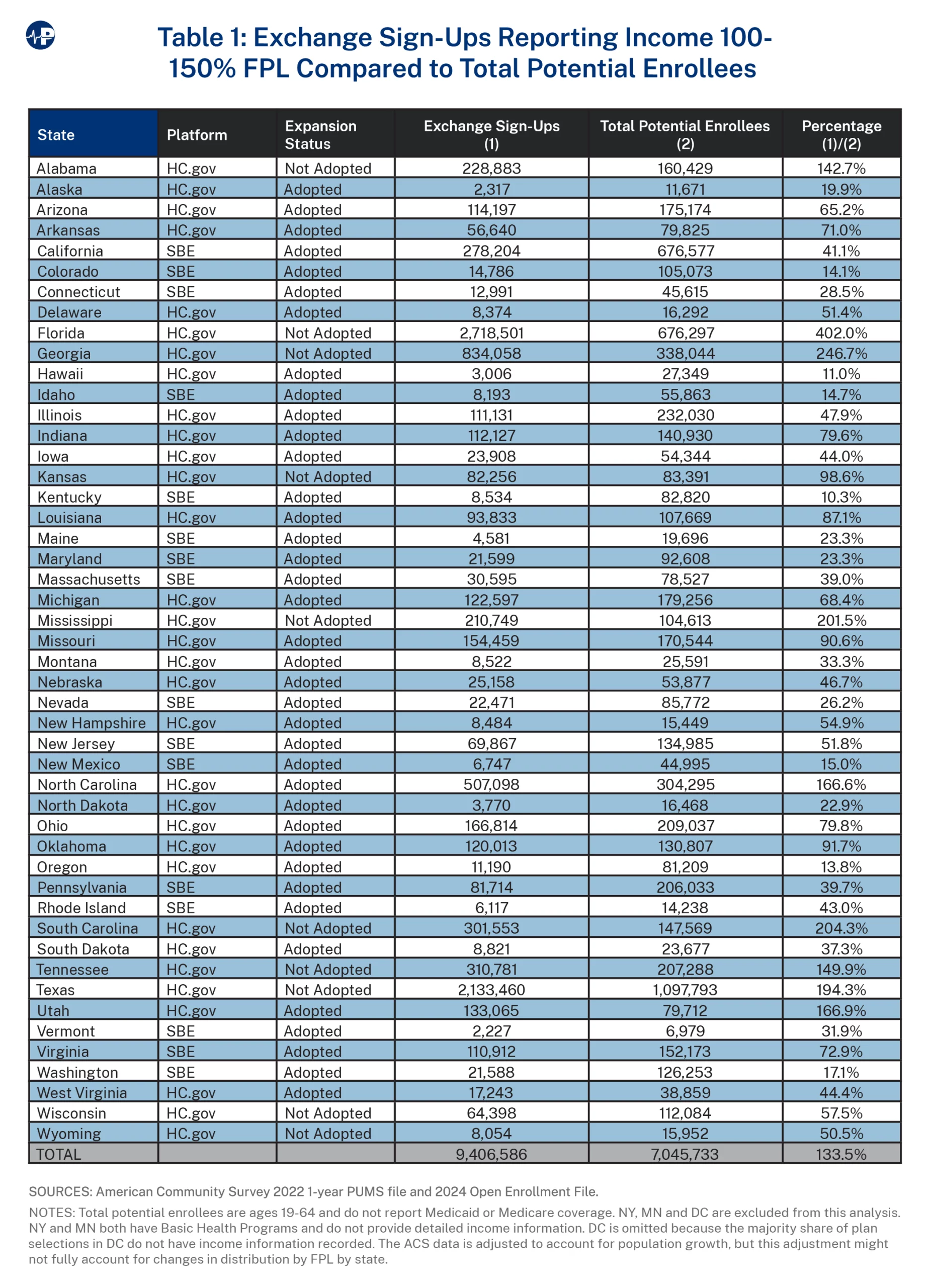
In nine states, more people signed up for coverage than would be eligible, meaning that the number of people who enrolled in a plan with zero premium and very low cost-sharing plans exceeded the number of eligible adults in that income range. Seven of these nine states did not expand their Medicaid programs—an indication that a large part of the issue is people in non-Medicaid expansion states overestimating their income in order to qualify for fully subsidized, low cost-sharing plans. This outcome is expected considering people with incomes between 100 percent and 138 percent FPL in the 100 percent to 150 percent FPL range do not legally qualify for APTCs in expansion states. Florida is a clear outlier, enrolling more than four times as many people in this income category as we estimate are eligible. Georgia, Mississippi, and South Carolina enrolled more than twice as many people in this income category as estimated eligible. Texas enrolled nearly twice as many people in this income category as estimated eligible.
Conservative Estimates of Enrollment Fraud: Upwards of 4-5 Million People and $15-$20 Billion in 2024
We estimate four to five million people improperly enrolled for subsidized health coverage on the exchanges in 2024 and that the cost of improper enrollment is likely upward of $15-$20 billion this year.
We estimate improper enrollment separately for Medicaid expansion and non-Medicaid expansion states. In non-Medicaid expansion states, we count improper enrollment as any enrollment above the total potential enrollees (i.e., the number of 19-64-year-olds with income in that category as reported by the ACS). In expansion states, we count improper enrollment as any enrollment above half the number of potential enrollees. As a reminder, only those with income between 138 percent to 150 percent FPL would be eligible for exchange coverage in this income category. We believe both estimates are conservative.
This method yields 4.84 million fraudulently enrolled people at 100 percent to 150 percent FPL, but only in 21 states as the other states, which include New York and Minnesota that rely on the BHP for coverage for this population, do not meet the above criteria. Since there is some degree of improper enrollment in every state, and our methodology is designed to yield a conservative estimate, the number of improperly enrolled people at 100 to 150 percent FPL is likely higher than this four to five million people range.
Taking a conservative estimate of five million people improperly enrolled in fully subsidized plans, we estimate that 60 percent of enrollees have income below 100 percent of the FPL and are receiving $6,000 worth of subsidy to which they are not entitled. Of the remaining 40 percent of enrollees who have underestimated their income, we estimate they have received an excess subsidy of $1,000.22 Putting these together yields about $20 billion of improper PTCs for 2024.
The main reason these estimates are conservative is because we use a $6,000 average subsidy, which is the subsidy for a 40-year-old. The average age of an exchange enrollee is older than 40 and, as Figure 3 shows, the PTC is much larger for older enrollees. If the average PTC for improperly enrolled people is $8,000 (which may be more realistic), then the estimated cost of improper enrollment would be $26 billion in 2024.
An additional reason the $20 billion is a conservative estimate is that the number of people who have overestimated their income in non-expansion states who are receiving fully subsidized PTCs to which they are not entitled (by far the biggest contributor to improper spending) almost certainly exceeds 3.0 million people. In seven non-expansion states, there are 4.0 million more 100 percent to 150 percent sign-ups than ACS data indicate are eligible in that income category. Our back-of-the-envelope estimate does not consider any improper enrollment in the other three non-expansion states—Kansas (sign-ups are 98.7 percent of potential enrollees), Wisconsin, and Wyoming.
Using a similar methodology for the more expansive set of potential enrollees for the 100 percent to 150 percent FPL group, consistent with Table 3 below, produces estimates of roughly 4 million improper enrollees in this category at a cost of about $15 billion in 2024. We believe that this estimate is a lower bound of total fraudulent enrollment in the 100 percent to 150 percent group and the associated cost.
Fraudulent Enrollment in North Carolina
North Carolina expanded Medicaid on December 1, 2023, and was the only state to adopt the ACA’s expansion of the program during the 2024 ACA open enrollment period, which started on November 1, 2023.
As of May 5, 2024, 451,194 people enrolled under North Carolina’s Medicaid expansion.23 While enrollment in Medicaid expansion has been substantial, at the same time significantly more North Carolinians reporting income between 100 percent and 150 percent FPL enrolled in exchange plans in the 2024 open enrollment period (507,098) than selected plans in 2023 (347,551).
Combining 2024 exchange plan selections in open enrollment with the number of Medicaid expansion enrollees totals 958,292 individuals. This is 28.2 percent higher than the 2023 ACS estimate for the number of people in North Carolina under 150 percent FPL ages 19-64 who did not report having Medicaid or Medicare—which is an upper bound on the number of individuals potentially eligible for the exchanges or Medicaid expansion.24
The data indicates that many North Carolinians were (and likely still are) simultaneously enrolled in Medicaid and the exchanges. Because North Carolina transitioned its Medicaid program to managed care in 2021,25 this suggests that insurers are potentially reaping windfall profits from dual enrollment. It also suggests that enrollees in North Carolina are at substantial risk of financial penalties, as the state put out the following guidance: “If you qualify for full Medicaid, you will not be able to get financial help with the cost of your Marketplace plan. Therefore, you probably will not want to keep your Marketplace coverage because it will cost more than coverage through NC Medicaid.”26

Table 3 shows the same results as Table 1, except it compares the number of people who signed up for coverage during open enrollment reporting income between 100 percent and 150 percent FPL with all potential enrollees who are residents ages 19-64 by state. The difference with Table 1 is that we include people who report either Medicaid or Medicare in this income category as potential exchange enrollees with PTCs. We do this because it is possible that people are confusing exchange plans with Medicaid plans.27 In many states, exchange plans are very similar to Medicaid plans, and many of these enrollees use little if any health care and are not highly engaged or knowledgeable about their coverage.28 So Table 3 provides conservative estimates on the extent of the fraudulent enrollment problem and likely represents a lower bound on the degree of improper enrollment in the income category of 100 percent to 150 percent FPL.
Table 3 illustrates that fraudulent enrollment is so acute in several states that there are more people signing up for exchange plans than could possibly be eligible, even under expansive assumptions that raise the number of potential enrollees. These states include Florida, Georgia, Texas, South Carolina, Mississippi, Utah, and North Carolina, but fraudulent enrollment is certainly occurring to a significant degree in many other states as well. The states with the most severe problems are all states that use HealthCare.gov, and most are states that did not expand Medicaid. Of the 20 states that have fewer than 20 percent of the 19-64 year old, 100 percent to 150 percent of the FPL population enrolling in exchange plans during open enrollment (from Table 3’s calculation), 14 are states with state-based exchanges. For context, there are only 16 state-based exchange states in our analysis, as we have excluded Minnesota, New York, and the District of Columbia.29

Fraudulent Enrollment Much Greater in Non-Expansion States and HealthCare.gov States
Table 4 shows the enrollment estimates broken down by expansion states and non-expansion states and states using the federal exchange (HealthCare.gov) and those states that established their own exchanges. The data clearly indicates that fraudulent enrollment is much more severe in states that did not expand Medicaid as well as in states that use the HealthCare.gov platform. As expected, the number of people misestimating their income is much greater in non-expansion states, as there is both an incentive for people above 200 percent FPL to report lower income and an incentive for people with income below 100 percent FPL to report higher income.

More surprising is that fraud is much greater in HealthCare.gov states. In states that used HealthCare.gov, 8.7 million sign-ups reported enrollment between 100 percent and 150 percent FPL compared to only 5.1 million people likely eligible for such coverage, or 1.7 signups for every eligible person.
Unique deficiencies with HealthCare.gov are shown when controlling for whether states expanded Medicaid. All states with state-based exchanges did expand Medicaid, but many expansion states also used HealthCare.gov. Isolating the analysis to expansion states excludes the states where fraudulent enrollment is severe. The percentage of open enrollment sign-ups reporting income between 100 percent and 150 percent FPL relative to all those ages 19-64 eligible for such coverage is more than twice as high in expansion states with HealthCare.gov than in expansion states with state-based exchanges.
Some state-based exchanges verify income using alternative data sources, such as state tax data.30 In 2017, the Government Accountability Office reviewed processes in three states—Idaho, Maryland, and Rhode Island—to verify eligibility for APTCs and found “few indications of potentially improper enrollments.”31 States using alternative data or state-specific data to verify eligibility could contribute to observed differences in fraudulent enrollment between the federal and state-based exchanges.
Some of the differences appear to be in how states have handled the removal of Medicaid enrollees (the “unwinding” process) who were no longer eligible for that program after the conclusion of the public health emergency. For the duration of the public health emergency, which lasted for more than three years, states did not remove enrollees from Medicaid regardless of whether they gained other coverage or earned income making them ineligible.32
As detailed in Table 5, according to CMS, 70 percent of individuals enrolled in Medicaid and CHIP at the start of the unwinding process were enrolled in an exchange plan when removed from Medicaid in HealthCare.gov states. In expansion states, this percentage was 68 percent—demonstrating that there was not a difference in this percentage overall based on whether states adopted Medicaid expansion or not. In contrast, in states with state-based exchanges, only 16 percent of people who lost Medicaid or CHIP during the unwinding were enrolled in an exchange plan. In states with state-based exchanges, a far lower percentage of enrollees was deemed eligible for PTCs and a far lower percentage of enrollees deemed eligible for PTCs enrolled in coverage. This data strongly suggests that HealthCare.gov eased the flow of people from Medicaid to the exchanges, potentially without proper verification, including through more fraudulent claims of income between 100 percent and 150 percent FPL.

Examining the Population Between 138 Percent and 150 Percent FPL States
While the majority of this analysis focuses on incentives that occur for populations under 100 percent FPL, there is an incentive for people in expansion states to report income between 138 percent and 150 percent FPL in order to gain fully subsidized exchange plans. Table 6 presents similar findings to previous tables, focusing on people reporting income between 138 percent and 150 percent FPL. Plan sign-ups are calculated from the 2024 open enrollment files, and this table focuses on working-age adults (19-64) who do not report Medicaid or Medicare enrollment (and so corresponds to Table 1).

Regardless of expansion status, many states have more exchange sign-ups reporting income between 138 percent and 150 percent FPL than potentially eligible individuals in this income range. Utah is an outlier at more than four times as many people reporting income in this category than would be eligible. Twenty-two states have more people signing up who report income between 138 percent and 150 percent FPL than are potentially eligible.
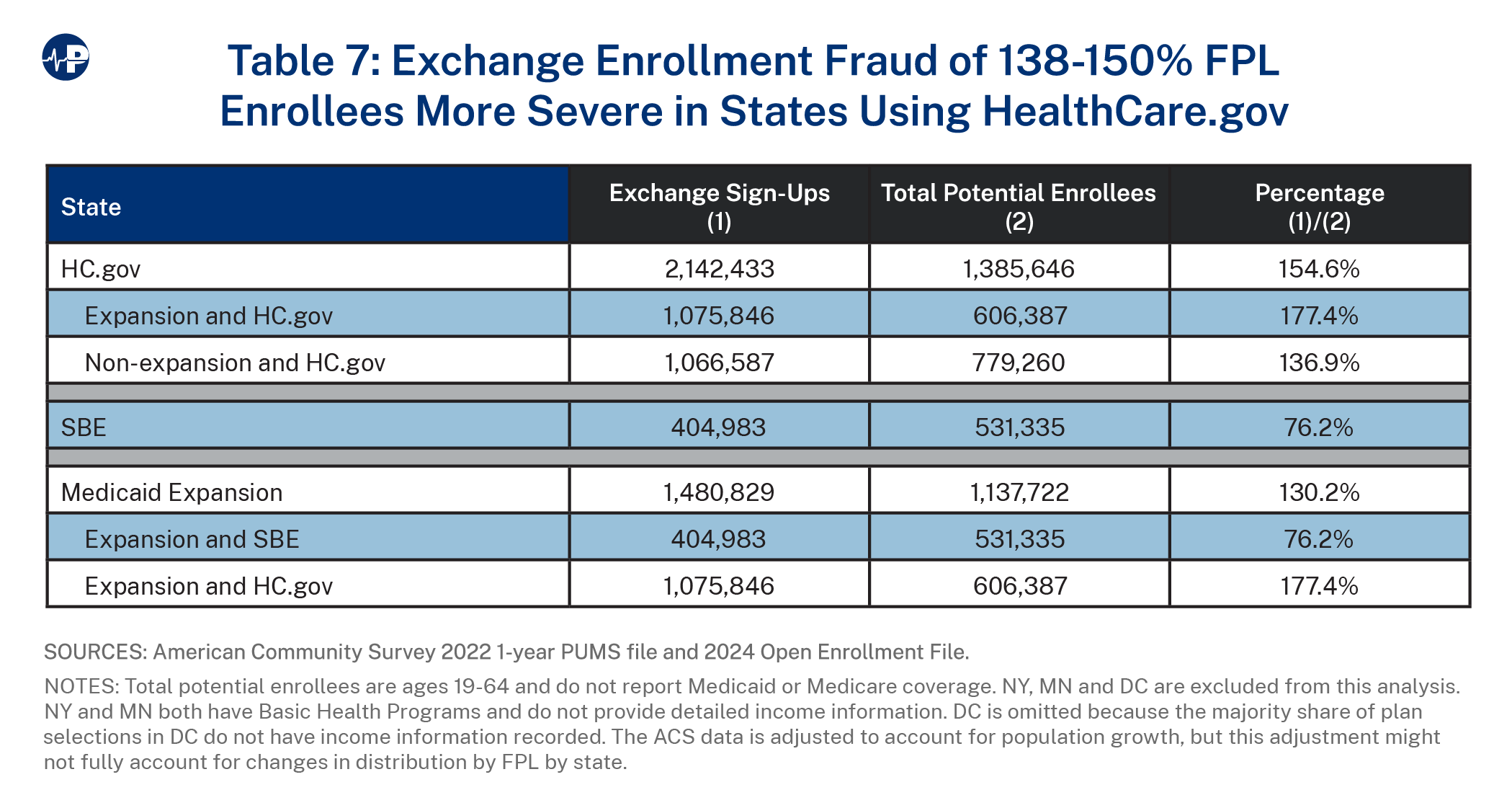
Again, there is a drastic difference between federal exchange states and state-based exchange states in fraudulent enrollment rates—as noted in Table 7. In federal exchange states, sign-ups reporting income between 138 percent and 150 percent FPL are 155 percent of the eligible population. In states with state-based exchanges, sign-ups are 76 percent of the eligible population. In expansion states using HealthCare.gov, sign-ups who report income between 138 percent and 150 percent FPL are 177 percent of the eligible population. This implies that the misreporting of income is also a severe issue in expansion states, with the biggest fraud in those using HealthCare.gov.
Big Money for Insurers and Brokers
The Biden administration has made a political decision to prioritize enrollment in public programs and neglect program integrity issues. For example, the administration extended the COVID public health emergency into the spring of 2023 to delay Medicaid redeterminations and removals.33 This led to approximately 18 million ineligible Medicaid enrollees in March 2023.34 The administration has created a continuous open enrollment period for the exchanges for people below 150 percent FPL.35 As should be apparent from the analysis above, because half of exchange enrollees are claiming income below 150 percent FPL, this open enrollment period is almost certainly subject to widespread abuse. The administration has also been sympathetic to self-attestation rather than verification of information.36
In 2021, a federal district court stopped four provisions of the 2019 Notice of Benefit and Payment Parameters (NBPP),37 which would have required people to submit additional information to verify their income if they reported income above the FPL and administrative data suggests that their income is below that level.38 In City of Columbus, et al. v. Norris Cochran, the cities of Columbus, Baltimore, Cincinnati, Chicago, and Philadelphia (along with two individuals) sued the federal government, alleging that the 2019 NBPP would harm enrollees and that the Trump administration was working to undercut the exchanges.39 The court sided with the plaintiffs and effectively gutted income verification requirements for low-income exchange enrollees. This court decision—combined with no subsidy recapture for enrollees below 100 percent FPL and incentives facing brokers and insurers—set the stage for substantial improper spending.
A primary beneficiary of the surge in improper enrollment from people misestimating their income are health insurers. The larger subsidies mean that consumers are less sensitive to prices of plans, so more of them enroll. It is also much easier to collect subsidies from the U.S. Treasury than premiums from customers. Because roughly half of enrollees have fully subsidized plans, the cost to enrollees is only the paperwork burden. This means that people have incentives to enroll even if they receive very low benefit from the plan. Worse, given automatic re-enrollment, many people might be enrolled for a second year when they already have other coverage, have moved out of state, or have passed away. For re-enrollees in all states, 32.8 percent were automatically re-enrolled in coverage in 2024.40 All this leads to large payments to health insurers on behalf of many people who are likely receiving low value or no value from the coverage.
Importantly, the insurers are held harmless when people are enrolled receiving larger subsidies than what they were entitled to. Even though the payment goes directly from the U.S. Treasury to the insurer, the payment is effectively a PTC for the enrollee. So, the liability, which is limited for most enrollees who underestimate income (and nonexistent for enrollees with less than 100 percent FPL), is on the enrollees when they reconcile their taxes (assuming that they file their taxes). Insurers have significant financial upside from improper enrollment aimed at maximizing subsidies.
Some private brokers are likely making the problem of fraudulent enrollment worse. These entities have contracts with insurers, and these contracts require the insurers pay them a commission for each enrollee. Some brokers have come under increased scrutiny the past few months for changing the agent of record to capture other agents’ commissions, enrolling people without their knowledge, and canceling exchange enrollee coverage and re-enrolling people in different plans to earn higher commissions.41
Unscrupulous broker behavior is also made easier in federal exchange states. Julie Appleby’s reporting for KFF on unauthorized plan switching highlighted that brokers need very little information to access individuals’ accounts.42 If the broker is registered on HealthCare.gov, all they need is a name, date of birth, and state of residence to enroll an individual into coverage. Additionally, HealthCare.gov lacks basic consumer protections, such as two-factor authentication, and it does not notify enrollees when changes occur to their accounts. Furthermore, any broker or agent can get access to the account of any enrollee for whom the name, date of birth and state enrolled is available regardless of the enrollment platform used, including HealthCare.gov and direct enrollment platforms. On direct enrollment platforms, the user is redirected to HealthCare.gov. However, on enhanced direct enrollment platforms, an enrollment entity hosts a version of HealthCare.gov’s eligibility application and integrates directly with the back-end suite of federal exchange interfaces.43 The coupling of these improper safeguards with fully subsidized plans means that enrollees can be signed up or have their coverage switched without their knowledge. Prior to fully subsidized plans, the vast majority of enrollees paid some premium each month and would have had a much greater opportunity to know if they were switched.
On May 20, 2024, the Chairman of the Senate Finance Committee Ron Wyden sent a letter to the CMS Administrator Chiquita Brooks-LaSure expressing his “outrage with reports that agents and brokers are submitting plan changes and enrollments in the Federal marketplace without the consent of the people who rely on these plans.”44 Chairman Wyden criticized enhanced web-broker platforms, alleging that “bad actors with access to a consumer’s eligibility information through web-broker platforms can make plan and agent-of-record changes while keeping people and their legitimate brokers in the dark.”45
An additional example of unscrupulous behavior by brokers and agents includes fraudulently signing up homeless people.46 Law-abiding brokers are harmed by unscrupulous broker behavior and recently filed a complaint against brokers they allege to be stealing their commissions.47 The fraudsters are likely a small percentage of brokers, but they could still be having a large impact given the plethora of fully taxpayer-subsidized plans where enrollees have little, if any, incentive to pay attention to coverage changes.
According to a CMS presentation to brokers, agents and brokers assisted over 6.8 million enrollments during the 2023 open enrollment period. Direct enrollment and enhanced direct enrollment accounted for 81 percent of all active agent- and broker-assisted plan selections, or 5.5 million plan selections. CMS highlighted that data matching issues were over twice as likely to occur under agent- and broker-assisted enrollments. In fact, 16 percent of those who worked with agents or brokers submitted exchange applications that did not include Social Security Numbers versus less than one percent of consumers who self-enrolled.48
Heath care “navigators,” who work at nonprofit entities, may also be complicit in encouraging misestimates of income, with some likely seeing it as consistent with their purpose and ideological aims to enroll as many people as possible in coverage, knowing that estimating income to maximize subsidies has little downside for people. In 2013, the House Committee on Oversight and Government Reform issued a scathing report on navigators, including a concerning section related to lax protocols to prevent tax fraud.49
RECOMMENDATIONS
As discussed by Theo Merkel and Brian Blase in Follow the Money: How Tax Policy Shapes Health Care, enormous problems result from the widespread availability of fully subsidized plans, and this data analysis provides more evidence for the magnitude of resulting waste, fraud, and abuse.50 The most important way that Congress can mitigate this problem, protect enrollees from unauthorized plan enrollment and switching, ensure that coverage provides at least a modicum of value to enrollees, and protect taxpayers is to let the enhanced PTCs expire after 2025.
Second, Congress should raise the subsidy recapture limits so that there are not large incentives for people to misestimate their income, and Congress should put a portion of the liability on entities that gain from improper enrollment—insurers and brokers—for repaying ill-gotten PTCs. As Senator Wyden recently recommended, brokers who are knowingly working with people to manipulate information to maximize subsidies should also be held criminally liable. And states should suspend their licenses.
Third, Congress or the next administration should limit automatic re-enrollment into exchange plans from one year to the next and end it for people moving from or into fully taxpayer-subsidized plans. Fourth, as outlined by Merkel and Blase, Congress should appropriate cost-sharing reduction payments and prohibit silver-loading, which has significantly increased PTC amounts.51 Doing so would reduce the benchmark plan premium and PTCs, returning to a more sensible structure for the overall ACA subsidy structure.
Fifth, Congress should conduct aggressive oversight of both the Biden administration’s management of HealthCare.gov, enhanced direct enrollment, and insurer and broker actions. Congress should ask the Joint Committee on Taxation and Treasury what percentage of people overestimate their income, what percentage of people underestimate their income, and how much PTC is improperly expended by year. Congress should require CMS to provide more information on navigators, particularly with respect to the information navigators are providing related to the large subsidies available for people with income between 100 percent and 150 percent FPL. Congress should also require CMS to provide information on data matching issues by platform.
Sixth, Congress or the next administration should reverse policies of the Biden administration that enabled such widespread fraudulent enrollment, particularly the continuous open-enrollment period for people who report they have income below 150 percent FPL.
APPENDIX
Appendix Tables 1 and 2 correspond to Tables 1 and 3 but display the information for sign-ups reporting income between 100 percent and 200 percent FPL. There is not as significant an incentive for people to report income between 150 percent and 200 percent FPL, because those enrollees are not eligible for fully subsidized benchmark plans. However, some people who expect income well above 200 percent FPL and who may not wish to exaggerate their income to such a large degree to report it under 150 percent FPL may be amenable to reporting it under 200 percent FPL to get both large subsidies for the premium and qualify for the CSR program, which significantly reduces deductibles and copayments to hit an 87 percent actuarial value.
Appendix Tables 1 and 2 continue to show severe fraudulent enrollment problems, again concentrated largely in Sunbelt states along with Utah. The fraudulent enrollment problem appears concentrated in states that did not adopt Medicaid expansion as well as states using the HealthCare.gov platform.


Footnotes
1↑ A silver plan has an actuarial value of 70 percent, which means that the plan pays for about 70 percent of the typical enrollee’s medical expenses covered by the plan.
2↑ ARPA enhanced subsidies applied for 2021 and 2022, while IRA enhanced subsidies applied for 2023-2025. American Rescue Plan Act of 2021, Pub. L. No. 117-2, 135 Stat. 4 (2021). Inflation Reduction Act of 2022, Pub. L. No. 117-169, 136 Stat. 1818 (2022).
3↑ In 2024, 100 percent FPL for a single person is $15,050. For a household of two, this amount is $20,440. For a four-person household, 100 percent FPL is $31,200.
4↑ Refundable means that they not only reduce tax liability but are direct payments to qualifying individuals. Most people who claim PTCs do not owe income taxes and receive money back from the federal government through the income tax code after the PTC.
5↑ People with income between 200 percent and 250 percent FPL also qualify for the CSR program, but for them the effect is much more limited as the actuarial value of the plan increases to only 73 percent, just a 3 percentage point increase from the standard silver plan without CSR subsidies.
6↑ Brian Blase, “Fourteen Reasons to Let the Expanded Obamacare Subsidies Expire,” Forbes, May 26, 2022, https://www.forbes.com/sites/theapothecary/2022/05/26/fourteen-reasons-to-let-the-expanded-obamacare-subsidies-expire/?sh=32c98a3b6cba; Brian Blase, “Expanded ACA Subsidies: Exacerbating Health Inflation and Income Inequality,” Galen Institute, June 2021, https://galen.org/assets/Expanded-ACA-Subsidies-Exacerbating-Health-Inflation-and-Income-Inequality.pdf.
7↑ IRS, Revenue Procedure 2023-34, https://www.irs.gov/pub/irs-drop/rp-23-34.pdf. These amounts are indexed to inflation. The amounts are also double for married persons filing jointly.
8↑ KFF, “Health Insurance Marketplace Calculator,” https://www.kff.org/interactive/subsidy-calculator/
9↑ Since most silver plan enrollees report income that qualifies them for the CSR program, the average actuarial value for a silver plan is 88 percent. In order to approximate the added marginal benefit of the CSR program for enrollees who report income between 100 to 150 percent FPL, we multiplied the benchmark premium by 94/88.
10↑ IRS, 2023 Instructions for Form 8962, https://www.irs.gov/pub/irs-pdf/i8962.pdf
11↑ KFF, “Marketplace Average Benchmark Premiums: 2024,” https://www.kff.org/affordable-care-act/state-indicator/marketplace-average-benchmark-premiums/?currentTimeframe=0&sortModel=%7B%22colId%22:%22Location%22,%22sort%22:%22asc%22%7D
12↑ KFF, “Marketplace Average Benchmark Premiums: 2024.” We apply age rating tables from CMS. “State Specific Age Curve Variations” https://www.cms.gov/cciio/programs-and-initiatives/health-insurance-market-reforms/downloads/statespecagecrv053117.pdf
13↑ Ben Hopkins, Jessica Banthin, and Alexandra Minicozzi, “How Did Take-Up of Marketplace Plans Vary with Price, Income, and Gender?,” American Journal of Health Economics 10, no. 2 (Spring 2024), https://www.journals.uchicago.edu/doi/epdf/10.1086/727785
14↑ U.S. Department of the Treasury, “Treasury’s Baseline Estimates of Health Coverage, FY 2020,” September 11, 2019, https://home.treasury.gov/system/files/131/Treasurys-Baseline-Estimates-of-Health-Coverage-FY-2020.pdf. Total subsidies were $43.89 billion according to Treasury in 2020.
15↑ To be eligible for PTCs, individuals must not be eligible for public coverage including Medicaid, CHIP, Medicare, or military coverage (TRICARE). Section 5000A(f) of the ACA refers to these types of insurance as “Minimum Essential Coverage.” Affordable Health Care Act, Pub. L. No. 111-148, 124 Stat. 119 (2010), https://www.govinfo.gov/content/pkg/PLAW-111publ148/pdf/PLAW-111publ148.pdf
16↑ IRS, Publication 974 (2023), https://www.irs.gov/publications/p974
17↑ Our approach is simpler than Hopkins et al. Regarding potential exchange enrollment, Hopkins et al. classify this population as those between the ages of 20 and 64, excluding Medicare, Medicaid, CHIP, and TRICARE enrollees. Additionally, they exclude individuals who would be eligible for Medicaid or CHIP based on age and imputed income, as well as through pregnancy pathways. They also use different income assumptions for potential eligibility between expansion and non-expansion states. For expansion states, they apply a lower bound reflective of current law: 100 percent FPL. In non-expansion states, they apply a lower bound of 80 percent FPL, because their “analysis strongly suggests that many people with income below 100 percent FPL in non-expansion states obtain advanced PTCs.” Our work is illustrative of this specific finding in Hopkins et al.’s research for individuals below 100 percent FPL using CMS exchange data but using publicly available data. Hopkins et al. focuses on federal exchanges while this piece looks at all exchanges.
18↑ United States Census Bureau. “State Population Totals and Components of Change: 2020-2023” Vintage 2023. https://www.census.gov/data/tables/time-series/demo/popest/2020s-state-total.html#v2023. We apply the three-year trend to fully estimate state populations in 2024. This approach will not capture distributional changes that might be present.
19↑ This is partially due to eligibility for health coverage being defined differently than the FPL variables in ACS capture. These “tax unit” or “health insurance unit” designations tend to increase the number of people below 150 percent FPL.
20↑ For more discussion see Giovann Alarcon et al., “Defining Family for Studies of Health Insurance Coverage,” State Health Access Data Assistance Center (SHADAC), August 2021, https://www.shadac.org/sites/default/files/publications/2021%20HIU%20Defining%20families%20brief.pdf; and Ithai Lurie and James Pierce, “The Effects of ACA on Income Eligibility for Medicaid and Subsidized Private Insurance Coverage: Income Definitions and Thresholds Across CPS and Administrative Data,” U.S. Department of Treasury, Office of Tax Analysis. In SHADAC’s methodology, this undercount is substantial, but the majority of the adjustment occurs below 100 percent FPL. In some states, fewer people are estimated in the 100 percent to 150 percent FPL category. Using Tresury’s estimates suggests that 50 percent additional people could be between 100 percent and 150 percent of poverty ages 0-64. Treasury estimates 31.9 million versus 21 million in the ACS. Treasury estimates there are 9.3 million people aged 0-64 who have income between 100 percent to 150 percent FPL after excluding those with government and employer coverage. Our primary estimate of potential enrollees, which excludes children, seniors and people with Medicaid or Medicare, totals 7.0 million without New York, Minnesota, and the District of Columbia. Our expansive estimate, which includes those in this income range who report Medicare or Medicaid is 12.0 million.
21↑ Dong Ding, Benjamin D. Sommers, and Sherry A. Glied, “Unwinding and the Medicaid Undercount: Millions Enrolled in Medicaid During the Pandemic Thought They Were Uninsured,” Health Affairs 43, no. 5 (May 2024), https://www.healthaffairs.org/doi/10.1377/hlthaff.2023.01069
22↑ The $1,000 is a rough average of the improper benefit for people with income between 150 percent and 400 percent FPL who underestimate their income to between 100 percent and 150 percent FPL.
23↑ North Carolina Office of the Governor, “NC Medicaid Expansion Hits 450,000 Enrollees in Just Five Months,” press release, May 9, 2024, https://governor.nc.gov/news/press-releases/2024/05/09/nc-medicaid-expansion-hits-450000-enrollees-just-five-months
24↑ CMS, 2024 Open Enrollment Public Use File, https://www.cms.gov/data-research/statistics-trends-reports/marketplace-products/2024-marketplace-open-enrollment-period-public-use-files. Note: Even adjusting the population under 100 percent FPL according to SHADAC methodology still implies that the entire population under 150 percent FPL has health coverage. We attempt to provide this estimate for the project expansion population by excluding enrollment in traditional Medicaid.
25↑ NC Medicaid, "Fact Sheet NC Medicaid Managed Care," April 2021, https://medicaid.ncdhhs.gov/ncmt-fact-sheet-managedcarepopulations-04292021/download?attachment
26↑ NC Medicaid Division of Health Benefits, “Questions and Answers about Medicaid Expansion,” April 11, 2024, https://medicaid.ncdhhs.gov/questions-and-answers-about-medicaid-expansion
27↑ Research shows that there are more false positives for Medicaid—people with private coverage reporting Medicaid—in the ACS than in other surveys. “Among those for whom public coverage was reported, over-reporting in the ACS was higher than in the CPS—8.6% and 2.1%, respectively.” See Joanne Pascale, Angela Fertig, and Kathleen Call, “Validation of Two Federal Health Insurance Survey Modules After Affordable Care Act Implementation,” Journal of Official Statistics 35, no. 2 (June 2019), https://sciendo.com/article/10.2478/jos-2019-0019
28↑ Daniel Cruz and Greg Fann, “The Shortcomings of the ACA Exchanges: Far Less Enrollment at a Much Higher Cost,” Paragon Health Institute, September 2023, https://paragoninstitute.org/wp-content/uploads/2023/11/Shortcomings-of-the-ACA-Cruz-Fann.pdf
29↑ New Jersey and Virginia are the two state-based exchange states that do not satisfy this criteria.
30↑ Tara Straw, “Final 2024 Payment Rule, Part 3: Exchange Operational Standards And APTC Policies,” Health Affairs Forefront, April 21, 2023, https://www.healthaffairs.org/content/forefront/final-2024-payment-rule-part-3-exchange-operational-standards-and-aptc-policies
31↑ U.S. Government Accountability Office, State Health-Insurance Marketplaces: Three States Used Varied Data Sources for Eligibility and Had Few Indications of Potentially Improper Enrollments, GAO-17-694, September 2017, https://www.gao.gov/assets/gao-17-694.pdf
32↑ Drew Gonshorowski, Brian Blase, and Niklas Kleinworth, “The Cost of Good Intentions: The Harm of Delaying the Disenrollment of Medicaid Ineligibles,” Paragon Health Institute, July 2023, https://paragoninstitute.org/wp-content/uploads/2023/07/the-cost-of-good-intentions.pdf
33↑ President Joe Biden, “Continuation of the National Emergency Concerning the Coronavirus Disease 2019 (COVID-19) Pandemic,” 88 Fed. Reg. 9385 (February 10, 2023), https://www.federalregister.gov/d/2023-03218
34↑ Matthew Buettgens and Andrew Green, “The Impact of the COVID-19 Public Health Emergency Expiration on All Types of Health Coverage,” Urban Institute, December 5, 2022, https://www.urban.org/research/publication/impact-covid-19-public-health-emergency-expiration-all-types-health-coverage
35↑ CMS, “HHS Notice of Benefit and Payment Parameters for 2025 Final Rule,” April 2, 2024, https://www.cms.gov/newsroom/fact-sheets/hhs-notice-benefit-and-payment-parameters-2025-final-rule
36↑ CMS, “2024 Notice of Benefit and Payment Parameters,” https://www.cms.gov/files/document/cms-9899-f-patient-protection-final.pdf; CMS, “Streamlining Medicaid and CHIP, Final Rule, Fact Sheet,” September 18, 2023, https://www.cms.gov/newsroom/fact-sheets/streamlining-medicaid-and-chip-final-rule-fact-sheet.
37↑ The four provisions vacated by the decision in City of Columbus, et al. v. Norris Cochran included “Federal Review of Network Adequacy,” “Income Verification,” “Standardized Options,” and “Medical Loss Ratio.”
38↑ CMS, HHS; Monetary Offices, Department of the Treasury. “Patient Protection and Affordable Care Act; Updating Payment Parameters, Section 1332 Waiver Implementing Regulations, and Improving Health Insurance Markets for 2022 and Beyond.” 86 FedReg 24,216. https://www.federalregister.gov/documents/2021/09/27/2021-20509/patient-protection-and-affordable-care-act-updating-payment-parameters-section-1332-waiver
39↑ City of Columbus, et. al. v. Norris Cochran, in his official capacity as Acting Secretary of the Department of HHS, et al., https://democracyforward.org/wp-content/uploads/2021/03/Columbus-et-al.-v.-Trump.pdf
40↑ CMS, “2024 OEP State, Metal Level, and Enrollment Status Public Use File,” https://www.cms.gov/data-research/statistics-trends-reports/marketplace-products/2024-marketplace-open-enrollment-period-public-use-files
41↑ Julie Appleby, “Rising Complaints of Unauthorized Obamacare Plan-Switching and Sign-Ups Trigger Concern,” KFF Health News, April 8, 2024, https://kffhealthnews.org/news/article/aca-unauthorized-obamacare-plan-switching-concern/
42↑ Appleby, “Rising Complaints.”
43↑ CMS, “Direct Enrollment and Enhanced Direct Enrollment,” https://www.cms.gov/marketplace/agents-brokers/direct-enrollment-partners
44↑ United States Senator Ron Wyden, “Wyden Letter to CMS on Brokers” May 20, 2024, https://www.finance.senate.gov/imo/media/doc/wyden_letter_to_cms_on_brokerspdf.pdf
45↑ Ibid.
46↑ Daniel Chang, “Florida Homeless People Duped into Affordable Care Act Plans They Can’t Afford,” Tampa Bay Times, June 12, 2023, https://www.tampabay.com/news/florida-politics/2023/06/12/florida-homeless-people-duped-into-affordable-care-act-plans-they-cant-afford/
47↑ Appleby, “Rising Complaints.”
48↑ CMS, “Welcome to the 2023 Agent and Broker Summit,” May 24, 2023, https://www.cms.gov/files/document/ab-summit-2023-welcome-slides.pdf
49↑ U.S. Congress, House Committee on Oversight and Government Reform, Risks of Fraud and Misinformation with ObamaCare Outreach Campaign: How Navigator and Assister Program Mismanagement Endangers Consumers, majority staff report, December 16, 2013, https://oversight.house.gov/wp-content/uploads/2013/12/Navigator-Report-Number-Two-12-13-13.pdf
50↑ Theo Merkel and Brian Blase, “Follow the Money: How Tax Policy Shapes Health Care,” Paragon Health Institute, May 2024, https://paragoninstitute.org/private-health/follow-the-money-how-tax-policy-shapes-health-care/
51↑ Silver-loading is the practice of loading the cost of CSRs onto the silver plans when the Trump administration complied with a federal court ruling that there was no valid congressional appropriation for the CSR payments.
Author


Acknowledgements
The authors are grateful to Doug Badger, Jonathan Ingram, Theo Merkel, and Peter Nelson for exceptional review and comments, and to Emma Gallutia for exceptional research assistance and work in review of the paper.