



Paragon Health Institute Icon White

Paragon Prognosis

Paragon’s quick-hitting analysis is the best way to stay up to date with the most important issues impacting health care policy reform.

1Aw Aca Improper Enrollment Alley A0Wuu000005P4Ujyaa
Private Health

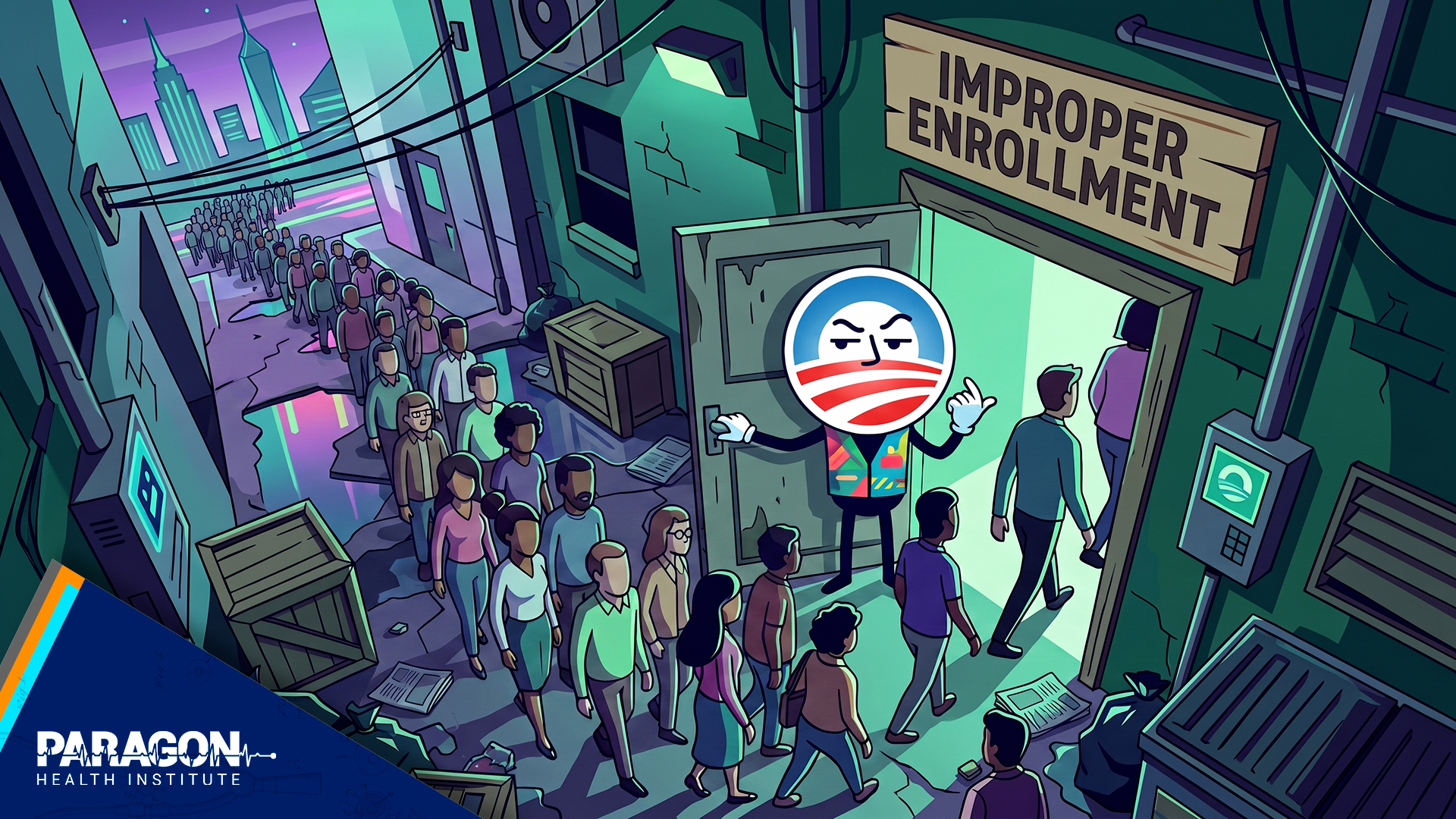
Obamacare Enrollment Abuse Update: $65 Billion Cost in 2024

The Affordable Care Act (ACA) expanded health insurance in two main ways: 1) the creation of the government-sponsored exchanges that provide federal subsidies to purchase private health insurance plans and 2) the expansion of Medicaid to able-bodied, working-age adults with incomes up to 138 percent of the federal poverty level (FPL). The exchanges use federal premium tax credits (PTC) to subsidize plans, while the federal government pays at least 90 percent of the cost of Medicaid expansion enrollees.

Read Article
1Aw Nyt Logo Aca A0Wuu000005Qvcvyam
Private Health

What The New York Times Gets Wrong About Obamacare

In an August 15 editorial, The New York Times offered a revisionist history of the Affordable Care Act (ACA) and badly mischaracterized recent actions by congressional Republicans and the Trump administration. Two telltale signs of a misleading ACA analysis are that it fails to explain just how heavily subsidized the individual market has become and that it ignores the widespread growth of improper and phantom enrollees in the ACA exchanges and Medicaid expansion. The Times editorial fails to mention either of these key facts—and contains a host of additional errors.

Read Article
1Aw Obbb Monument A0Wuu000005Q89Tyaa
Medicaid

The Massive Win of OBBB’s Medicaid Financing Reforms: HHS Economists Find Lower Health Care Prices on Top of Sizeable Taxpayer Savings

The One Big Beautiful Bill (OBBB) contained significant Medicaid financing reforms to address state schemes that have shifted hundreds of billions of dollars in Medicaid costs to federal taxpayers. A new report from the Assistant Secretary for Planning and Evaluation (ASPE) at HHS shows that the benefits extend well beyond the substantial taxpayer savings. By reducing provider taxes and excessive state-directed payments (SDPs), the reforms are projected to lower prices and increase access to care for Americans outside Medicaid. ASPE estimates those benefits at between $502 billion and $875 billion from 2025 through 2034.

Read Article
1AW SMALLER Fraud Beach A0wUU000005kYDWYA2
Medicaid

Health Care Fraud Roundup: July 11–July 24, 2026

Paragon’s Fraud Roundup continues to highlight widespread health care fraud across the country—including the FBI nabbing one of its “Most Wanted Fraudsters”; a group allegedly forcing unnecessary respiratory tests on elderly patients; and multiple cases of billing for lab tests, medical devices, and services that patients did not need or receive. It’s always important to stress that these are stories that came to light between July 11 and July 24—just two weeks of fraud in America.

Read Article
1AW SMALLER Fraud Fireworks A0wUU000005hTFBYA2
Medicaid

Health Care Fraud Roundup: June 27–July 10, 2026

Health care fraud continues to siphon hundreds of millions of dollars from taxpayers, according to the Paragon Health Care Fraud Dashboard. Between June 27 and July 10, the Department of Justice (DOJ) announced numerous charges, settlements, and sentences spanning laboratory testing, behavioral health, and medical transportation, and the Department of Health and Human Services Office of Inspector General (HHS-OIG) stripped funding from a state’s Medicaid fraud unit over insufficient fraud enforcement.

Read Article
1AW SMALLER Obamacare Ouija Board A0wUU000005gpKzYAI
Private Health

Improper and Phantom Enrollment Predict Exchange Attrition

States with the greatest amounts of improper and phantom enrollment consistently experienced the largest declines in effectuated enrollment after program integrity efforts intensified and zero-premium plans became less prevalent. That is what we would expect if much of the observed decline reflects the removal of duplicate, improper, and phantom enrollment rather than the loss of legitimate coverage.

Read Article
1AW SMALLER ASPE Ghostbusting A0wUU000005dhqDYAQ
Private Health

New HHS Report Finds Decline in ACA Enrollment Results From Removal of Improper and Phantom Enrollees

The assistant secretary for planning and evaluation (ASPE) at the Department of Health and Human Services (HHS) released an important report on Friday documenting widespread improper enrollment, phantom enrollees, broker misconduct, and weak eligibility verification in the Affordable Care Act (ACA) exchanges. The report reaches a striking conclusion: exchange enrollment declined by 2.9 million people between 2025 and 2026, and that entire net decline resulted from the removal of improper and phantom enrollees. Despite the decline, ACA enrollment remains far above pre-pandemic levels. February 2026 effectuated enrollment was 85 percent higher than in February 2019—an increase of 8.8 million enrollees.

Read Article
4AW SMALLER Blind Scientist A0wUU000005WUmTYAW
Medicaid

Joan Alker’s Narrative on Child Medicaid Enrollment Is Built on Speculation, Not Evidence

Joan Alker, the Executive Director of the Georgetown Center for Children and Families, has theorized that falling Medicaid and CHIP enrollment among children is a troubling sign that the One Big Beautiful Bill (OBBB) is harming children. More recently, Maya Goldman, citing Alker, repeated a similar argument in Axios, suggesting that declining child enrollment reflects “spillover effects” from the law even before its major provisions have been broadly implemented. Both pieces rely on assumptions that are not demonstrated by the available evidence and overlook several alternative explanations that are at least as plausible—and in many cases more obvious—than the explanations they advance.

Read Article