



On July 1, 2026, the House Ways & Means Committee passed a bill that would take an important step towards making hospitals justify their tax-exempt status. The Tax Exempt Hospital Transparency Act (H.R. 9504) would impose stricter reporting requirements on hospitals that benefit from this privilege.
The tax exemption is for charities, not just hospitals, and dates to well before hospitals profited from the gusher of government subsidies that has turned them into today’s corporate giants. Even when Congress unconstitutionally levied corporate income taxes which were struck down by the Supreme Court (before the 16th Amendment), Congress exempted charities from taxation. The current exemption, known as 501(c)(3) after the relevant section of the Internal Revenue Code, dates to 1954. The creation of Medicare and Medicaid in 1965 had an immediate impact on hospitals’ operating models: Instead of operating as charities, they became objects of government procurement.
Recognizing this change, the Internal Revenue Service (IRS) issued a ruling in 1969 specific to health services, replacing the charity-care standard with a “community benefit” standard. The new rule (Revenue Ruling 69-545) meant that hospitals no longer had to provide free or low-cost care to patients unable to pay. Rather, they had to promote the health of a sufficiently broad class of people to benefit the community. This new standard is extremely difficult to measure, and Congress has never addressed whether this administrative change was in the public interest.
Although §501(r) of the Affordable Care Act (2010) added more bureaucratic reporting requirements in an attempt to measure community benefit, the U.S. Department of Treasury Inspector General for Tax Administration (TIGTA) described the standard as “vague and outdated” as recently as 2025. Nor did the ACA reforms lead hospitals to act more charitably.
An example shows the significant change in organization and character of these hospitals. The Sisters of Mercy opened their first hospital in San Francisco in 1854, when eight religious sisters arrived from Ireland and immediately began caring for cholera, typhoid, and influenza victims. Sisters of Mercy themselves take vows of poverty. However, they no longer actually run hospitals. Today, their hospitals are part of the second-largest system in the country, CommonSpirit Health, which spreads across 18 Western states, has over 17,000 beds, and took in $34.5 billion in operating revenue in 2023. Its CEO earned $35 million in 2021. Yet, CommonSpirit remains tax exempt.
A Significant Reduction in Corporate Tax Revenue for No Clear Purpose
Nearly three-quarters of privately operated community hospitals (71 percent) benefit from tax-exempt status. According to research commissioned by the American Hospital Association (AHA), this tax break shifted $13.2 billion to other taxpayers in 2022 (though independent experts report a wide variance of estimates). Table 1 displays all federal tax breaks for health spending in 2022. These tax breaks represent tax revenue forgone by the Treasury.
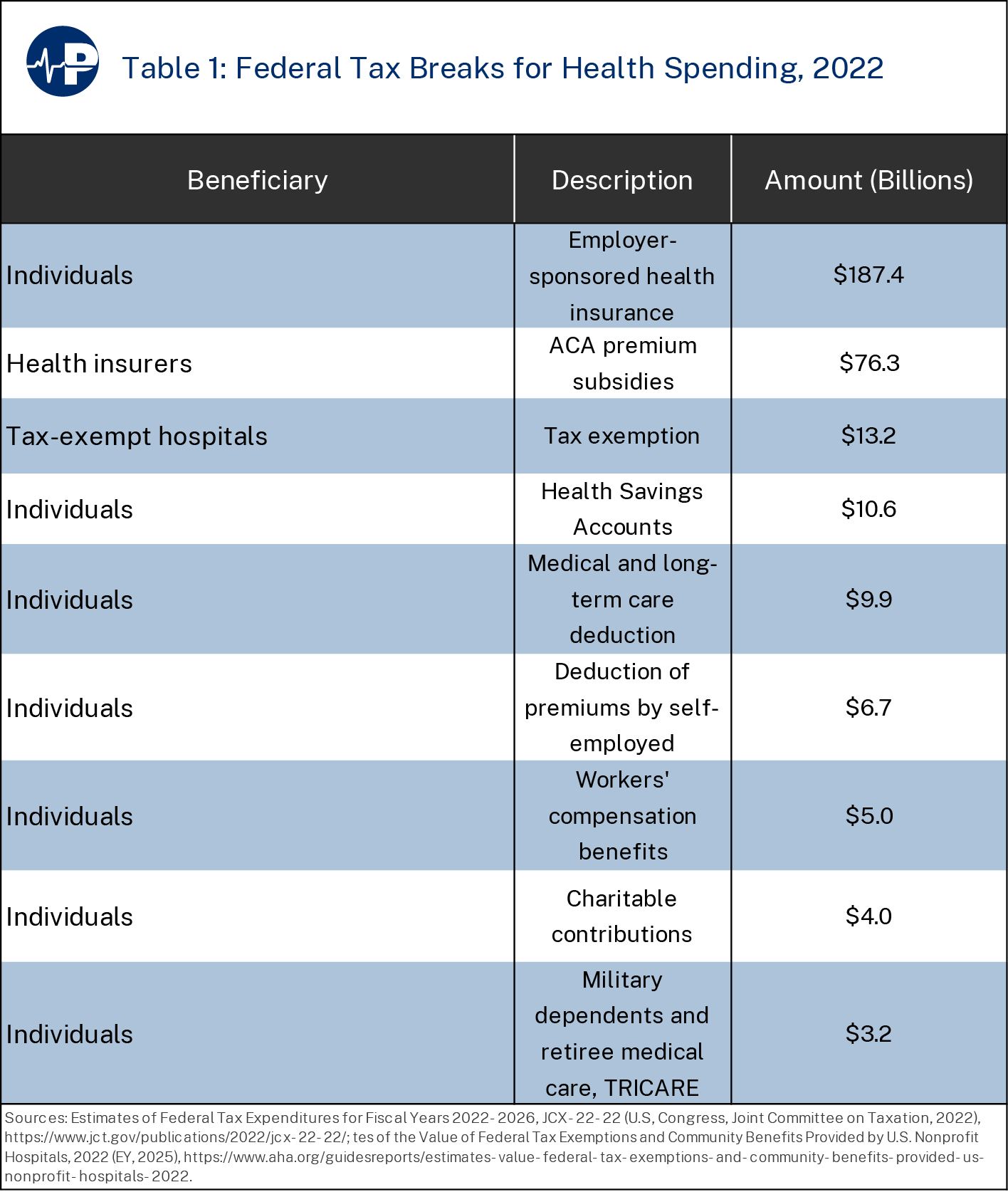
By far the largest tax break is the exemption of employer-sponsored health insurance from federal income tax, at $187.4 billion in 2022. However, this benefit accrues to individuals by reducing their tax liability—not to corporations.
The next most costly health-related tax break was $76.3 billion for ACA premium subsidies, which the federal government pays to health insurers on behalf of people enrolled in ACA exchange plans—and which remains elevated well above the cost before the COVID-19 pandemic. (Although ACA premium subsidies are often described as benefits to individuals, that is not quite right. Evidence suggests ACA policies are driven by supply, not demand. Many individuals do not value ACA coverage very much and would not buy policies without subsidies to health insurers that drive enrollees’ own costs down to nearly zero. Further, these subsidies to health insurers have led to an estimated 6.2 million improper ACA enrollees this year—roughly 27 percent of enrollees.) Other than ACA subsidies and the hospitals’ tax exemption, health-related tax breaks flow to individuals, not corporations.
The federal tax exemption for hospitals pales in comparison with the tax benefit hospitals receive from their exemption from state and local income and property taxes. The same AHA-commissioned research estimate was $41.1 billion in 2022, although an independent estimate was slightly lower.
Casting a Light on Hospitals’ Tax Exemption
H.R. 9504 would significantly improve oversight of tax-exempt hospitals by requiring hospitals to break down details of three types of spending they report on Schedule H—the schedule they submit to the IRS to justify their tax exemption—quality improvement, nonclinical programming, and advertising.
“Quality improvement” benefits patients, but they and their insurers already pay for those activities through higher prices. Examples of nonclinical programming include training in cultural skills or youth mentorship. And advertising includes sponsoring sports venues. None of these activities are clearly “charitable” and none justify tax breaks.
Congress cannot improve the standard for hospitals’ charitable tax exemption without better and more precise information about the spending hospitals claim as community benefits. Ultimately, the best community benefit hospitals could provide would be to charge customers affordable prices for their services—and at a minimum to stop raising already excessive prices by more than the rate of inflation. This bill will not change that, but the needed transparency will provide policymakers and the public information on the extent to which hospitals availing themselves of this tax break are actually providing a public benefit to warrant the exemption.
The bill would also increase hospitals’ reporting requirements relative to their 340B profit centers. Congress created the 340B program to enable eligible safety-net providers to purchase outpatient drugs at substantial discounts, with the aim of helping these providers serve vulnerable patients. Yet hospitals are not required to demonstrate that the discounts they receive are passed along to low-income patients, and the evidence demonstrates their 340B businesses have become very profitable.
The bill would also require precise reporting by facility and by service line, both important improvements. State and local leaders cannot balance the value of the property tax exemption with community benefit if reporting is only systemwide across health systems that may span multiple states. Reporting by service line will reveal how profitable each service line is so authorities can oversee whether tax-exempt hospitals are expanding only their most profitable lines of business or those which are more beneficial to their communities.
The Federal Government Has Never Really Held Hospitals Accountable for Their Tax Privileges
The IRS has never revoked a tax exemption from a hospital that the hospital wasn’t willing to lose. The IRS has twice revoked the tax exemption from hospitals, once in 2017 and once in 2025, but these hospitals were government-affiliated and did not need 501(c)(3) tax-exempt status. In another 2017 case, the IRS revoked a hospital’s tax exemption after it had entered a lease with a for-profit operator. However, the tax-exempt hospital was a non-operating shell by the time the IRS acted, and it did not appeal. Hospitals have not been identified in any of these cases, due to statutory protection of taxpayer identification.
States have begun to demonstrate more initiative. In 2002, Illinois revoked a hospital’s tax exemption for failing to act like a charity. However, this resulted in years of litigation, which the legislature ended in 2012 disappointingly by passing a law reducing hospitals’ charitable obligations. A New Jersey Tax Court judge revoked most of Morristown Medical Center’s property-tax exemption in 2015. The decision prompted New Jersey municipalities to challenge the exemptions of other nonprofit hospitals. Rather than allowing those hospitals to become fully taxable, the legislature enacted a 2021 law restoring their exemption while requiring them to make annual “community-service payments” to their host municipalities. In 2023, Pennsylvania revoked the tax-exempt status of four hospitals affiliated with the same system. H.R. 9504 indicates the tide is turning, and that Congress is willing to scrutinize tax-exempt hospitals.
Tax exemption is a privilege, not an entitlement. Hospitals receiving billions of dollars in tax benefits should be required to demonstrate that the public receives commensurate value in return. H.R. 9504 contains important provisions that would provide Congress, taxpayers, and communities with the information necessary to make that determination.
