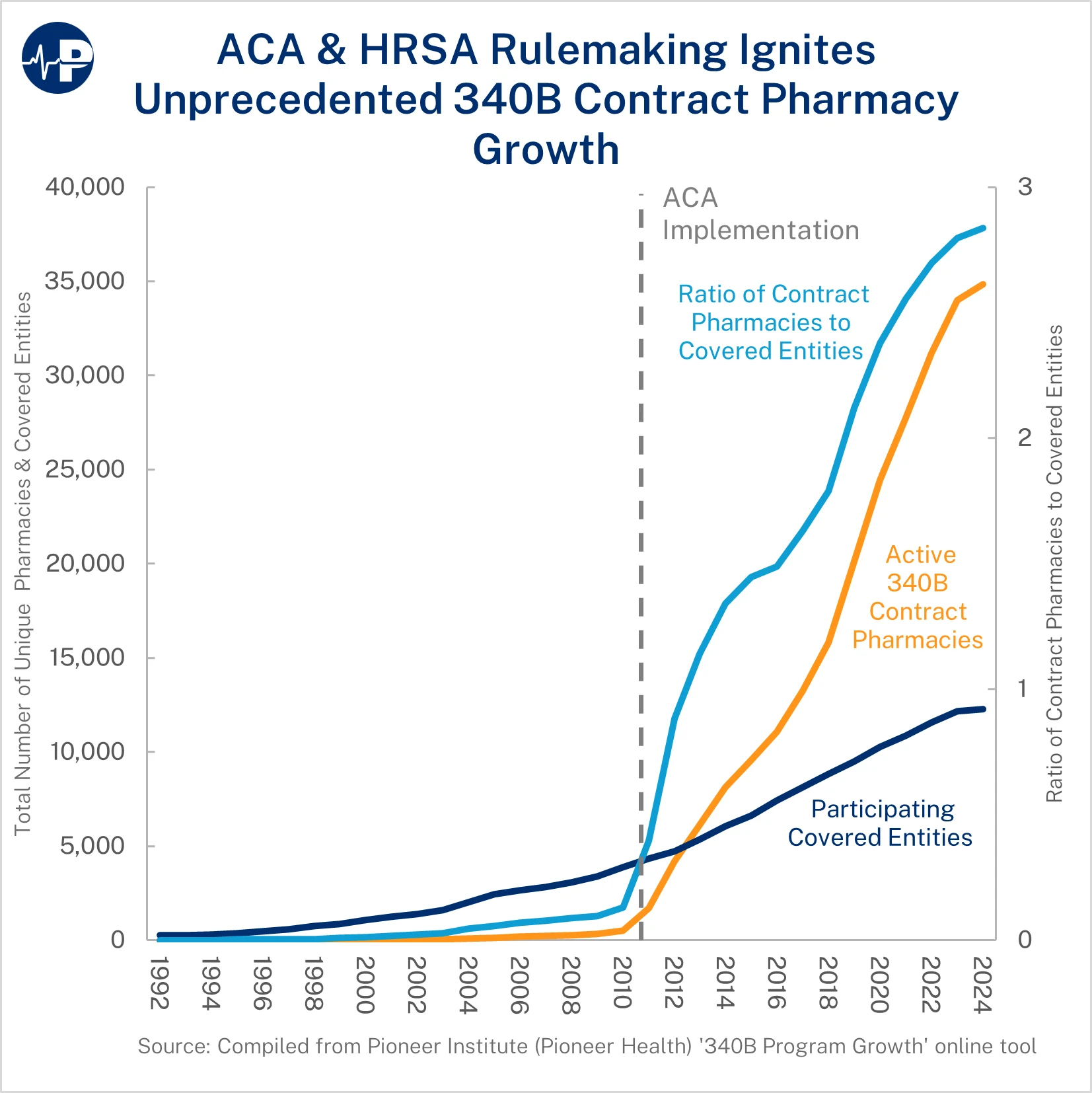
That explosive CE and contract pharmacy growth has led to a massive increase in 340B drug purchases. Purchases at the 340B discounted price increased from $5 billion in 2010 to $81.4 billion in 2024. The total value of these drugs at list price was $147.8 billion. It should be noted that the $66.4 billion difference between the discounted amount and the list price overstates the financial benefit of 340B to CEs, because actual reimbursement is typically lower than the list price.
The typical range for a 340B discount is around 22.5 to 50 percent of the average sales price, though some can go as high as 100 percent. (By law, CEs must pay at least $0.01 for 340B drugs.) The spread between the discounted price and the price received by payers is how hospitals turn 340B into a profit-generating machine.
Mo’ Money, Mo’ Problems
340B creates perverse incentives that encourage the use of higher-cost drugs and drive consolidation across the health care system. As the Congressional Budget Office explains, the 340B spread incentivizes hospitals to choose more expensive drugs in order to increase net revenues—which means higher out-of-pocket costs for patients and taxpayers.
The program is also a prime driver of provider consolidation. Because CEs are counted at the parent hospital level, any provider facilities owned by a hospital (known as child sites) can also receive 340B discounts, giving them a revenue advantage over independent practices as well as significant incentives to buy up physician practices and other hospitals. Consolidation means less competition and is directly linked to higher prices and premiums. Research has shown that 340B is a factor driving ACA premiums higher and, according to a report by the analysis firm IQVIA, was responsible for health care cost increases of $6.6 billion for employer-sponsored insurance and $1 billion for state and local governments in 2023.
The perverse incentives of the 340B Program also encourage hospital systems to acquire independent physician practices and build child sites in areas with high levels of private, commercial insurance instead of increasing support for services in low-income areas—in direct contradiction with the raison d’être of the program. CEs generate more revenue from the 340B Program when they have large percentages of commercially insured patients and lower levels of uninsured and Medicaid patients. The result has been hospitals divesting from low-income areas while expanding their presence in higher-income areas. For example, Bon Secours Mercy Health, a nonprofit system in Richmond, Virginia, used its 340B profits to build more clinics in wealthy suburbs while reducing services in lower-income areas. This phenomenon is also seen with contract pharmacies, where a 2022 JAMA paper found that contract pharmacy growth was concentrated in wealthy and predominantly White areas, while contract pharmacies in poorer and predominantly Black and Hispanic areas declined.
The statute does not require hospitals to report how much money they make through 340B, how they make money (even when revenue comes from Medicare), or how they spend the money. Research on nonprofit hospitals’ low average charity care spending shows that most hospitals do not put most of their 340B revenue towards helping needy patients.
The intent of 340B was to “stretch scarce federal resources” to better enable safety-net hospitals to provide more care to more indigent patients. Instead, 340B has resulted in large nonprofit hospital systems raking in cash while many small, rural, and low-income-serving hospitals struggle. That lack of transparency in 340B accounting provides fertile ground for waste, fraud, and abuse, as hospitals can illegally get discounts for 340B drugs already receiving Medicaid rebates (known as “duplicate discounts”) as well as discounts on drugs going to ineligible patients (called “diversion”).
The Trump Administration’s Proposed Pilot
In an attempt to mitigate some of the deep flaws in the program, the Trump administration proposed a pilot program requiring CEs to provide data to participating manufacturers that verify the drug in question is not receiving a Maximum Fair Price discount in Medicare or that a 340B rebate is not being provided to another entity on the same claim. Participating manufacturers are required to provide the rebate within 10 days of data submission.
Slated to begin at the start of 2026, the hospitals sued to stop the pilot. The courts decided in their favor, ruling that the administration had violated the Administrative Procedure Act and had not given stakeholders enough opportunity to provide input before the planned start of the pilot program. The administration eventually scrapped the pilot, but it issued a Request for Information in February on whether to continue the program.
Doing What Must Be Done
Legislation imposing the bare minimum of transparency requirements on hospitals in the 340B Program has been repeatedly introduced in Congress, only to be beaten back by formidable hospital lobbying campaigns. Although transparency is a good first step, the program needs a massive overhaul. Crucial to fixing the negative impacts of the program on drug prices, patient costs, and premiums is eliminating the buy low, bill high spread. Ryan Long has covered the deleterious impacts of this spread, as well as the need to replace it with a system that directs assistance to entities based on their need.
Currently, 340B forces pharmaceutical manufacturers to give massive discounts to major health systems while small, rural, and inner-city hospitals struggle. Instead, policymakers should transform 340B into a program where manufacturers pay a user fee, and that money is then distributed based on how much charity care a hospital provides in proportion to its revenues. This would achieve the original aim of the program by supporting hospitals providing indigent care while maintaining a subsidy to support true safety-net hospitals. This also would remove the incentives for consolidation because a hospital’s volume of 340B prescriptions would no longer determine how much revenue it receives from 340B. Finally, eliminating the spread would end the incentive to have a larger spread, thus reducing or eliminating 340B’s effect on increasing drug costs.
Conclusion
Large hospital systems will fight these changes because their massive health systems have built up a huge revenue model around 340B. The Trump administration’s proposed 340B pilot program is a useful reform, given the current constraints of the 340B statute. However, part of making health care—and specifically hospital care—more affordable is fixing what’s wrong with 340B and helping truly struggling hospitals, by eliminating the spread system in 340B.