
Reforming Government. Empowering Patients.
Navigation
The Persistent Obamacare Enrollment Fraud

The Paper
Executive Summary
What This Paper Covers
This paper examines improper enrollment in the Affordable Care Act (ACA) exchanges during the 2026 open enrollment period. It builds on our earlier, pioneering research papers, The Great Obamacare Enrollment Fraud (2024) and The Greater Obamacare Enrollment Fraud (2025). In 2026, we know more than ever before about the schemes, distorted incentives, the networks of bad actors, and the impact of improper enrollment and fraud on taxpayers.
In this year’s study, we evaluate at even greater depth the scale of improper enrollment, the mechanisms and incentives driving it, and why improper and phantom enrollments continue to be widespread even after the expiration of the COVID-era subsidy boosts. Using exchange enrollment data and Census Bureau population estimates, the paper analyzes how excessive subsidies, weak verification systems, automatic re-enrollment, and enrollment intermediaries contributed to improper enrollment and phantom coverage across the ACA exchanges.
The paper also examines:
- major differences between states that use the federal HealthCare.gov platform and those that run their own state-based exchanges (SBEs);
- changes in plan-selection behavior during the 2026 open enrollment period; and
- the role of Enhanced Direct Enrollment (EDE) platforms and enrollment intermediaries in facilitating large-scale unauthorized enrollment activity.
Although exchange enrollment declined modestly in 2026 following the expiration of the COVID subsidy boosts, the paper finds that the structural conditions that enabled widespread improper enrollment largely remained intact. Fortunately, the Trump administration and Congress have taken some initial steps to address improper enrollment in the exchanges and improve the integrity of the ACA. But much more should be done to build on these reforms.
What We Found & Why It Matters
Our research demonstrates that improper enrollment remains deeply embedded within the ACA exchanges and that structural vulnerabilities continue to create incentives for improper enrollment. This paper evaluates open enrollment sign-ups, not effectuated enrollment over the course of the year. We define improper enrollment as the number of people signed up in the lowest income category (100 to 150 percent of the federal poverty line), thus receiving the highest possible subsidy, above the number of potentially eligible people in that income category, across states. Although exchange sign-ups—both proper and improper—declined modestly between the 2025 and 2026 open enrollment periods following the expiration of the COVID-era subsidy boosts, the underlying drivers of improper enrollment largely remain intact.
We estimate that approximately 6.2 million exchange sign-ups in 2026 were improper, representing roughly 27 percent of all ACA exchange sign-ups, the same percentage level as after 2025 open enrollment. We project taxpayers will fund up to $25 billion in improper subsidy payments in 2026—nearly one-quarter of projected ACA subsidy spending in 2026.
The paper identifies several interconnected themes driving persistent improper enrollment.
- First, excessive subsidies and the widespread availability of zero-premium plans created strong incentives for both consumers and enrollment intermediaries to misstate enrollee income to maximize subsidies and commissions.
- Second, weak verification systems and permissive enrollment pathways—particularly in HealthCare.gov states—allowed improper and unauthorized enrollment activity to proliferate.
- Third, automatic re-enrollment and weak oversight enabled improper and phantom enrollment to persist for years, even after individuals became ineligible or were unaware of their coverage and after states transitioned from HealthCare.gov.
As with our past reports, we find major differences between HealthCare.gov states and those with SBEs. Improper enrollment remains overwhelmingly concentrated in HealthCare.gov states, particularly among states in the South that have not expanded Medicaid under the ACA, where incentives to overstate income above the federal poverty level threshold remain especially strong. In HealthCare.gov states, 56 percent of all exchange sign-ups in 2026 claimed income between 100 and 150 percent FPL—the income range qualifying for the largest ACA subsidies.
Enrollment growth since 2022 has been overwhelmingly concentrated in this category. SBEs generally maintained stronger enrollment controls and verification systems than the federal platform during the period of rapid enrollment growth. Improper enrollment was also substantially higher in states where brokers and enrollment intermediaries handled a larger share of exchange applications, particularly in HealthCare.gov states with extensive use of EDE platforms and outsourced enrollment pathways.
Enrollment patterns among many low-income enrollees are inconsistent with normal economic behavior. Large numbers of low-income enrollees selected bronze and gold plans even when silver plans provided dramatically better financial protection with substantially lower deductibles and cost-sharing obligations at little or no additional premium cost. This migration away from silver plans was concentrated in HealthCare.gov states and is highly consistent with intermediary-driven or unauthorized enrollment activity. The data strongly suggest widespread phantom enrollment—individuals who are fictitious, have duplicate enrollment, or are unaware of their coverage.
The combination of fully subsidized plans, weak verification systems, enrollment intermediary incentives, and automatic re-enrollment created conditions in which enrollment growth became increasingly disconnected from authentic health insurance utilization. In 2024, 35 percent of exchange enrollees had no medical claims during their enrollment period, including 40 percent of low-income enrollees in zero-premium plans with 94 percent actuarial value. CMS also found that an average of 1.6 million people per month in 2024 were simultaneously enrolled in Medicaid and subsidized exchange coverage.
Evidence continues to show that unscrupulous brokers and other enrollment intermediaries generally know very little about the applicant, only gathering the minimum information necessary for enrollment. This was reflected in the sharp increase in the share of exchange enrollees reporting unknown race or ethnicity during the period of rapid enrollment growth. By 2024, approximately half of all exchange sign-ups nationally—and nearly 60 percent in HealthCare.gov states—reported unknown race or ethnicity. This trend persisted in 2025 and 2026.
These findings suggest that a substantial portion of recent ACA exchange enrollment growth may not reflect legitimate increases in insured individuals. Instead, excessive subsidies, weak verification controls, misaligned intermediary incentives, and permissive enrollment systems created conditions that enabled large-scale improper enrollment and phantom coverage to persist throughout the exchanges, costing federal taxpayers tens of billions of dollars.
The ACA exchanges will continue to face program integrity challenges unless policymakers strengthen verification systems, reduce incentives for unauthorized enrollment activity, and improve oversight of enrollment intermediaries and outsourced enrollment platforms.
What We Recommend
Restoring program integrity to the ACA exchanges will require stronger oversight, stronger enrollee verification, and structural reforms that reduce incentives for improper enrollment. The Trump administration has already taken important initial steps by removing ineligible enrollees, including individuals simultaneously enrolled in Medicaid and subsidized exchange coverage, and those who failed to file tax returns to reconcile prior advance subsidy payments. The administration has also issued rules to strengthen ACA program integrity through tighter eligibility verification requirements and stronger oversight of enrollment pathways.
Although several key provisions from the administration’s 2025 integrity rule were blocked by a federal court, the One Big Beautiful Bill (OBBB) and the recently finalized 2027 Notice of Benefit and Payment Parameters include additional reforms intended to reduce improper enrollment and phantom coverage. Congress also reduced incentives for income underreporting through the OBBB by requiring full repayment of excess subsidies. When fully implemented and enforced, the OBBB reforms and Trump administration integrity actions should materially reduce improper enrollment, unauthorized enrollment activity, and phantom coverage in the ACA exchanges.
The ACA exchanges cannot function effectively if millions of sign-ups improperly receive taxpayer-funded subsidies and enrollment systems remain vulnerable to unauthorized and phantom enrollment. While reforms adopted by the Trump administration and Congress were important steps, policymakers should take additional actions to meaningfully reduce improper enrollment, including:
- Strengthen eligibility verification
- Tighten automatic re-enrollment procedures and require stronger periodic eligibility re-verification
- Require stronger identity authentication
- Impose tighter oversight on EDE platforms and third-party enrollment entities
- Aggressively investigate and suspend unscrupulous brokers and intermediaries involved in unauthorized enrollment activity
- Reduce subsidy distortions and eliminate zero-premium plan structures that facilitate improper and phantom enrollment.
Introduction
Improper enrollment remains a central feature of the Affordable Care Act (ACA) exchanges. We estimate that more than one-quarter of all ACA exchange sign-ups are improperly claiming income between 100 and 150 percent of the federal poverty level (FPL) to receive the largest possible subsidy. Many of these enrollees are victims of schemes of enrollment intermediaries seeking to maximize commissions. These intermediaries understand that fully subsidized plans are substantially easier to enroll and retain consumers in than plans requiring premium payments. Insurers also benefit from improper enrollment, as they receive direct payment of the subsidies, and the improper enrollment leads to higher subsidy payments.
Using a methodology that compares reported exchange enrollment in the 100–150 percent FPL category after open enrollment against Census Bureau–based estimates of the plausibly eligible population, we estimate that approximately 6.2 million exchange enrollees in 2026 were improperly enrolled. The methodology, assumptions, and limitations underlying these estimates are described in Appendix A. Our estimate of improper enrollment is conservative for two principal reasons. First, in states with detectable improper enrollment, we assume that every plausibly eligible individual actually enrolled in exchange coverage. Second, we estimate improper enrollment only in the 28 states where observed enrollment materially exceeds plausible eligibility estimates. We also exclude New York, Minnesota, and Oregon because they operate Basic Health Programs for this population rather than standard ACA exchange coverage.1
While the number of improper enrollees declined by about 250,000 from the 2025 open enrollment period, improper enrollment as a percentage of total enrollment held steady at about 27 percent of all enrollees. We estimate that insurers will receive up to $25 billion in subsidy payments associated with improper enrollment this year2—an amount nearly 25 percent of expected subsidy spending in 2026.3
This report builds on our work in “The Great Obamacare Enrollment Fraud” (2024) and “The Greater Obamacare Enrollment Fraud” (2025). We estimate improper enrollment at approximately 5.1 million individuals in 2024 and growing to nearly 6.5 million in 2025—roughly 27 percent of all enrollees.4 Using conservative assumptions, we estimated that federal subsidies expended on improper enrollees equaled $20 billion in 2024 and $27 billion in 2025.5
Our analysis also revealed significant differences across exchange types. Improper enrollment was much greater in states using the federal HealthCare.gov platform than in state-based exchanges (SBEs), reflecting the federal platform’s weaker verification and oversight structures. The problem was especially acute in states that did not expand Medicaid. The ACA prohibited subsidies for Americans with income below 100 percent FPL, creating strong incentives for low-income individuals in non-expansion states to report incomes above 100 percent FPL.6
Enrollment fraud is particularly severe in Florida, where there are nearly five times as many improper enrollees as eligible enrollees in the 100–150 percent FPL category—and where improper enrollment has been a concern for nearly the entire history of the ACA.7 More than half (53 percent) of all enrollees in Florida are improperly enrolled. Improper enrollment is particularly extreme in South Florida, a region long associated with large-scale health care fraud and aggressive enrollment intermediary activity.8
In addition to these eligibility concerns, the data also point to widespread phantom enrollment—enrollees who are fictitious, unaware of their enrollment, or enrolled in other coverage.9 In 2024, 35 percent of exchange enrollees had no medical claims during the period of their enrollment, and among the low-income enrollees in zero-premium plans with a 94 percent actuarial value, 40 percent had no claims.10 These percentages were up from 20 percent in 2021.
The percentage of zero-claim enrollees in the exchanges is dramatically higher than observed in the broader private market and strongly suggests a substantial number of phantom enrollees.11 The data clearly show that improper enrollment—and associated phantom enrollment—accelerated sharply beginning in 2023. Because excessive subsidies led to a proliferation of fully subsidized plans and automatic re-enrollment allowed coverage to persist from one year to the next, improper and phantom enrollment became entrenched.
Weak Verification and Platform Vulnerabilities
Analysis of 2024 enrollment data by the Centers for Medicare and Medicaid Services (CMS) found that an average of 1.6 million Americans each month were simultaneously enrolled in Medicaid and subsidized exchange plans, evidence of the duplicate coverage that helps explain at least part of the surge in zero-claim enrollment.12 In 2025, CMS ended premium subsidies for nearly 1.5 million people found to be ineligible for financial assistance or enrolled without their authorization in HealthCare.gov states. More than 1 million of them either were concurrently enrolled in Medicaid and exchange coverage with advance payment of subsidies or failed to file their income taxes and reconcile previously received subsidies—a requirement to continue subsidized coverage.13
A review by the Government Accountability Office (GAO) confirmed significant vulnerabilities and conditions ripe for improper enrollment. GAO was able to enroll 23 of 24 fictitious applications in coverage.14 As a result of the exchange vulnerabilities, overly subsidized products, and Biden administration focus on maximizing enrollment, large fraud rings developed to take advantage of the government-created profit opportunity. Unscrupulous agents and brokers could earn commissions of $6,000 per day enrolling applicants, with one customer service agent at an enrollment intermediary claiming that half of people being enrolled were unaware they were signing up for health insurance.15 There have been numerous Department of Justice (DOJ) indictments and convictions for widespread exchange enrollment fraud.
Trump Administration Integrity Reforms
In response to mounting evidence that the ACA exchanges had become vulnerable to large-scale improper enrollment, unauthorized enrollment activity, and phantom coverage, the Trump administration issued a major ACA program integrity rule in June 2025. The rule sought to reverse Biden administration policies that prioritized maximizing enrollment while weakening eligibility verification, identity authentication, and enrollment oversight.
The 2025 rule strengthened income verification requirements after the Biden administration had largely permitted exchanges to rely on applicant self-attestation when tax-return data was unavailable or inconsistent. It also restored stricter subsidy reconciliation requirements, strengthened Special Enrollment Period (SEP) verification standards, and required certain automatically reenrolled individuals on the federal exchange who otherwise owed no premium to make at least a minimal $5 monthly premium payment unless they actively confirmed or updated their eligibility information. Together, these reforms were intended to reduce repeated subsidy overpayments, unauthorized enrollment activity, and phantom coverage resulting from weak verification and passive reenrollment practices.
In August 2025, however, a federal district court in City of Columbus v. Kennedy stayed several provisions of the rule nationwide pending litigation. The Trump administration has appealed the ruling.
Congress subsequently enacted several important ACA integrity provisions through the One Big Beautiful Bill (OBBB), including requiring full repayment of excess subsidies and eliminating the abused 100–150 percent FPL monthly SEP. These changes directly target many of the improper enrollment incentives documented throughout this paper.
CMS also incorporated many similar integrity reforms into the finalized 2027 Notice of Benefit and Payment Parameters. Under the finalized rule, exchanges must resolve income data conflicts and require supporting documentation when trusted data sources conflict with an applicant’s reported income. When fully implemented and enforced, the OBBB reforms and Trump administration integrity actions should materially reduce improper enrollment, unauthorized enrollment activity, and phantom coverage in the ACA exchanges.
Automatic Re-enrollment and Persistence
The number of improper enrollees declined by only 4 percent between the 2025 and 2026 open enrollment periods, remaining at 27 percent of all enrollees. However, the nature of improper enrollment changed, particularly in HealthCare.gov states. In those states where unscrupulous intermediary enrollment activity is much more severe, a large amount of improper and phantom enrollment switched from silver plans to bronze and gold plans. This is because bronze and many gold plans are fully subsidized in 2026 for the lowest-income exchange enrollees, while silver plans are not (except in rare circumstances). In some rating areas, intensified silver-loading increased premium subsidies enough that certain gold plans became available at zero or near-zero premium, making them attractive targets for commission-preserving reenrollment activity. In state-based exchanges, a larger portion of enrollees were automatically re-enrolled.
The evidence presented throughout this paper suggests that the exchanges are experiencing substantial and persistent program integrity challenges driven by weak verification, misaligned incentives, and structural gaps in oversight. After rapid growth from 2023 through 2025, improper enrollment remained elevated in 2026. By 2024, half of all sign-ups during open enrollment had unknown race or ethnicity—a substantial increase from the early part of the Biden administration and highly consistent with large-scale unauthorized or incomplete enrollment activity.
Excessive subsidies and zero-premium plans created unusually strong incentives for enrollment intermediaries to maximize sign-ups. Weak verification and Enhanced Direct Enrollment (EDE) platforms, which allow private entities to conduct front-end exchange enrollment and application intake, enabled large-scale unauthorized or improper enrollment activity. Automatic re-enrollment then allowed improper and phantom enrollment to persist over time, while intensified silver-loading (which lowers enrollees’ share of the premium for bronze and gold plans) and the expiration of COVID-era enhanced subsidies shifted many improper enrollees from silver plans into zero-premium bronze and gold coverage.
The Biden administration prioritized maximizing exchange enrollment while systematically weakening eligibility verification, identity authentication, and program integrity safeguards. The permissive approach toward eligibility verification—including accepting applications without Social Security numbers—combined with the COVID-era subsidy boosts contributed to substantial improper and phantom enrollment. The evidence suggests that both policy design and Biden-era administrative failures contributed to the current situation. Excessive subsidies and zero-premium plans created unusually strong incentives for improper enrollment, while weak verification systems, permissive enrollment pathways, and insufficient oversight allowed those incentives to be exploited at scale.
CMS is now taking steps to remove ineligible enrollees, including individuals simultaneously enrolled in Medicaid coverage and those who failed to file tax returns reconciling prior advance subsidy payments. As a result of CMS’s long-overdue program integrity efforts and the expiration of the COVID-era subsidy boosts, effectuated enrollment attrition relative to open enrollment sign-ups will almost certainly exceed levels observed during the past five years. From 2014 through 2019, average effectuated enrollment was 18 percent below open enrollment selections. Applying an 18 percent attrition rate to 2026 open enrollment would yield average effectuated enrollment of roughly 19 million in 2026.
The following section examines the major empirical indicators of persistent improper enrollment in the ACA exchanges during the 2026 open enrollment period.
Findings
Here are the 10 main findings from the 2026 open enrollment period:
- At Least 6.2 Million Improper Sign-Ups in 2026
- Nearly Half of Enrollees Claim to Have the Lowest Possible Income to Receive the Largest Possible Subsidy
- Unknown Race or Ethnicity Surged with Improper Enrollment Spike, Unknown for Half of All Enrollees
- Implausibly High Number of Low-Income Enrollees Selected Non-Silver Plans from 2022-2025 When 94% Actuarial Value Silver Plans Were Fully Subsidized, Particularly in HealthCare.gov States
- Nearly 30 Percent of Enrollees Are in Zero-Premium Plans in 2026, Despite the Expiration of Enhanced Subsidies
- The Subsidy Covers 94 Percent of the Premium for the Median Enrollee
- Suspiciously High Number of Low-Income Enrollees Moving to Non-Silver Plans in 2026, Particularly in HealthCare.gov States
- States with State-Based Exchanges and State Subsidy Programs Preserved Silver Plan Enrollment
- Much Higher Active Re-enrollment in HealthCare.gov States, With Switching to Non-Silver Plans
- Age and Income Distributions in 2026 Remain Similar to 2025 Patterns
#1: At Least 6.2 Million Improper Sign-Ups in 2026
Using the same methodology as our prior papers (described in Appendix A), Table 1 shows the 2026 improper enrollment estimates compared to 2024 and 2025. We estimate 6.22 million improper enrollees in 2026, down from 6.47 million in 2025. This represents a 3.9 percent decline in improper enrollment from 2025. About 27 percent of all exchange plan sign-ups were improperly enrolled in the 100–150 percent FPL category after both the 2025 and 2026 open enrollment periods.
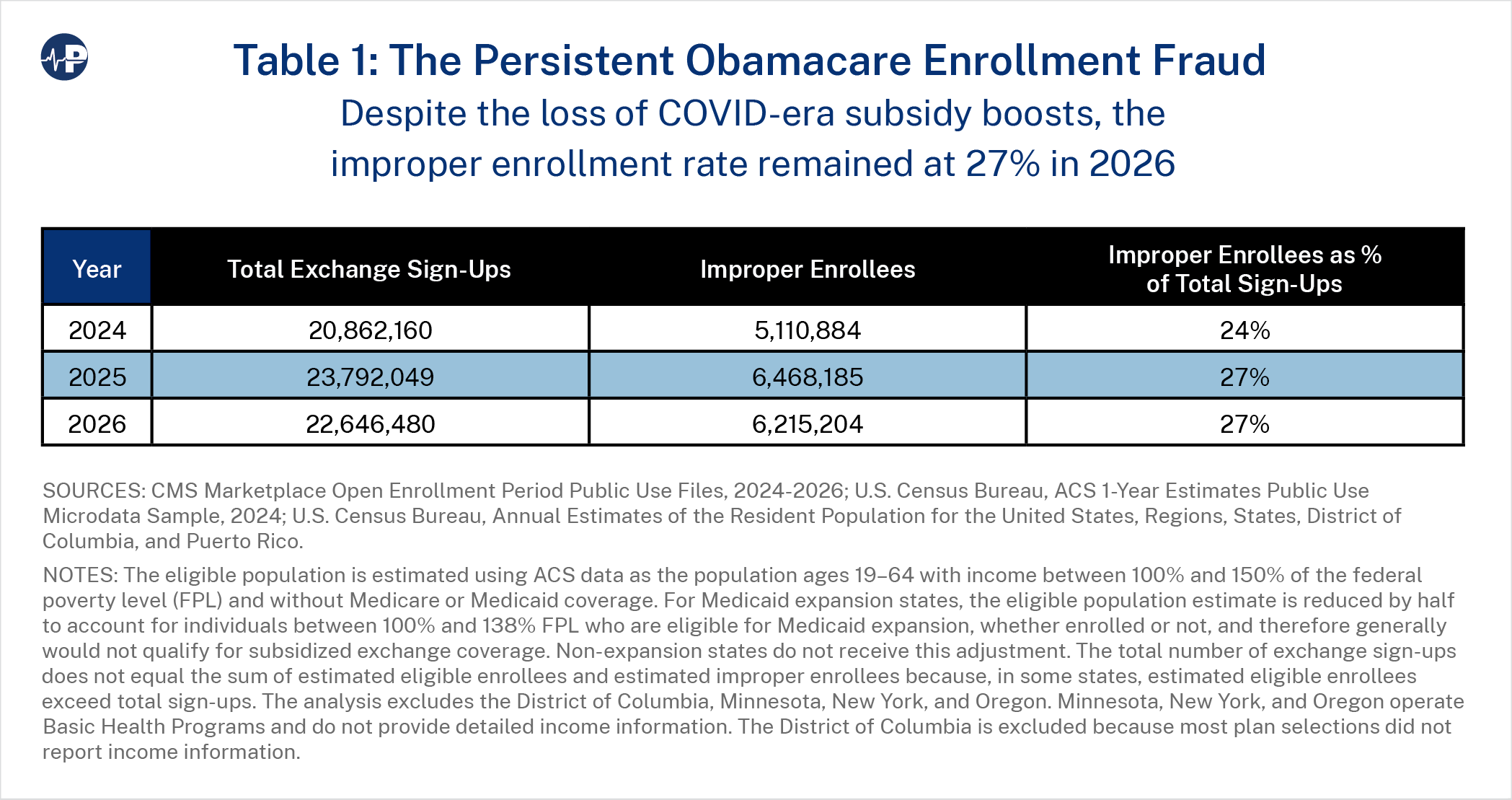
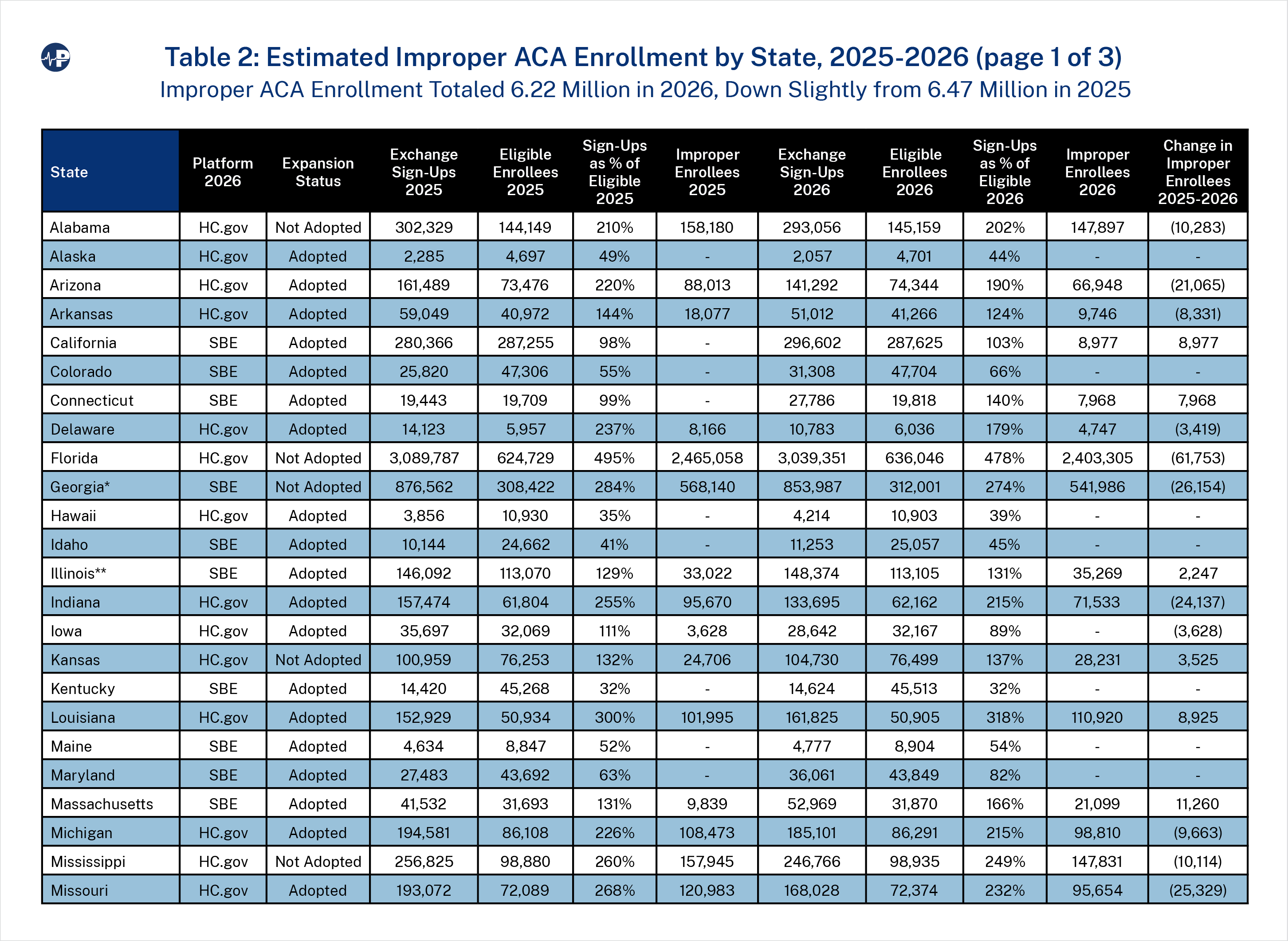
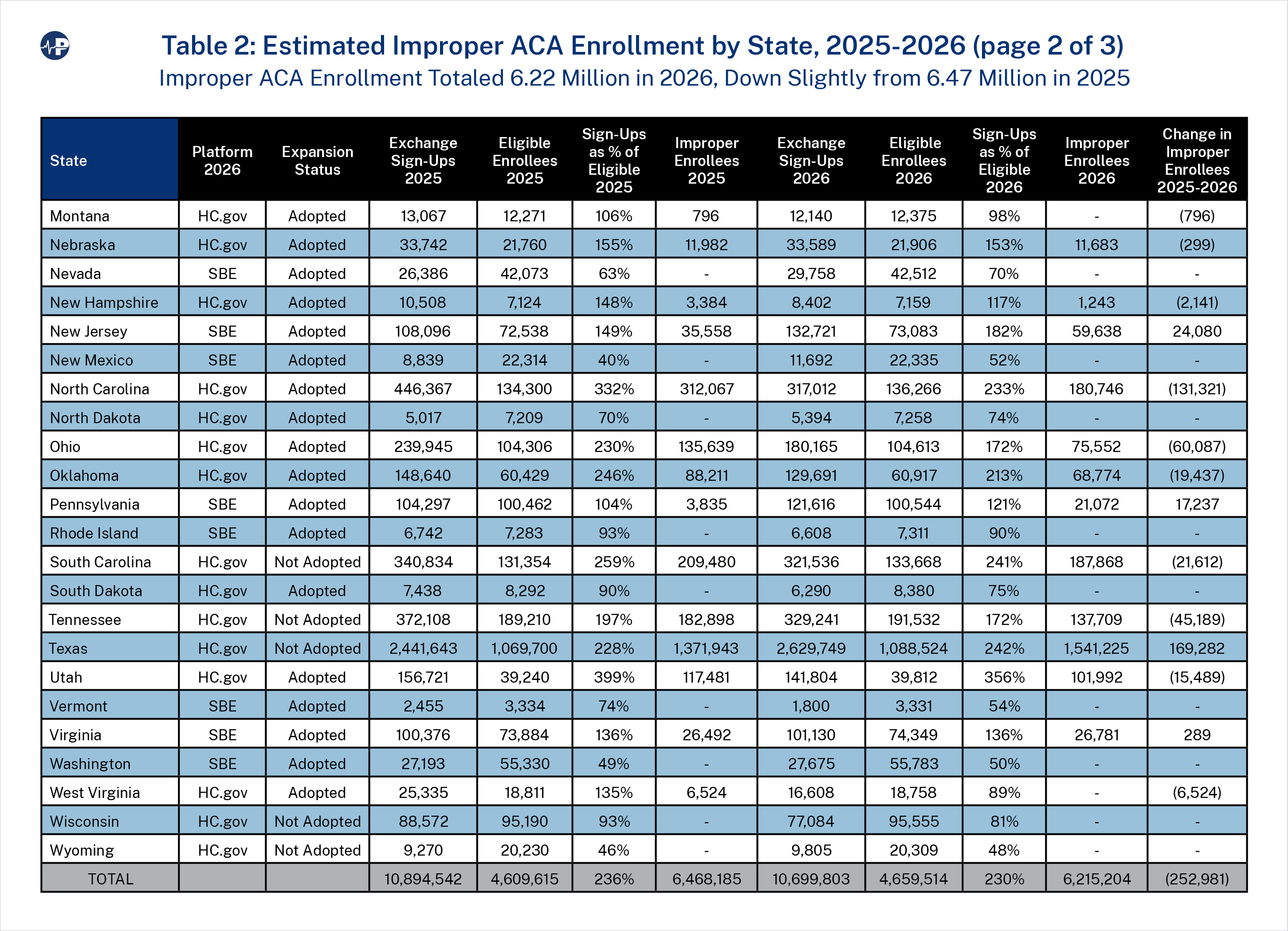
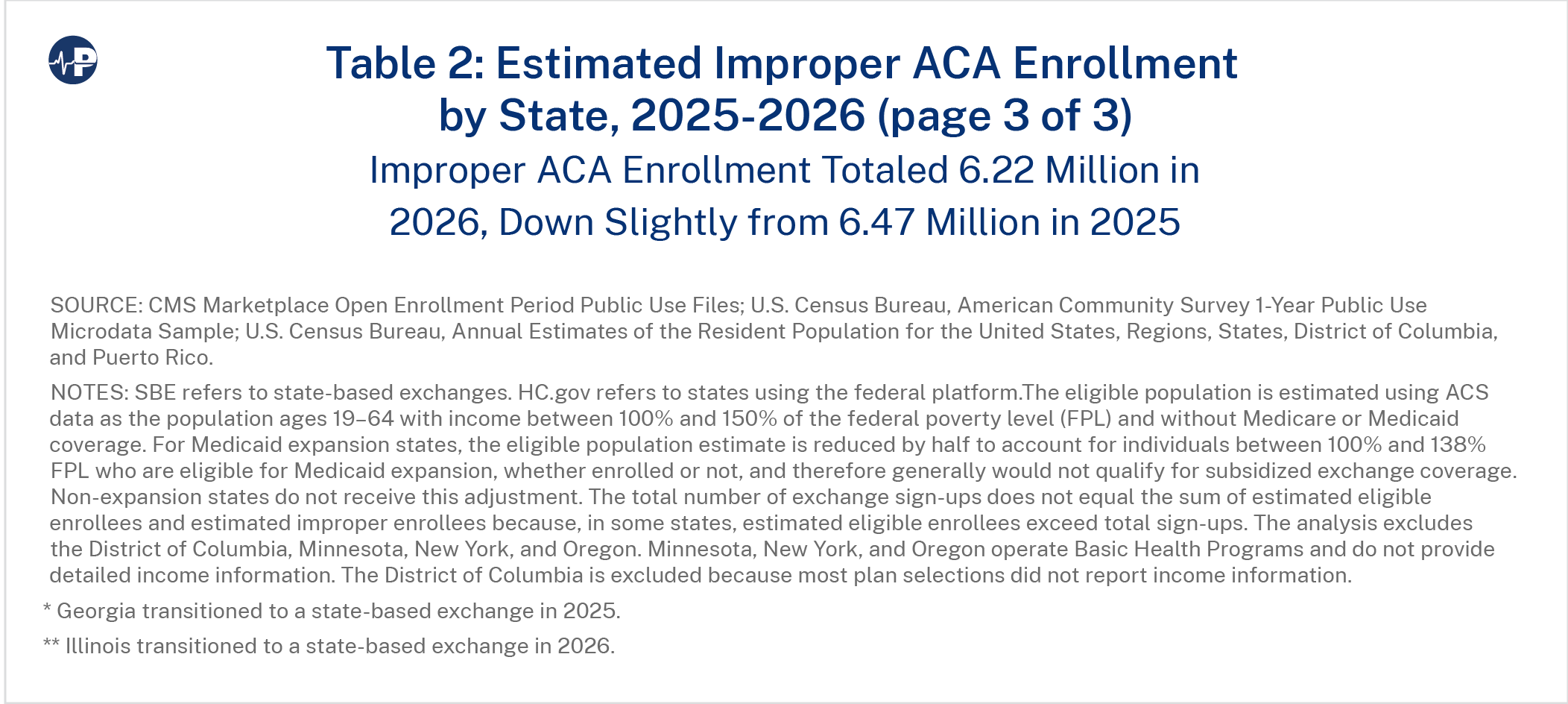
Table 2 shows improper enrollment estimates by state for 2025 and 2026. Improper enrollment is concentrated in a handful of larger states. The five states with the highest number of improper enrollees in 2026—Florida (2.40 million enrollees), Texas (1.54 million), Georgia (0.54 million), South Carolina (0.19 million), and North Carolina (0.18 million)—have 78 percent of all improper enrollees nationally. Florida and Texas have 63 percent of all improper enrollment. In these five states, improper enrollment increased the most in Texas (12.3 percent) and decreased the most in North Carolina (–42.1 percent) from the 2025 and 2026 open enrollment periods. The decline in North Carolina is likely driven by de-duplication of people simultaneously enrolled in Medicaid and exchange plans given the state expanded Medicaid in December 2023 and because automatic re-enrollment in the exchanges likely produced significant duplication of enrollment in the two programs.
#2: Nearly Half of Enrollees Claim to Have the Lowest Possible Income to Receive the Largest Possible Subsidy
Three national data patterns provide strong prima facie evidence of widespread improper enrollment, particularly in HealthCare.gov states. First, exchange enrollment in the 100–150 percent FPL category exceeds plausible eligibility estimates by approximately 6.2 million enrollees. Second, an implausibly high share of exchange enrollees report income between 100 and 150 percent FPL. Third, enrollment patterns among many low-income enrollees are inconsistent with normal economic behavior, particularly the migration away from highly generous silver plans into bronze and gold coverage. Taken together, these patterns strongly suggest that a substantial portion of exchange enrollment growth since 2022 does not reflect legitimate increases in eligible enrollees. Not all enrollment growth during this period was improper, and the enhanced COVID-era subsidies likely increased legitimate enrollment among some previously uninsured individuals.
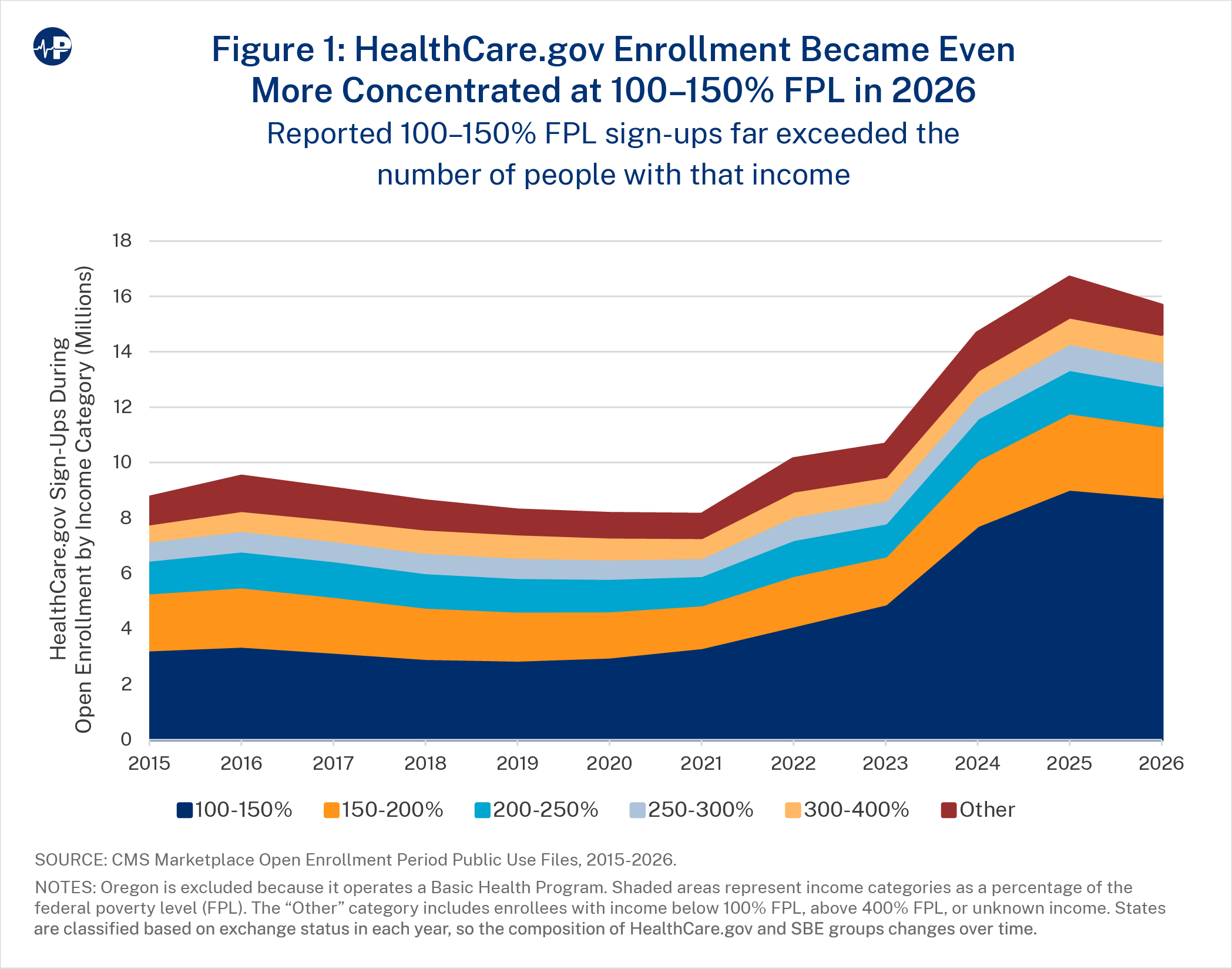
In 2026, a staggering 56 percent of all sign-ups in states using HealthCare.gov claimed income in the 100–150 percent FPL range—qualifying for the largest subsidies. From 2021 to 2025, enrollees claiming income in this category qualified for a fully subsidized 94 percent actuarial value silver plan (meaning one with extremely limited cost sharing).16 Figure 1 illustrates how overall enrollment, broken down by income category, has evolved over time in SBE states. Between 2020 and 2026, the number of open enrollment sign-ups increased by 7.5 million people—with a 5.8 million increase in the number claiming income between 100 and 150 percent FPL.
Incentives to Misreport Income
Particularly in non-Medicaid-expansion states, individuals who expect to have income below the FPL can report expected income just above the FPL threshold in order to qualify for large exchange subsidies. If their actual income later falls below the FPL, they generally face no repayment obligation or penalty.
In all states, exchange enrollees receive larger advanced subsidies when they report lower expected income. Prior to 2026, individuals who underestimated their income generally had to repay only a portion of the excess subsidy advanced to insurers on their behalf—and often less than the full excess amount. In addition, individuals claiming income between 100 and 150 percent FPL qualified for silver plans with a 94 percent actuarial value, which substantially reduced deductibles and other cost-sharing obligations.
These incentives also benefited brokers, insurers, and other enrollment intermediaries. Fully subsidized plans are much easier to market and enroll consumers into, because they impose no premium obligation. Insurers also benefited because larger subsidies increased federal payments to insurers and because many improperly enrolled or phantom enrollees generated little or no medical claims expense.
The OBBB substantially reduced incentives for individuals to underestimate their income by requiring them to repay the full amount of any excess subsidy received when they file their taxes. The law did not address the incentive for individuals with income below the FPL in non-expansion states to overstate their expected income in order to qualify for exchange subsidies. Some incentive to underreport income also remains, because lower reported income can still qualify enrollees for more generous cost-sharing assistance through higher actuarial value plans.
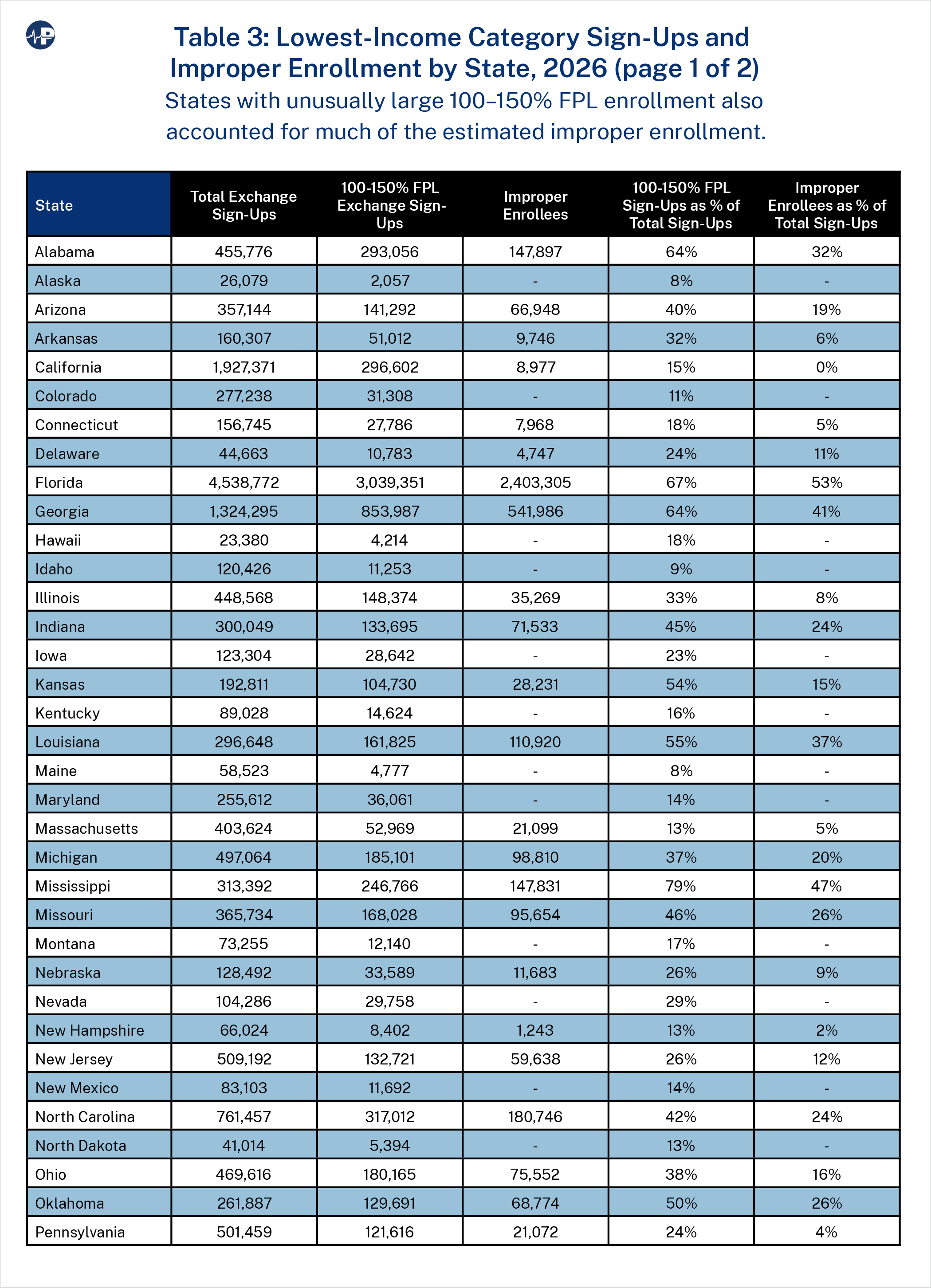
Table 3 shows the number of 100–150 percent FPL sign-ups by state compared to total sign-ups. It also shows estimated improper enrollment by state compared to total sign-ups. In five states, the portion of enrollees claiming income between 100 and 150 percent FPL exceeds 60 percent of all sign-ups: Mississippi (79 percent), Florida (67 percent), Georgia (64 percent), Alabama (64 percent), and Texas (63 percent). In five states, improper enrollees exceeded one-third of all sign-ups: Florida (53 percent), Mississippi (47 percent), Georgia (41 percent), Louisiana (37 percent), and Texas (37 percent). Louisiana’s inclusion on this list is notable, because the state adopted the ACA’s Medicaid expansion.

Improper enrollment existed before the COVID-era subsidy boosts because the underlying ACA subsidies were generous and larger for people who misestimated their income. The ACA design created large financial incentives to misreport income, which benefited insurers and enrollment intermediaries as well as enrollees who were aware of their enrollment, as described in detail in “The Great Obamacare Enrollment Fraud.”17 The misreporting of income to claim more subsidies increased substantially with the COVID-era subsidy boosts, as demonstrated by the significant increase in the percentage of enrollees—particularly in states using HealthCare.gov—claiming income between 100 and 150 percent FPL during open enrollment.
#3: Unknown Race or Ethnicity Surged with Improper Enrollment Spike, Unknown for Half of All Enrollees
The second piece of prima facie evidence of large-scale improper enrollment is a surge in enrollees with unknown race or ethnicity with the implementation of the enhanced COVID-era subsidy boosts. In 2020, 33 percent of enrollees did not report race or ethnicity. This steadily increased to 50 percent of enrollees by 2024, a percentage where it remained after the 2025 and 2026 open enrollment periods.
The sharp increase in missing race and ethnicity information from 2020 to 2024 is difficult to explain through normal enrollment behavior and is highly consistent with fraud or improper enrollment, with rogue brokers enrolling individuals without their consent. Figure 2 shows the percentage of enrollees with unknown race or ethnicity from 2018 to 2026 for all states—as well as HealthCare.gov states and SBE states.18 The persistence of such a high percentage of enrollees with unknown race or ethnicity in 2025 and 2026 is likely also due to the large amount of automatic re-enrollment in the exchanges.
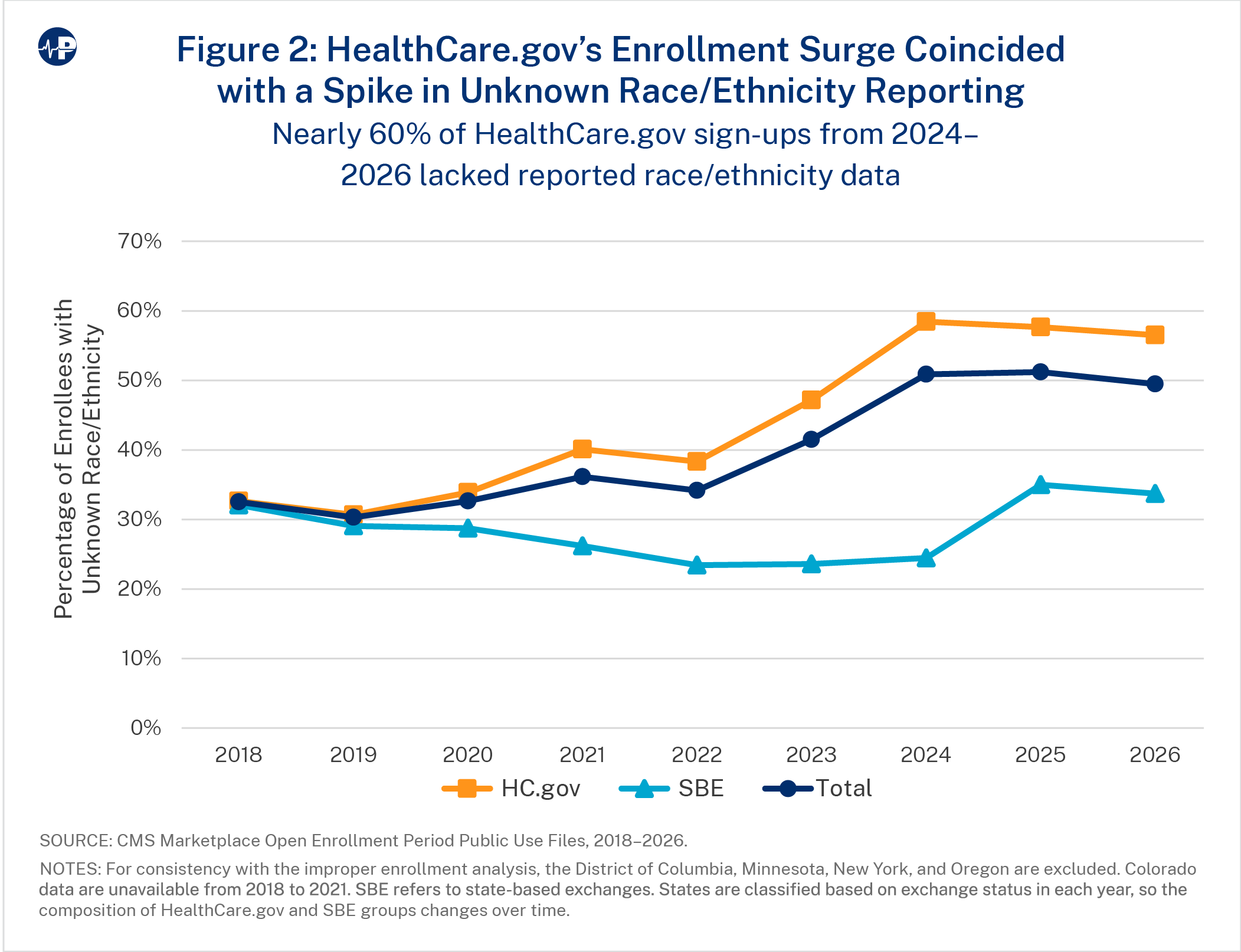
In HealthCare.gov states, race or ethnicity is unknown for 56.2 percent of enrollees in 2026. This is significantly higher than in state exchanges (32.9 percent). The fact that race/ethnicity demographics are 71 percent more likely to be unknown in HealthCare.gov states is another data point consistent with much higher improper enrollment in those states.
In fact, the disparity between HealthCare.gov and SBE states is even more significant when accounting for current SBE states that were HealthCare.gov states at one time. Figure 3 distinguishes states with SBEs over the entire period from states that switched from HealthCare.gov to SBE during the period. It shows the continued stronger integrity of SBE states, with the proportion of enrollees with unknown race or ethnicity gradually declining from 2018 through 2026 in states that consistently operated SBEs over the entire period. The switcher states, with Georgia being the most significant in terms of improper enrollment, also had a significant increase in the sign-ups with unknown race/ethnicity after 2022, suggesting that enrollment integrity issues persisted in these states even after the transition to SBEs.

#4: A Suspiciously High Number of Low-Income Enrollees Selected Non-Silver Plans
As a result of the COVID-era subsidy boost, during the 2022–2025 open enrollment periods, 94 percent actuarial value silver plans were fully subsidized for individuals claiming income between 100 and 150 percent FPL. Bronze plans were also fully subsidized for this group, and in some states, gold plans were as well. Bronze and gold plans generally carried much higher deductibles and other cost-sharing obligations, making them economically irrational choices for the vast majority of enrollees in this income range.
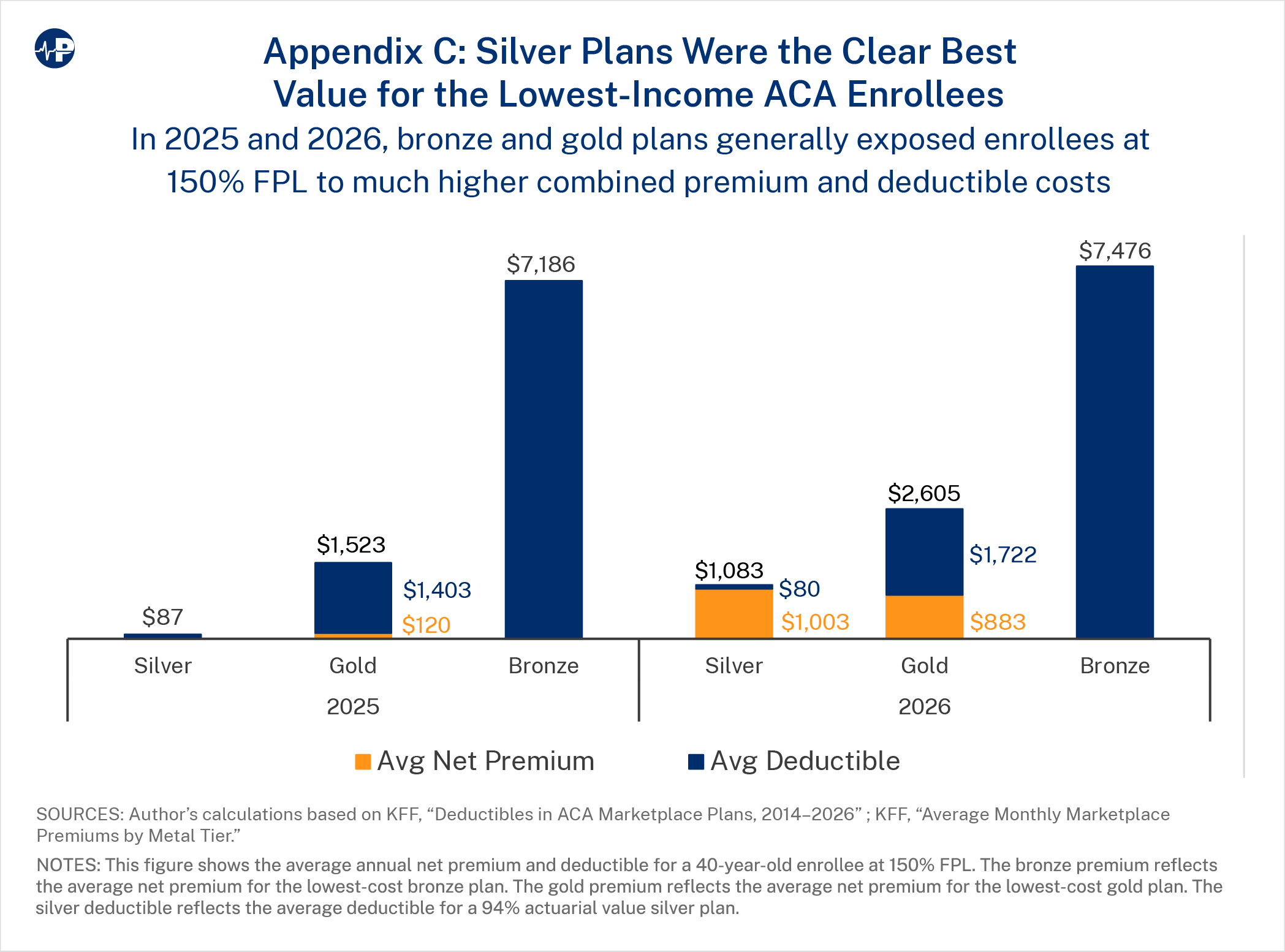
Figure 4 shows the annual net premiums and deductibles for a 40-year-old enrollee at 100 percent FPL in 2025 (when the enhanced COVID-era subsidies were in place) and in 2026 (after those subsidies expired). In 2025, enrollees paid no premium for silver or bronze plans and an average premium of $120 for a gold plan. Deductibles varied dramatically across these plans, with the bronze plan deductible more than 80 times higher than the silver plan deductible. Appendix C contains an identical figure for an individual at 150 percent FPL. Choosing any plan other than silver was generally against the economic interest of enrollees between 100 and 150 percent FPL in 2025, yet in HealthCare.gov states nearly one-in-four enrollees selected non-silver plans.
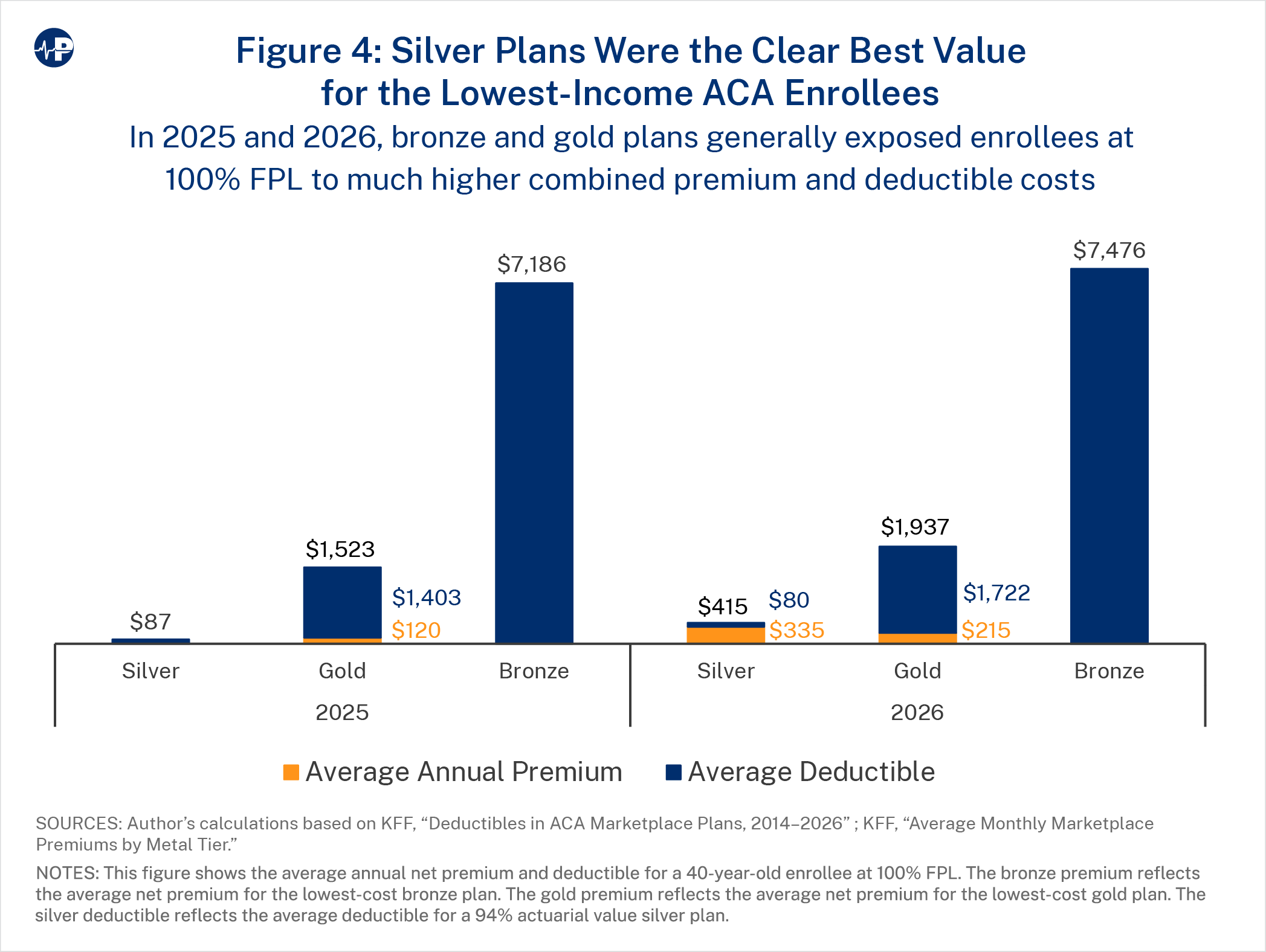
Table 4 shows the metal tier plan selections for these enrollees from 2020 to 2026. From 2020 to 2022—before the sharp increase in improper enrollment—more than six in seven enrollees in HealthCare.gov and SBE states selected silver plans, with SBE states being just a few percentage points higher.

Between 2022 and 2024, the percentage of 100–150 percent FPL enrollees in HealthCare.gov states selecting silver coverage dropped from 84.9 percent to 76.4 percent—a drop more than twice as large as the decline in SBE states. Yet by 2024 and 2025, roughly one-quarter of HealthCare.gov sign-ups claiming income between 100 and 150 percent FPL selected non-silver coverage despite fully subsidized 94 percent actuarial value silver plans being available.
Selection of bronze and gold plans by this population is not normal consumer behavior, because these plans exposed low-income enrollees to substantially greater out-of-pocket costs despite offering little or no premium savings relative to fully subsidized 94 percent actuarial value silver coverage. The pattern is highly consistent with improper enrollment, unauthorized enrollment activity, or intermediary-driven plan selection that prioritized commissions over enrollee financial protection. Economic theory would predict the opposite result: Making 94 percent actuarial value silver plans fully subsidized should have increased silver plan selection among the lowest-income enrollees, not reduce it.
In contrast, in SBE states, only about one-eighth of 100–150 percent FPL enrollees were in non-silver plans—or half the rate as in HealthCare.gov states. Among active HealthCare.gov plan selections, nearly 75 percent were assisted by agents and brokers during the open enrollment periods from 2023 through 2026—up nearly 20 percentage points from the 2021 open enrollment period.19
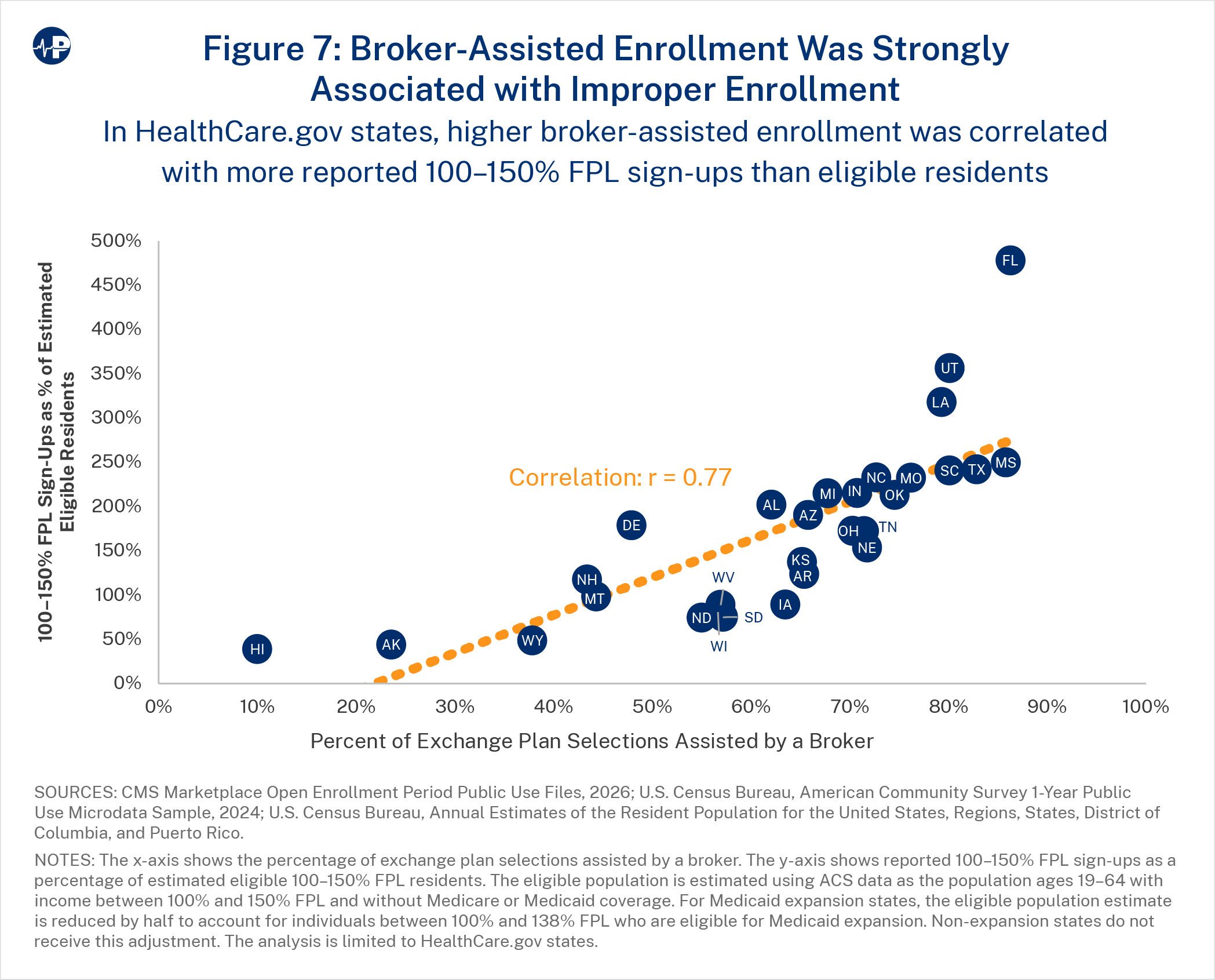
High broker utilization alone does not establish fraud or improper enrollment. As discussed below, the concern is the interaction of high-volume commission incentives, EDE-enabled enrollment pathways, weak authentication controls, and the widespread availability of fully subsidized plans. Improper enrollment is substantially higher in HealthCare.gov states—where these factors overlap—and, within those states, improper enrollment is strongly positively correlated with enrollment intermediaries handling a larger share of applications.20
#5: Nearly 30 Percent of Enrollees Are in Zero-Premium Plans in 2026 Despite the Expiration of Enhanced Subsidies
In 2025, 40 percent of HealthCare.gov open enrollment sign-ups selected (or had selected for them) zero-premium plans.21 In 2025, in every state, silver plan enrollees claiming income between 100 and 150 percent FPL were enrolled in zero-premium plans—and many lower-income enrollees were enrolled in bronze and gold plans—because of “silver-loading.”22
In 2026, 29 percent of HealthCare.gov open enrollment sign-ups were in zero-premium plans.23 Enrollees in silver plans for the 2026 plan year are unlikely to be in zero-premium plans unless there is a substantial spread between the lowest-cost silver plan and the second-lowest-cost silver plan.24 As a result of the significant increase in benchmark premiums and the intensification of silver-loading in many states, even more lower-income enrollees would qualify for zero-premium bronze and gold plans in 2026. This explains how only about one-quarter fewer enrollees are in zero-premium plans despite the expiration of the enhanced COVID-era subsidy boost.
#6: The Subsidy Covering 94 Percent of the Premium for the Median Enrollee
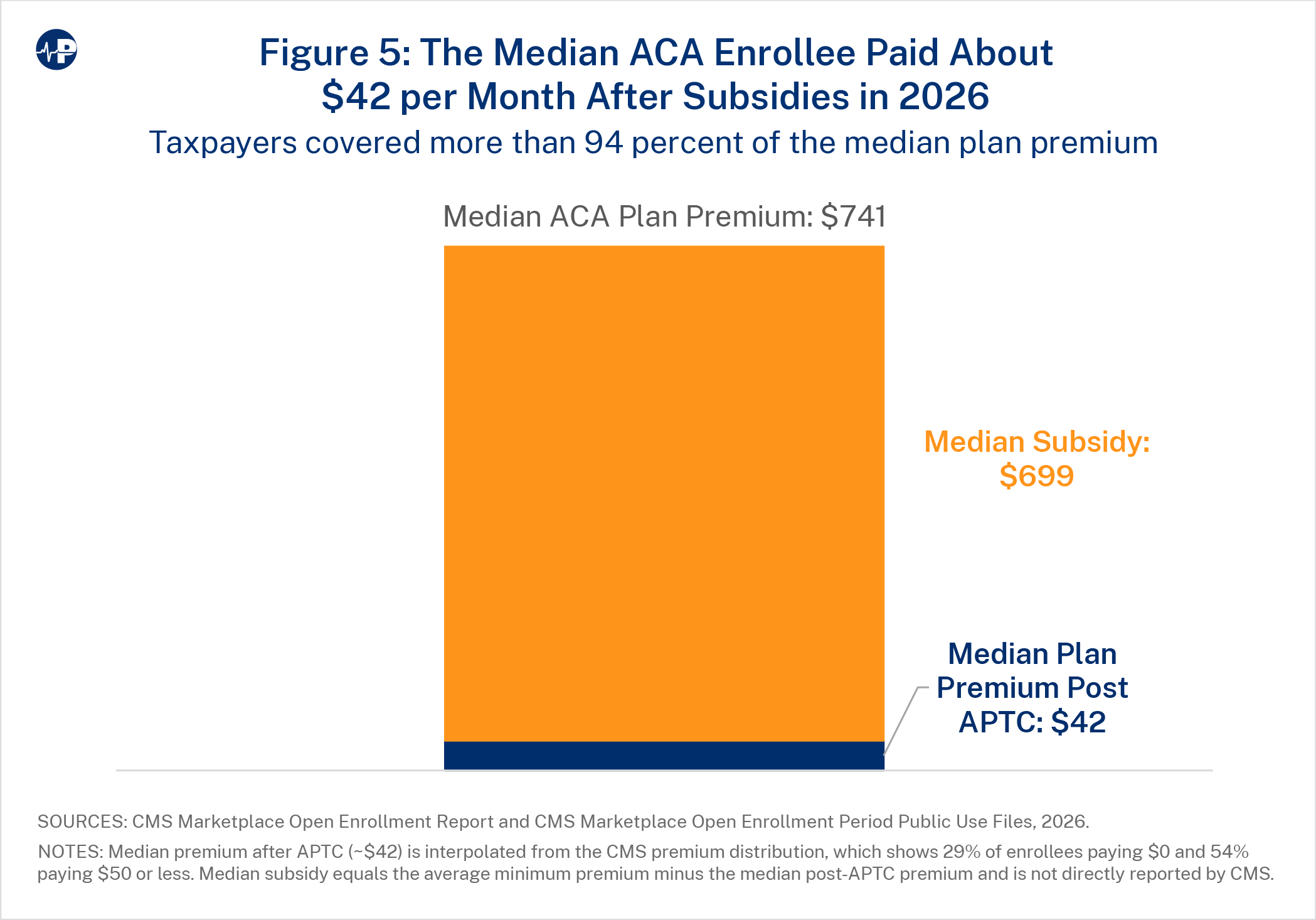
Despite widespread claims that ACA exchange coverage has become broadly unaffordable, the median enrollee pays just $42 a month—after advanced subsidies paid directly to insurers—for a plan with a $741 premium.25 Thus, as Figure 5 shows, the median enrollee receives a subsidy that covers 94 percent of the premium.26 While the number of enrollees with zero-premium plans has declined, 29 percent of 2026 sign-ups had fully subsidized plans. Despite the large increase in gross premiums from 2025 to 2026, the average premium for a subsidized enrollee increased by only about $22 a month—and nearly 90 percent of ACA exchange enrollees receive subsidies.
#7: Suspiciously High Number of Low-Income Enrollees Moving to Non-Silver Plans in 2026, Particularly in HealthCare.gov States
There was significant enrollee migration from silver plans to bronze and gold plans from 2025 to 2026 among all enrollees, with a much greater shift in HealthCare.gov states than in SBE states. The primary reason is that the expiration of the enhanced COVID-era subsidies, combined with intensified silver-loading, made bronze and gold plans relatively less expensive than silver plans. Silver-loading results in insurers receiving additional subsidies, because the premium subsidy is linked to the second-lowest-cost silver plan premium—the benchmark plan. Initially, silver-loading was a response to the loss of the cost-sharing reduction (CSR) subsidies, but in many states, insurers have so increased silver plan premiums that the increase in the premium subsidy is substantially more than the loss of the CSR payments.27
The percentage of the lowest-income sign-ups enrolled in silver plans dropped precipitously between 2025 and 2026, with a much larger decline in HealthCare.gov states. The large shift away from silver plans among 100–150 percent FPL enrollees is surprising—and suspicious—because silver plans still offered dramatically better financial protection than bronze plans for only modest additional premiums. Although most silver plans were no longer fully subsidized after the expiration of the COVID-era subsidy boosts, average net premiums for many low-income enrollees remained relatively modest—roughly $30–$40 per month—while the reduction in cost-sharing protection from moving into bronze coverage was enormous.
Figure 4 shows that silver plans provided substantially greater financial protection than bronze or gold plans for low-income enrollees in 2026 after the enhanced subsidies expired. The average deductible for a bronze plan in 2026 was $7,476, compared to just $80 for a 94 percent actuarial value silver plan. The average benchmark silver plan net premium was $335, compared to no premium for a bronze plan. The average lowest-cost gold plans carried a $215 net premium, and the average gold plan had a $1,722 deductible.28 Given these plan economics, the vast majority of low-income enrollees would be expected to remain in silver plans. Yet there was substantial migration—particularly in HealthCare.gov states—away from silver plans among the lowest-income enrollees.
The data strongly suggest that active re-enrollment, which was much more prevalent in HealthCare.gov states, moved improper enrollees—including some who are phantom enrollees—into fully subsidized bronze and gold plans. The migration away from silver plans also differed substantially between long-standing SBE states and states that only recently transitioned from HealthCare.gov to SBEs. Long-standing SBE states generally maintained much higher silver plan enrollment rates, while much of the migration into bronze and gold plans occurred in former HealthCare.gov states that had already exhibited signs of substantial improper enrollment. Table 4 shows that, among enrollees with incomes between 100 and 150 percent FPL, silver-plan enrollment in the states that transitioned from HealthCare.gov to SBEs declined from 89.2 percent in 2020 to 69.2 percent in 2026. By contrast, in SBE states that never used HealthCare.gov, silver-plan enrollment increased from 88.8 percent to 93.1 percent over the same period. This pattern suggests that legacy improper enrollment and intermediary-driven enrollment behavior persisted even after some states transitioned to SBEs.
This pattern is most plausibly explained by intermediary incentives and the actions of unscrupulous enrollment entities. Brokers and agents have strong financial incentives to enroll individuals into fully subsidized plans, because plans without premium obligations are substantially easier to retain and re-enroll. Broker commissions are generally tied to effectuated enrollment and may continue through re-enrollment periods so long as coverage remains active, creating incentives to maintain enrollment in fully subsidized plans that are less likely to terminate for nonpayment.
Following the expiration of enhanced subsidies, bronze and gold plans were more likely than silver plans to remain fully subsidized, making them the rational choice for bad actors seeking to preserve commissions—even when these plans were not in the best interest of enrollees. In some rating areas, intensified silver-loading increased premium subsidies enough that certain gold plans became available at zero or near-zero premium.
#8: SBE States with State Subsidy Programs Preserved Silver Plan Enrollment
Ten state-based exchange states—California, Colorado, Connecticut, Maryland, Massachusetts, New Jersey, New Mexico, New York, Vermont, and Washington—operate their own subsidy programs that supplement federal subsidies. The availability of zero-premium plans through these programs varies considerably. California, Connecticut, Massachusetts, and New Mexico preserve zero-premium benchmark silver coverage for enrollees in the lowest income tier (100–150 percent FPL, except in New Mexico, where zero-premium plans were available up to 200 percent FPL) by holding the required premium contribution at zero through a state premium subsidy that replicates the expired federal enhanced COVID-era subsidy boost.29 These state subsidy programs also reduced incentives for low-income enrollees to migrate into bronze and gold plans solely to avoid premium obligations. Similarly, Massachusetts’s program offers zero-premium HMO coverage to enrollees at or below 150 percent FPL.30 Colorado and Washington use flat per-member-per-month subsidies that are capped at the remaining post-ACA subsidy premium and therefore produce $0 premiums only for the subset of enrollees whose post-subsidy net premium is at or below the cap.31
Maryland’s subsidy program reduces premiums to as low as $1 per month in the lowest income tier.32 New Jersey’s state subsidy program, which has operated since 2021, produced zero or near-zero plans for many low-income enrollees when combined with the enhanced federal ACA subsidies—but for far fewer enrollees in 2026 because state funds did not fully replace the lost COVID-era subsidy boost. The share of New Jersey enrollees with premiums of $1 or less fell from 43 percent in 2025 to 8 percent in 2026.33 Vermont’s ACA subsidy program reduces (but does not eliminate) the required premium contribution by 1.5 percentage points of household income.34
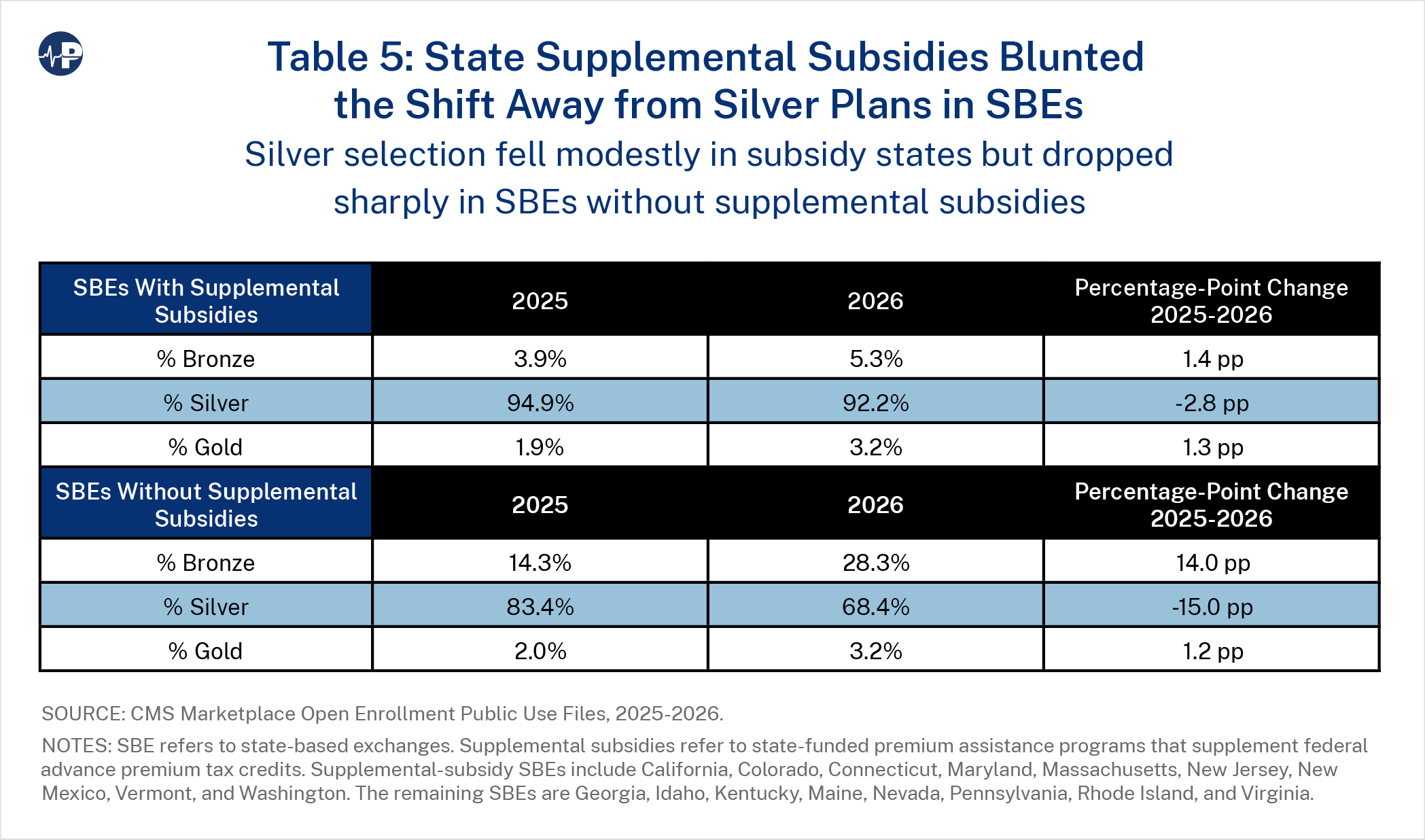
Table 5 shows that state subsidies materially affected which plans low-income enrollees selected during the 2026 open enrollment period. Among enrollees with household incomes between 100 and 150 percent FPL, silver plan selection fell modestly, from 94.9 percent to 92.2 percent in SBE states with state subsidies. By contrast, silver plan enrollment fell sharply from 83.4 percent to 68.4 percent in states with SBEs without state subsidies—with a 14-percentage-point increase in enrollees selecting bronze plans. This suggests that state subsidies preserving zero or near-zero silver premiums reduced the incentive for enrollees and brokers to migrate to bronze and gold plans after the federal COVID-era enhanced subsidies expired.
#9: Much Higher Active Re-Enrollment in HealthCare.gov States, with Switching to Non-Silver Plans
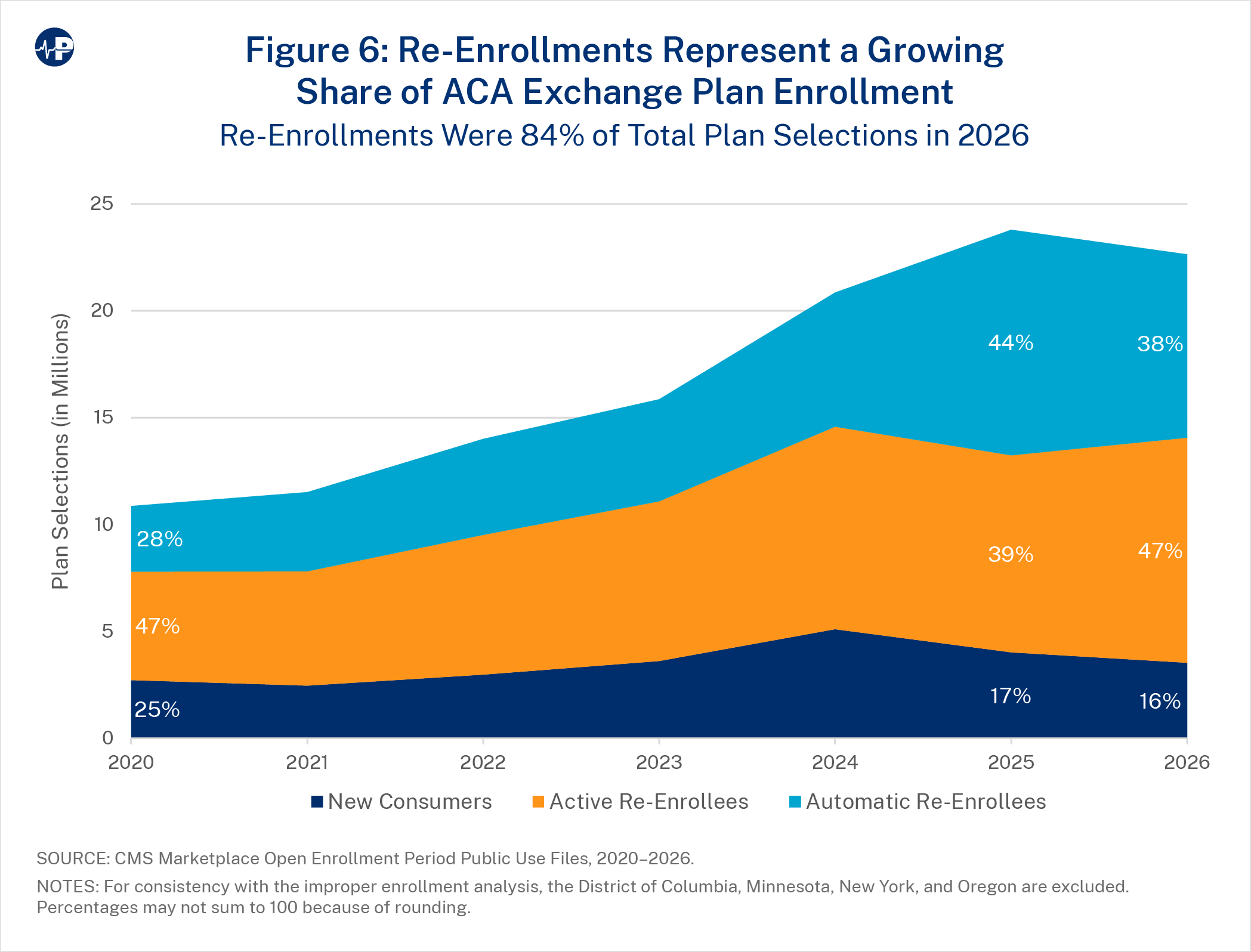
In many cases, to maintain improper and phantom enrollment, enrollment intermediaries needed to switch people from zero-premium silver plans to zero-premium bronze or gold plans. Because enrollees who fail to pay premiums are eventually disenrolled—and an individual who never pays an initial premium may never effectuate coverage at all—enrollment intermediaries have incentives to place improper or phantom enrollees into fully subsidized plans in order to maximize commission retention. Phantom enrollees remaining in silver plans would typically owe a premium.35 Figure 6 shows the number of new enrollees, automatic re-enrollees, and active re-enrollees over time.
Along with the migration out of silver plans (discussed above), Table 6 shows that active re-enrollment was much greater in HealthCare.gov states in the 2026 open enrollment. Active re-enrollees were 52 percent of all sign-ups in HealthCare.gov states, compared to 31 percent in SBE states and 36 percent in switcher states. This distinction is important, because active re-enrollment facilitates plan switching, including movement into fully subsidized bronze and gold plans.
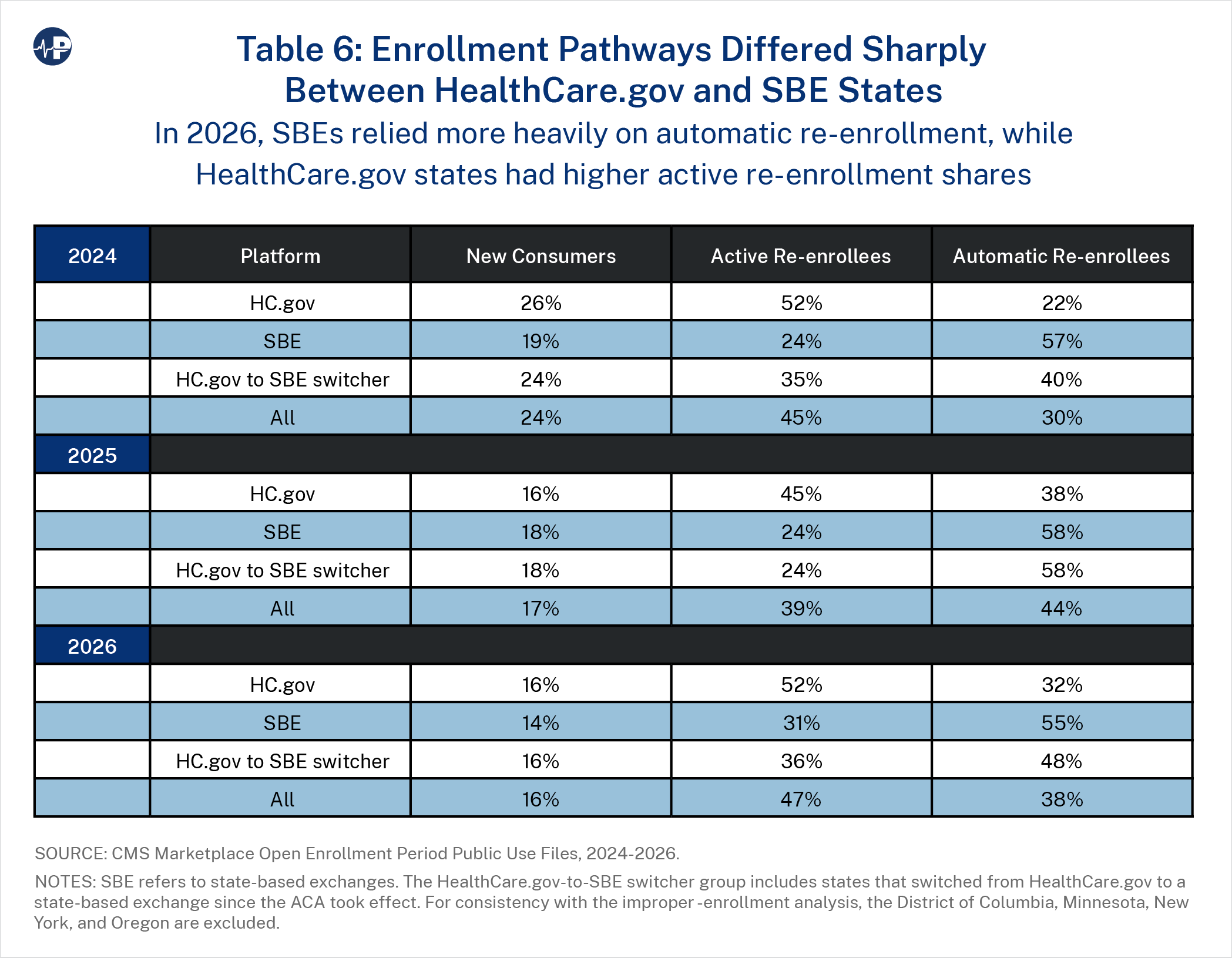
As a share of total enrollment, active re-enrollment returned to levels consistent with pre-2025 patterns after an unusually low level in 2025, when a large share of enrollees were automatically re-enrolled. Automatic re-enrollment remains elevated at 38 percent of total enrollment—above the pre-2024 average of 31 percent, though below the 44 percent level observed in 2025.
#10: Age and Income Distributions Remain Similar in 2025 and 2026
The age distribution of sign-ups remains largely unchanged between 2025 and 2026. The overall income distribution also shows a continued increase in the concentration of enrollees between 100 and 150 percent FPL alongside a decline in higher-income enrollees above 400 percent FPL.
The Anatomy of Fraud Schemes
ACA enrollment fraud resulted from both policy choices and CMS oversight failures, particularly during the Biden administration, which created strong incentives for intermediaries to maximize enrollment, often without adequate regard for eligibility verification or consumer consent. Zero-premium plans, weak documentation requirements, automatic renewal, and per-enrollee commissions enabled brokers, call centers, EDE platforms, and insurers to significantly benefit from improper enrollment.
In practice, many improper enrollment schemes followed a similar pattern: Enrollment intermediaries used online advertisements, misleading marketing, purchased consumer data, or unauthorized broker switching to enroll individuals into fully subsidized exchange plans. Weak verification requirements and inadequate identity authentication allowed applications to be submitted with little friction, while automatic re-enrollment and recurring commissions enabled improper and phantom enrollment to persist over time.
Agents and brokers operating through SBEs, the federal HealthCare.gov platform, and EDE platforms earn per-enrollee commissions—typically $20–$30 per enrollee per month, recurring as long as coverage remains active—plus enrollment volume bonuses. HealthSherpa, the leading EDE platform, has offered agents payments of up to $150 per qualifying enrollee during open enrollment.36 These incentives, combined with lax documentation requirements and widespread access to zero-premium plans, produced a market with few effective safeguards limiting improper enrollment activity.
Intermediary fraud is well-documented and imposes substantial costs on both consumers—who are enrolled into coverage without their consent or switched into an inferior plan without their knowledge—and taxpayers.37 Recent DOJ cases indicate that ACA enrollment fraud involves broader networks of brokerages, marketers, lead generators, and enrollment intermediaries. In February 2026, Cory Lloyd of AssuredPartners of South Florida (APSF) and Steven Strong each received over 20-year sentences for a scheme that generated at least $180 million in improperly obtained subsidies by targeting homeless, unemployed, and mentally ill individuals with bribes and fraudulent applications. In a second case, APSF paid $27.6 million in restitution, while parent company AssuredPartners paid $107 million over related False Claims Act allegations.38 In a third case, Florida brokerage executive Dafud Iza pled guilty to collecting at least $133.9 million in fraudulent subsidies through similar tactics.39 Available evidence suggests that Florida—particularly south Florida—has become a major center of ACA enrollment fraud.40
In the 2026 open enrollment period, 76 percent of applications were broker- or agent-assisted in HealthCare.gov states,41 down slightly from 78 percent for the 2025 open enrollment period.42 Broker- or agent-assisted applications are slightly lower in SBEs due to higher rates of automatic enrollment. Unlike HealthCare.gov, full SBEs generally retain more direct control over enrollment intake, account access, broker assignment, special enrollment period verification, and consumer authentication. Because SBEs bear the operational and political consequences of market instability and consumer complaints—without directly profiting from higher enrollment volume—they have stronger incentives to maintain enrollment integrity. HealthCare.gov, by contrast, relies extensively on federally approved private enrollment channels that prioritize enrollment volume and commission generation. As Figure 7 demonstrates, improper enrollment is highly and positively correlated with the percentage of open enrollment applications that are assisted by enrollment intermediaries.43
Beyond enhanced program integrity measures (see Table 7),44 the biggest difference between the two platforms—and a prominent reason why there is more fraud in HealthCare.gov states—is the rapid rise of EDE in HealthCare.gov states but not in SBEs.45 EDE platforms serve as the consumer-facing portal for plan comparison, application intake, and submission, while federal agencies and marketplace handle eligibility.46 EDE enabled commission-driven intermediaries to rapidly scale enrollment activity and exploit enrollment loopholes, while HealthCare.gov’s weaker intake controls made it harder to prevent unauthorized, inaccurate, or fraudulent applications from entering the system in the first place.
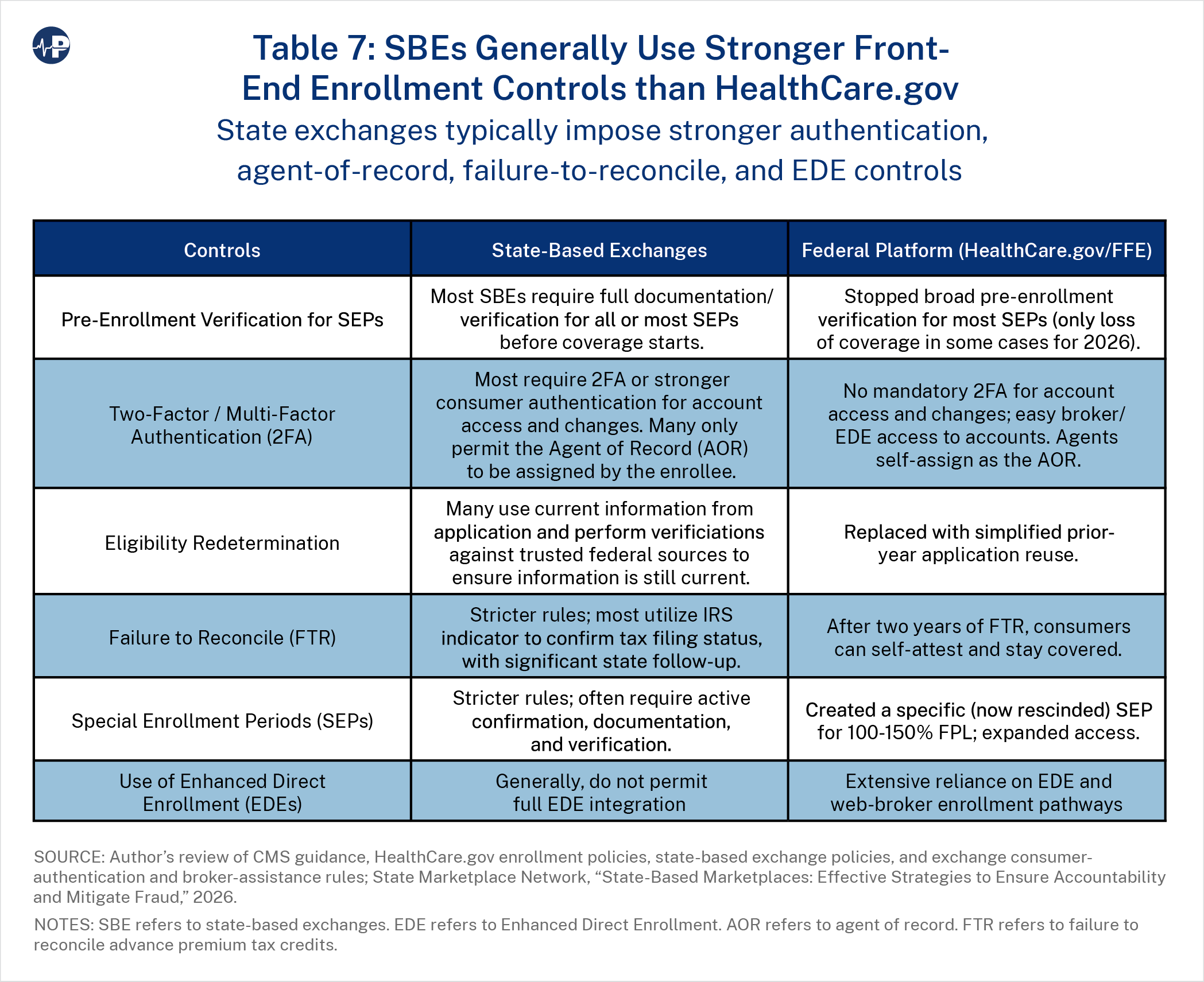
During the 2019 open enrollment period, EDE accounted for less than 1 percent of HealthCare.gov applications.47 By 2024, EDE accounted for more than 60 percent of all HealthCare.gov applications. One EDE alone, HealthSherpa, handled more than 40 percent of submissions across the HealthCare.gov states.48 Documented improper and fraudulent enrollment is overwhelmingly clustered in states that rely on HealthCare.gov (including SBEs facilitated by the federal platform), where EDE and web-broker enrollment dominate the consumer pathway. The ability of brokers and enrollment intermediaries to use EDE, partnered with the lack of stronger intake controls concentrated in HealthCare.gov states, significantly contributed to large-scale improper enrollment.49 As shown in Table 7, full SBEs generally employ stronger verification, authentication, and enrollment integrity safeguards than the federal HealthCare.gov platform does.
Collectively, these differences indicate that full SBEs generally retain more direct exchange control over enrollment intake, identity verification, and account changes than HealthCare.gov does. The federal platform’s heavier reliance on outsourced enrollment pathways creates greater exposure to unauthorized or improper enrollment activity.
EDE platforms appear to have played a major role in scaling improper enrollment in HealthCare.gov states. States that operated full SBEs before enhanced subsidies and widespread zero-premium plans became available generally show much lower estimated improper enrollment than states that relied on HealthCare.gov during this period. Several states that transitioned away from HealthCare.gov after 2021 still show elevated estimated improper enrollment, suggesting that improper enrollment introduced under weaker federal controls may persist through automatic re-enrollment even after states adopt stronger SBE safeguards.
Third-party intermediaries also play a central role in unauthorized plan switching, reaping financial rewards for doing so. Call centers, often connected to or cooperating with EDEs and other enrollment intermediaries, can generate commissions by manipulating applications or switching enrollees into new plans without their knowledge.50 For zero-premium plans in particular, unauthorized plan switching often goes unnoticed by enrollees, as there is no change in monthly payments. For 2026, plan switching likely contributed to the significant shift away from silver plans (which no longer have zero premiums) to bronze and gold plans (which often offer zero premiums for low-income enrollees).51 Notable ACA tracker and supporter Andrew Sprung also supports this theory:
[The] combination of zero-premium coverage availability, the ability to switch plans monthly at incomes up to 150% FPL, and ridiculously easy broker access to enrollees’ accounts via e-broker platforms opened the door wide to broker fraud, which metastasized in HealthCare.gov states in 2023 and 2024 and has been only partially quelled by CMS in 2025 and 2026. A subindustry of high-volume/low ethics call centers has sprung up—centered mainly in Florida, long a hotbed of insurance fraud of all kinds.52
Sprung further explained that plan switching and intermediary fraud contributed to changes in plan-level distribution changes:
When broker fraud happens, it usually takes the form of unauthorized plan-switching, which in [open enrollment] 2026 could be done up to January 15. When fraudster brokers do this, breaking into an account and switching the enrollment to a different plan, they often move the enrollee to a bronze plan, since the enrollee may not notice the switch if there is no premium to pay (thanks largely to silver loading, bronze plans are still available to many for zero premium). Broker fraud may therefore be a factor in the shift to bronze enrollment.53
EDE-driven fraud is especially pervasive, as it occurs before the enrollee’s eligibility determination is made. Intermediaries can submit applications without consumer knowledge or consent, manipulate income data, misrepresent enrollee identity, switch consumers between plans without authorization, or generate phantom enrollments.54
These abuses enter the system upstream, as illustrated by the GAO’s “secret shopper” audit of ACA enrollment, in which GAO was able to enroll 23 of 24 fictitious applications into coverage in 2024 and 2025.55 The exchange’s back-end eligibility process cannot reliably prevent improper enrollment once false or unauthorized information has already entered the system.56
CMS enforcement to date has been ineffective, focusing too narrowly on individual brokers rather than the firms, platforms, and enrollment entities that enable large-scale improper enrollment. In the summer of 2024, CMS suspended approximately 850 brokers for suspicious enrollment activity, but many were later reinstated. One EDE that processed more than 1 million exchange applications was only suspended in September 2024 and permanently barred in 2026, despite previous enforcement referrals in 2018 and 2022.57 Evidence also showed enrollment activity associated with overseas IP addresses, raising additional concerns about account security and compliance with CMS enrollment rules. Allowing repeat offenders and high-risk enrollment entities to continue operating at this scale illustrates both the magnitude of the program integrity failures and the weakness of CMS oversight. CMS and the Center for Program Integrity should take substantially stronger and faster action to suspend and permanently remove unscrupulous brokers, EDEs, and enrollment intermediaries engaged in improper or unauthorized enrollment activity.
Level-Setting on ACA Enrollment in 2026—Enrollment Decline Is Not Driven by Affordability Concerns
The COVID-era subsidy boosts delivered the largest benefit to enrollees with income above 400 percent FPL, because the ACA did not include financial assistance for households with income above that threshold. Because the underlying subsidies are so generous and because of intensified silver-loading, most ACA enrollees can obtain other plans without paying more than a small additional premium in 2026 above what they paid in 2025. That is not true for many enrollees above 400 percent FPL. Therefore, generally the only enrollees who will be dropping ACA plans because of affordability issues have income above four times the poverty level.
In HealthCare.gov states, the median net premium is just $42 a month—with taxpayers covering 94 percent of the premium. Seventy percent of all sign-ups face net premiums of less than $100 a month—for a plan with a total premium that averages $746. In HealthCare.gov states, 90 percent of consumers receive advanced subsidies—and again for these enrollees, there is very little change in the net premium between 2025 and 2026. This percentage is down from 95 percent of sign-ups last year. In SBE states, 79 percent of all consumers received advance subsidies in 2026—down from 86 percent in 2025.
Prior to the COVID-era subsidy boosts, average monthly exchange enrollment typically ran about 18 percent below open enrollment selections (see Table 8), reflecting normal attrition as individuals transitioned to other coverage or failed to pay their share of the premiums. In some cases, individuals are incentivized to hop from plan to plan, because if they stop paying, they still receive coverage during a grace period and can sign up again at the start of the next open enrollment period without penalty.58 With the COVID-era subsidy boosts, average yearly enrollment was only about 4 percent below open enrollment selections. This period also corresponded to loose special enrollment period requirements that enabled most people to enroll at any point during the year.59
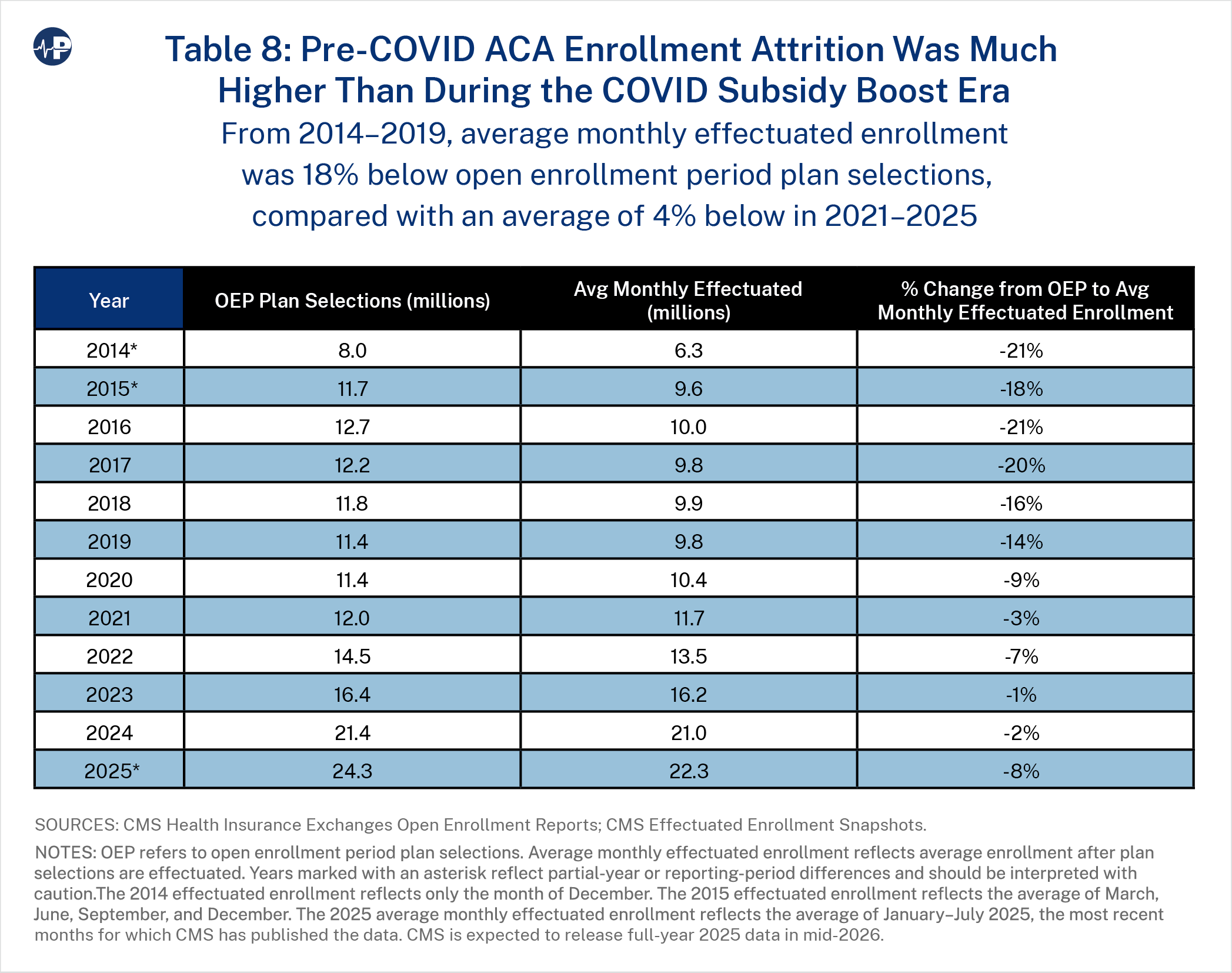
Because of the expiration of the COVID-era subsidy boosts and the buildup of substantial improper and phantom enrollment, enrollment attrition will likely return closer to pre-COVID patterns. Assuming an 18 percent decline from this year’s open enrollment in 2026 would result in average monthly effectuated enrollment of about 19 million people in 2026—an amount still 90 percent higher than the pre-COVID average.
These dynamics suggest that enrollment attrition may be higher in SBE states, where automatic re-enrollment was much more prevalent during the 2026 open enrollment period. The decline will likely be the sharpest in SBE states that did not initiate their own state subsidy programs when the COVID-era subsidy boosts expired.
Bottom Line and Takeaways
Allowing the enhanced COVID-era ACA subsidy boosts to expire was a prudent policy change. The exchanges remain heavily subsidized, particularly for lower-income enrollees, and the underlying ACA subsidy structure continues to provide substantial premium assistance. In HealthCare.gov states, taxpayers still cover roughly 94 percent of premiums for the median subsidized enrollee, while nearly 70 percent of enrollees face monthly premiums below $100. The evidence presented in this report suggests that the exchange market remains saturated with subsidies, particularly for individuals claiming income between 100 and 150 percent FPL.
At the same time, improper enrollment remains a major and persistent problem. We estimate that roughly 27 percent of all exchange enrollment in 2026 consisted of improper sign-ups in the 100–150 percent FPL category. Although the number of improper enrollees declined modestly from 2025 levels, the underlying structure that enabled large-scale abuse remains largely intact. The evidence suggests that both policy design and administrative failures contributed to the current situation. Excessive subsidies and zero-premium plans created unusually strong incentives for improper enrollment, while weak verification systems, permissive enrollment pathways, and insufficient oversight allowed these incentives to be exploited at scale. These problems were substantially more severe in HealthCare.gov states than in long-standing SBEs, strongly suggesting that platform design, enrollment oversight, and intermediary controls materially affect program integrity outcomes.
Once improper or phantom enrollment enters the exchange system, automatic re-enrollment and recurring commissions allow it to persist across multiple plan years with little affirmative consumer involvement. In many cases, consumers may not even realize that they remain enrolled, because re-enrollment can occur automatically through broker-assisted or intermediary-controlled enrollment pathways.
The nature of improper enrollment also evolved in 2026. During the enhanced subsidy period, improper and phantom enrollment was concentrated in fully subsidized silver plans. Following expiration of the enhanced subsidies, much of this enrollment appears to have shifted into bronze and gold plans that remain available at zero premium because of intensified silver-loading. This migration is particularly apparent in HealthCare.gov states, where active re-enrollment rates are much higher and where enrollment intermediaries appear to have actively switched consumers into plans that preserved commission revenue streams. The fact that roughly one-quarter of low-income enrollees in HealthCare.gov states selected non-silver coverage in 2026—despite dramatically inferior cost-sharing protection and little premium difference—is highly inconsistent with normal consumer behavior.
The evidence also suggests that zero-premium plans remain a major driver of improper enrollment and phantom coverage. In 2025, 40 percent of HealthCare.gov sign-ups selected zero-premium plans. That figure declined to 29 percent in 2026 but remains high. We previously estimated that there were between 3 million and 4 million phantom enrollees in 2024, although sufficient data are not yet available to estimate phantom enrollment in 2025. Because phantom enrollment appears strongly associated with zero-premium coverage, the reduction in zero-premium plan availability in 2026 will likely reduce phantom enrollment by about 1 million enrollees in 2026.
Several recent policy changes from the Trump administration and Congress should help improve program integrity over time. Eliminating the heavily abused 100–150 percent FPL SEP will likely reduce opportunities for unauthorized and improper enrollment. And there is currently ongoing litigation on broader reforms in the 2025 Program Integrity Rule. Similarly, provisions in the OBBB requiring more information to receive advance subsidies, greater subsidy reconciliation and repayment of excess subsidies should strengthen incentives for accurate income reporting. However, substantially more reform is still necessary.
Policymakers should establish meaningful minimum premium payments, strengthen verification requirements, require multi-factor authentication, suspend problematic brokers and enrollment entities more aggressively, and impose substantially stronger controls on outsourced enrollment pathways, including EDE platforms, agent-of-record changes, and third-party application submission. Without structural reform, improper enrollment and phantom coverage are likely to remain embedded features of the ACA exchanges—benefitting unscrupulous enrollment intermediaries and insurers—rather than isolated abuses.
Appendix A: Methodology for Estimating Improper Enrollment
The analysis in this paper replicates and extends our prior work comparing observed open enrollment sign-up levels in 2024 and 2025 with independent estimates of the eligible population derived from the Census Bureau’s American Community Survey (ACS).
The central question is the degree to which ACA exchange enrollment in the 100–150 percent FPL income band exceeds the plausible number of individuals who could legitimately be enrolled—indicating improper or fraudulent enrollment. Our analysis focuses on the 100–150 percent FPL group because enrollees in this income range receive the largest subsidies, driving net premiums close to or equal to zero and creating strong incentives for enrollees, unscrupulous brokers, other dishonest insurance intermediaries, and health insurers to misreport income.
Data Sources
The analysis draws on three distinct data sources, each contributing a specific element to the final estimates:
- The 2026 State-Level Open Enrollment Period Public Use File. This data is reported by CMS and details the observed exchange enrollment during the open enrollment period by income band and state. This dataset also supplies the CMS designation of whether the state uses an SBE or the federal exchange hosted by HealthCare.gov.
- 2024 ACS Integrated Public Use Microdata Series (IPUMS) Extract. This dataset utilizes the ACS 1-Year Estimates to derive our population-level eligibility estimates for the 100–150 percent FPL income band. It supplies information on age; poverty level; and Medicaid, Medicare, or other government coverage enrollment by state.
- Census Bureau Annual Estimates of Resident Population. We use the Census Bureau’s NST-EST2025-POP file to adjust the ACS estimates forward one year to match the open enrollment data. We gather the estimates of total population for each state for years 2021, 2024, and 2025.
Preparatory Data Steps
Before conducting the main analysis, we assembled several supporting datasets.
State Exchange Platform Classification
We imported and cleaned the 2026 OEP state-level file (available on the CMS website) to retain one record per state, identifying whether each state uses the federal platform (HealthCare.gov) or an SBE. It is important to note that Georgia and Illinois recently transitioned from using HealthCare.gov to an SBE, which may affect the comparison of 2026 improper enrollment in these states to prior years. When comparing aggregate improper enrollment levels between HealthCare.gov and SBE states, we created a third category for the nine states—Georgia, Illinois, Kentucky, Maine, Nevada, New Jersey, New Mexico, Pennsylvania, and Virginia—that have recently switched from HealthCare.gov to SBEs.
Population Growth Factors
We imported U.S. Census Bureau Annual Estimates of Resident Population and computed a growth factor as:

We used this factor in the 2025 estimates to project the 2024 ACS-derived counts forward by one year. This updates the 2025 numbers from last year’s “Greater Obamacare Enrollment Fraud” report to ensure we present the latest information.
We used a second growth factor, defined below, to obtain 2026 estimates from the 2025 estimates. Because the Census Bureau has not released state-level population estimates for 2026 at the time of publication, we used the state-level average annual growth rate from 2021 to 2025.

Eligibility Estimation from the ACS
ACS Sample Selection
We loaded the raw ACS IPUMS extract and restricted it to the 2024 ACS 1-year sample. Minnesota, New York, and Oregon were excluded from our analysis, because they each operated Basic Health Programs as of January 1, 2025, routing low-income individuals outside the standard exchanges. The District of Columbia was also excluded due to missing income information among the majority of plan selections reported in CMS documentation.
Target Population Definition
We classified an individual as part of the target population if all of the following conditions were met:
- Ages 19–64 (inclusive)
- Not covered by Medicaid (hinscaid = 1 in IPUMS coding, indicating no Medicaid or other government coverage for those with low incomes or disabilities)
- Not covered by Medicare (hinscare = 1 in IPUMS coding, indicating no Medicare coverage)
- Income between 100 percent and 149.9 percent FPL (cbpoverty > 100 and < 150)
Survey person-weights are summed within each state to produce a weighted count of the eligible population.
Medicaid Expansion Adjustment
In states that expanded Medicaid, many adults with incomes between 100 and 138 percent FPL are generally eligible for Medicaid rather than subsidized exchange coverage. To avoid overstating the population plausibly eligible for exchange enrollment, we apply a conservative adjustment in expansion states by reducing the estimated eligible population by 50 percent. This adjustment approximates the share of individuals within the 100–150 percent FPL range who would generally fall below the 138 percent Medicaid eligibility threshold in expansion states. Non-expansion states did not receive this adjustment.
This adjustment, which was also used in our 2024 and 2025 reports, likely overstates exchange eligibility (assuming a uniform income distribution in the 100–150 percent FPL range) and thus produces a conservative estimate of improper enrollment. All counts are rounded to the nearest whole person.
Population Growth Adjustment
Because the 2026 plan year OEP data reflects a population two years more recent than the 2024 ACS, we scaled the Preliminary Eligible Pop count upward before applying the Medicaid expansion adjustment:
Raw Eligible Pop = Preliminary Eligible Pop
× (1 + Growth Factor 2025) × (1 + Growth Factor 2026)
The growth factor is derived from the U.S. Census Bureau NST-EST2025 estimates and is applied at the state level. This adjusted figure then undergoes the same Medicaid expansion halving rule as described above to obtain the final eligible enrollees estimates.
Improper Enrollment Calculation
For each state, the number of improper enrollees is calculated as:
Improper Enrollees = OEP Enrollment (100–150% FPL) – Eligible Enrollees
OEP enrollment is the observed exchange sign-up count from the CMS OEP state-level files and eligible enrollees reflect the ACS-derived estimate described above.
States where this difference is negative (i.e., observed enrollment does not exceed the eligibility estimate) are set to zero, indicating no detectable excess enrollment. Only positive values—where sign-ups exceed the estimated eligible population—are reported as improper enrollment.
We also express improper enrollment as the ratio of observed sign-ups to estimated eligible enrollees, providing a relative measure of improper enrollment intensity by state.
Methodological Notes and Limitations
- Eligibility estimates are conservative. The halving rule applied to Medicaid expansion states (Section 3) produces an upper-bound estimate of exchange eligibility. The share of 100–150 percent FPL residents eligible for exchange coverage in expansion states is likely smaller, because the number of people in the 100–138 percent FPL range likely exceeds the number of people in the 138–150 percent FPL range.
- Population projection for 2026. The 2026 estimates adjust the 2024 ACS counts using state-level population growth factors derived from Census Bureau estimates. This approximation assumes uniform compositional changes within the 100–150 percent FPL group relative to the general population.
- Scope of the improper enrollment measure. The improper enrollee estimates capture any enrollment in excess of the estimated eligible population. This includes fraudulent enrollment by brokers or third parties, administrative errors, income misreporting, and legitimate enrollment by individuals whose circumstances the ACS does not fully capture. The analysis cannot distinguish among these cases.
Appendix B: Methodology for Estimating Improper Spending
To obtain an estimate of the fiscal cost of improper enrollment in the 100–150 percent FPL category, it is necessary to distinguish between enrollees below the income threshold (100 percent FPL) from enrollees above the income threshold (150 percent FPL), as each type of improper enrollee imposes different costs on the federal government.
We estimate that in non-Medicaid-expansion states, two-thirds of improper enrollees (3.42 million people) have income below 100 percent FPL. We assume that the remaining improper enrollees (2.79 million people)—in both Medicaid expansion and non-expansion states—have income above 150 percent FPL. The average subsidy for a 45-year-old with income between 100 and 150 percent FPL is $8,055—this is the cost of improper enrollment for people with income below 100 percent FPL. For people above 150 percent FPL who underestimate their income, we assume an average loss to the taxpayer of $1,800, which is approximately the average difference in subsidy level between the 100–150 percent FPL category and enrollees above 150 percent FPL.
Two additional factors influence the federal costs of improper enrollment. First, subsidy recapture reforms instituted for the 2026 plan year under the OBBB require enrollees above 100 percent FPL who receive subsidies based on incorrect estimated income to reconcile those amounts with their actual year-end earnings and repay any excess subsidies received. We estimate that this recapture rule will affect half of improper enrollees with incomes above 150 percent FPL, while half of enrollees will evade the recapture requirement, possibly failing to file taxes.
Second, because exchange enrollment declines over the course of the year, open enrollment sign-ups overstate average monthly enrollment. Based on historical patterns, we assume that average monthly enrollment in the 100–150 percent FPL category will be 18 percent lower than initial open enrollment sign-ups. Combining this attrition adjustment with the partial-recapture scenario described above, we estimate that improper enrollment will cost approximately $24.7 billion in 2026.
To illustrate the sensitivity of this estimate, the projected cost would decline to $22.0 billion if none of the improper enrollees above 150 percent FPL evade subsidy recapture requirements and attrition reaches 20 percent. Conversely, the estimated cost would increase to $27.7 billion if all improper enrollees above 150 percent FPL evade recapture requirements and attrition is only 15 percent.
Appendix C
Footnotes
1↑ Bill Hammond, "Medicaid Overdose: The Excessive Growth of State-Sponsored Health Coverage in New York," Empire Center for Public Policy, https://www.empirecenter.org/wp-content/uploads/2024/11/Medicaid-Overdose-Empire-Center.pdf
2↑ See Appendix A for methodological details for how we estimated improper enrollment.
3↑ The Congressional Budget Office estimates that the ACA subsidies will be $88 billion in 2026. Phillip L. Swagel et al., "CBO's Baseline Projections of Federal Subsidies for Health Insurance," Congressional Budget Office, May 11, 2026, See Appendix B for more details on the estimates of improper expenditures https://www.cbo.gov/system/files/2026-05/62380-Federal-Health-Subsidies.pdf
4↑ These estimates are slightly higher than the estimates presented in our previous reports because of data updates. See Liam Sigaud, "New Data Shows Obamacare Improper Enrollment Was Higher Than We Originally Estimated," Paragon Health Institute, May1, 2026, https://paragoninstitute.org/paragon-prognosis/new-data-shows-obamacare-improper-enrollment-was-higher-than-we-originally-estimated/
5↑ These were the estimates of improper payments presented in the 2024 and 2025 reports. Re-analysis using updated enrollment and Census Bureau data indicates that improper enrollment in both years was modestly higher than originally estimated, implying that the earlier improper payment estimates likely understated the true fiscal impact.
6↑ Prior to enactment of the OBBB, certain lawfully present noncitizens who were ineligible for Medicaid because of the mandated waiting period could qualify for ACA exchange subsidies even if their income was below 100 percent FPL. Section 71301 of OBBB limited premium tax credits to lawful permanent residents, Cuban and Haitian entrants, and individuals lawfully residing in the United States under Compacts of Free Association. See Brian Blase and Ryan Long, "Immigration and Health Care in the One Big Beautiful Bill: How the New Law Reforms Eligibility for Medicaid, Medicare, and ACA Subsidies," Paragon Health Institute, September 17, 2025, https://paragoninstitute.org/medicaid/immigration-and-health-care-in-the-one-big-beautiful-bill-how-the-new-law-reforms-eligibility-for-medicaid-medicare-and-aca-subsidies/
7↑ Ben Hopkins et al., "How Did Take-Up of Marketplace Plans Vary with Price, Income, and Gender?," American Journal of Health Economics 10, no. 2 (Spring 2024), https://www.journals.uchicago.edu/doi/epdf/10.1086/727785
8↑ Niklas Kleinworth, "Obamacare Enrollment Fraud Deep Dive: New Analysis Estimates Substantial Fraud in Nearly All Florida Counties," Paragon Health Institute, February 6, 2026, https://paragoninstitute.org/paragon-prognosis/obamacare-enrollment-fraud-deep-dive-new-analysis-estimates-substantial-fraud-in-nearly-all-florida-counties/
9↑ Brian Blase, "The Rise of Phantom Obamacare Enrollees: Biden COVID Credits Drive Massive Increase in Individual Market Enrollees with No Medical Claims," Paragon Health Institute, August 13, 2025, https://paragoninstitute.org/paragon-prognosis/the-rise-of-phantom-obamacare-enrollees-biden-covid-credits-drive-massive-increase-in-individual-market-enrollees-with-no-medical-claims/
10↑ These figures represent individuals enrolled at any point during the year, regardless of enrollment duration, because CMS did not publish claims data limited to full-year enrollees.
11↑ Jennifer Tolbert et al., "Key Facts About the Uninsured Population," KFF, April 9, 2026, https://www.kff.org/uninsured/key-facts-about-the-uninsured-population/?entry=executive-summary-introduction
12↑ CMS, "CMS Finds 2.8 Million Americans Potentially Enrolled in Two or More Medicaid/ACA Exchange Plans," press release, July 2025, https://www.cms.gov/newsroom/press-releases/cms-finds-2-8-million-americans-potentially-enrolled-two-or-more-medicaid-aca-exchange-plans
13↑ CMS, "CMS Actions to Protect Consumers and Strengthen Exchange Program Integrity," January 2026, https://www.cms.gov/newsroom/fact-sheets/cms-actions-protect-consumers-strengthen-exchange-program-integrity
14↑ Seto Bagdoyan and John Dicken, "Patient Protection and Affordable Care Act: Preliminary Results from Ongoing Review Suggest Fraud Risks in the Advance Premium Tax Credit Persist," U.S. Government Accountability Office, Letter to the House Committee on Energy and Commerce, House Committee on the Judiciary, and House Committee on Ways and Means, December 3, 2025, https://www.gao.gov/assets/gao-26-108742.pdf
15↑ Zeke Faux and Zachary Mider, "Chasing Big Money with the Health-Care Hustlers of South Florida," Bloomberg, June 5, 2025, https://www.bloomberg.com/features/2025-deepfake-ads-fueled-florida-health-insurance-scheme/
16↑ American Rescue Plan Act of 2021, Pub. L. No. 117-2, ? 9661, 135 Stat. 4 (2021), https://www.congress.gov/bill/117th-congress/house-bill/1319
17↑ Prior to 2026, many lower-income enrollees who received excess subsidies based on underestimated income were subject only to capped repayment obligations when filing their taxes, meaning they often retained a portion of the excess subsidies advanced to insurers on their behalf.
18↑ The variable we use is the percentage of unique consumers who did not attest to a race and either did not attest to being Hispanic/Latino or attested they are not Hispanic/Latino.
19↑ CMS, "Health Insurance Exchanges 2026 Open Enrollment Report," 2026, https://www.cms.gov/files/document/health-insurance-exchanges-2026-open-enrollment-report.pdf
20↑ See Figure 6.
21↑ CMS, "Health Insurance Exchanges 2026 Open Enrollment Report."
22↑ Silver-loading refers to the practice whereby enrollees selecting the lowest-cost or second-lowest-cost silver plan may qualify for zero-premium coverage. Enrollees who selected a silver-plan premium more expensive than the second-lowest-cost plan would face a small premium.
23↑ CMS, "Health Insurance Exchanges 2026 Open Enrollment Report."
24↑ Because ACA premium subsidies are tied to the benchmark second-lowest-cost silver plan, substantial premium differences between silver plans can result in some lower-cost silver plans being available at zero net premium.
25↑ CMS, "Health Insurance Exchanges 2026 Open Enrollment Report."
26↑ Brian Blase and Mark Howell, "New ACA Data?Improper Enrollment Barely Changed While Out-of-Pocket Premiums Remain Very Low," Paragon Health Institute, April 8, 2026, https://paragoninstitute.org/paragon-pic/new-aca-data-improper-enrollment-barely-changed-while-out-of-pocket-premiums-remain-very-low/
27↑ Enrollees who select silver plans on the ACA exchange are eligible for additional subsidies known as CSRs, which are designed to reduce copayments, deductibles, and out-of-pocket limits for individuals with income below 250 percent FPL. The CSRs effectively increase the actuarial value of the plan?raising the actuarial value to 94 percent for enrollees claiming income between 100 and 150 percent FPL, 87 percent for enrollees claiming income between 150 and 200 percent FPL, and 73 percent for enrollees claiming income between 200 and 250 percent FPL. There was not a valid appropriation for CSRs, and federal courts ruled that the Obama administration was making unlawful payments to insurers. Insurers are still required to offer the CSRs despite the lack of federal funding. In response, insurers raised the premiums of silver plans to draw down more ACA premium subsidies that could reimburse them for the loss of the CSR subsidy. By inflating the cost of silver plans, insurers inflated the subsidy that can be applied to any plan. This silver-loading dynamic substantially increased federal premium subsidy spending while also making many bronze and gold plans available at zero or near-zero premiums.
28↑ KFF, "Deductibles in ACA Marketplace Plans, 2014-2026," November 2025, https://www.kff.org/affordable-care-act/deductibles-in-aca-marketplace-plans/
29↑ Covered California, "2026 California Premium Subsidy Program Final Design," July 28, 2025, https://board.coveredca.com/meetings/2025/July%2028,%202025/CoveredCA_2026_Premium_Subsidy_Program_Design_Final.pdf; Access Health CT, "Federal Changes to Health Coverage," https://www.accesshealthct.com/federal-changes-to-health-coverage/; Access Health CT, "Temporary Premium Assistance," https://help.accesshealthct.com/en_US/premium-assistance; BeWell New Mexico, "Federal and State Policy Changes," https://bewellnm.com/answers/federal-changes/
30↑ Massachusetts Health Connector, "ConnectorCare Plans," https://www.mahealthconnector.org/learn/plan-information/connectorcare-plans
31↑ Connect for Health Colorado, "Colorado Premium Assistance," https://connectforhealthco.com/financial-help/colorado-premium-assistance/. Colorado's subsidy structure effectively eliminates out-of-pocket premium obligations for many subsidized enrollees whose post-tax-credit premium falls below the state subsidy cap, including through separate state payments covering the abortion-coverage segregation charge required under federal law. See Colorado Division of Insurance, "Concerning Payments to Carriers Related to Abortion," adopted October 22, 2025, https://doi.colorado.gov/sites/doi/files/documents/Bulletin%20B-4.148%20Abortion%20payments%20PY%202026%20update%20-%20adoption.pdf; Washington Health Benefit Exchange, "Final Plan Year 2026 Cascade Care Savings Policy," 2025, https://www.wahbexchange.org/content/dam/wahbe-assets/materials/communications/policy/2025/FinalDraftPY2026CascadeCareSavingsPolicy.pdf
32↑ Maryland Insurance Administration, "Approved 2026 ACA Individual Market Rate Filing Summary," 2025, https://insurance.maryland.gov/Documents/newscenter/newsreleases/2026-ACA-Approved-Rates-Exhibits.pdf
33↑ Get Covered New Jersey, "2026 Open Enrollment Final Snapshot," 2026, https://www.nj.gov/getcoverednj/help/about/2026openenrollmentupdate/FinalSnapshot.pdf. Eight percent of Get Covered NJ enrollees had premiums of $1 or less in 2026, down from 43 percent in 2025. See New Jersey Department of Banking and Insurance, "FY 2026 Budget Response," 2025, https://pub.njleg.state.nj.us/publications/budget/governors-budget/2026/dobi_response_2026.pdf
34↑ Vermont Health Connect, "Financial Help," Vermont Premium Assistance reduces the household monthly insurance bill by 1.5 percent of household income. See also 33 V.S.A. ? 1812 https://info.healthconnect.vermont.gov/financial-help
35↑ See footnote 24.
36↑ Brian Blase et al., "Public Comment: Patient Protection and Affordable Care Act, HHS Notice of Benefit and Payment Parameters for 2027; and Basic Health (CMS-9883-P)," Paragon Health Institute, March 16, 2026, https://paragoninstitute.org/private-health/public-comment-patient-protection-and-affordable-care-act-hhs-notice-of-benefit-and-payment-parameters-for-2027-and-basic-health-cms-9883-p/
37↑ Gabrielle Kalisz, "Victims of Biden's Enrollment-at-Any-Cost Exchange Strategy," Paragon Health Institute, July 18, 2025, https://paragoninstitute.org/paragon-prognosis/victims-of-bidens-enrollment-at-any-cost-exchange-strategy/
38↑ DOJ, "National Partnership of Insurance Brokers and Its Former Subsidiary Agree to Pay Over $135 Million for Affordable Care Act Enrollment Fraud Scheme," press release, April 7, 2026, https://www.justice.gov/opa/pr/national-partnership-insurance-brokers-and-its-former-subsidiary-agree-pay-over-135-million
39↑ DOJ, "Executive Vice President of Insurance Brokerage Pleads Guilty in $133M Affordable Care Act Fraud Scheme," press release, April 18, 2025, https://www.justice.gov/opa/pr/executive-vice-president-insurance-brokerage-pleads-guilty-133m-affordable-care-act-fraud
40↑ Niklas Kleinworth, "Obamacare Enrollment Fraud Deep Dive: New Analysis Estimates Substantial Fraud in Nearly All Florida Counties," Paragon Health Institute, February 6, 2026, https://paragoninstitute.org/paragon-prognosis/obamacare-enrollment-fraud-deep-dive-new-analysis-estimates-substantial-fraud-in-nearly-all-florida-counties/
41↑ CMS, "Health Insurance Exchanges 2026 Open Enrollment Report."
42↑ In 2026, 30 states (27 federally facilitated exchange states plus three SBEs that use the federal platform, known as SBE-FP) used HealthCare.gov. The remaining 21 states and Washington, DC, run full independent SBEs.
43↑ Figure 7 was created by Paragon Health Institute Visiting Fellow, Eric Sun.
44↑ State Marketplace Network, "State-Based Marketplaces: Effective Strategies to Ensure Accountability and Mitigate Fraud," April 2026, https://eadn-wc02-12144036.nxedge.io/wp-content/uploads/2026/04/SBM-Strategies-to-Ensure-Accountability-and-Mitigate-Fraud.pdf
45↑ EDEs are not currently permitted to operate or integrate with SBEs.
46↑ Brian Blase et al., "CMS Request for Information (RFI) Related to Comprehensive Regulations to Uncover Suspicious Healthcare (CRUSH) RIN 0938-AV97," Paragon Health Institute, letter to CMS Administrator Mehmet Oz, March 30, 2026, https://paragoninstitute.org/wp-content/uploads/securepdfs/2026/03/Paragon_Health_Institute_CMS_CRUSH_Fraud_RFI_20260330_RELEASE_V1.pdf
47↑ George Kalogeropoulos, CEO, HealthSherpa, "Patient Protection and Affordable Care Act; HHS Notice of Benefit and Payment Parameters for 2025," letter to CMS, January 8, 2024, https://downloads.regulations.gov/CMS-2023-0191-0205/attachment_1.pdf
48↑ In 2024, 19 states were full SBEs and 3 states were SBE-FP (Arkansas, Oregon, and Georgia).
49↑ Blase et al., "Public Comment."
50↑ Andrew Sprung, "Quelling Agent Fraud in the ACA Marketplace: Security vs. Ease of Enrollment," xpostfactoid, Substack, June 3, 2024, https://xpostfactoid.substack.com/p/quelling-agent-fraud-in-the-aca-marketplace
51↑ Andrew Sprung, "CSR Forsaken: Long-Term Trends and 2026 Changes in the ACA Marketplace," xpostfactoid, Substack, April 6, 2026, https://xpostfactoid.substack.com/p/csr-forsaken-long-term-trends-and
52↑ Sprung, "CSR Forsaken."
53↑ Sprung, "CSR Forsaken."
54↑ Brian Blase, "Testimony of Brian Blase before the House Committee on the Judiciary?'Fighting Obamacare Subsidy Fraud: Is the Administrative Procedure Act Working as Intended?,'" Paragon Health Institute, December 10, 2025, https://paragoninstitute.org/private-health/testimony-of-brian-blase-before-the-house-committee-on-the-judiciary-fighting-obamacare-subsidy-fraud-is-the-administrative-procedure-act-working-as-intended/
55↑ "Patient Protection and Affordable Care Act: Preliminary Results from Ongoing Review Suggest Fraud Risks in the Advance Premium Tax Credit Persist," Government Accountability Office, December 3, 2025, Report no. GAO-26-108742, https://www.gao.gov/products/gao-26-108742
56↑ Blase et al., "CMS Request for Information."
57↑ CMS, "Notice of Final Determination of Noncompliance and Denial of Right to Enter into Future Exchange Agreements," November 24, 2025, https://www.cms.gov/files/document/speridian-notice-final-determination.pdf
58↑ The ACA's three-month grace period for subsidized enrollees can allow inactive or nonpaying coverage to remain on exchange rolls for extended periods, contributing to phantom enrollment and inflated enrollment totals.
59↑ In September 2021, the Biden administration implemented a new special enrollment period (SEP) for those between 100 and 150 percent FPL. This new SEP allowed those in this income category to enroll in subsidized health coverage on an ACA exchange without having to wait until the start of the next open enrollment period?allowing these enrollees to enter coverage at any point in the year. It was an optional policy for SBE states. When coupled with COVID-era subsidies that created $0 premium plans for this population, this left virtually no market or regulatory barriers to fraudulent enrollment. This SEP was temporarily suspended by rule through the end of 2026. The OBBB ended subsidies for any enrollee using this SEP without another qualifying life event, such as moving or having a baby.
Author





Acknowledgements
The authors are grateful to Doug Badger, John R. Graham, Chris Medrano, Chris Pope, and the Paragon team for their exceptional comments and work in review of the paper.