



In a recent analysis, Paragon estimates fraudulent enrollment among Affordable Care Act (ACA) health insurance exchange plans, broken down to the county level in the state of Florida. This analysis builds on two prior studies featured in our paper, The Great Obamacare Enrollment Fraud (2024), and a follow-up report, The Greater Obamacare Enrollment Fraud: The Fraud Got Much Worse in 2025. Both reports detail the severity of fraudulent enrollment enabled by weak program integrity in the ACA exchanges and catalyzed by the temporary Biden COVID credits.
Across this series of reports, we document how projected national ACA enrollment fraud increased from an estimated 5.0 million enrollees to 6.4 million between plan years 2024 and 2025. This fraudulent enrollment translates to a $27 billion cost to taxpayers in 2025 alone. Among all states, Florida represented the most egregious example of fraud, making it ripe for further investigation.
Researchers and public officials have consistently identified Florida the worst example of ACA enrollment fraud through various schemes. Evidence suggests that many individuals misrepresented their income to qualify for larger ACA subsidies, particularly in South Florida. Others responded to advertisements promising cash giveaways but were instead enrolled in ACA plans without their knowledge. In one high-profile case, two CEOs of a Florida insurance marketing company were indicted for stealing more than $160 million in ACA subsidies.
While our earlier work examined fraudulent enrollment primarily at the state level, this analysis evaluates enrollment at a more granular county level within Florida. This document describes our methodology and addresses key considerations underlying our estimates.
Overview of Methodology
We estimate potential ACA marketplace enrollment fraud in Florida by comparing Public Use Microdata Area (PUMA)–level American Community Survey (ACS) one-year estimates with Open Enrollment Period Public Use File (PUF) data on ACA exchange enrollment. Both datasets are restricted to individuals reporting incomes between 100 and 150 percent of the federal poverty level (FPL). ACS data are further limited to individuals between the ages of 19 and 64 and exclude those covered by Medicare or Medicaid.
Because PUMAs do not align cleanly with county boundaries, we allocate eligible populations using an official crosswalk tool provided by the U.S. Census Bureau. This method distributes individuals based on the geographic share of each PUMA that falls within county borders. County totals are then projected forward one year using official Census population growth estimates to approximate the eligible population for the 2025 plan year. These steps yield a county-level estimate of the number of residents reasonably eligible for marketplace coverage.
We then compare these eligibility estimates with actual marketplace enrollment among individuals between 100 and 150 percent FPL. Counties where enrollment exceeds the number of potentially eligible residents are flagged for improper or fraudulent enrollment.
Using Data from Open Enrollment Period Public Use Files
The Centers for Medicare and Medicaid Services provide county-level data on enrollments in ACA plans through both state-based exchanges and HealthCare.gov. Our analysis uses the most recent published data available for plan year 2025.
Scope of Sample
Our sample includes PUF-reported enrollment among individuals between 100 and 150 percent FPL. It excludes those with other minimum essential coverage offered through Medicaid, Medicare, or the Children’s Health Insurance Program (CHIP). With few exceptions, children are excluded because those in households below 200 percent FPL qualify for CHIP in Florida. These children are generally ineligible for ACA subsidies and unlikely to enroll in unsubsidized marketplace coverage at this income band.
Addressing Effectuated Enrollment
The PUF reports pre-effectuated enrollment, defined as individuals who select an exchange plan but have not yet paid their first monthly premium. Some critics argue this measure overstates actual enrollment relative to ACS estimates. However, two factors substantially mitigate this concern.
First, our sample focuses exclusively on individuals between 100 and 150 percent FPL, for whom the temporary Biden-era COVID credits created fully-subsidized plans, specifically $0 premiums for plans with extremely low deductibles, cost-sharing, and out-of-pocket limits. For many enrollees, these $0 premium plans effectively make coverage automatic since there is no enrollee contribution necessary for effectuation. This significantly reduces the likelihood of attrition prior to the first premium payment.
Second, the overall loss from non-effectuation is modest. Comparing effectuated enrollment as of February 2025 with PUF enrollment in Florida shows a decline of just over 170,000 enrollees—approximately 3.6 percent of total reported enrollment. Examining enrollment across the full plan year yields a similar result, with about 49,000 fewer average annual effectuated enrollees compared with open enrollment sign-ups in 2024. Moreover, because our analysis focuses on a narrower, heavily subsidized population, significant attrition in our sample is even less likely.
Using ACS One-Year Estimates
The American Community Survey one-year microdata sample is the nation’s most comprehensive household survey, sampling roughly three million households annually. We use the most recent available ACS sample from 2024 and adjust county-level populations using three-year growth trends to align the estimates with 2025 PUF data. This approach is standard practice in empirical policy analysis.
Our analysis does not adjust for short-term income volatility within this population. Although individuals between 100 and 150 percent FPL may experience more income fluctuations, we assume these changes are roughly symmetric over time. This assumption is reasonable since, on average, income for this population is just as likely to move above or below the threshold.
Estimating Fraudulent Enrollment
The FPL measure reported in the ACS differs somewhat from the FPL calculations used to determine tax credit eligibility in ACA exchanges. Accordingly, our results should be interpreted as estimates of explicit fraud rather than precise counts.
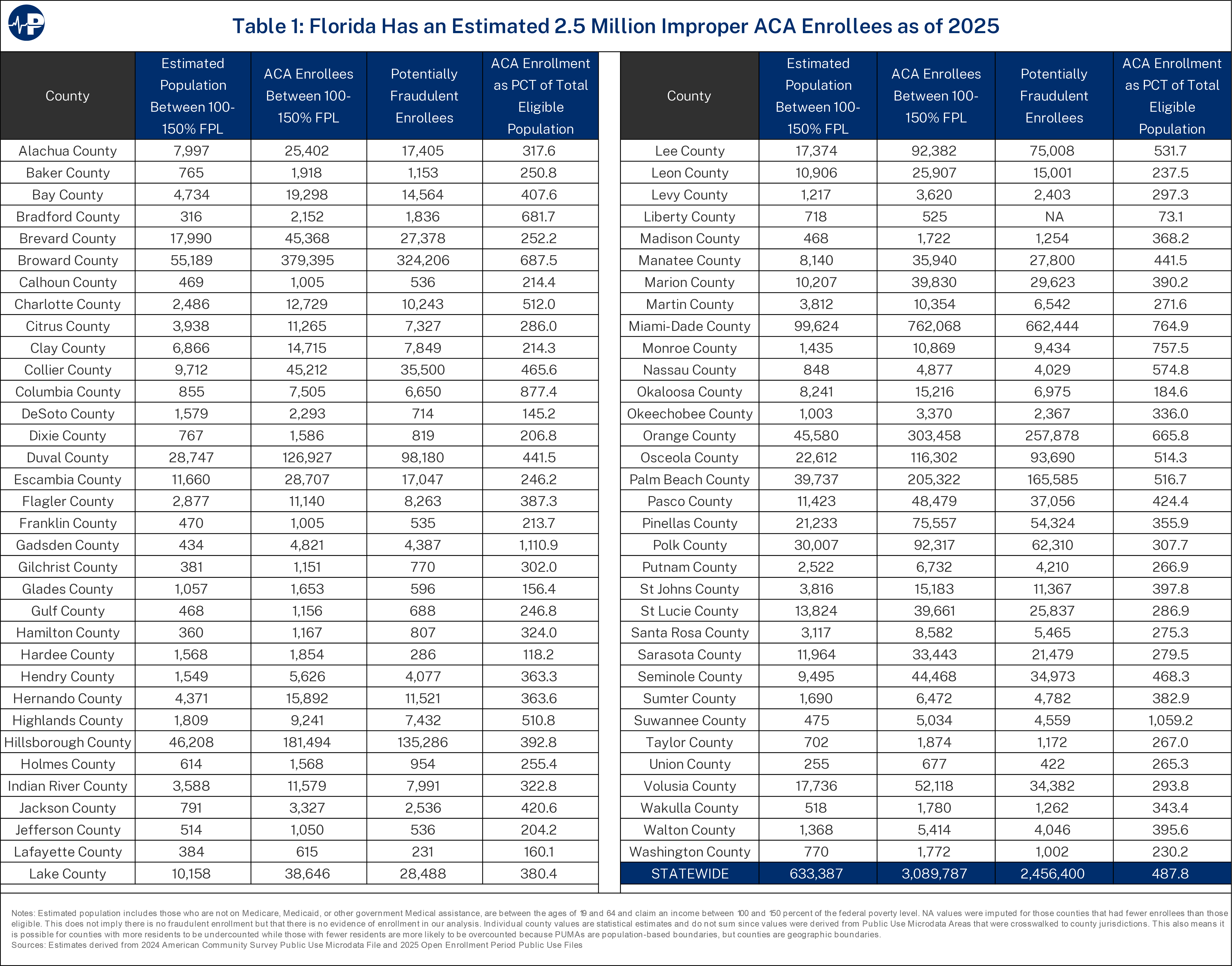
Our analysis identifies counties where ACA enrollment of individuals between 100 and 150 percent FPL substantially exceeds the number of individuals plausibly eligible according to ACS data. Explaining these gaps through legitimate enrollment alone would require the implausible assumption that every eligible resident enrolled in marketplace coverage, with additional enrollment largely driven by technical differences in tax filing rules. Such variations cannot explain Florida’s wide divergence between those eligible, even according to ACS data, and those enrolled. Our methodology was also referenced and corroborated in a CMS proposed rule in 2025.
Results
Our findings indicate that ACA enrollment exceeds the total eligible population in nearly all Florida counties. In some cases, enrollment exceeds eligibility by more than eleven times. Only one county, Liberty County, experienced enrollment below the estimated eligible population. While enrollment below eligibility does not preclude fraud, it suggests no explicit fraud detectable under our methodology. Counties with the most egregious examples of estimated fraud include Bradford, Broward, Columbia, Gadsden, Miami-Dade, Monroe, Orange, and Suwannee (see Figure 1). In the table, we detail our estimates for all Florida counties.

Florida is the nation’s hotbed of fraudulent ACA enrollment, driven through various schemes. Fueled in part by temporary Biden-era COVID subsidies that fully-subsidized plans, this fraud carries significant human and fiscal costs. In many cases, consumers are unknowingly enrolled in coverage they did not request, while taxpayers shoulder the expense of sustaining these abuses. Paragon’s county-level estimates of this fraud demonstrates that these problems are not isolated to one part of the state. Rather, they are a systemic, statewide issue impacting millions of Floridians.
