
Paragon Health Institute Icon White
Paragon Pic

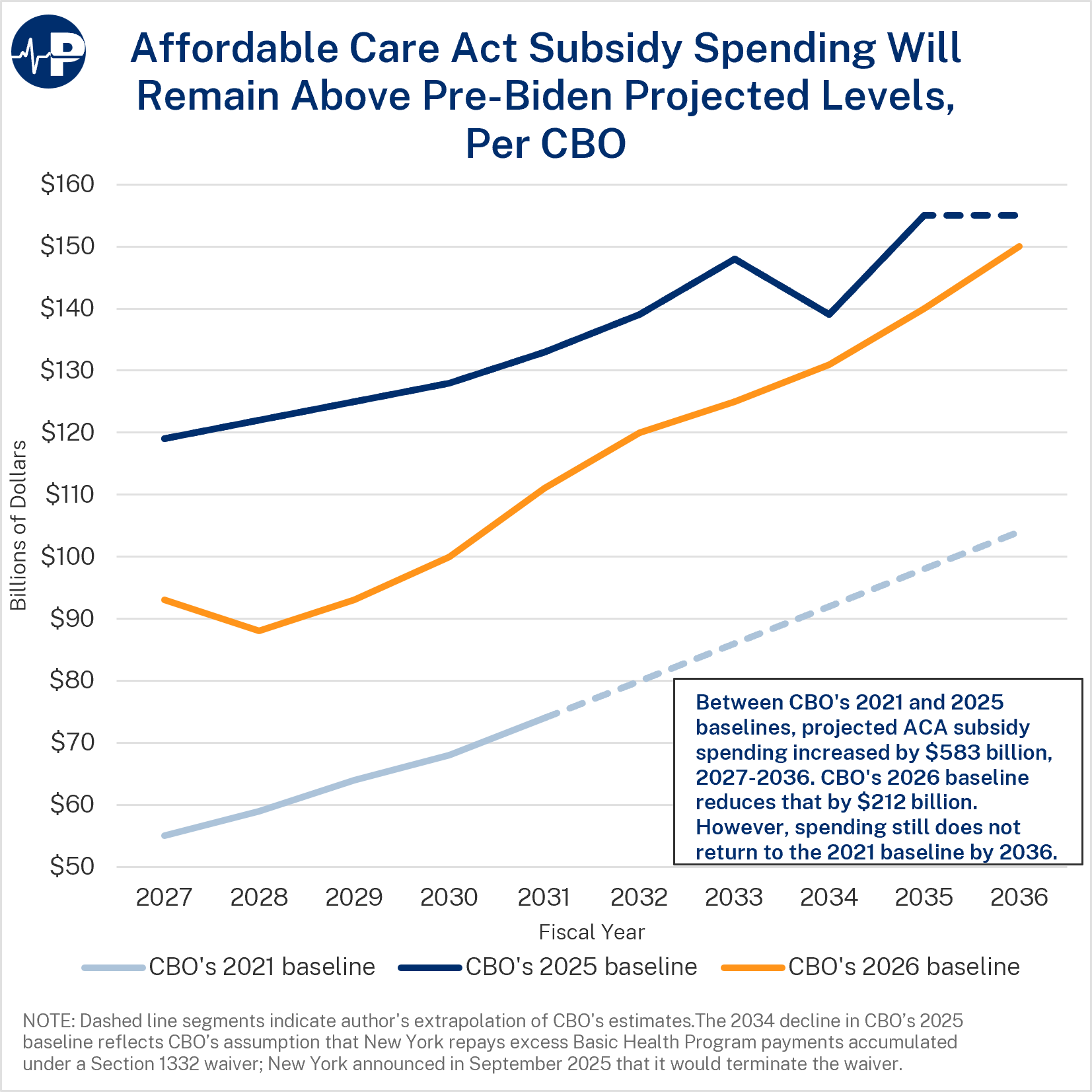
Affordable Care Act Subsidy Spending Will Remain Above Pre-Biden Projected Levels, Per CBO

3MH ACA Spending 64 Percent Higher Tha COVID A0wUU000005SJeLYAW
Click the Pic to expand the image
John Graham Headshot 2 SMALLER Thumbnail

John R. Graham is a Visiting Fellow who contributes nearly three decades of health policy expertise to research across all of Paragon’s initiatives. He worked on Capitol Hill from 2021 to 2024 as a Professional Staff Member on the Senate Special Committee on Aging and the House Committee on Ways & Means. From 2018 to 2021, he served as the U.S. Department of Health & Human Services (HHS) Regional Director for Region 10 (Washington State, Oregon, Idaho, and Alaska), where he managed relationships with state governments and the private sector. In 2017-2018, John was the HHS Acting Assistant Secretary for Planning & Evaluation.

CBO’s most recent estimates show that federal spending on Obamacare subsidies will remain well above pre-pandemic estimates. The One Big Beautiful Bill made important changes to improve the integrity of the exchanges.

This is especially important given the massive extent of improper enrollment in the exchanges. The CBO’s 2026 baseline projection reduces the rate of growth of Obamacare spending by $212 billion over ten years, 2027 to 2036, versus the baseline projection published in 2025. However, the 2025 baseline for the same period jumped by $583 billion from the 2021 baseline.

The main driver of the Biden spending increase was a set of administration policies that prioritized increasing Obamacare enrollment at any cost along with an expansion of subsidies as a COVID-era boost. These policies weakened program integrity measures, stopped income verification for many enrollees, and essentially opened a year-round enrollment period—and created large incentives for enrollees, brokers, and insurers to misstate applicant income to maximize subsidies. Paragon estimates that 6.2 million people were improperly enrolled in Obamacare in 2026.

(The 2021 baseline stops in 2031; and the 2025 baseline stops in 2035.  Those baselines are extrapolated through 2036 using common-sense assumptions, as indicated by the dotted line in the figure.)


3MH ACA Spending 64 Percent Higher Tha COVID A0wUU000005SJeLYAW

CBO’s most recent estimates show that federal spending on Obamacare subsidies will remain well above pre-pandemic estimates. The One Big Beautiful Bill made important changes to improve the integrity of the exchanges.

This is especially important given the massive extent of improper enrollment in the exchanges. The CBO’s 2026 baseline projection reduces the rate of growth of Obamacare spending by $212 billion over ten years, 2027 to 2036, versus the baseline projection published in 2025. However, the 2025 baseline for the same period jumped by $583 billion from the 2021 baseline.

The main driver of the Biden spending increase was a set of administration policies that prioritized increasing Obamacare enrollment at any cost along with an expansion of subsidies as a COVID-era boost. These policies weakened program integrity measures, stopped income verification for many enrollees, and essentially opened a year-round enrollment period—and created large incentives for enrollees, brokers, and insurers to misstate applicant income to maximize subsidies. Paragon estimates that 6.2 million people were improperly enrolled in Obamacare in 2026.

(The 2021 baseline stops in 2031; and the 2025 baseline stops in 2035.  Those baselines are extrapolated through 2036 using common-sense assumptions, as indicated by the dotted line in the figure.)
Related Research

No results found.
John Graham Headshot 2 SMALLER Thumbnail

John R. Graham is a Visiting Fellow who contributes nearly three decades of health policy expertise to research across all of Paragon’s initiatives. He worked on Capitol Hill from 2021 to 2024 as a Professional Staff Member on the Senate Special Committee on Aging and the House Committee on Ways & Means. From 2018 to 2021, he served as the U.S. Department of Health & Human Services (HHS) Regional Director for Region 10 (Washington State, Oregon, Idaho, and Alaska), where he managed relationships with state governments and the private sector. In 2017-2018, John was the HHS Acting Assistant Secretary for Planning & Evaluation.