Most Americans who are not enrolled in Medicare or Medicaid receive health insurance through their employers or those of their spouses or parents. These workers pay for that coverage. Although commonly called the employer’s share of the premium, that amount simply represents wages the employee forgoes. Because premiums are excluded from income and payroll taxes, employees face a lower tax burden than if the same compensation were paid in wages. This is an untaxed earned benefit.
By contrast, the vast majority of people who receive coverage on the exchanges established under the Affordable Care Act (ACA) bear little, if any, of the cost. In effect, the ACA exchanges function as welfare—an unearned benefit provided by federal taxpayers.
The ACA created premium subsidies that limit the amount of income households must pay for health insurance on the ACA exchanges. The subsidies are structured to be much more favorable for Americans nearing retirement than for younger Americans. In 2021 and 2022, without any Republican support, Democrats expanded those subsidies—the so-called Biden COVID credits—and lifted the cap that had originally limited ACA subsidies to households earning less than four times the federal poverty level (FPL). Congressional Democrats set the COVID credits to expire at the end of 2025. As a result of that subsidy expansion, in 2024, federal taxpayers covered 83 percent of the revenue insurers collected for exchange plans and 87 percent in states using the federal exchange. Moreover, roughly half of all enrollees were enrolled in fully subsidized plans that did not require enrollees to pay any portion of the premium.
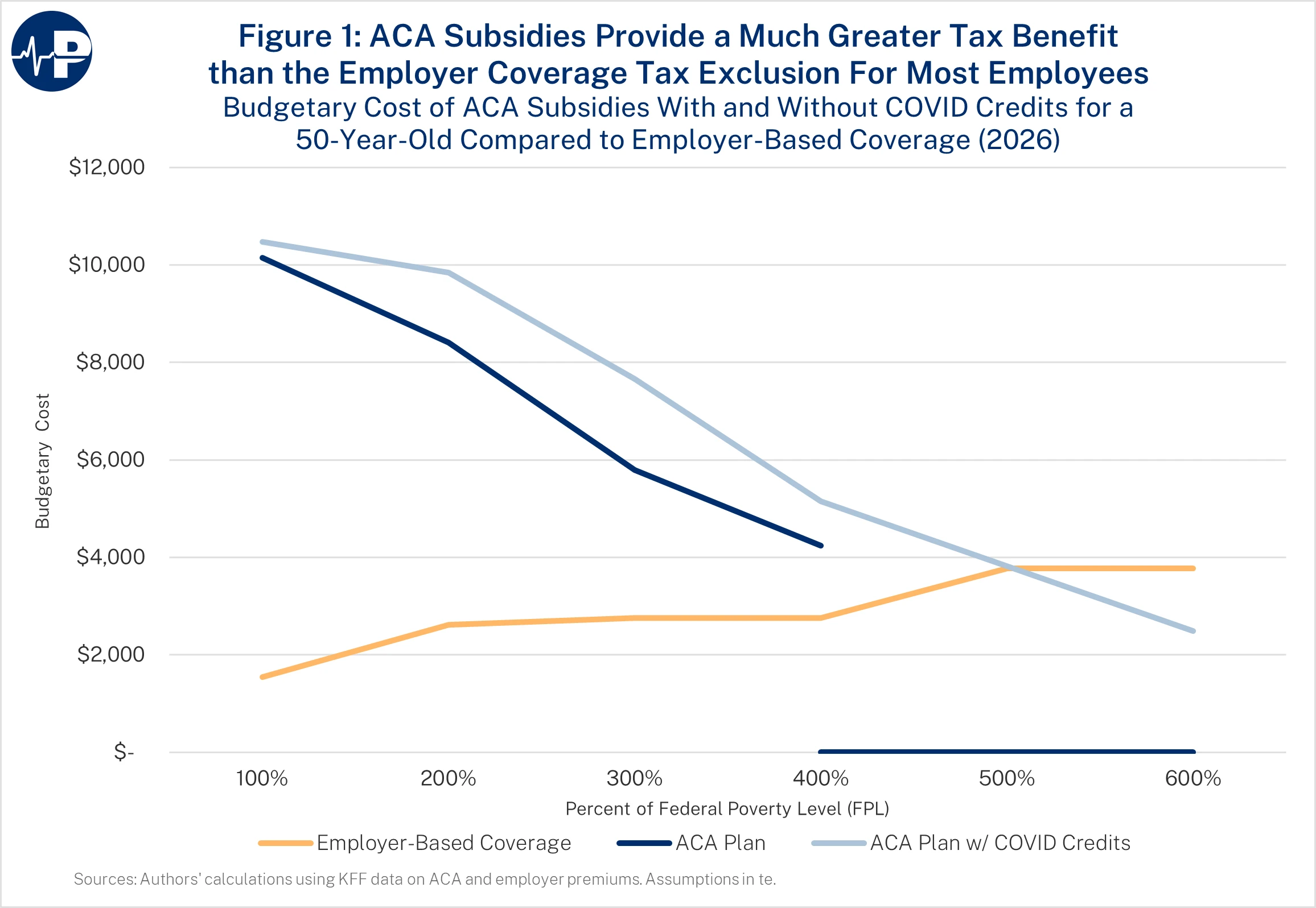
As a result, two workers creating equal value for an employer receive dramatically different after-tax compensation depending on whether their employer offers coverage. If one worker receives employer coverage and earns a low or middle income, he is worse off, because part of his compensation must go toward that coverage. If he does not receive employer coverage, he generally qualifies for large premium subsidies—particularly after the Biden pandemic-era subsidy expansion—and will in most cases be much better off economically. Thus, the worker without employer coverage ends up with higher wages and greater federal health insurance benefits.
The authors of the ACA needed to build on employer-based health benefits—a characteristic of the American workplace since around World War II—for political and policy reasons. In an attempt to expand coverage with the lowest possible budgetary cost, the ACA included an employer mandate and barred people with offers of “affordable” employer plans from premium subsidy eligibility. Under the mandate, employers with 50 or more workers have to offer “affordable” coverage to at least 95 percent of their full-time employees (those who work for at least 30 hours a week) or suffer significant fines. The ACA defines <em>affordable</em> as no more than 9.5 percent of an employee’s household income.
Of note, the Biden administration expanded eligibility for subsidies in the so-called “family glitch” fix by—with questionable legal authority—redefining affordability based on the cost of family coverage, not single coverage. By doing this, employers have less incentive to offer “affordable” dependent coverage, which means that more dependents will lose employer coverage and be shifted to the exchanges unless the Trump administration returns to the policy that prevailed in the Obama administration and first Trump administration.
The employer mandate penalty was necessary because the ACA’s subsidy design discriminates against low- and middle-income workers offered employer-provided health benefits. Without government coercion to continue offering health benefits under threat of severe penalty, many employers would have stopped offering coverage, leading their workers to enroll in exchange plans at significant additional cost to taxpayers.
Despite the ACA’s employer mandate, some anticipated a reduction in employer-based insurance offerings because of the exchanges and corresponding subsidies. The Congressional Budget Office (CBO) forecast that about 3 million fewer people would have employer-based plans in 2019, five years after the ACA exchanges launched—a reduction of about 2 percent. But some surveys of employers forecast a different result. A McKinsey and Company survey in 2011 attracted the most attention, finding that 30 percent of employers would “definitely” or “probably” stop offering health coverage under the new law. Among employers with a high awareness of the reform, the proportion choosing to drop coverage increased to 50 percent.
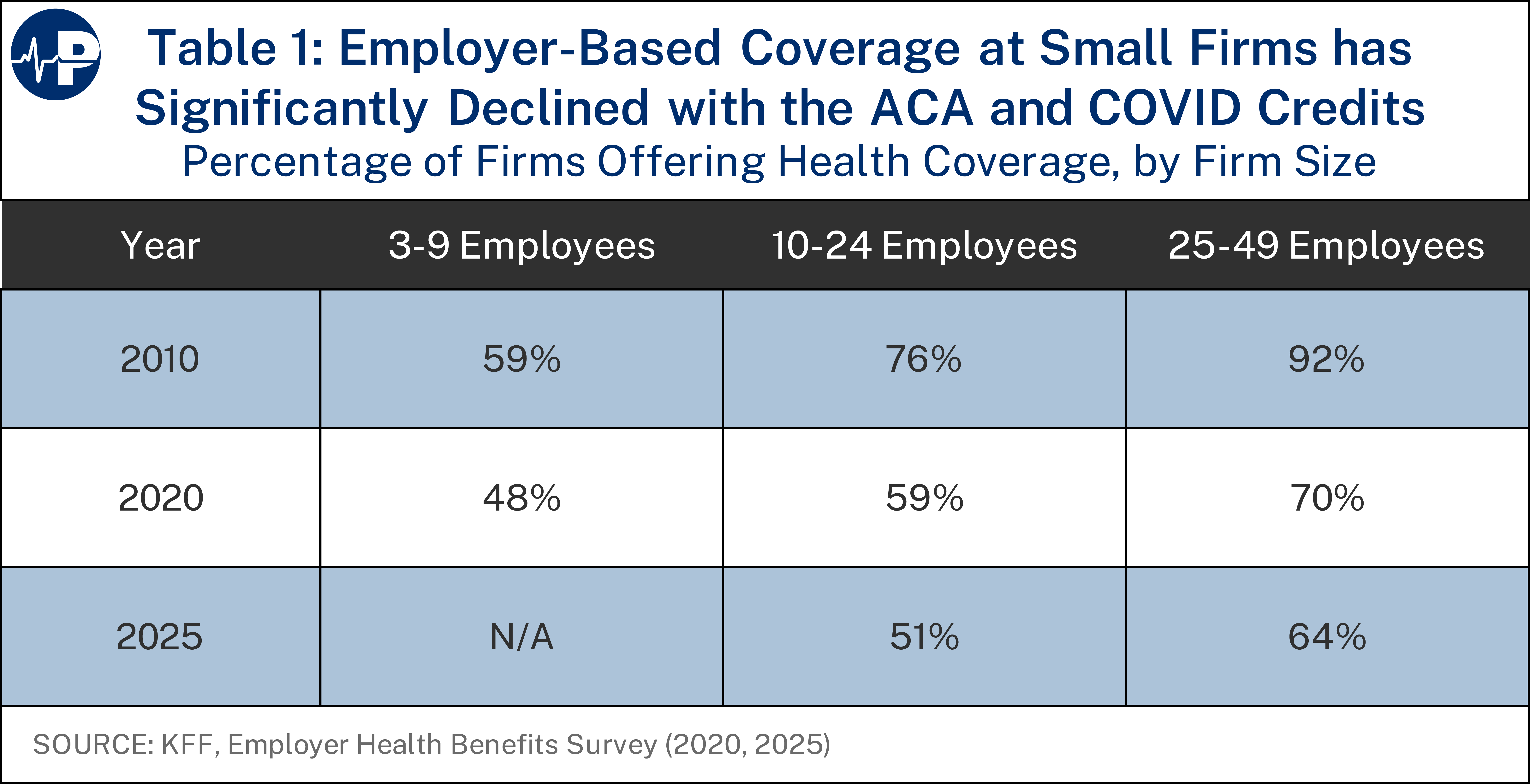
Although a large drop in employer-based coverage has not occurred, coverage has declined significantly at small firms. Exchange coverage was widely viewed as unattractive for employees, and few large employers altered their offerings because of the law. Because small businesses are exempt from the employer mandate, some dropped coverage after the ACA passed. As shown in Table 1, in 2010, 76 percent of firms with 10-24 employees and 92 percent of firms with 25-49 employees offered health insurance. By 2020 (the last year before the COVID credits), those numbers had dropped to 59 percent and 70 percent. By 2025, those numbers had fallen further—to 51 percent and 64 percent, respectively. There was also attrition in offerings at firms with three to nine employees from 59 percent to 48 percent from 2010 to 2020 (although this percentage was not reported for 2025). Small businesses are also more likely to drop coverage because administrative costs per employee for managing health benefits are higher at small firms than large ones.