Paragon Health Institute Icon White
Paragon Pic

Insurer Revenues from ACA Premiums Were 87% Taxpayer-Funded in 2024: Ten Percentage Points Higher Than Pre-COVID Credits

9NK Government Revenues For ACA Insurers A0wUU000004fFyTYAU
Click the Pic to expand the image
Niklas Kleinworth Headshot SMALLER V2
Director, State Health Reform Initiative; and Policy Analyst

Niklas Kleinworth is the Director of the State Health Reform Initiative and a Policy Analyst at the Paragon Health Institute, focusing on Medicaid and state policy initiatives. He has served in state and federal policy roles since 2021.

Brian Blase
President at Paragon Health Institute

Brian Blase, Ph.D., is the President of Paragon Health Institute. Brian was Special Assistant to the President for Economic Policy at the White House’s National Economic Council (NEC) from 2017-2019, where he coordinated the development and execution of numerous health policies and advised the President, NEC director, and senior officials. After leaving the White House, Brian founded Blase Policy Strategies and served as its CEO.

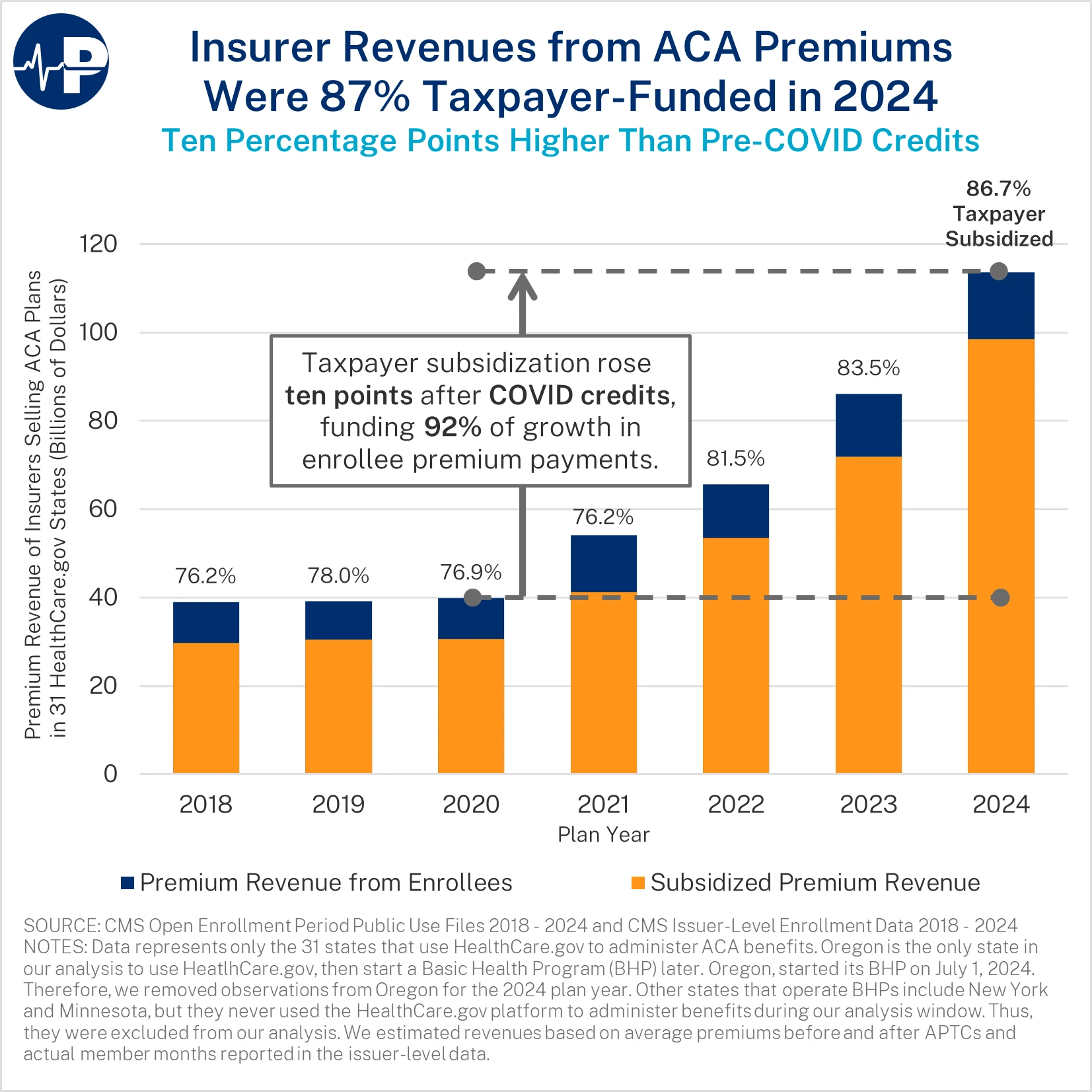
The Affordable Care Act (ACA) transformed the individual market from an unsubsidized market into a heavily subsidized one, and Biden’s COVID credits expanded this subsidization significantly. In 2024, 87 percent of the revenue made by insurers selling ACA exchange plans in the 31 states that utilize the federal exchange, HealthCare.gov, came from federal taxpayers. This is a ten-percentage point jump in the taxpayer-financed share of premium revenue since before the pandemic. Taxpayers bore 92 percent of the increased cost of ACA plans from 2020 to 2024.

This Paragon Pic shows premium revenue collected by the insurers from enrollees and from federal taxpayers. The percentage at the top of the bar shows the percentage of revenue that is subsidized.

Previous work from Paragon reveals that much of the ACA enrollment growth is from heavily subsidized enrollees, many of whom are improperly enrolled. Paragon estimated that at least 5.0 million ineligible enrollees in 2024 on fully subsidized plans — a number which grew to 6.4 million in 2025. Zero-dollar plans make it possible for fraudsters to enroll people in the ACA without their knowledge, then pocket commissions while insurers collect higher revenues. Recent data shows massive growth in zero-claim enrollees, with 35 percent of all enrollees not making a claim in the period when they were enrolled, and an even higher percentage of fully subsidized enrollees never using their plan.

A higher portion of the premium is paid by taxpayers in federal exchange states because all the non-Medicaid expansion states are federal exchange states. In those states, enrollees between 100 and 150 percent of the federal poverty level (FPL) receive fully-subsidized plans versus just 138 to 150 percent FPL in expansion states. Looking at all states, the percentage of insurers’ ACA premium revenue deriving from federal taxpayers increased from 73 percent in 2021 to 83 percent in 2024—a ten-percentage point increase. The data include enrollees who do not receive any subsidy, as this provides a more complete picture of the extent of this subsidization. For perspective, a 50-year-old at 200 percent of the federal poverty level, which is higher income than for the median enrollee, receives a subsidy that covers at least 90 percent of their premium because of the COVID credits.
9NK Government Revenues For ACA Insurers A0wUU000004fFyTYAU

The Affordable Care Act (ACA) transformed the individual market from an unsubsidized market into a heavily subsidized one, and Biden’s COVID credits expanded this subsidization significantly. In 2024, 87 percent of the revenue made by insurers selling ACA exchange plans in the 31 states that utilize the federal exchange, HealthCare.gov, came from federal taxpayers. This is a ten-percentage point jump in the taxpayer-financed share of premium revenue since before the pandemic. Taxpayers bore 92 percent of the increased cost of ACA plans from 2020 to 2024.

This Paragon Pic shows premium revenue collected by the insurers from enrollees and from federal taxpayers. The percentage at the top of the bar shows the percentage of revenue that is subsidized.

Previous work from Paragon reveals that much of the ACA enrollment growth is from heavily subsidized enrollees, many of whom are improperly enrolled. Paragon estimated that at least 5.0 million ineligible enrollees in 2024 on fully subsidized plans — a number which grew to 6.4 million in 2025. Zero-dollar plans make it possible for fraudsters to enroll people in the ACA without their knowledge, then pocket commissions while insurers collect higher revenues. Recent data shows massive growth in zero-claim enrollees, with 35 percent of all enrollees not making a claim in the period when they were enrolled, and an even higher percentage of fully subsidized enrollees never using their plan.

A higher portion of the premium is paid by taxpayers in federal exchange states because all the non-Medicaid expansion states are federal exchange states. In those states, enrollees between 100 and 150 percent of the federal poverty level (FPL) receive fully-subsidized plans versus just 138 to 150 percent FPL in expansion states. Looking at all states, the percentage of insurers’ ACA premium revenue deriving from federal taxpayers increased from 73 percent in 2021 to 83 percent in 2024—a ten-percentage point increase. The data include enrollees who do not receive any subsidy, as this provides a more complete picture of the extent of this subsidization. For perspective, a 50-year-old at 200 percent of the federal poverty level, which is higher income than for the median enrollee, receives a subsidy that covers at least 90 percent of their premium because of the COVID credits.

Related Research

No results found.
Niklas Kleinworth Headshot SMALLER V2
Director, State Health Reform Initiative; and Policy Analyst

Niklas Kleinworth is the Director of the State Health Reform Initiative and a Policy Analyst at the Paragon Health Institute, focusing on Medicaid and state policy initiatives. He has served in state and federal policy roles since 2021.

Brian Blase
President at Paragon Health Institute

Brian Blase, Ph.D., is the President of Paragon Health Institute. Brian was Special Assistant to the President for Economic Policy at the White House’s National Economic Council (NEC) from 2017-2019, where he coordinated the development and execution of numerous health policies and advised the President, NEC director, and senior officials. After leaving the White House, Brian founded Blase Policy Strategies and served as its CEO.