


Brian Blase, Ph.D., is the President of Paragon Health Institute. Brian was Special Assistant to the President for Economic Policy at the White House’s National Economic Council (NEC) from 2017-2019, where he coordinated the development and execution of numerous health policies and advised the President, NEC director, and senior officials. After leaving the White House, Brian founded Blase Policy Strategies and served as its CEO.
Biden’s COVID Credits Are an ObamaCare Expansion That Congress Should Allow To Expire

Key Findings
- Taxpayers pay the vast majority of ObamaCare plan premiums and will continue to do so when Biden’s COVID credits expire.
- Biden’s COVID credits vastly expanded ObamaCare subsidies—supersizing taxpayer payments to insurers.
- Those COVID credits led to an explosion in fraudulent spending.
- Extending Biden’s temporary COVID credits would cost an estimated $450 billion, fueling deficits and inflation.
- Congress has better options to broaden choice and improve affordability.
The Bottom line: Congress should allow Biden’s temporary COVID credits to expire on schedule.
Biden’s COVID credits make ObamaCare much more expensive
ObamaCare mandates and pricing rules raised premiums and reduced quality, with fewer doctors and hospitals willing to participate.1–2 The law raised premiums the most for young and healthy enrollees—making the coverage a lousy deal for them.3 In order to compel this group into the market, ObamaCare contained an individual mandate—a penalty on people who went without “acceptable” coverage—and massive taxpayer-funded subsidies. The individual mandate was ineffective at bringing these individuals into the market, leading Congress to repeal the penalty in 2017.4–5 Most enrollees have needed large taxpayer-funded subsidies—which go directly to insurance companies—to purchase coverage.6 Those without subsidies have mostly found ObamaCare plans so unattractive that they forego purchasing individual market coverage.
ObamaCare mandates and pricing rules raised premiums and reduced quality, with fewer doctors and hospitals willing to participate.
Biden’s COVID credits, first enacted in the American Rescue Plan Act (ARPA) and then extended by the Inflation Reduction Act, funneled even larger subsidies directly to health insurers.7–8 These COVID credits caused a surge of enrollment in the exchanges and higher insurer profits, although many new enrollees were ineligible, unaware they were signed up, or never used their plan.9 Even without the COVID credits, the original subsidies will cost taxpayers nearly $1 trillion over the next decade.10 Continuing the COVID credits would raise that cost by more than 40 percent.11
ObamaCare needs reform. Insurance plans are too expensive and unattractive for consumers. But Biden’s COVID credits give insurers even less incentive to design plans that people truly value because taxpayers cover nearly all of the costs. Pouring more taxpayer money into this broken system would only delay needed reforms.
Taxpayers pay the vast majority of ObamaCare plan premiums and will continue to do so when Biden’s COVID credits expire
The authors of ObamaCare expected enrollees to pay a portion of the premiums based on their income. Under this structure, someone at the federal poverty line (FPL) could receive the “benchmark” plan for about two percent of his or her household income.12–13 Those contributions increase along a sliding scale up to nearly 10 percent for someone earning about four times the poverty line, with the subsidies unavailable beyond that point.14 Taxpayers would then pick up the cost of the rest of the premium, regardless of how high the premium was.15 If individuals pick plans that are less expensive than the subsidy amount, taxpayers cover the entire premium.16
Virtually all ObamaCare enrollees receive taxpayer-funded subsidies for their coverage.17 In addition to covering premiums, ObamaCare also limits cost-sharing for most enrollees.18–19 For most subsidized enrollees, those plans are often even more generous than “platinum” plans, as they generally have no deductible and often no copayments for primary care and generic drugs.20–21–22–23
Tying the subsidy to the premium creates inflationary pressures. The enrollee is largely insulated from premium increases, which are instead borne by taxpayers.24 Enrollee insensitivity to premium increases gives insurers some degree of pricing power, particularly in less competitive markets. This means that they are able to set health care prices and corresponding premiums higher. And since the subsidies are tied to premiums, the higher premiums caused by the subsidy design result in higher subsidies. Research finds this “price-linking” design “increases premiums 1-6 percent, and much more in less competitive markets,” reducing societal welfare.25
Democrats used reconciliation to expand ObamaCare subsidies in a party-line vote on ARPA as temporary emergency relief during the COVID pandemic.26–27–28 These subsidy enhancements, or Biden’s COVID credits, made two fundamental changes to the nature of the ObamaCare subsidies. First, they broadened the scope to include households with incomes above 400 percent of FPL, subsidizing even affluent households’ health insurance.29 Second, the COVID credits increased the size of the subsidies across all income categories.30 This second change had the effect of passing the entire cost of the premium to taxpayers for households with incomes between 100 and 150 percent FPL for a 94 percent actuarial value plan, i.e., one with extremely low cost sharing.31 The extra subsidies were meant to prevent health insurance coverage rates from declining during the pandemic.32–33 But the public health emergency ended nearly two and a half years ago.34
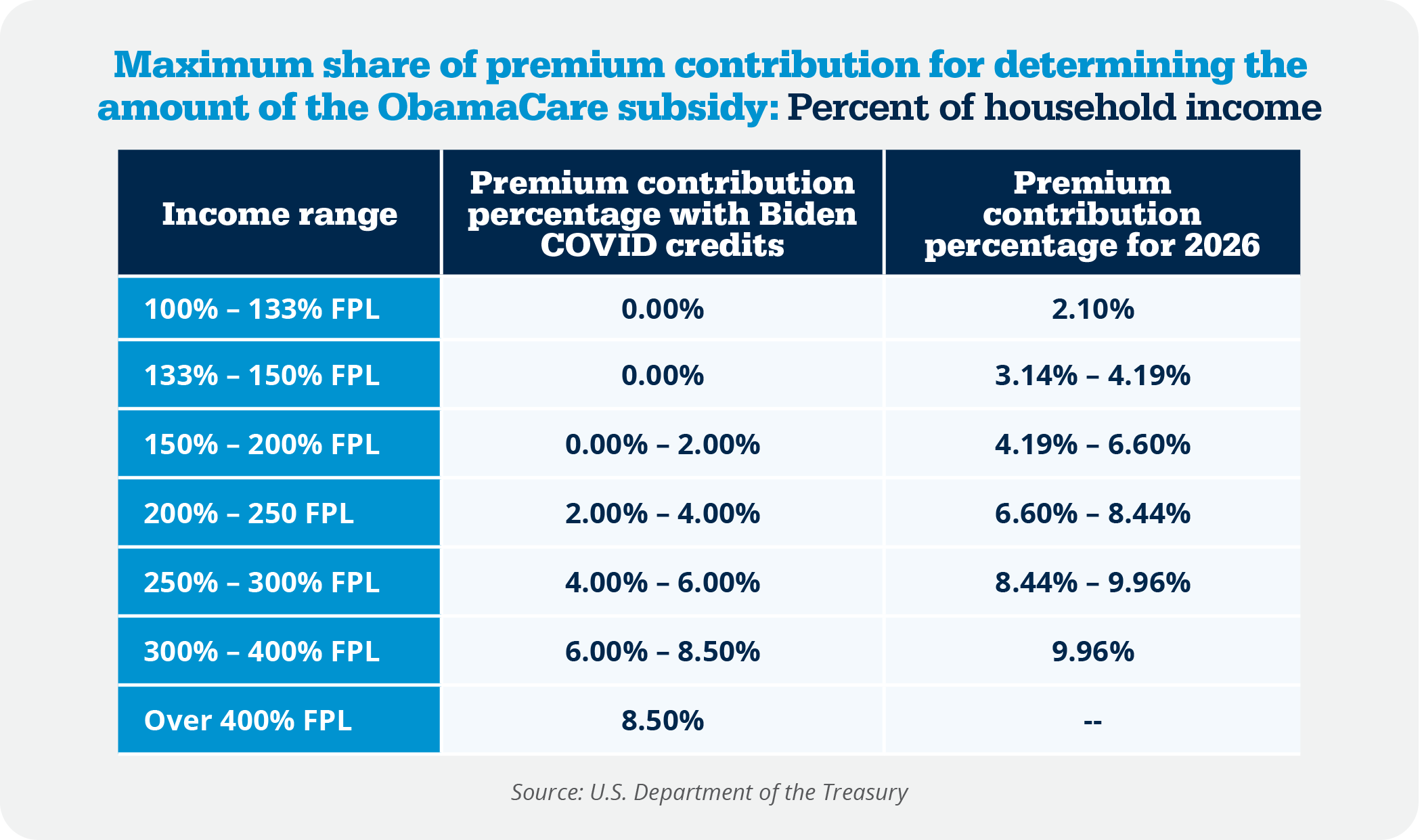
ObamaCare’s original subsidies had taxpayers picking up most of the premium cost, and the enhanced subsidies disproportionately benefited high-income earners
Even after the COVID credits expire, subsidies remain very generous under ObamaCare’s original design. Taxpayers will continue to pay the vast majority of premiums for most enrollees, particularly those with incomes below 250 percent FPL—who make up nearly three-quarters of the exchange population.38 For example, taxpayers will cover roughly 98 percent of the cost of the cheapest platinum-plus plan for the average enrollee at the poverty line.39–40–41–42–43–44–45–46–47–48–49–50 The enrollee would be expected to pay less than $4 per week for that plan, roughly the price of a commercial-free streaming service.51–52–53–54
For the average enrollee earning 150 percent FPL, taxpayers will still cover 92 percent of the cost.55 Enrollees would be expected to pay less than $15 per week for that plan—on par with what many drivers pay for minimum auto insurance and comparable to the price of a monthly Internet or phone service plan.56–57–58 If those enrollees chose a bronze plan, taxpayers would cover the entire cost.59–60 The average enrollee earning between 200 and 250 percent FPL would have federal taxpayers picking up more than two-thirds of the premium.61 These enrollees would be expected to pay between $32 and $53 per week—the equivalent of the price for dining out a few times a month.62–63
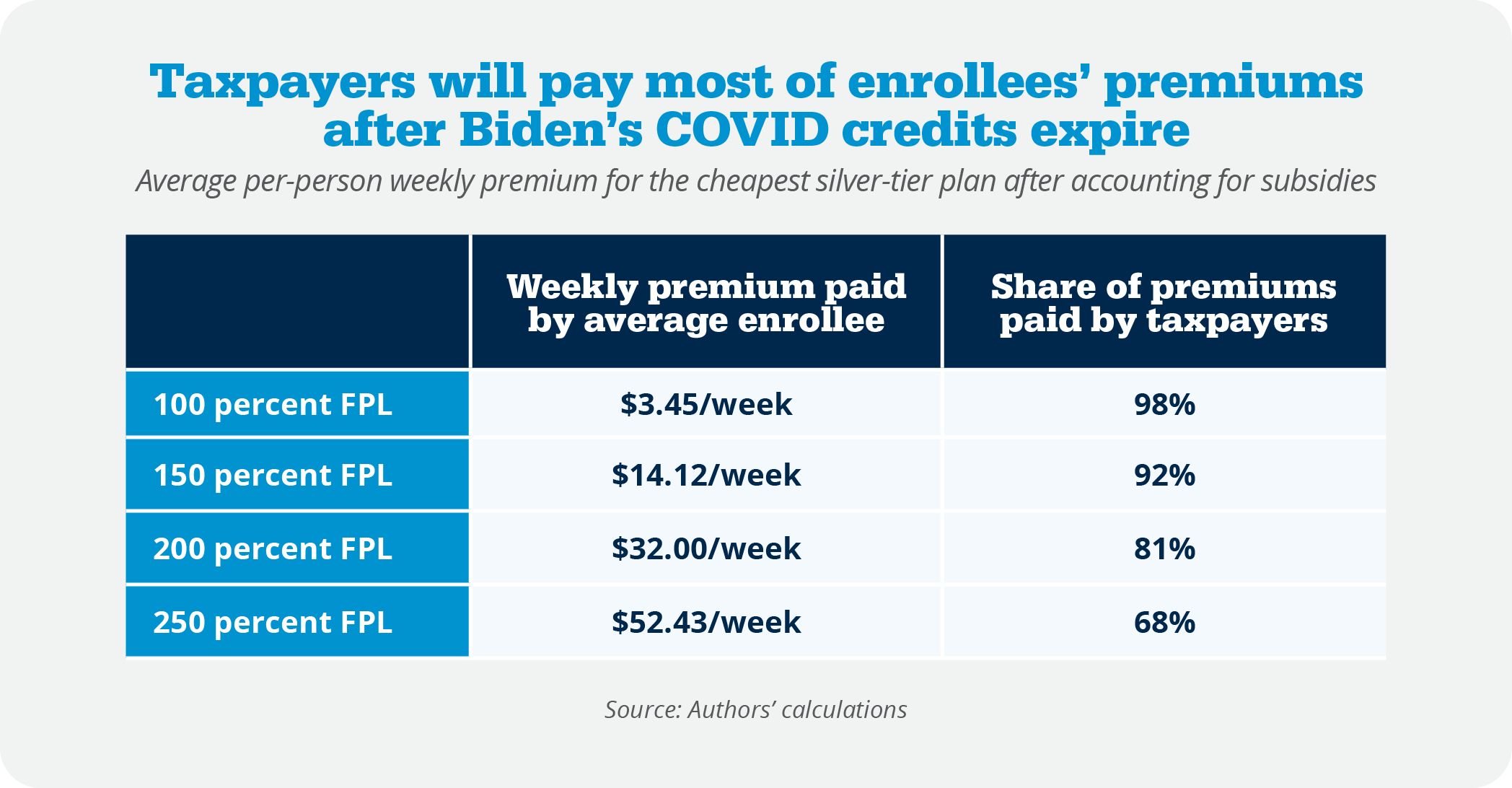
Even middle-income households earning nearly four times the poverty line will receive thousands of dollars in annual support. By lifting the subsidy cap above 400 percent FPL—income of nearly $130,000 for a family of four—Biden’s COVID credits result in federal taxpayers significantly subsidizing health insurance for households in the top 10 percent of earners—some households making more than $500,000.64
Biden’s COVID credits led to an explosion of fraudulent spending
ObamaCare subsidies are largely a function of enrollees’ estimated income for the following year. Once an enrollee makes a plan selection, the U.S. Treasury sends those subsidies directly to insurers. When enrollees file their tax returns, the amount that their insurer received in advance subsidies is supposed to be reconciled with the actual amount to which the enrollee was entitled.
Federal law sharply limits the Treasury Department’s ability to recover subsidies if too much was advanced to the insurer.65–66 Federal regulations issued during the Obama administration also provide no repayment whatsoever for people below the poverty line who overestimated their income to qualify for a subsidy.67 Zero-premium plans, combined with lax oversight, created perverse incentives. Lead generators and brokers coached applicants to inflate income—or even enrolled people without consent—because they knew enrollees would only participate if coverage was free.68 An estimated 6.4 million enrollees in 2025 were improper—enrollees who incorrectly or falsely reported income that would make them eligible for zero-premium plans.69
The U.S. Department of Health and Human Services (HHS) recently released data showing a consequence of improper enrollment—a surge in the number of exchange enrollees who did not use any health care services.70 Between 2019 and 2024, the number of individual market enrollees without a single claim—no doctor visit, lab test, or prescription filled—more than tripled to nearly 12 million enrollees in 2024.71–72 Among those now eligible for zero-premium plans with low or no deductible, that number increased nearly sevenfold.73
Between 2019 and 2024, the number of individual market enrollees without a single claim—no doctor visit, lab test, or prescription filled—more than tripled to nearly 12 million enrollees in 2024.
A whopping 40 percent of enrollees in fully subsidized plans had no claims in 2024.74 In 2024 alone, taxpayers sent at least $35 billion to insurers for people who paid no premiums and never used their plan.75–76–77–78–79–80–81–82–83 This shows the surge in phantom enrollees, people unknowingly signed up or double-covered elsewhere, in the market.84 According to HHS, there are at least 1.6 million people doubly covered by Medicaid and a subsidized exchange plan.85
Biden’s COVID credits created a policy environment that fueled improper and phantom enrollment. Incredibly, nearly half of exchange enrollees in 2025 claimed income that made them eligible for zero-premium plans—a result of large incentives for enrollees, enrollment intermediaries, and insurers to cheat.86–87 In previous years, the Treasury Department found just 18 percent of subsidized enrollees were in that income range after reconciling the expected income reported to the exchange with actual income at tax filing.88
The Biden administration prioritized maximizing enrollment regardless of the cost to taxpayers. This disregard for program integrity, combined with the COVID credits, fueled overall enrollment, much of it among people not eligible for subsidies they are receiving and others unaware of their enrollment or covered by either Medicaid or an employer plan. The result is an ObamaCare exchange baseline inflated with millions of improper enrollments.
Extending Biden’s COVID credits would cost an estimated $450 billion, fueling deficits and inflation
Continuing the Biden COVID credits would cost taxpayers an estimated $450 billion over the next decade, including the additional interest costs from higher federal debt.89–90 More deficit spending fuels higher interest rates and inflation in the broader economy, lowering the American standard of living.91
Continuing the Biden COVID credits would cost taxpayers an estimated $450 billion over the next decade, including the additional interest costs from higher federal debt.
In the case of premium subsidies, though, it is not just the problem of too many dollars chasing too few goods. As highlighted earlier, because the subsidy is tied to the premium payment, enrollees do not feel the brunt of premium increases. Insurers are aware that their premium increases are ultimately passed on to taxpayers. And without consumer pressure, insurers have little incentive to negotiate better prices with hospitals and providers. In turn, providers are less likely to curb excess utilization. ObamaCare also sets limits requiring insurers to spend a minimum percentage of premiums on medical claims. This exacerbates these problems by incentivizing insurers to push up plan spending to maximize profits and to avoid paying rebates to enrollees.
The original ObamaCare subsidies raised overall premiums. The situation is worse with the expanded subsidies because they make consumers even less sensitive to premium increases and make even more people eligible for them.92
The expanded subsidies also exacerbate the crowd-out of employer insurance. Because subsidies aren’t available to workers with “affordable” job-based coverage, employers have a clear incentive to drop health plans and shift workers to the exchanges. The larger the subsidies—and the more people who qualify for them—the greater the incentive for employers to decide not to offer a workplace plan. The Congressional Budget Office estimates that Biden’s COVID credits would reduce employment-based coverage by four million.93
Lastly, the expanded subsidies also reduce economic activity through deadweight loss. A central economic feature of the expanded subsidies is the crowd-out of private financing with taxpayer financing. Most individual market enrollees would have coverage even without Biden’s COVID credits—for these people, the credits drive up taxpayer costs without expanding coverage. The expanded subsidies increase borrowing, or the amount that the government needs to raise in taxes in the future to finance. Higher taxes result in reduced economic activity. The deadweight loss of taxation represents the value of foregone productive activity. According to assumptions used by the Council of Economic Advisors about deadweight loss, extending the Biden COVID credits would cause more than $200 billion of deadweight loss over the next decade.94
Congress should let Biden’s COVID credits expire and pursue better options to broaden choice and improve affordability
Extending Biden’s COVID credits would cost more than $40 billion per year, reduce employer coverage, prop up insurer profits, and entrench a dysfunctional regulatory structure that significantly increased premiums, lowered the quality of individual market plans, and reduced Americans’ options for health coverage.95–96 Congressional Democrats enacted them as a temporary pandemic measure. They have resulted in large amounts of fraud and improper enrollment.97 Congress should allow them to expire as scheduled and enact reforms that help consumers and small businesses get access to affordable coverage without increasing taxpayer costs.
Increasing choice and competition through alternative coverage options, such as short-term limited-duration plans and Association Health Plans, combined with continued progress on price transparency, are ways to strengthen market forces in a sector that has been strangled by government.98–99 Moreover, Congress can significantly reduce premiums and subsidies by funding ObamaCare’s cost-sharing reduction (CSR) program—a provision of the One Big Beautiful Bill Act passed out of the House but struck by Senate Democrats in a parliamentary procedure. Instead of expanding ObamaCare relative to current law, as extending the Biden COVID credits would do, the CSR appropriation would free up ObamaCare subsidy dollars, providing lawmakers with about $30 billion over the next decade to offer more targeted assistance.
The Bottom line: Congress should allow Biden’s temporary COVID credits to expire on schedule.
Footnotes
1↑ Public Law 111-148 (2010), https://www.congress.gov/111/statute/STATUTE-124/STATUTE-124-Pg119.pdf
2↑ Daniel Cruz and Greg Fann, "The shortcomings of the ACA Exchanges: Far less enrollment at a much higher cost," Paragon Health Institute (2023), https://paragoninstitute.org/private-health/shortcomings-of-the-aca-exchanges/
3↑ Edmund F. Haislmaier and Doug Badger, "How Obamacare raised premiums," Heritage Foundation (2018), https://www.heritage.org/sites/default/files/2018-03/BG3291.pdf
4↑ Brian Blase, "Downgrading the Affordable Care Act: Unattractive health insurance and lower enrollment," Mercatus Center (2016), https://www.mercatus.org/system/files/Blase-ACA-Underperforming.pdf
5↑ Sarah Kliff, "Republicans killed the Obamacare mandate. New data shows it didn't really matter," The New York Times (2020), https://www.nytimes.com/2020/09/18/upshot/obamacare-mandate-republicans.html
6↑ Brian Blase, "The ACA is making health insurers much richer," Paragon Health Institute (2024), https://paragoninstitute.org/newsletter/the-aca-is-making-health-insurers-much-richer
7↑ Public Law 117-2 (2021), https://www.congress.gov/117/plaws/publ2/PLAW-117publ2.pdf
8↑ Public Law 117-169 (2022), https://www.congress.gov/117/plaws/publ169/PLAW-117publ169.pdf
9↑ Michael Greibrok, "The Trump administration and Congress are stopping the Biden administration's supercharged version of ObamaCare subsidy fraud," Foundation for Government Accountability (2025), https://thefga.org/research/stopping-the-biden-administrations-supercharged-version-of-obamacare-subsidy-fraud
10↑ Congressional Budget Office, "Baseline projections: The premium tax credit and related spending?July 2024," Congressional Budget Office (2024), https://www.cbo.gov/system/files/2024-07/60523-2024-07-premium-tax-credit.pdf
11↑ Matthew Dickerson, "Let Biden's COVID credits expire," Economic Policy Innovation Center (2025), https://epicforamerica.org/wp-content/uploads/2025/08/EPIC-Paper-Let-Biden-COVID-Credits-Expire-8.13.20205.pdf
12↑ 26 U.S.C. ? 36B(b)(2) (2023), https://www.govinfo.gov/content/pkg/USCODE-2023-title26/pdf/USCODE-2023-title26-subtitleA-chap1-subchapA-partIV-subpartC-sec36B.pdf
13↑ Internal Revenue Service, "Revenue procedure 2025-25," U.S. Department of the Treasury (2025), https://www.irs.gov/pub/irs-drop/rp-25-25.pdf
14↑ Ibid.
15↑ 26 U.S.C. ? 36B(b)(2) (2023), https://www.govinfo.gov/content/pkg/USCODE-2023-title26/pdf/USCODE-2023-title26-subtitleA-chap1-subchapA-partIV-subpartC-sec36B.pdf
16↑ Ibid.
17↑ In 2025, roughly 95 percent of HealthCare.gov enrollees and 92 percent of all ObamaCare enrollees received taxpayer-funded subsidies. Even before Biden's COVID credits were enacted, roughly 85 percent of enrollees received subsidies. See, e.g., Centers for Medicare and Medicaid Services, "Health insurance exchanges 2025 open enrollment report," U.S. Department of Health and Human Services (2025), https://www.cms.gov/files/document/health-insurance-exchanges-2025-open-enrollment-report.pdf
18↑ 42 U.S.C. ? 18071(c)(2) (2023), https://www.govinfo.gov/content/pkg/USCODE-2023-title42/pdf/USCODE-2023-title42-chap157-subchapIV-partA-sec18071.pdf
19↑ In 2025, approximately 51 percent of ObamaCare enrollees received "cost-sharing reduction" subsidies. See, e.g., Centers for Medicare and Medicaid Services, "Health insurance exchanges 2025 open enrollment report," U.S. Department of Health and Human Services (2025), https://www.cms.gov/files/document/health-insurance-exchanges-2025-open-enrollment-report.pdf
20↑ Enrollees with income below 150 percent FPL qualify for cost-sharing reduction subsidies that increase the actuarial value of their plan to 94 percent. See, e.g., 42 U.S.C. ? 18071(c)(2) (2023), https://www.govinfo.gov/content/pkg/USCODE-2023-title42/pdf/USCODE-2023-title42-chap157-subchapIV-partA-sec18071.pdf
21↑ A platinum-tier plan has an actuarial valuation of approximately 90 percent. See, e.g., 42 U.S.C. ? 18022(d) (2023), https://www.govinfo.gov/content/pkg/USCODE-2023-title42/pdf/USCODE-2023-title42-chap157-subchapIII-partA-sec18022.pdf
22↑ The median deductible for the 94 percent actuarial value plan, weighted by actual enrollment, has been zero for several years. See, e.g., Centers for Medicare and Medicaid Services, "2014-2024 open enrollment period plan design public use file," U.S. Department of Health and Human Services (2025), https://www.cms.gov/files/zip/2014-2024-oep-plan-design-public-use-file.zip
23↑ An analysis of ObamaCare enrollees with income below 138 percent FPL in states that did not expand Medicaid found more than 94 percent of enrollees had access to zero-premium plans that had no deductibles and no copayments for primary care or generic drugs. See, e.g., Jonathan Ingram and Liesel Crocker, "Medicaid expansion is a bad deal for states, providers, and those it claims to help," Foundation for Government Accountability (2024), https://thefga.org/research/medicaid-expansion-is-a-bad-deal-for-states
24↑ Theo Merkel and Brian Blase, "Follow the money: How tax policy shapes health care," Paragon Health Institute (2024), https://paragoninstitute.org/private-health/follow-the-money-how-tax-policy-shapes-health-care/
25↑ Sonia Jaffe and Mark Shepard, "Price-linked subsidies and imperfect competition in health insurance," American Economic Association (2020), https://www.aeaweb.org/articles?id=10.1257%2Fpol.20180198
26↑ Public Law 117-2 (2021), https://www.congress.gov/117/plaws/publ2/PLAW-117publ2.pdf
27↑ Lauren Underwood et al., "Letter to The Honorable Joseph R. Biden, Jr., et al.," U.S. House of Representatives (2021), https://underwood.house.gov/sites/evo-subsites/underwood-evo.house.gov/files/Health%20Care%20Affordability%20Act%20Letter%20-%20Rep.%20Lauren%20Underwood.pdf
28↑ House Committee on Ways and Means, "Supporting health and affordable health coverage during the COVID-19 pandemic," House Committee on Ways and Means (2020), https://democrats-waysandmeans.house.gov/sites/evo-subsites/democrats-waysandmeans.house.gov/files/documents/Supporting%20Health%20and%20Health%20Coverage%20%28WM%20Proposal%29.pdf
29↑ Hayden Dublois, "Broken promises: Why expanded ObamaCare subsidies must expire on time," Foundation for Government Accountability (2022), https://thefga.org/research/broken-promises-why-expanded-obamacare-subsidies-must-expire-on-time/
30↑ Ibid.
31↑ People who are eligible for Medicaid are ineligible for these subsidies, which means that in Medicaid expansion states, eligibility is limited to people with income between 100 and 138 percent FPL. Theo Merkel and Brian Blase, "Follow the money: How tax policy shapes health care," Paragon Health Institute (2024), https://paragoninstitute.org/private-health/follow-the-money-how-tax-policy-shapes-health-care/
32↑ Lauren Underwood et al., "Letter to The Honorable Joseph R. Biden, Jr., et al.," U.S. House of Representatives (2021), https://underwood.house.gov/sites/evo-subsites/underwood-evo.house.gov/files/Health%20Care%20Affordability%20Act%20Letter%20-%20Rep.%20Lauren%20Underwood.pdf
33↑ House Committee on Ways and Means, "Supporting health and affordable health coverage during the COVID-19 pandemic," House Committee on Ways and Means (2020), https://democrats-waysandmeans.house.gov/sites/evo-subsites/democrats-waysandmeans.house.gov/files/documents/Supporting%20Health%20and%20Health%20Coverage%20%28WM%20Proposal%29.pdf
34↑ Hayden Dublois, "Broken promises: Why expanded ObamaCare subsidies must expire on time," Foundation for Government Accountability (2022), https://thefga.org/research/broken-promises-why-expanded-obamacare-subsidies-must-expire-on-time/
35↑ Brian Blase and Drew Gonshorowski, "The Great Obamacare Enrollment Fraud," Paragon Health Institute (2024), https://paragoninstitute.org/private-health/the-great-obamacare-enrollment-fraud/
36↑ Brian Blase and Gabrielle Kalisz, "Unpacking the Great Obamacare Enrollment Fraud," Paragon Health Institute (2024), https://paragoninstitute.org/private-health/unpacking-the-great-obamacare-enrollment-fraud/
37↑ Brian Blase et al., "The greater Obamacare enrollment fraud: The fraud got much worse in 2025," Paragon Health Institute (2025), https://paragoninstitute.org/private-health/the-greater-obamacare-enrollment-fraud/
38↑ Brian Blase et al., "Taxpayers will finance vast majority of ACA plan premiums for most enrollees after Biden's COVID credits expire," Paragon Health Institute (2025), https://paragoninstitute.org/private-health/taxpayers-will-finance-vast-majority-of-aca-plan-premiums-for-most-enrollees-after-bidens-covid-credits-expire/
39↑ Authors' calculations based upon data provided by the U.S. Department of Health and Human Services on exchange enrollment, disaggregated by county, premium levels, disaggregated by plan, metal tier, and county, data provided by the U.S. Department of Commerce on subsidized exchange enrollees, disaggregated by age, household size, and number of subsidized enrollees in the household, and data provided by the U.S. Department of the Treasury on applicable percentages in calendar year 2026.
40↑ ObamaCare subsidies are calculated by subtracting the household's maximum contribution?the product of a taxpayer's "applicable percentage" and his or her income?from the premium cost of the "benchmark" plan in the area in which the taxpayer resides. See, e.g., 26 U.S.C. ? 36B(b)(2) (2023), https://www.govinfo.gov/content/pkg/USCODE-2023-title26/pdf/USCODE-2023-title26-subtitleA-chap1-subchapA-partIV-subpartC-sec36B.pdf
41↑ In 2026, the "applicable percentage" will be 2.1 percent for an individual at the federal poverty line and 4.19 percent for an individual earning 1.5 times the federal poverty line. See, e.g., Internal Revenue Service, "Revenue procedure 2025-25," U.S. Department of the Treasury (2025), https://www.irs.gov/pub/irs-drop/rp-25-25.pdf
42↑ The "benchmark" plan for subsidy purposes is the second-cheapest silver-tier plan. See, e.g., See, e.g., 26 U.S.C. ? 36B(b)(2) (2023), https://www.govinfo.gov/content/pkg/USCODE-2023-title26/pdf/USCODE-2023-title26-subtitleA-chap1-subchapA-partIV-subpartC-sec36B.pdf
43↑ Because subsidies are tied to the benchmark plan, individuals who choose plans with lower premiums than the benchmark plan?either by choosing the cheapest silver-tier plan or choosing a plan from the less-expensive bronze tier?will pay less than the maximum household contribution.
44↑ This analysis reviewed 2025 premium filings for qualified health plans offered on HealthCare.gov in 2,157 counties nationwide to identify each county's benchmark plan, cheapest silver-tier plan, and cheapest bronze-tier plan. See, e.g., Centers for Medicare and Medicaid Services, "Qualified health plan landscape: Plan year 2025," U.S. Department of Health and Human Services (2025), https://data.healthcare.gov/datafile/py2025/individual_market_medical.zip
45↑ The counties included in this analysis represent approximately 85 percent of all ObamaCare enrollees with income below 150 percent FPL. See, e.g., Centers for Medicare and Medicaid Services, "2025 open enrollment period state-level public use file," U.S. Department of Health and Human Services (2025), https://www.cms.gov/files/zip/2025-oep-state-level-public-use-file.zip
46↑ This analysis adjusted 2025 premiums to reflect expected premium increases for plan year 2026. These increases averaged 20 percent, in line with rate filings submitted by insurers for 2026 plans. See, e.g., Jared Ortaliza et al., "How much and why ACA Marketplace premiums are going up in 2026," Peterson Center on Healthcare (2025), https://www.healthsystemtracker.org/brief/how-much-and-why-aca-marketplace-premiums-are-going-up-in-2026/#Distribution%20of%20proposed%202026%20rate%20changes%20among%20312%20ACA%20Marketplace%20insurers
47↑ This analysis calculated the difference between the cheapest silver-tier plan and the benchmark plan in each county, disaggregated by each enrollee's age, household size, and number of subsidized enrollees in the household, which was then used to calculate how much an enrollee in that county would pay for the cheapest silver-tier plan at various income levels.
48↑ This analysis utilizes demographic data on subsidized ObamaCare enrollees provided by the U.S. Department of Commerce to create appropriate weights for each single-year age, household size, and the number of subsidized enrollees in the household.
49↑ This analysis utilizes enrollment data provided by the U.S. Department of Health and Human Services to create appropriate weights for each county. See, e.g., Centers for Medicare and Medicaid Services, "2025 open enrollment period county-level public use file," U.S. Department of Health and Human Services (2025), https://www.cms.gov/files/zip/2025-oep-county-level-public-use-file.zip
50↑ This analysis calculates the taxpayer share of premiums as the taxpayer subsidy for an enrollee divided by the cheapest silver-tier plan available for that enrollee.
51↑ Authors' calculations based upon data provided by the U.S. Department of Health and Human Services on exchange enrollment, disaggregated by county, premium levels, disaggregated by plan, metal tier, and county, data provided by the U.S. Department of Commerce on subsidized exchange enrollees, disaggregated by age, household size, and number of subsidized enrollees in the household, and data provided by the U.S. Department of the Treasury on applicable percentages in calendar year 2026.
52↑ This analysis calculated the difference between the cheapest silver-tier plan and the benchmark plan in each county, disaggregated by each enrollee's age, household size, and number of subsidized enrollees in the household, which was then used to calculate how much an enrollee in that county would pay for the cheapest silver-tier plan at various income levels.
53↑ This analysis presents average premium cost for enrollees choosing the cheapest silver-tier plan on a weekly basis to provide a better comparison to workers with job-based coverage, as virtually all employees are paid weekly, biweekly, or semi-monthly. Monthly ObamaCare premiums are converted into annual premiums by multiplying the monthly premium by 12 months. Annual premiums are converted into weekly premiums by dividing the annual premium by 52 weeks. See, e.g., Bureau of Labor Statistics, "Length of pay periods in the Current Employment Statistics survey," U.S. Department of Labor (2023), https://www.bls.gov/ces/publications/length-pay-period.htm
54↑ Drew Weisholtz, "Streaming subscriptions guide: Prices and how to track payments," Today.com (2025), https://www.today.com/popculture/list-of-streaming-services-and-prices-rcna189095
55↑ Authors' calculations based upon data provided by the U.S. Department of Health and Human Services on exchange enrollment, disaggregated by county, premium levels, disaggregated by plan, metal tier, and county, data provided by the U.S. Department of Commerce on subsidized exchange enrollees, disaggregated by age, household size, and number of subsidized enrollees in the household, and data provided by the U.S. Department of the Treasury on applicable percentages in calendar year 2026.
56↑ Ibid.
57↑ Kayda Norman, "Average car insurance cost in 2025," Nerdwallet (2025), https://www.nerdwallet.com/article/insurance/how-much-is-car-insurance
58↑ Roxanne Downer, "How much does internet cost in 2025? A complete guide to monthly prices, speeds and fees," USA Today (2025), https://www.usatoday.com/story/tech/internet/cost-of-internet/85517217007/
59↑ Authors' calculations based upon data provided by the U.S. Department of Health and Human Services on exchange enrollment, disaggregated by county, premium levels, disaggregated by plan, metal tier, and county, data provided by the U.S. Department of Commerce on subsidized exchange enrollees, disaggregated by age, household size, and number of subsidized enrollees in the household, and data provided by the U.S. Department of the Treasury on applicable percentages in calendar year 2026.
60↑ This analysis calculated the difference between the cheapest bronze-tier plan and the benchmark plan in each county, disaggregated by each enrollee's age, household size, and number of subsidized enrollees in the household, which was then used to calculate how much an enrollee in that county would pay for the cheapest bronze-tier plan at various income levels.
61↑ Authors' calculations based upon data provided by the U.S. Department of Health and Human Services on exchange enrollment, disaggregated by county, premium levels, disaggregated by plan, metal tier, and county, data provided by the U.S. Department of Commerce on subsidized exchange enrollees, disaggregated by age, household size, and number of subsidized enrollees in the household, and data provided by the U.S. Department of the Treasury on applicable percentages in calendar year 2026.
62↑ Ibid.
63↑ Ramsey Solutions, "How much to budget for eating out," Ramsey Solutions (2025), https://www.ramseysolutions.com/budgeting/average-eating-out-cost
64↑ Maureen Leddy, "Concerns grow as premium tax credit sunset looms," Thomson Reuters (2025), https://tax.thomsonreuters.com/news/concerns-grow-as-premium-tax-credit-sunset-looms/
65↑ Federal law limited recapture of erroneous ObamaCare subsidies to $600 for individuals earning less than 200 percent FPL, $1,500 for individuals earning between 200 percent FPL and 300 percent FPL, and $2,500 for individuals earning between 300 percent FPL and 400 percent FPL. See, e.g., 26 U.S.C. ? 36B(f) (2023), https://www.govinfo.gov/content/pkg/USCODE-2023-title26/pdf/USCODE-2023-title26-subtitleA-chap1-subchapA-partIV-subpartC-sec36B.pdf
66↑ These recapture limitations were repealed in the One Big Beautiful Bill Act of 2025. See, e.g., Public Law 119-21 (2025), https://www.congress.gov/119/plaws/publ21/PLAW-119publ21.pdf
67↑ 26 C.F.R. ? 1.36B-2 (2023), https://www.govinfo.gov/content/pkg/CFR-2023-title26-vol1/pdf/CFR-2023-title26-vol1-sec1-36B-0.pdf
68↑ Brian Blase et al., "The greater Obamacare enrollment fraud: The fraud got much worse in 2025," Paragon Health Institute (2025), https://paragoninstitute.org/private-health/the-greater-obamacare-enrollment-fraud/
69↑ Ibid.
70↑ Centers for Medicare and Medicaid Services, "2019-2024 enrollees without claims by state market metal level," U.S. Department of Health and Human Services (2025), https://view.officeapps.live.com/op/view.aspx?src=https%3A%2F%2Fwww.cms.gov%2Ffiles%2Fdocument%2Fenrolleeswithoutclaims-2019-24.xlsx&wdOrigin=BROWSELINK
71↑ Authors' calculations based upon data provided by the U.S. Department of Health and Human Services on the number of ObamaCare enrollees with no claims, disaggregated by year. See, e.g., Centers for Medicare and Medicaid Services, "2019-2024 enrollees without claims by state market metal level," U.S. Department of Health and Human Services (2025), https://www.cms.gov/files/document/enrolleeswithoutclaims-2019-24.xlsx
72↑ Brian Blase, "The rise of phantom ObamaCare enrollees: Biden COVID credits drive massive increase in individual market enrollees with no medical claims," Paragon Health Institute (2025), https://paragoninstitute.org/paragon-prognosis/the-rise-of-phantom-obamacare-enrollees-biden-covid-credits-drive-massive-increase-in-individual-market-enrollees-with-no-medical-claims
73↑ Authors' calculations based upon data provided by the U.S. Department of Health and Human Services on the number of ObamaCare enrollees with no claims, disaggregated by year. See, e.g., Centers for Medicare and Medicaid Services, "2019-2024 enrollees without claims by state market metal level," U.S. Department of Health and Human Services (2025), https://www.cms.gov/files/document/enrolleeswithoutclaims-2019-24.xlsx
74↑ Ibid.
75↑ Authors' calculations based upon data provided by the U.S. Department of Health and Human Services on the number and share of ObamaCare enrollees with no claims in 2024, disaggregated by state and metal tier, the number of ObamaCare enrollees in 2024, disaggregated by state and metal tier, the number of ObamaCare enrollees with income between 100 percent FPL and 150 percent FPL in 2024 and 2025, disaggregated by state, exchange type, and year, the number of ObamaCare enrollees in HealthCare.gov states enrolled in 94 percent actuarial value plans in 2024, disaggregated by state, the average annualized plan duration of ObamaCare enrollees, and the average premiums for ObamaCare enrollees in 2025, disaggregated by state, exchange type, and metal tier.
76↑ This analysis utilizes claims data provided by the U.S. Department of Health and Human Services, disaggregated by state and metal tier, to calculate the number of individuals in zero-premium plans with no claims. This data covers 44 states, which represent approximately 99.6 percent of all enrollees between 100 percent and 150 percent FPL in 2024. Data for the missing states was imputed at the weighted average for this analysis. See, e.g., Centers for Medicare and Medicaid Services, "2019-2024 enrollees without claims by state market metal level," U.S. Department of Health and Human Services (2025), https://www.cms.gov/files/document/enrolleeswithoutclaims-2019-24.xlsx
77↑ In 2024, approximately two-thirds of ObamaCare enrollees in HealthCare.gov states who had income between 100 percent and 150 percent FPL chose plans with 94 percent actuarial value. The remainder chose plans from other metal tiers, typically Bronze or Gold. See, e.g., Centers for Medicare and Medicaid Services, "2024 open enrollment period state-level public use file," U.S. Department of Health and Human Services (2024), https://www.cms.gov/files/zip/2024-oep-state-level-public-use-file.zip
78↑ This analysis imputes the number of ObamaCare enrollees in states that do not utilize HealthCare.gov who had income between 100 percent and 150 percent FPL and who chose plans with 94 percent actuarial value by calculating the ratio of similar enrollees in HealthCare.gov states that chose those plans, as these states do not submit actuarial value plan selection data to HHS.
79↑ This analysis allocates a portion of bronze-tier and gold-tier enrollees with no claims to ObamaCare enrollees in zero-premium plans by distributing ObamaCare enrollees in HealthCare.gov states who had income between 100 percent and 150 percent FPL but did not choose 94 percent actuarial value plans to bronze-tier or gold-tier plans. Average bronze-tier premiums were utilized for those distributed to bronze-tier plans. Average silver-tier premiums were utilized for those distributed to gold-tier plans where gold-tier plan premiums were higher, as subsidies are capped based on the benchmark silver-tier plan.
80↑ This analysis utilized average premiums in 2025, disaggregated by state and metal tiers, in HealthCare.gov states, to calculate the aggregate monthly premium cost for zero-claim enrollees. See, e.g., ., Centers for Medicare and Medicaid Services, "2024 open enrollment period state, metal level, and enrollment status public use file," U.S. Department of Health and Human Services (2024), https://www.cms.gov/files/zip/2025-oep-state-metal-level-and-enrollment-status-public-use-file.zip
81↑ This analysis imputes average silver-tier and bronze-tier premiums in states that do not utilize HealthCare.gov by calculating the ratio of each state's overall average premium to the overall average premium in HealthCare.gov states, as these states do not submit metal-tier premium data to HHS.
82↑ This analysis assumes taxpayers cover only eight months of the average enrollee's premium, based on the total number of enrollees at any point during the calendar year relative to the number who signed up during the open enrollment period each year.
83↑ This analysis adjusts 2024 zero-claims enrollment subsidy cost to 2025 by the percentage increase in ObamaCare enrollees with income between 100 percent and 150 percent FPL between 2024 and 2025, disaggregated by state.
84↑ Brian Blase, "The rise of phantom ObamaCare enrollees: Biden COVID credits drive massive increase in individual market enrollees with no medical claims," Paragon Health Institute (2025), https://paragoninstitute.org/paragon-prognosis/the-rise-of-phantom-obamacare-enrollees-biden-covid-credits-drive-massive-increase-in-individual-market-enrollees-with-no-medical-claims
85↑ Centers for Medicare and Medicaid Services, "CMS finds 2.8 million Americans potentially enrolled in two or more Medicaid/ACA Exchange plans," U.S. Department of Health and Human Services (2025), https://www.cms.gov/newsroom/press-releases/cms-finds-28-million-americans-potentially-enrolled-two-or-more-medicaid/aca-exchange-plans
86↑ Brian Blase et al., "The greater Obamacare enrollment fraud: The fraud got much worse in 2025," Paragon Health Institute (2025), https://paragoninstitute.org/private-health/the-greater-obamacare-enrollment-fraud/
87↑ Centers for Medicare and Medicaid Services, "Health insurance exchanges 2025 open enrollment report," U.S. Department of Health and Human Services (2025), https://www.cms.gov/files/document/health-insurance-exchanges-2025-open-enrollment-report.pdf
88↑ Office of Tax analysis, "Treasury's baseline estimates of health coverage: FY2020," U.S. Department of the Treasury (2019), https://home.treasury.gov/system/files/131/Treasurys-Baseline-Estimates-of-Health-Coverage-FY-2020.pdf
89↑ Phillip Swagel, "The effects of permanently extending the expansion of the premium tax credit and the costs of that credit for deferred action for Childhood Arrivals recipients," Congressional Budget Office (2024), https://www.cbo.gov/system/files/2024-06/60437-Arrington-Smith-Letter.pdf
90↑ Matthew Dickerson, "Let Biden's COVID credits expire," Economic Policy Innovation Center (2025), https://epicforamerica.org/wp-content/uploads/2025/08/EPIC-Paper-Let-Biden-COVID-Credits-Expire-8.13.20205.pdf
91↑ William W. Beach, "Is inflation the result of excessive deficit spending?," Economic Policy Innovation Center (2024), https://epicforamerica.org/wp-content/uploads/2024/02/EPIC-Paper-Inflation-and-Spending-R.pdf
92↑ Theo Merkel and Brian Blase, "Follow the money: How tax policy shapes health care," Paragon Health Institute (2024), https://paragoninstitute.org/private-health/follow-the-money-how-tax-policy-shapes-health-care/
93↑ Authors' calculations based upon previously unpublished data provided by the Congressional Budget Office.
94↑ Council of Economic Advisors, "Economic report of the President," Council of Economic Advisors (2019), https://bidenwhitehouse.archives.gov/wp-content/uploads/2021/07/2019-ERP.pdf
95↑ Phillip Swagel, "The effects of permanently extending the expansion of the premium tax credit and the costs of that credit for deferred action for Childhood Arrivals recipients," Congressional Budget Office (2024), https://www.cbo.gov/system/files/2024-06/60437-Arrington-Smith-Letter.pdf
96↑ Hayden Dublois, "Broken promises: Why expanded ObamaCare subsidies must expire on time," Foundation for Government Accountability (2022), https://thefga.org/research/broken-promises-why-expanded-obamacare-subsidies-must-expire-on-time/
97↑ Brian Blase et al., "The greater Obamacare enrollment fraud: The fraud got much worse in 2025," Paragon Health Institute (2025), https://paragoninstitute.org/private-health/the-greater-obamacare-enrollment-fraud/
98↑ Michael Greibrok, "The Biden administration's action on short-term health plans will only harm Americans, Foundation for Government Accountability (2023), https://thefga.org/research/biden-administrations-action-short-term-health-plans/
99↑ Nick Stehle and Jonathan Ingram, "Association health plans: Expanding opportunities for small business owners and entrepreneurs," Foundation for Government Accountability (2018), https://thefga.org/research/association-health-plans-small-business/
Subscribe
Sign up now for your health policy updates.