


Brian Blase, Ph.D., is the President of Paragon Health Institute. Brian was Special Assistant to the President for Economic Policy at the White House’s National Economic Council (NEC) from 2017-2019, where he coordinated the development and execution of numerous health policies and advised the President, NEC director, and senior officials. After leaving the White House, Brian founded Blase Policy Strategies and served as its CEO.
New HHS Report Finds Decline in ACA Enrollment Results From Removal of Improper and Phantom Enrollees

The assistant secretary for planning and evaluation (ASPE) at the Department of Health and Human Services (HHS) released an important report on Friday documenting widespread improper enrollment, phantom enrollees, broker misconduct, and weak eligibility verification in the Affordable Care Act (ACA) exchanges. The report reaches a striking conclusion: exchange enrollment declined by 2.9 million people between 2025 and 2026, and that entire net decline resulted from the removal of improper and phantom enrollees. Despite the decline, ACA enrollment remains far above pre-pandemic levels. February 2026 effectuated enrollment was 85 percent higher than in February 2019—an increase of 8.8 million enrollees.
ASPE’s conclusion contradicts the widespread claim that declining affordability following the expiration of the COVID-era enhanced premium tax credits is responsible for the reduction in exchange enrollment. It is not surprising that the hypothesis does not hold up to scrutiny. Premium subsidies remain extraordinarily generous. Following the close of 2026 open enrollment, the median exchange enrollee paid just $42 per month in premiums, with taxpayers covering approximately 94 percent of the total premium cost.
The report is also significant because it independently confirms many of the findings that Paragon has documented over the past two years in The Great Obamacare Enrollment Fraud, Unpacking The Great Obamacare Enrollment Fraud, The Greater Obamacare Enrollment Fraud, The Rise of Phantom Obamacare Enrollees, and The Persistent Obamacare Enrollment Fraud. It also demonstrates that reforms enacted by Congress and implemented by the Trump administration are already producing meaningful improvements in exchange integrity. ASPE reports that one million exchange enrollees remain enrolled despite lacking valid Social Security numbers, and millions of improper and phantom enrollees remain (perhaps one to two million more than ASPE estimates). Thus, additional reforms to protect the integrity of the exchanges, which we describe in The Persistent Obamacare Enrollment Fraud, are still needed.
ASPE Estimates that Enrollment Decline is From the Removal of Improper and Phantom Enrollees
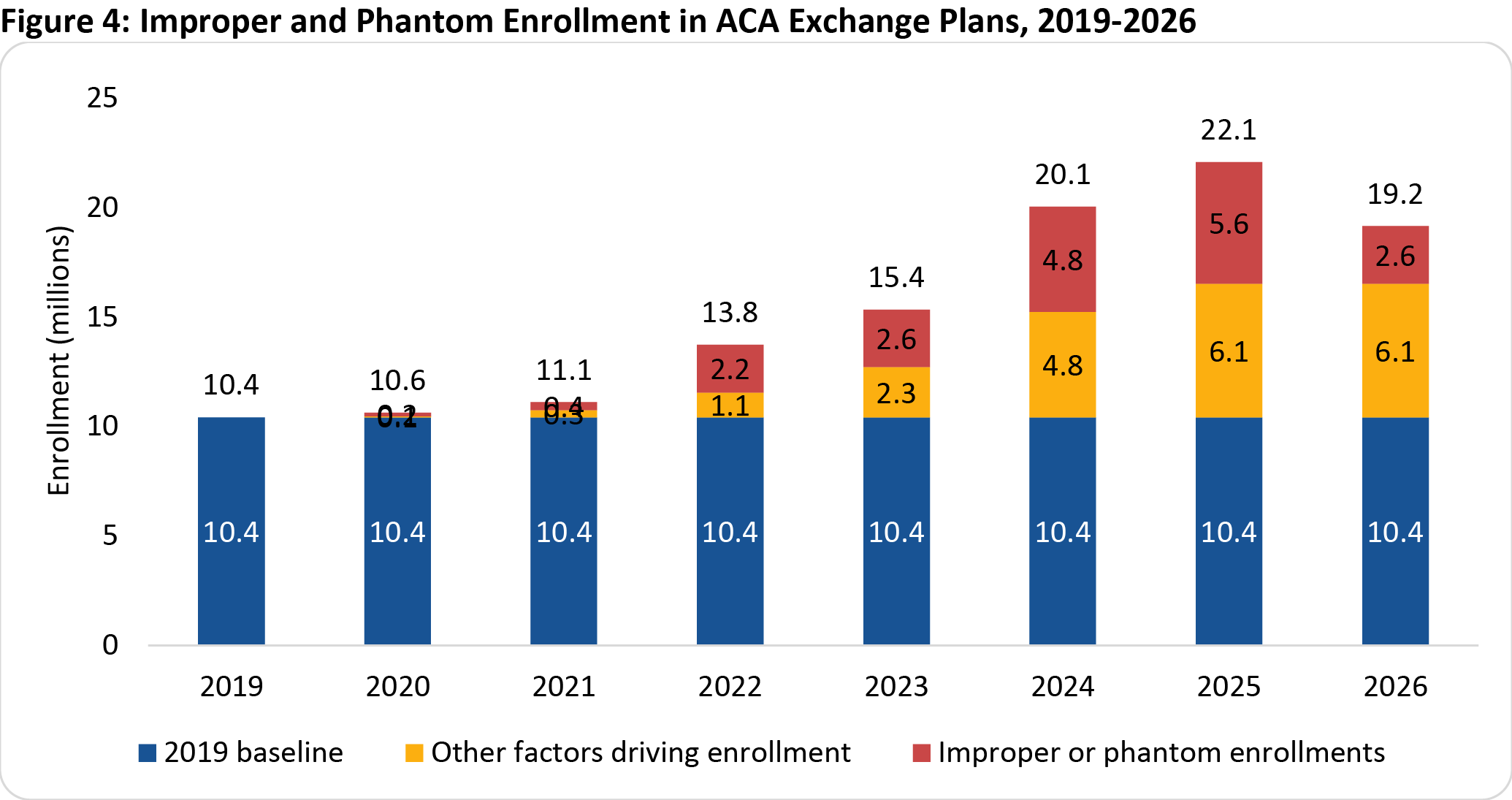
Figure 4 in the ASPE report shows February effectuated exchange enrollment from 2019 through 2026, separating total enrollment into the 2019 baseline, other factors driving enrollment, and improper or phantom enrollment. Figure 4 contains the report’s central finding and two important conclusions.
- ASPE estimates that the entire enrollment decline from 2025 to 2026 reflects the removal of improper and phantom enrollees.
- From 2019 to 2025, exchange enrollment increased by 11.7 million people. ASPE estimates that nearly half of that increase—5.6 million people—consisted of improper or phantom enrollees.
Note: CCIIO analysis of February Effectuated Enrollment as of 4/15/2026, 2019-2026.
At Paragon, we define improper enrollees as individuals who claim income between 100 and 150 percent of the federal poverty level (FPL) to qualify for the ACA’s largest subsidies but do not actually have income in that range. Phantom enrollees are enrollees who are unaware of their enrollment, fictitious individuals, or people with other primary coverage. The vast majority of phantom enrollees are improper enrollees. (Technical note: because of silver-loading, some phantoms with income above 150 percent FPL could be enrolled in zero-premium plans.)
ASPE Provides Additional Evidence of Large Presence of Improper and Phantom Enrollees Since 2023
One of the report’s most striking visuals, which closely corroborates Paragon’s earlier work, is how concentrated the problem remains among enrollees claiming incomes between 100 and 150 percent of the federal poverty level (FPL). Figure 1 from the ASPE report shows that 60 percent of all exchange enrollment growth from 2019 to 2025 was in the 100 to 150 percent FPL group. This is the group that qualified for zero-premium plans because of the COVID-era subsidy boosts. The enhanced subsidies dramatically increased the financial incentive for enrollment factories and unscrupulous brokers to misstate applicant information and fraudulently enroll individuals into zero-premium coverage. The natural result: an explosion of enrollees who never used their health plans. The only way for enrollment intermediaries to continue receiving monthly commissions from phantom enrollees is to keep them enrolled in zero-premium plans.
Figure 2 from the ASPE report shows that the 100 to 150 percent FPL group experienced dramatically higher rates of zero-utilization coverage than other income groups. As reports emerged of unauthorized enrollment and with some enrollment intermediaries publicly acknowledging that half of sign-ups had no idea they were being enrolled in coverage, this trend is unsurprising and represents strong evidence of phantom enrollment.

Notes: CCIIO analysis of 2019-2024. We identify enrollments by FPL by using the number of enrollees in each silver/CSR plan and derive the FPL by the CSR variant, since only those with incomes between 100-150 percent of FPL are eligible for the silver 94 plan, only those with incomes between 151-200 percent of FPL are eligible for the silver 87 plans and only those with incomes between 201-250 percent of FPL are eligible for the silver 73 plan. Thus, the data presented is for a subset of exchange enrollees in each income group since not all those that are eligible necessarily select these plans.
Figure 3 from ASPE’s report provides important evidence of improper and phantom enrollment through a different lens: nonpayment of premiums. These trends are for enrollees in zero-premium plans who were automatically re-enrolled into plans with a non-zero premium. Prior to the COVID-era subsidy boosts, premium nonpayment for such enrollees was only 18 percent. But during the 2023–2026 period, nonpayment among such enrollees tripled. The dramatic increase is exactly what one would expect if many people were enrolled without authorization or had other coverage. The ASPE figure therefore reinforces a central conclusion of Paragon’s work: much of the recent enrollment surge reflected improper and phantom enrollment rather than durable coverage expansion among eligible consumers. That improper enrollment is now beginning to unwind as program integrity improves and fewer enrollees qualify for zero-premium plans following the expiration of the COVID-era subsidy enhancements.

Note: CCIIO analysis of ACA Exchange effectuated enrollment data. Sample: Individuals who had been enrolled in zero premium plans, but were auto re-enrolled into plans with non-zero premium.
Likely At Least Six Million Improper Enrollees in 2025
The report’s estimates of improper enrollment in 2025 are consistent with Paragon’s findings—although both estimates almost certainly understate the true extent of improper enrollment. ASPE’s estimates are conservative because they do not count any of the baseline enrollment in the pre-COVID era as improper (more on this in the next section). Paragon’s estimates are conservative for several reasons, including our assumption that all eligible people are enrolled in coverage and the fact that for technical reasons we do not attempt to estimate improper enrollment in the District of Columbia, Minnesota, New York, and Oregon, which collectively represent about 9 percent of the U.S. population. At least one of these states (New York) has substantial improper enrollment in its low-income ACA program.
In its report, ASPE estimates that approximately 5.6 million exchange enrollees were improperly enrolled as of February 2025. We estimated approximately 6.5 million improper enrollees following the close of 2025 open enrollment. These estimates are not inconsistent. Paragon’s estimates measured enrollment immediately after open enrollment closed (meaning before any premiums were paid and more than 60 percent of those who signed up that year selected a plan with a premium payment). The HHS analysis uses effectuated enrollment at the end of February. Some improper enrollments naturally terminated during that period because premiums were never paid or coverage was otherwise canceled, including for phantom enrollees in 2025 who were automatically re-enrolled into a plan with a premium in 2026.
This helps explain why Paragon’s estimate is higher than ASPE’s estimate: the two analyses measure enrollment at different points in time. Below, I discuss another reason why ASPE’s estimates of improper enrollment are somewhat understated (and perhaps the drop in improper enrollment is somewhat overstated).
In the report, ASPE revealed that one million exchange enrollees remain enrolled who lack valid Social Security numbers. That finding alone raises significant questions about a basic lack of eligibility verification and demonstrates why stronger front-end verification procedures remain essential.
The report contains several additional findings that reinforce Paragon’s earlier work. According to ASPE, 27.8 percent of individuals enrolled in zero-premium plans had already canceled their coverage through May 2026. ASPE speculates that many of these cancellations likely reflect individuals who discovered they had been enrolled without their knowledge, obtained other coverage, or realized they faced unexpected tax liability because they received premium subsidies in past years for which they were not eligible.
More than 80 percent of these cancellations occurred among individuals whose coverage was arranged by an insurance agent or broker. That finding suggests that many of the enrollments now disappearing were facilitated through the same broker-driven enrollment practices that Paragon has repeatedly identified as a major source of improper enrollment. A key figure from our most recent paper, The Persistent Obamacare Enrollment Fraud, showed a very strong positive correlation between improper enrollment in a state and the percentage of applications submitted by brokers.
Improper Enrollment Did Not Begin in 2023
ASPE’s methodology almost certainly understates the full extent of improper enrollment because it implicitly treats 2019 enrollment as an appropriate baseline for legitimate exchange participation. But improper enrollment did not suddenly appear during the COVID-era subsidy expansions. Rather, the enhanced subsidies and weakened verification dramatically expanded an existing problem inherent in the ACA’s design and subsidy structure. The COVID-era subsidy expansions did not create improper enrollment; they dramatically increased the returns to improper enrollment while making unauthorized enrollment far less likely to be detected because so many plans became free.
Prior research has documented widespread income misreporting among exchange applicants dating back to the earliest years of the ACA. In a 2024 economics study, three researchers with past or present experience at the Congressional Budget Office found strong evidence that many applicants in states that did not expand Medicaid under the ACA reported expected incomes just above the federal poverty level in order to qualify for subsidies, with the problem especially large in Florida. The authors found that enrollment exceeded the estimated eligible population among individuals reporting income just above the eligibility threshold, with remarkable bunching at dollar amounts corresponding to the subsidy cutoff. This is classic evidence of strategic income misreporting and should not be surprising given the financial incentives for fraud embedded in the ACA’s structure.
The academic evidence is consistent with the Treasury Department’s own estimates. In 2019, the Treasury Department projected that more than one-quarter of all subsidies—approximately $11.3 billion for 2020—would be paid on behalf of households with incomes below 100 percent of the federal poverty level, despite such households generally being ineligible for exchange subsidies. Taken together, this evidence suggests that improper enrollment was already substantial before 2020. Consequently, measuring recent improper enrollment relative to a 2019 baseline likely understates both the historical prevalence of improper enrollment and the total number of improper enrollees that remain today.
ASPE Likely Underestimates Remaining Improper Enrollment
ASPE estimates that approximately 2.9 million improper enrollees were removed between 2025 and 2026. That represents substantial progress and demonstrates that stronger eligibility verification, enhanced oversight of brokers and enrollment entities, and other administrative reforms are producing meaningful results. It is also important that about 30 percent fewer 2026 enrollees, compared to 2025, have zero-premium plans because of the expiration of the COVID-era subsidy boosts.
The improper enrollment problem likely remains larger than ASPE’s estimate of 2.6 million—largely because ASPE’s 2019 baseline was not free from improper enrollment. Accounting for existing improper enrollment in the exchanges, which would have been included in the 2019 baseline, there are probably closer to 4 million improper exchange enrollees, as of February 2026.
Crowd-out of Other Coverage
The report also contains an important finding about the broader implications of the COVID-era subsidy boosts for coverage and access to care: ASPE estimates that roughly two-thirds of the enrollment growth from 2019 to 2026—other than improper enrollees—represents individuals shifting from other sources of coverage rather than becoming newly insured. Approximately half of that crowd-out came from Medicaid, with the other half coming from private coverage.
2026 Exchange Enrollment Remains Very High by Historic Standards
Although exchange enrollment has declined, it remains higher than every other year other than 2024 and 2025—when improper and phantom enrollment was exceptionally high. February 2026 enrollment is up 85 percent, or 8.8 million people, from February 2019.
Additional Reforms Needed
The HHS report should be viewed as an important milestone. It estimates that the enrollment decline from February 2025 to February 2026 is, on net, entirely driven by removing improper and phantom enrollees from the exchanges.
The report independently validates many of the concerns that Paragon has raised over the past three years while demonstrating that stronger program-integrity measures are already reducing improper enrollment. Congress deserves credit for the statutory reforms in the One Big Beautiful Bill, including eliminating the 100 to 150 percent FPL Special Enrollment Period, strengthening premium tax credit reconciliation, and requiring the removal of individuals who repeatedly fail to file tax returns to reconcile advance subsidies.
The Trump administration deserves equal credit for implementing stronger eligibility verification, increasing oversight of brokers and enrollment entities, and removing individuals with duplicate coverage. These complementary legislative and administrative reforms have already reduced improper and phantom enrollment and deserve continued support.
At the same time, the report underscores that administrative reforms, while crucial, are unlikely to solve the problem of improper and phantom enrollment. With silver-loading, nearly 30 percent of 2026 open-enrollment sign-ups were in zero-premium bronze or gold plans. The continued availability of zero-premium plans perpetuates the powerful incentives for unscrupulous brokers to generate improper and phantom enrollment because unauthorized coverage can persist indefinitely without requiring any premium payment from the enrollee.
The Persistent Obamacare Enrollment Fraud contains numerous recommendations to further improve exchange program integrity, but the most important would be a $25 minimum premium payment—an amount that would alert patients to when their identities are stolen, deter enrollment intermediaries from enrolling others without their knowledge, and that would ensure that legitimate enrollees receive at least a modicum of value from the plans that are overwhelmingly financed by taxpayers.
Related Content
Subscribe
Sign up now for your health policy updates.