
Reforming Government. Empowering Patients.
Navigation
Beyond Box-Checking
The Case for Dismantling Medicare’s Quality Bureaucracy


The Paper
This paper critiques Medicare’s ineffective quality improvement programs and recommends alternative reforms to align health care assessments and payments more closely with patient needs and cost control.
Executive Summary
What This Paper Covers
Over the past few decades, quality improvement initiatives have become a common feature across Medicare. These programs use quality measures and payment incentives to encourage changes in health care delivery. While these efforts take different forms, this paper focuses on the pay-for-performance programs that are embedded in traditional fee-for-service Medicare’s provider payment systems.
What We Found
Medicare’s quality programs have not achieved their aims, in part due to their complexity, poorly designed and managed metrics, and ineffective or counterproductive payment incentives. The main beneficiaries of these programs have been the public agencies and nongovernmental organizations that receive significant funding to develop and evaluate them. This bureaucracy also elevates its own priorities over those that are most relevant to patients, such as whether a health care service was appropriate in the first place. Efforts to correct the flaws in Medicare’s quality programs have been unsuccessful and suggest that the government is incapable of effectively measuring or promoting quality in the health care system.
Why It Matters
Medicare is the nation’s largest payer of health care services, and its policies influence the rest of the health care sector. Despite a long-standing focus on quality improvement, low-value care continues to be a major problem. Estimated waste in the health care system exceeds $1 trillion annually while failing to improve care. As much as 15 percent of health care interactions result in errors that directly harm patients. Policymakers should be aware that these flaws extend throughout the entire Medicare program and warrant a consistent approach to reform.
Policy Suggestions
- Given its unsuccessful attempts to be the arbiter of quality, Medicare should end its pay-for-performance quality programs in favor of different approaches.
- The federal government should be limited to facilitating the reporting and publication of health care data to allow patients, payers, or other third parties to meaningfully compare providers and hold them accountable for quality.
- The most effective way to transition from fee-for-service payment toward value in health care over the long run is enacting permanent payment reforms in traditional Medicare, giving patients greater control over health care financing, and permitting the continued growth of an improved Medicare Advantage program.
Introduction
In any healthy market, competition is based on price and quality. But in health care, the measurement of medical quality has been crude, which is one way markets break down. And unlike almost every other industry, the end user of health care has his bills paid by a third-party payer. Through programs such as Medicare—the nation’s largest payer of health care items and services—the federal government takes an interest in health care quality. As a result of its prominent status, Medicare’s quality improvement efforts impact the health care system as a whole.
The purpose of quality programs is to ensure that the health care system is helping people as intended. Also relevant is how to best mobilize resources to that end. These questions form the basis of what the policy community calls “value-based care,” which typically refers to quality measurement programs and alternative payment models (APMs). Value in health care is often defined as the quality of outcomes achieved per dollar spent.1 Most of Medicare’s quality programs use a conceptually straightforward mechanism to encourage quality: offering health care providers financial incentives to perform activities that are expected to either improve or shed light on quality of care.2 But in the vast majority of cases, defining and measuring quality—and value in general—is an extremely complex undertaking.
Balancing quality with factors such as financial cost or risk tolerance is a matter of preference for individuals and families when they shop for care or coverage. In many markets, consumers can use trusted sources of information to help inform these decisions. Consumer behavior aggregated through markets and expressed in terms of prices, in turn, provides a more objective measurement of value.3
One key question, then, is where health care consumers can readily access information on quality. Despite individual determinations of value, third parties can play a role in providing quality-assurance information. The federal government, through the Centers for Medicare and Medicaid Services (CMS), currently plays an outsized role in health care quality measurement through mandates, incentives, and establishing norms and systems that are easier for other payers to adopt rather than reinvent. As a result, the shortcomings of government measurement of health care quality go far beyond programs such as Medicare: Many private payers use similar quality measures and integrate them into their own payment policies.
Private entities could conceivably play a bigger role in improving quality. Health insurance plans have an incentive to maximize the value of care in order to attract enrollees while yielding profits. Ratings organizations, providers themselves, or other entities can and do offer information about health care quality to patients or other stakeholders. But the government’s preeminent role in quality improvement dwarfs these efforts and excludes approaches that do not fall under its traditional rubric of “value-based care.”
A major flaw with standard quality measures, particularly within government programs, is that they do not indicate whether the medical intervention itself was appropriate. A high-quality procedure that was not necessary or wise, such as a C-section or back surgery, may still be low-value or misguided if it created additional costs or patient risk relative to more conservative treatment. On the other hand, private payers tend to be more proactive at managing unnecessary utilization of care, even outside of a quality-measure-based framework. Typically this is done through practices that can act as a check against low-quality services or providers, such as prior authorization, selective provider networks, and even coverage limits in some cases. As a result of tools such as these, enrollees in Medicare Advantage (MA) plans receive about 9 percent fewer low-value services than those in traditional fee-for-service (FFS) Medicare.4 They also have spillover effects in FFS Medicare.5 But these practices are not generally described as “value-based care” or fall within a quality-measure-based framework: Even the development of quality metrics to measure clinical appropriateness has been under-examined.
Given the government’s influence over quality improvement and “value-based care” initiatives, policymakers should foster a consumer-driven approach. Unfortunately, Medicare’s quality improvement efforts have imposed significant costs on providers and taxpayers without improving the quality of health care. It therefore makes sense to eliminate the government’s role in measuring and rewarding health care quality in favor of other ways to allow for a meaningful comparison of quality by patients, payers, and others. This paper describes Medicare’s quality reporting and performance programs for providers in its FFS payment systems—which often serve as the basis of quality measurement programs in the broader market—evaluates their performance, and explores different options for reforming them in a way that allows patients rather than government officials to seek and obtain value in the health care system.
THE HISTORY OF MEDICARE’S QUALITY PROGRAMS
From the start, Medicare’s design has not been conducive to encouraging value. Its initial cost-based reimbursement approach led to decades of overspending: Growth in hospital and clinician expenditures each exceeded 10 percent per year on average in the 1970s and 1980s, while general inflation averaged 7 percent and 4 percent, respectively.6 Congress attempted to contain these costs through prospective payment, pay freezes, and aggregate spending limits. Throughout these changes in Medicare payment, its underlying FFS structure has continued to pay providers based on the volume of services they furnish regardless of their quality. This encourages the delivery of low-value services that increase costs without improving health.
Outside of payment policy, the government devotes resources to ensure that providers comply with program requirements. Contractors called quality improvement organizations (QIOs) provide technical assistance to health care providers and conduct reviews of beneficiary complaints, appeals, and other cases—which totaled nearly 370,000 in fiscal year 2022.7 CMS and other government agencies penalize violations of program rules on a case-by-case basis. For instance, CMS enforces provider conditions of participation in Medicare, such as requiring hospitals that offer emergency services have adequate personnel. In the most extreme cases, CMS may terminate providers’ Medicare participation. However, this step is rare: As of May 9, 2024, CMS had 290 termination notices issued since September 2019 listed on its website out of over 380,000 participating medical facilities in 2021.8
Despite long-standing programmatic safeguards, there have long been fundamental concerns with the quality of U.S. health care. A pivotal 1999 report by the Institute of Medicine found that errors were pervasive throughout the health care system and that 44,000-98,000 Americans die each year from medical errors.9 Recognizing the need to evolve beyond FFS and create more accountability for quality, policymakers looked to encourage value using the underlying incentives in payment policy. In particular, they attempted to connect provider payment to quality metrics.
Starting with the hospital inpatient quality reporting program (QRP) in 2004 and expanding to other provider and service types, Congress began to enact payment incentives for providers to report quality data. In 2003, CMS instituted the Premier Hospital Quality Incentive Demonstration, which tested whether Medicare payment incentives tied to performance on quality metrics—sometimes called “pay for performance” (P4P) or “value-based purchasing” (VBP)—would improve quality of care. Based in part on this demonstration, CMS recommended replacing the inpatient QRP with a hospital VBP (HVBP) program. Although it did not eliminate the inpatient QRP, Congress later implemented an HVBP through the Affordable Care Act along with several other new quality programs.10
Through the Medicare Access and CHIP Reauthorization Act of 2015, Congress consolidated existing quality initiatives targeted to clinicians into a new Quality Payment Program with two separate tracks: the Merit-Based Incentive Payment System (MIPS) and bonuses for participating in advanced APMs. Today, there are numerous quality programs across Medicare’s payment systems.
HOW MEDICARE’S QUALITY PROGRAMS WORK
Measuring Quality
Although quality reporting and performance programs for Medicare providers began in the 2000s, the high-level designations that CMS uses to describe its quality measures go back to the 1960s.11 These designations describe the types of metrics that CMS uses to measure performance in its quality programs, each with its own strengths and weaknesses. Major examples of these categories are below:
- Structural measures evaluate care delivery settings and the capabilities of providers themselves, such as the adoption of certain health information technology systems. These can be easy to report, compute, and interpret, but they do not capture how providers perform in the delivery of care.
- Process measures reflect specific actions that providers take or do not take based on evidence-based guidelines. These include performing certain screenings or meeting documentation standards. Process measures are easy to calculate from administrative data and highlight activities that may be useful based on clinical evidence, but they also encourage providers to expend time and resources in ways that may not be directly relevant to patient circumstances.
- Outcome measures capture the effects of health care services on patient health. These include metrics such as unplanned hospital readmissions. Outcome measures tend to focus on objective information about provider performance that is of most interest to patients, although these may differ based on factors outside of providers’ control, such as patient health risk.
- Composite measures combine different metrics to create a single measure of quality. These can be more comprehensive and comprehensible than other measures, but they are more complex to design.12


While CMS chooses measures for its quality programs, it incorporates numerous stakeholders across and outside the federal government to develop them. There are many steps in the “lifecycle” of measure development: conceptualization; specification; testing; implementation; and use, continuing evaluation, and maintenance. Figure 1 describes each step.13
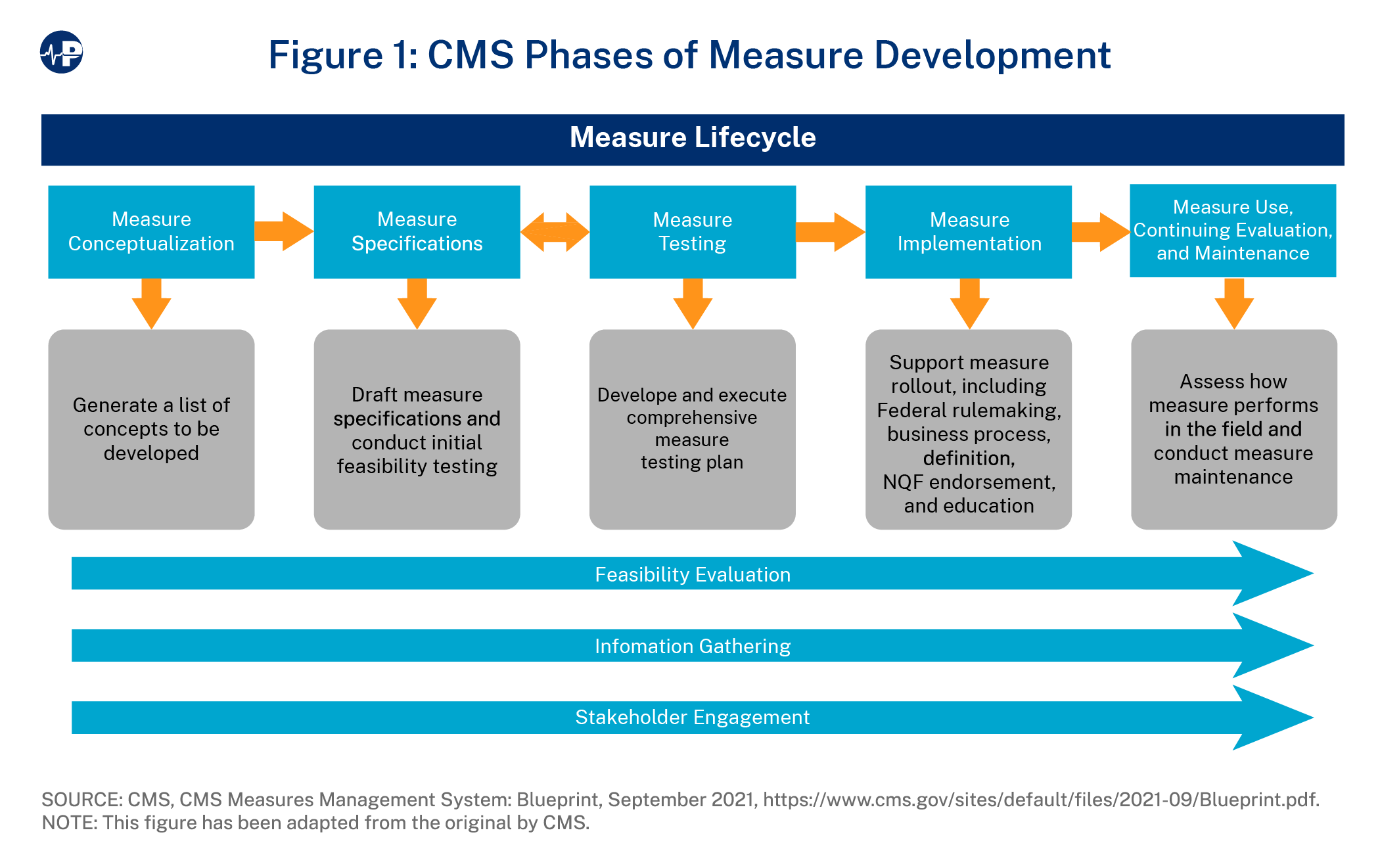
The process of adding or removing measures is highly formalized by government procedures. Current law requires a series of pre-rulemaking tasks before measures are proposed in regulation, such as submitting measures for placement on a “measures under consideration” list.14 CMS must also contract with a consensus-based entity (CBE), which “endorses” quality measures developed and maintained by “measure stewards” that can include public or private entities (see Figure 2).15 To get a sense of the scale of this industry, the National Quality

Forum, a nonprofit organization created in 1999 that was CMS’s CBE until 2023, counted over 400 member organizations in 2022.16 Likewise, the scale of Medicare’s quality programs has become significant. According to a triennial report released in 2024 on the national impact of its quality measures, CMS had about 492 unique measures across 26 quality programs.17
Rewarding Quality
Medicare’s quality programs aim to shape provider behavior by adjusting payment, usually adding or subtracting a small percentage of total program payment for health care services, depending on whether providers comply with particular requirements. This may mean completing a required activity (such as data reporting or adopting certain health technology) or achieving a desired result (such as a certain performance score on a quality measure).
QRPs usually apply negative payment adjustments to providers who do not fully comply with data reporting requirements. In a VBP or P4P program, the adjustment can entail either rewards or penalties, respectively representing “upside” or “downside” risk, for performance against quality measures. There are numerous considerations in designing these payment incentives, including:
- The nature of the incentive. For example, CMS may measure achievement on an absolute scale, relative to other participants, or in terms of improvement over time. It may also calculate payment adjustments on a “continuous” scale or based on specific thresholds, as may be the case in a “pass/fail” structure.
- The size of the incentive, often as a percentage of Medicare payment.
- The level of measurement, such as the individual practitioner versus the group or practice level.
- The timing of incentives, such as the length of time between performance and payment periods or whether payment is retrospective or prospective.
- Overall participation rules. Some programs are voluntary while mandatory programs may include exemptions on a temporary basis (such as “extreme and uncontrollable circumstances”) or permanent basis (including “low volume” thresholds that exclude small providers).
P4P and QRP incentives generally maintain the underlying architecture of FFS, but other initiatives significantly restructure payment. In traditional Medicare, these policies are most often tested on a limited basis within APMs. Such models often incorporate quality metrics but are frequently designed to encourage value by shifting financial risk onto providers so that they stand to benefit through more effective care management—for example, keeping patients healthier can mitigate the need for costly health care procedures in the future. However, these methods may also encourage under-provision of care in some cases in order to reduce costs. Such models of payment may take one of a few different forms or some combination thereof:
- Shared savings arrangements apply payment adjustments based on how provider expenditures compare to a target level. These are often applied to groups of providers called accountable care organizations (ACOs). Providers keep a percentage of the difference between their actual and target spending (hence, “shared savings”). If the program is designed on a two-sided basis, there may also be “shared losses” for spending that exceeds the target. Sharing savings may be contingent upon criteria such as achieving a minimum level of savings or quality performance. The Medicare Shared Savings Program, a statutory ACO model, is the most prominent example. As of 2021 there were roughly 10 million beneficiaries assigned to ACOs, about 28 percent of total traditional Medicare enrollment.18 In 2024, about 67 percent of participants in the Shared Savings Program faced some level of downside risk ranging from 1 percent to 15 percent of their revenue.19 CMS has said that it hopes to have all traditional Medicare beneficiaries in “accountable care relationships” by 2030.20
- Episode-based payments reimburse providers for specific episodes of care or health conditions rather than per service. Examples of this may include diagnosis-related groups of conditions treated in inpatient settings or “bundled” payments for outpatient procedures that cover both primary and ancillary services. As with shared savings, payment levels are established using a target price for the episode. Providers retain savings below that price or may bear costs above it, which incentivizes more efficient treatment.
- Population-based payments reimburse providers for the total cost of care for their patient populations. For example, they may receive “capitated” per beneficiary per month payments. Similar to episode-based payments, these encourage providers to keep costs within a specific budget. Outside of APMs focused on providers, capitation is also used in MA, albeit for payers rather than providers.
MEDICARE’S INEFFECTIVE APPROACH TO QUALITY MEASUREMENT
Continued Problems with Health Care Quality
Despite the lofty goal of using the country’s largest payer to drive quality in the entire health care system, errors and waste persist. Physicians believe that 20 percent of health care delivered in the United States is unnecessary.21 Studies find that a significant portion of health care spending, ranging from 5 percent to as high as 30 percent ($225 billion to over $1.35 trillion in 2022), is wasteful.22
More troublingly, serious diagnostic errors result from an estimated 5 percent to 15 percent of health care interactions.23 Inpatient hospital medication error rates are estimated to be roughly 5 percent.24 One study found that nearly a quarter of inpatient admissions result in adverse events, of which more than one-fifth were judged to be preventable and about one-third of which resulted in “serious” harm (i.e., requiring substantial intervention or prolonged recovery) or worse.25
Performance of Quality Programs
Over the past two decades, policymakers have expanded the scope of Medicare’s quality efforts to dozens of programs spanning across its payment systems, with hundreds of measures, billions of dollars in dedicated funding, and participation across the public, nonprofit, and for-profit sectors. Unfortunately, these programs have not been successful in improving quality of care in Medicare or the health care system.
The success of Medicare’s hospital P4P programs was limited from the start. A retrospective analysis of the Premier Hospital Quality Incentive Demonstration found no evidence that it achieved its goal of encouraging greater quality improvement, particularly among lower-performing hospitals.26 Two current programs the Hospital Readmissions Reduction Program (HRRP) and the Hospital-Acquired Condition Reduction Program (HACRP)—have also had disappointing results.
HRRP reduces annual payment updates for inpatient acute hospital services by up to 3 percent based on facilities’ unplanned 30-day readmissions rates after initial hospitalizations for select conditions. Studies have found that HRRP participants increase observation stays and emergency department visits after inpatient episodes in order to avoid penalties for readmissions. Participants have also been found to decline or delay appropriate readmissions, and one study found that the HRRP is actually associated with increased mortality.27
The HACRP evaluates hospital-acquired conditions such as infections or post-operative complications. It reduces payments each year by 1 percent for inpatient services furnished by the lowest-performing quartile of hospitals. Relatedly, since 2008, Medicare has not paid hospitals to treat certain hospital-acquired conditions. While it makes sense not to financially reward hospitals for causing harm to patients, these efforts have not necessarily reduced such infections.28 The HACRP’s efforts to reduce such outcomes have also been flawed. Studies have found that it suffers from poor measure construction and targeting of penalties, the latter of which tend to punish hospitals more based on their patient case-mix rather than poor clinical performance.29
Another major attempt to transition Medicare toward value was tying clinicians’ annual payment updates to participation in MIPS or advanced APMs. These programs, along with their predecessors, have also had little success.30 MIPS is a P4P program that adjusts payments up to 9 percent (with most positive and negative adjustments) depending on clinician performance within four measure domains. The program’s basic design (large swaths of clinicians are exempt and participating practitioners can pick which measures to report) and complex reporting requirements (which force practitioners to devote many hours and dollars to reporting and compliance) have made it both unhelpful for patients and burdensome to participants. Meanwhile, payment bonuses meant to induce more providers to join advanced APMs have not done so. These APMs have also largely failed to save money as intended.31
Despite the hopes for “value-based care” initiatives, the failure of Medicare’s quality improvement programs has been difficult to ignore. Since 2019, Congress’s Medicare Payment Advisory Commission (MedPAC) has recommended replacing Medicare’s hospital quality programs with a single value incentive program.32 MedPAC also advocated for replacing MIPS with a voluntary value program in 2018.33 MedPAC’s findings show that policy experts are willing to acknowledge the programs’ disappointing results, although some recommend simply enacting new iterations of these programs.
Medicare’s current approach to quality improvement may be considered the worst of both worlds: It largely retains the default arrangement of FFS reimbursement with administrative pricing and exacerbates the economic distortions and costs of government micromanagement without effectively requiring accountability for quality or value in general. The following subsections examine more closely specific factors that have hindered Medicare’s quality programs and the lack of success by policymakers in addressing them.
Large and Unbalanced Measure Inventory
The expansion of Medicare’s quality programs over time indicates policymakers’ confidence in their potential, but such growth has been to these programs’ detriment. In particular, the growing number of metrics imposed on providers not only increases reporting burden for providers—compliance costs for all-payer quality programs have been estimated to be between $15 billion and $18 billion annually for physicians—but may actually harm the programs’ effectiveness by introducing confounding variables, contradictory incentives, and opportunities for gaming.34 It also complicates meaningful quality comparison for patients and other stakeholders.
The composition of CMS’s measure inventory has also been scrutinized. Some policy experts have recommended refocusing measurement toward health outcomes and patient experience rather than box-checking exercises that have come to consume more of providers’ time.35 Simply shifting the types of quality measures would not be a panacea. For example, while patient experience metrics can be a direct way of measuring the degree of “person-centered” care, it can be difficult to design them so that they are clear to patients, objective, and relevant to care.36 But it is true that the prevalence of process measures tend to be burdensome and unimpactful. Asking providers process-based questions—such as the share of patients who are screened for social drivers of health or the percentage of personnel who are up to date on their COVID-19 vaccines—may reflect useful practices in certain instances, but they are not necessarily relevant to patients or their reasons for seeking care in the first place. Rather, they reflect the priorities of CMS.37
Even as federal officials have nominally recognized the complexity of Medicare’s quality programs and declared their intention to simplify and rebalance their measures, progress has been slow. Between 2016 and 2020, CMS reduced the overall number of measures by about 32 percent, but between 2020 and 2023 this decline was only 4 percent, and there are still roughly 500 unique measures. Furthermore, 51 percent of measures were process-based in 2020, roughly the same as in 2023.38 Between 2021 and 2023, 40 percent of the 123 additional measures CMS proposed were outcome measures, and 33 percent were process measures.39
Results also differ by individual programs. For MIPS, the total inventory of measures declined by 27 percent, but almost 70 percent of its measures in 2023 were still process-focused, and only 30 percent were based on outcomes or patient experience.40 For the MIPS “Quality” measure domain (which accounted for 30 percent of the total MIPS score in 2023), clinicians had to choose six measures to report out of roughly 200, which allows them to report just a few metrics for payment purposes—presumably only the ones in which they will perform well.41 CMS has touted plans to replace “traditional MIPS” with MIPS Value Pathways, a framework of consolidated and cross-cutting quality measures intended for simpler reporting and feedback targeted to particular specialties. The start of this initiative was delayed from 2021 to 2023, and the Biden administration has said that more funding is needed to fully implement it.42
Flawed Measures
Medicare’s quality measures also suffer from underlying flaws that seriously compromise their ability to predict quality. For example, measures may be “topped out,” meaning that performance is so high that further improvement is not possible, making them attractive targets for easy compliance but less useful for comparability. CMS had established a fouryear timeline for removing topped out measures from MIPS starting in 2018.43 Yet about 60 percent of applicable measures in the MIPS “Quality” domain for 2024 (which accounts for about 30 percent of the total MIPS performance score) were topped out, and roughly 58 percent of those were “high priority” measures with special weight.44
Another technical issue is the prevalence of measures that lack benchmarks, meaning clinician performance cannot be compared with any baseline level and therefore progress cannot be meaningfully measured. About 41 percent of the metrics in the MIPS Quality measure domain do not have benchmarks.45
More fundamental is the question of whether measures actually predict real-world quality of care. Performing well on measures is not an end in itself, and there is little point to rewarding it if the underlying measures do not correlate with quality. Unfortunately, Medicare’s quality programs have also largely failed on this front. A 2018 review of 87 measures found that only 37 percent were “valid” under criteria set by the American College of Physicians.46 Numerous individual measures may lack evidence as to their usefulness: Roughly 34 percent of the measures listed in CMS’s inventory do not have evidence associated with them.47 Furthermore, a 2019 Government Accountability Office (GAO) report found that CMS did not have processes in place for determining whether the quality measures it uses even align with the strategic objectives of its programs. As of May 2024, none of the recommendations from that report have been fully addressed and were last updated in August 2023.48
Effectiveness of Payment Incentives
The complexity and ineffectiveness of Medicare’s quality measures are enough to undermine the utility of its programs, but policymakers should also keep in mind that financial incentives to adopt certain behaviors can fail as well. One cross-country review of private and public performance-based quality programs from 2016 suggests that “P4P is not motivating quality improvement in a manner anticipated by payers or predicted by economic theory,” because quality improvement does not appreciably lead to financial gain.49
One factor influencing the strength of the incentives is their size. In theory, large swaths of Medicare providers face downside risk to some extent: Hundreds of thousands of clinicians participating in MIPS are subject to 9 percent payment reductions for poor performance, and there are cumulative penalties of up to 6 percent across hospital P4P programs.50 But in practice, net adjustments to hospitals are usually less than 2 percent of Medicare payments, while the share of MIPS clinicians receiving penalties has never exceeded 5 percent in a given year.51 Reporting requirements may impose greater costs than poor performance penalties: Clinicians participating in MIPS on average faced $10 in additional costs for every $1 earned in performance bonuses in 2021.52
Some researchers have suggested that a higher degree of micromanagement by payers or quality measurers may be necessary to make payment incentives work. A 2023 review of VBP programs found that “higher intensity” VBP programs with stronger performance-based incentives and non-financial supports (such as technical assistance for participants) were more likely to have spending reductions and improved quality utilization, while “lower intensity” VBP programs were more likely to show no effect. Higher intensity VBPs mostly included models managed by private payers, while all of Medicare’s FFS P4P programs were lower intensity.53 However, the degree of involvement from CMS needed to replicate these findings may be neither feasible nor desirable given its poor track record of managing its quality programs so far and the risks of excessive government interference in the practice of medicine.
Growth in Spending
The development of a labyrinthine quality bureaucracy has come with a bevy of federal funding. According to the 2019 GAO report, CMS is unable to even track the scale of funding that it devotes to quality programs and the measure development process.54 By one estimate, its total spending on measure development alone exceeded $1.3 billion between 2008 and 2018.55 Federal funding beyond P4P activities makes its way to private entities as well. For example, Medicare spends billions of dollars for contractors such as QIOs (which are paid out of the Medicare trust funds) to conduct technical assistance for providers.56
Given the large amounts of funding that CMS devotes to quality initiatives, it is no surprise that an entire health care quality measurement industry has emerged. Indeed, much of the work of creating, maintaining, and evaluating measures comes from for-profit companies and nonprofit organizations utilized by CMS. The intent of the formalized processes for stakeholder feedback is to maintain evidentiary rigor behind these activities. Private development of quality metrics can be a useful exercise. However, these private entities have grown increasingly symbiotic with the public funding from CMS’s quality apparatus: A “quality-industrial complex” has benefitted from the bloat of such programs despite the lack of a concomitant increase in health outcomes that can be directly linked to them. Industry stakeholders in “consensus-based” processes can even limit significant changes to the quality programs. Historical accounts have cast doubt on the ability of CBEs to rebalance quality measurement activities, as “vested interests” have resisted and delayed the development or implementation of outcome-based measures.57
An Unfocused Strategy
Various efforts to coordinate across CMS’s many quality programs have ironically created a similar glut of publications, conferences, and initiatives accompanied by buzzword-laden five- (or 10-, or 15-) point plans, goals, and statements of principles. In recent years, this has included:
- The establishment of the Core Quality Measures Collaborative in 2015, a public-private partnership between CMS and a trade group of health insurance companies to facilitate cross-payer quality measure alignment and development. It is convened by CMS’s CBE and includes over 70 member organizations as of May 9, 2024.58
- CMS’s development of a “Meaningful Measures” framework in 2017 (later followed by “Meaningful Measures 2.0”) to focus on increasing measure alignment across programs.59
- A “National Health Quality Roadmap” in 2020 that outlined principles for reforming the federal “quality measurement enterprise” through coordinated governance and oversight; modernized data collection, reporting, and sharing; and aligning and streamlining of measures.60
- CMS’s National Quality Strategy, which launched in 2022 and focused on advancing health equity and eliminating preventable harm.61
- A “Universal Foundation” proposed as part of the National Quality Strategy in 2023 to apply measures to as many programs as possible based on criteria of broad impact and applicability.62
Perhaps some of these approaches could lead to marginal improvement in quality measurement, but overall they indicate an unfocused strategy of more tinkering with the quality-industrial complex rather than a fundamental change of approach.
REFORMING MEDICARE’S QUALITY IMPROVEMENT PROGRAMS
Can Quality Measurement Be Fixed?
The previous section described the particular operational failures of Medicare’s quality improvement programs. This raises the question of whether fixing them is simply a matter of picking the right measures or payment policies, perhaps in line with the goals of the government initiatives described above. To many policy experts, this might simply entail more significant efforts to streamline the CMS measure inventory, rebalance it to focus on validated outcome and patient experience measures, and implement more significant two-sided payment incentives.
Of course, such an approach is easier said than done. Higher standards for measure validation will make them harder to develop and not necessarily make them more predictive. Focusing more on outcomes or patient experience also does not inherently improve the effectiveness of such metrics. In fact, it is likely that government measurement of quality simply falls short in principle, not just in practice. Any measurement-based approach, even with well-designed metrics and effective incentives, will face fundamental shortcomings. For example:
- Focusing on “measurable” aspects of quality diverts resources from factors that are also important but difficult or impossible to measure;
- Quality measures incentivize a focus on improving measured performance (i.e., gaming), which does not necessarily address underlying causes of quality and may lead to unintended consequences; and
- Attributing a given outcome to a specific clinical practice is often difficult.63 Indeed, multiple programs have been found to punish providers for factors outside of their control, such as having a patient population with greater health needs.64
Furthermore, there are intrinsic limitations to the government’s ability to effectively manage a quality improvement program:
- As with other large bureaucracies, governmental bodies are centralized and lack complete information about the markets they regulate;
- Unlike in the private sector, government decisions typically do not face any competitive or market pressures to self-correct or be economically efficient; and
- In part due to these factors, government tends to be procedural, consensus-driven, and risk-averse rather than organic, objective, and innovative.
From this perspective, retaining a significant government role in quality improvement through P4P programs is a doubly wrong approach. It calcifies flawed approaches to measuring and encouraging quality and is unable to respond to diverse and changing preferences among patients.
There are certainly approaches to quality measurement that could be more effective than the status quo. Detecting outliers in terms of poor clinical practice patterns or performance rather than marginal differences among typical providers (which may convey a false precision given the inherent difficulties of quality measurement) would be a possible strategy. One analysis found that just 7-13 percent of clinicians perform outside widely accepted standards of clinical appropriateness.65 A study of diabetes and cardiovascular disease measures for commercially insured patients found that 4-11 percent of physician groups were in the bottom quartile for all measures for four years in a row.66 Identifying such consistently poor performers would be a narrower goal and provide simpler information to patients, payers, and others.
There are numerous potential ways to detect poor outcomes:
- Measuring clinical errors, such as misdiagnoses or mistreatment, would be the most obvious potential approach given their unacceptably high level in the U.S. health care system. However, such metrics have not been successfully deployed.67 Difficulties in attributing poor outcomes to errors or detecting such outcomes over a longer time frame are potential obstacles. As programs such as HRRP have shown, gameability by participants is another concern.
- Metrics that are “process” oriented but more directly relevant to specific clinical circumstances could be another approach. This could include measuring clinician attention to “do not miss” diagnoses and “red flag” symptoms, avoiding common diagnostic pitfalls, or some combination of these concepts.68
- Similarly, highlighting deviation from high-consensus standards of care and “clinical appropriateness”—for example, performing certain procedures at a high rate, such as C-sections in low-complication births, despite clear evidence of no benefit or of increased risk to patients—could encourage providers to adapt to new clinical evidence and avoid unnecessary or harmful care in the first place.69 This would address the fact that measuring the outcome of a procedure does not consider whether the procedure was needed to begin with, which is a crucial element of health care quality.
- Soliciting patient feedback—such as by using a “What Matters Index” to measure objective quality-of-life metrics, including pain or adverse medication effects—can capture patient experience consistently.70
Still, even using improved measures within a government P4P program would run into the pitfalls identified above. The theoretical benefits of a measurement approach do not guarantee that CMS would be able to execute it well. What role, then, do CMS and the federal government have to play in improving health care quality?
Recommendations for Quality Improvement
Measuring and rewarding health care quality is difficult, and government programs simply have fewer and slower feedback mechanisms to adapt their efforts. Therefore, to the extent that government plays a role in encouraging health care appropriateness and quality, it should be as a facilitator of more transparent information rather than itself directing the development, selection, and rewarding on the basis of quality measures. There is no shortage of ideas about how government may do these things better, but it may be able to do more by doing less. Allowing private actors to meet these needs could free policymakers from having to make a dizzying amount of design decisions, which may entail contradicting trade-offs to achieve conflicting goals. In short, CMS should end its P4P efforts, including MIPS, HRRP, HACRP, and other VBP programs.
In some cases, certain private actors may not have the incentive, leverage, or ability to demand quality information or accountability. In these cases, there could be a limited government role in requiring health care entities to report meaningful data, with an eye toward minimizing administrative burden.
Appropriateness and quality data could be compiled publicly or in a format available for use by third parties such as researchers and quality measurement entities. Even without formal payment incentives, simply making data available to the public can have an impact. For example, when New York began to publicly release data on risk-adjusted death rates following cardiac surgery in 1989, deaths from such surgeries fell by 41 percent in four years.71 Informing providers themselves of where they stand may also spur poor-performers to improve even if results are not immediately publicized—different approaches may rely on the intrinsic motivation of providers to improve before or instead of extrinsic methods such as public reporting or financial incentives.72
Whether publicized directly or summarized through intermediaries, providing clear and meaningful appropriateness and quality data to consumers would be a significant step toward having health care services function as other markets do. In the absence of distortions from government P4P programs, private entities could play a bigger role acting as trusted sources of information to patients shopping for care or coverage. CMS itself may choose to collect and publish reputable third-party quality ratings on its online Care Compare or Plan Finder websites or facilitate the development of such platforms outside the government.
Third parties such as private payers could continue to rely on quality data to deploy their own payment incentives or otherwise inform the design of their contracts, benefit offerings, and provider networks (even if such efforts fall outside the traditional definition of “value-based care”). But how would Medicare reward value if simply eliminating P4P would entail a return to FFS payment?
Looking to Long-Term Payment Reform
In actuality, P4P programs never got rid of FFS payment; they simply built on its architecture to offer some financial incentive for providers to respond to other goals. The way to move beyond FFS has always been to pursue permanent reforms to traditional Medicare’s underlying payment systems.
Some of the considerations for Medicare payment reform go beyond the scope of this paper. One key question, for example, is to what extent policymakers should make use of new APMs or draw lessons from those already tested. Testing different modes of payment in limited circumstances may seem like a relatively incremental or low-stakes way to see what reimbursement methods work without having to pursue wholesale structural changes to Medicare. But the experience of models tested through the Center for Medicare and Medicaid Innovation (CMMI)—including the numerous failures in lowering Medicare spending, the high net cost when considering the agency’s funding and other Medicare payment incentives, and the extraordinary powers granted to CMMI in statute—suggest that this experimentation has run its course. Methods such as capitation and bundling that hold providers accountable for the total cost of care, applied on a permanent basis across providers and payment systems, would be a more effective way to promote value.
Allowing consumers to easily compare providers both on appropriateness and quality measures (or at least identify the subset of poor performing outliers) would provide a natural mechanism to encourage quality improvement. As a corollary to this, efforts to increase patients’ control over health care financing (for example, through access to savings accounts) would be a worthy goal for long-term Medicare reform. Such considerations acknowledge the reality that cost, not just quality, is a key component of value for patients. Providers’ billing practices, including their ease of use and transparency, is also a relevant dimension to how patients experience health care costs.
Many of these policy features are already present in MA. Fully capitated and risk-adjusted plan payments hold plans accountable for the total cost of care, the ability to shop for coverage (including using medical savings accounts) allows beneficiaries to exercise their preferences, and flexibilities in contract design give plans tools to control utilization. There are certainly ways policymakers can improve MA (including by removing the distortions from its own P4P initiative, the Quality Bonus Program), but encouraging continued access to it would also serve as a platform to quality improvement in the rest of Medicare and the health care sector as a whole.73
Conclusion
Health care quality is of paramount concern to patients and families, but the different structure of the health care sector from other markets, including distortions from government policies, complicates patients’ abilities to observe and pursue it. The outsized role of Medicare and CMS in quality improvement has not succeeded. Numerous operational failures and program-specific examples of this failure abound, but the fundamental shortcomings of quality measurement and government policymaking in general suggest that incremental reforms are not enough.
CMS should end Medicare’s P4P programs and—to the extent that it participates in quality improvement efforts—it should facilitate the collection and dissemination of meaningful quality data. Directly publicizing such data can help consumers shop for coverage and care, while sharing data with payers, providers, and other stakeholders can create more organic opportunities to compare and improve quality. Over the long run, permanent payment reforms, increased control of health care financing by patients themselves, and continued access to alternative models of payment and coverage (such as MA) can effectuate a departure from FFS and make the Medicare program and health care system as a whole more efficient, patient-oriented, and value-based.
Appendix

Footnotes
1↑ Michael E. Porter, “What Is Value in Health Care?,” New England Journal of Medicine 363, no. 26 (December 23, 2010), https://vbhcprize.com/wp-content/uploads/2014/03/Porter-What-is-value-in-healthcare.pdf
2↑ One major exception within Medicare is the Medicare Advantage (MA) Quality Bonus Program, which applies quality metrics to insurance plans rather than providers. Many of the shortcomings of fee-for-service quality programs also apply to this program. For a current list of quality programs in Medicare, see Appendix Table A1. For more discussion about the MA Quality Bonus Program, see Joe Albanese, “Improving Medicare Through Medicare Advantage,” Paragon Health Institute, February 2024, https://paragoninstitute.org/medicare/improving-medicare-through-medicare-advantage/
3↑ Joe Albanese, “Roadblock to Progress: How Medicare Impedes Health Care Innovation,” Paragon Health Institute, September 2023, https://paragoninstitute.org/medicare/roadblock-to-progress-how-medicare-impedes-health-care-innovation/
4↑ Emily Boudreau et al., “Comparison of Low-Value Services Among Medicare Advantage and Traditional Medicare Beneficiaries,” JAMA Health Forum 3, no. 9 (September 9, 2022), https://jamanetwork.com/journals/jama-health-forum/fullarticle/2796210
5↑ Katherine Baicker, Michael Chernew, and Jacob Robbins, “The Spillover Effects of Medicare Managed Care: Medicare Advantage and Hospital Utilization,” Journal of Health Economics 32, no. 6 (December 2013), https://www.ncbi.nlm.nih.gov/pmc/articles/PMC3855665/; Fangli Geng et al., “Increased Medicare Advantage Penetration Is Associated with Lower Postacute Care Use for Traditional Medicare Patients,” Health Affairs 42, no. 4 (April 2023), https://www.healthaffairs.org/doi/10.1377/hlthaff.2022.00994.
6↑ CMS National Health Expenditure Accounts data (historical) is available at https://www.cms.gov/Research-Statistics-Data-and-Systems/Statistics-Trends-and-Reports/NationalHealthExpendData/NationalHealthAccountsHistorical. See also Bureau of Labor Statistics, “Table 24. Historical Consumer Price Index for All Urban Consumers (CPI-U): U.S. City Average, All Items,” https://www.bls.gov/cpi/tables/historical-cpi-u-201710.pdf.
7↑ QIOs were originally created in 1972 as Professional Standards Review Organizations and renamed in 1983 as Peer Review Organizations. See Youssra Marjoua and Kevin J. Bozic, “Brief History of Quality Movement in US Healthcare,” Current Reviews in Musculoskeletal Medicine 5, no. 4 (December 2012), https://www.ncbi.nlm.nih.gov/pmc/articles/PMC3702754/; https://www.cms.gov/files/document/final-fy-2022-qio-rtc.pdf
8↑ CMS, “Current Termination Notices and CLIA Revocations, Suspensions and Limitations,” https://www.cms.gov/medicare/health-safety-standards/medicare-termination-notices; CMS, “Past Termination Notices,” https://www.cms.gov/medicare/health-safety-standards/quality-safety-oversight-general-information/past-termination-notices; CMS, “CMS Program Statistics—Medicare Providers,” 2021, https://data.cms.gov/summary-statistics-on-provider-enrollment/medicare-provider-type-reports/cms-program-statistics-medicare-providers.
9↑ David W. Bates and Hardeep Singh, “Two Decades Since To Err Is Human: An Assessment of Progress and Emerging Priorities in Patient Safety,” Health Affairs 37, no. 11 (November 2018), https://www.healthaffairs.org/doi/10.1377/hlthaff.2018.0738; Molla S. Donaldson, Janet M. Corrigan, Linda T. Kohn, eds., To Err Is Human: Building a Safer Health System, vol. 6 (Washington, D.C.: National Academies Press, 2000), https://books.google.com/books?hl=en&lr=&id=Jj25GlLKXSgC&oi=fnd&pg=PT25&ots=bKhbloL66L&sig=QCs_vOLofi2U142egyZ3bcDLfw8#v=onepage&q&f=false.
10↑ CMS, Report to Congress: Plan to Implement a Medicare Hospital Value-Based Purchasing Program, November 21, 2007, https://www.cms.gov/Medicare/Medicare-Fee-for-Service-Payment/AcuteInpatientPPS/downloads/HospitalVBPPlanRTCFINALSUBMITTED2007.pdf; CMS, “Medicare Program; Hospital Inpatient Value-Based Purchasing Program,” 76 Fed. Reg. 26490 (May 6, 2011), https://www.govinfo.gov/content/pkg/FR-2011-05-06/pdf/2011-10568.pdf.
11↑ Avedis Donabedian, “Evaluating the Quality of Medical Care,” Milbank Quarterly 83, no. 4 (December 2005), 691-729, https://onlinelibrary.wiley.com/doi/10.1111/j.1468-0009.2005.00397.x
12↑ CMS, “Types of Measures,” https://mmshub.cms.gov/about-quality/new-to-measures/types; Tamara Beth Hayford and Jared Lane Maeda, “Issues and Challenges in Measuring and Improving the Quality of Health Care,” Congressional Budget Office, December 2017, https://www.cbo.gov/system/files/115th-congress-2017-2018/workingpaper/53387-workingpaper.pdf.
13↑ CMS, “Blueprint Measure Lifecycle Overview,” https://mmshub.cms.gov/blueprint-measure-lifecycle-overview
14↑ CMS, “Pre-Rulemaking,” https://mmshub.cms.gov/measure-lifecycle/measure-implementation/pre-rulemaking/overview
15↑ CMS, CMS Consensus-Based Entity (CBE) Endorsement and Maintenance, December 2022, https://mmshub.cms.gov/sites/default/files/Blueprint-CMS-CBE-Endorsement-Maintenance.pdf
16↑ The size of this list has dwindled since the National Quality Forum (NQF) was replaced with a different CBE, down to about 300 as of October 2023 and 171 as of May 2024. NQF, “Statement from National Quality Forum Board of Directors Members at Large,” press release, February 9, 2023, https://www.qualityforum.org/News_And_Resources/Press_Releases/2023/Statement_From_National_Quality_Forum_Board_of_Directors_Members_At_Large.aspx; Michael Young and Mark A. Smith, “Standards and Evaluation of Healthcare Quality, Safety, and Person-Centered Care,” StatPearls, updated December 13, 2022, https://www.ncbi.nlm.nih.gov/books/NBK576432/; NQF, “Member Organizations,” https://i20.qualityforum.org/NQF/Membership_Listing.aspx.
17↑ Some measures are used in multiple quality programs. CMS, 2024 National Impact Assessment of the Centers for Medicare & Medicaid Services (CMS) Quality Measures Report, 2024, https://www.cms.gov/files/document/2024-national-impact-assessment-report.pdf
18↑ KFF, “Medicare Beneficiaries Assigned to Accountable Care Organizations,” https://www.kff.org/other/state-indicator/medicare-shared-savings-program-aco-assigned-beneficiaries/; KFF, “Total Number of Medicare Beneficiaries by Type of Coverage,” https://www.kff.org/medicare/state-indicator/total-medicare-beneficiaries/.
19↑ CMS, “Shared Savings Program Participation Options for Performance Year 2024,” March 2023, https://www.cms.gov/Medicare/Medicare-Fee-for-Service-Payment/sharedsavingsprogram/Downloads/ssp-aco-participation-options.pdf; CMS, “Accountable Care Organizations,” 2024, https://data.cms.gov/medicare-shared-savings-program/accountable-care-organizations.
20↑ Purva Rawal et al., “The CMS Innovation Center’s Strategy to Support High-Quality Primary Care,” CMS, June 9, 2023, https://www.cms.gov/blog/cms-innovation-centers-strategy-support-high-quality-primary-care
21↑ Jim Fields, Marty Makary, and Frank Roberts, “The Biggest Breakthrough in Appropriate Care: Less Is More,” Oliver Wyman Health, https://www.oliverwyman.com/our-expertise/perspectives/health/2019/jan/the-biggest-breakthrough-in-appropriate-care--less-is-more.html
22↑ William H. Shrank, Teresa L. Rogstad, Natasha Parekh, “Waste in the US Health Care System: Estimated Costs and Potential for Savings,” Journal of the American Medical Association 322, no. 15 (October 15, 2019), https://pubmed.ncbi.nlm.nih.gov/31589283/; Health Affairs, “The Role of Clinical Waste in Excess US Health Spending,” June 9, 2022, https://www.healthaffairs.org/content/briefs/role-clinical-waste-excess-us-health-spending; CMS, National Health Expenditure Accounts, https://www.cms.gov/data-research/statistics-trends-and-reports/national-health-expenditure-data/historical.
23↑ Robert A. Berenson, “If You Can’t Measure Performance, Can You Improve It?,” Journal of the American Medical Association 315, no. 7 (2016), 645-646, https://jamanetwork.com/journals/jama/fullarticle/2491628
24↑ Sicheng Zhou et al., “Analyzing Medication Error Reports in Clinical Settings: An Automated Pipeline Approach,” AMIA Annual Symposium Proceedings (December 5, 2018), 1611-1620, https://www.ncbi.nlm.nih.gov/pmc/articles/PMC6371341/
25↑ David W. Bates et al., “The Safety of Inpatient Health Care,” New England Journal of Medicine 388, no. 2 (January 11, 2023), https://www.nejm.org/doi/full/10.1056/NEJMsa2206117
26↑ Andrew M. Ryan, Jan Blustein, and Lawrence P. Casalino, “Medicare’s Flagship Test of Pay-for-Performance Did Not Spur More Rapid Quality Improvement Among Low-Performing Hospitals,” Health Affairs 31, no. 4 (2012), 797-805, https://www.healthaffairs.org/doi/pdf/10.1377/hlthaff.2011.0626
27↑ Michael F. Cannon and Jacqueline Pohida, “Would ‘Medicare for All’ Mean Quality for All? How Public-Option Principles Could Reverse Medicare’s Negative Impact on Quality,” Cato Institute, April 8, 2022, https://www.cato.org/sites/cato.org/files/2022-04/cannon-qhlj-v25n2.pdf; Ankur Gupta et al., “Association of the Hospital Readmissions Reduction Program Implementation with Readmission and Mortality Outcomes in Heart Failure,” JAMA Cardiology 3, no. 1 (2018), 44-53, https://jamanetwork.com/journals/jamacardiology/fullarticle/2663213; Rishi K. Wadhera et al., “Association of the Hospital Readmissions Reduction Program with Mortality Among Medicare Beneficiaries Hospitalized for Heart Failure, Acute Myocardial Infarction, and Pneumonia,” Journal of the American Medical Association 320, no. 24 (2018), 2542-2552, https://jamanetwork.com/journals/jama/fullarticle/2719307; Mitchell A. Psotka et al., “The Hospital Readmissions Reduction Program: Nationwide Perspectives and Recommendations: A JACC: Heart Failure Position Paper,” JACC: Heart Failure 8, no. 1 (January 2020), 1-11, https://www.sciencedirect.com/science/article/pii/S2213177919306754; Christopher Ody et al., “Decreases in Readmissions Credited to Medicare’s Program to Reduce Hospital Readmissions Have Been Overstated,” Health Affairs 38, no. 1 (January 2019), https://www.healthaffairs.org/doi/10.1377/hlthaff.2018.05178; Ankur Gupta and Gregg C. Fonarow, “The Hospital Readmissions Reduction Program—Learning from Failure of a Healthcare Policy,” European Journal of Heart Failure 20, no. 8 (August 2018), https://www.ncbi.nlm.nih.gov/pmc/articles/PMC6105419/.
28↑ Bates and Singh, “Two Decades Since To Err Is Human;” Grace M. Lee et al., “Effect of Nonpayment for Preventable Infections in U.S. Hospitals,” New England Journal of Medicine 367, no. 15 (October 11, 2012), https://www.nejm.org/doi/full/10.1056/nejmsa1202419
29↑ Ashish K. Jha, “To Fix the Hospital Readmissions Program, Prioritize What Matters,” Journal of the American Medical Association 319, no. 5 (February 6, 2018), 431-433, https://jamanetwork.com/journals/jama/fullarticle/2671454
30↑ Medicare Payment Advisory Commission (MedPAC), “Moving Beyond the Merit-Based Incentive Payment System,” in Report to the Congress: Medicare Payment Policy, March 2018, https://www.medpac.gov/wp-content/uploads/import_data/scrape_files/docs/default-source/reports/mar18_medpac_ch15_sec.pdf
31↑ Joe Albanese, “MACRA: Medicare’s Fitful Quest for Value-Based Care,” Paragon Health Institute, May 2023, https://paragoninstitute.org/medicare/macra-medicare-value-based-care/; Joe Albanese, “Escaping from Medicare’s Flawed Physician Payment System,” Paragon Health Institute, December 2023, https://paragoninstitute.org/research-paper-post-joe-albanese-escaping-from-physician-payment-medicare-20231205/.
32↑ MedPAC, “Hospital Inpatient and Outpatient Services,” in Report to the Congress: Medicare Payment Policy, March 2019, https://www.medpac.gov/wp-content/uploads/import_data/scrape_files/docs/default-source/reports/mar19_medpac_ch3_sec.pdf
33↑ MedPAC, Report to the Congress: Medicare Payment Policy, March 2018, https://www.medpac.gov/wp-content/uploads/import_data/scrape_files/docs/default-source/reports/mar18_medpac_entirereport_sec_rev_0518.pdf. CMS has also recommended replacing the MA Quality Bonus Program, which is geared toward payers rather than providers. MedPAC, “Redesigning the Medicare Advantage Quality Bonus Program,” in Report to the Congress: Medicare and the Health Care Delivery System, June 2019, https://www.medpac.gov/wp-content/uploads/import_data/scrape_files/docs/default-source/reports/jun19_ch8_medpac_reporttocongress_sec.pdf.
34↑ Robert A. Berenson and Laura Skopec, “The Medicare Advantage Quality Bonus Program,” Urban Institute, March 2024, https://www.urban.org/sites/default/files/2024-03/The%20Medicare%20Advantage%20Quality%20Bonus%20Program%20New%20Ideas%20and%20New%20Conversations.pdf
35↑ MedPAC, Report to the Congress: Medicare Payment Policy (2018); Berenson and Skopec, “The Medicare Advantage Quality Bonus Program;” Douglas B. Jacobs et al., “Aligning Quality Measures Across CMS—the Universal Foundation,” New England Journal of Medicine 388, no. 9 (February 1, 2023), 776-779, https://www.nejm.org/doi/full/10.1056/NEJMp2215539
36↑ Elysia Larson et al., “When the Patient Is the Expert: Measuring Patient Experience and Satisfaction with Care,” Bulletin of the World Health Organization 97, no. 8 (August 1, 2019), https://www.ncbi.nlm.nih.gov/pmc/articles/PMC6653815/; CBO, “Issues and Challenges in Measuring and Improving the Quality of Health Care.”
37↑ CMS, “Medicare and Medicaid Programs; Policy and Regulatory Changes to the Omnibus COVID-19 Health Care Staff Vaccination Requirements; Additional Policy and Regulatory Changes to the Requirements for Long-Term Care (LTC) Facilities and Intermediate Care Facilities for Individuals with Intellectual Disabilities (ICFs-IID) to Provide COVID-19 Vaccine Education and Offer Vaccinations to Residents, Clients, and Staff; Policy and Regulatory Changes to the Long Term Care Facility COVID-19 Testing Requirements,” 88 Fed. Reg. 36485 (June 5, 2023), https://www.govinfo.gov/content/pkg/FR-2023-06-05/pdf/2023-11449.pdf; Kristen O’Brien and Rachel Stauffer, “CMS Withdraws COVID-19 Vaccination Mandate, Enhances Focus on Quality Measures,” McDermott Consulting, June 1, 2023, https://www.mcdermottplus.com/insights/cms-withdraws-covid-19-vaccination-mandate-enhances-focus-on-quality-measures/.
38↑ CMS, 2018 National Impact Assessment of the Centers for Medicare and Medicaid Services (CMS) Quality Measures Report, February 28, 2018, https://www.cms.gov/medicare/quality-initiatives-patient-assessment-instruments/qualitymeasures/downloads/2018-impact-assessment-report.pdf; CMS, 2024 National Impact Assessment; CMS, 2021 National Impact Assessment of the Centers for Medicare and Medicaid Services (CMS) Quality Measures Report, June 2021, https://www.cms.gov/files/document/2021-national-impact-assessment-report.pdf.
39↑ See CMS’s lists of measures under consideration for 2023, 2022, and 2021 at https://mmshub.cms.gov/sites/default/files/2023-MUC-List-Overview.pdf, https://mmshub.cms.gov/sites/default/files/2022-MUC-List-Overview.pdf, and https://mmshub.cms.gov/sites/default/files/Overview-of-the-2021-MUC-List-20220308-508.pdf, respectively.
40↑ CMS, “Quality Payment Program Measure Development,” https://www.cms.gov/medicare/quality-payment-program/measure-development/measure-development
41↑ Specifically, there were 198 MIPS and Medicare Part B claims measures—172 when excluding duplicate measures across collection types. Albanese, testimony before the House Committee on Energy and Commerce. See also CMS, “Explore Measures and Activities,” https://qpp.cms.gov/mips/explore-measures
42↑ CMS, “Transition from Traditional MIPS to MVPs,” accessed May 9, 2024, https://qpp.cms.gov/resources/resource-library; U.S. Department of Health and Human Services, Fiscal Year 2025: Budget in Brief, https://www.hhs.gov/sites/default/files/fy-2025-budget-in-brief.pdf.
43↑ CMS, “Medicare Program; CY 2018 Updates to the Quality Payment Program; and Quality Payment Program: Extreme and Uncontrollable Circumstance Policy for the Transition Year,” 82 Fed. Reg. 53568 (Nov. 16, 2017), https://www.govinfo.gov/content/pkg/FR-2017-11-16/pdf/2017-24067.pdf
44↑ Specifically, there were 198 MIPS and Part B claims measures in the “Quality” category (including duplicate measures collected in different formats, some of which had different topped out statuses depending on the collection type). Removing measures with topped out status of “N/A” leaves 122 measures, of which 59 had a status of “yes;” 64 of those 98 measures were flagged as “high priority” measures. See CMS, “Explore Measures and Activities.”
45↑ Specifically, there are 172 unique MIPS and Part B claims measures in the “Quality” category (i.e., with duplicates removed), of which 70 are flagged as not having benchmarks. See CMS, “Explore Measures and Activities.”
46↑ Catherine H. MacLean, Eve A. Kerr, and Amir Qaseem, “Time Out—Charting a Path for Improving Performance Measurement,” New England Journal of Medicine 378, no. 19 (April 18, 2018), https://www.nejm.org/doi/10.1056/NEJMp1802595
47↑ Based on a search of the CMS Measures Inventory Tool on April 25, 2024. Out of 791 total measures (including duplicate measures used in multiple programs, 272 had the both the “Rationale” and “Evidence” fields listed as “N/A” or “Not available.” CMS, “Centers for Medicare and Medicaid Services Measures Inventory Tool,” https://cmit.cms.gov/cmit/#/MeasureInventory
48↑ GAO, Health Care Quality: CMS Could More Effectively Ensure Its Quality Measurement Activities Promote Its Objectives, September 19, 2019, https://www.gao.gov/products/gao-19-628
49↑ Adam A. Markovitz and Andrew M. Ryan, “Pay-for-Performance: Disappointing Results or Masked Heterogeneity?,” Medical Care Research and Review 74, no. 1 (2017), 3-78, https://www.ncbi.nlm.nih.gov/pmc/articles/PMC5858565/
50↑ The HRRP penalizes hospitals with excess readmissions by up to 3 percent of their payments, HACRP penalizes the 25 percent of hospitals with the highest rate of hospital-acquired conditions by 1 percent of payments, and the HVBP can penalize hospitals by over 2 percent. See MedPAC, “Redesigning Medicare’s Hospital Quality Incentive Programs,” in Report to the Congress: Medicare Payment Policy, March 2019, https://www.medpac.gov/wp-content/uploads/import_data/scrape_files/docs/default-source/reports/mar19_medpac_ch15_sec.pdf
51↑ MedPAC, “Redesigning Medicare’s Hospital Quality Incentive Programs;” Seema Verma, “Quality Payment Program Releases 2017 Physician Compare Data and Sees Increases in Clinician Participation Rates and Success for 2018,” CMS, archived at https://web.archive.org/web/20201119080252/https://www.cms.gov/blog/quality-payment-program-releases-2017-physician-compare-data-and-sees-increases-clinician; CMS, “Quality Payment Program (QPP) Participation in 2018: Results at-a-Glance,” https://qpp-cm-prod-content.s3.amazonaws.com/uploads/586/2018%20QPP%20Participation%20Results%20Infographic.pdf; CMS, “Quality Payment Program Participation in 2020: Results at-a-Glance,” https://qpp-cm-prod-content.s3.amazonaws.com/uploads/1783/QPP%202020%20Participation%20Results%20Infographic.pdf; CMS, “QPP 2021 Participation Results at-a-Glance,” https://qpp-cm-prod-content.s3.amazonaws.com/uploads/2432/2021%20QPP%20Participation%20Results%20Infographic.pdf.
52↑ Berenson and Skopec, “The Medicare Advantage Quality Bonus Program.”
53↑ This review analyzed studies of 21 VBPs among Medicare VBPs and APMs, private payers, and state-based or Medicaid programs from 2000 to 2020. It included three quality programs within Medicare’s FFS payment systems: the Hospital Readmission Reduction Program, the Hospital Value-Based Purchasing Program, and the Physician Value-Based Modifier Program. Abhinav Pandey et al., “Value-Based Purchasing Design and Effect: A Systematic Review and Analysis,” Health Affairs 42, no. 6 (June 2023), https://www.healthaffairs.org/doi/10.1377/hlthaff.2022.01455
54↑ GAO, Health Care Quality.
55↑ Debra L. Beck, “CMS Allocated $1.3 Billion to Quality Measure Development Over 10 Years,” MedScape, May 13, 2020, https://www.medscape.com/viewarticle/930430
56↑ Office of Management and Budget, “Appendix,” Budget of the U.S. Government, Fiscal Year 2025, https://www.whitehouse.gov/wp-content/uploads/2024/03/appendix_fy2025.pdf; CMS, The Administration, Cost, and Impact of the Quality Improvement Organization Program for Medicare Beneficiaries, November 2023, https://www.cms.gov/files/document/final-fy-2022-qio-rtc.pdf.
57↑ Michael Porter and Elizabeth Olmsted Teisberg, Redefining Health Care: Creating Value-Based Competition on Results (Cambridge, MA: Harvard Business Review Press, 2006), 134.
58↑ Partnership for Quality Measurement, “About Core Quality Measures Collaborative (CQMC),” https://p4qm.org/CQMC
59↑ CMS, “Meaningful Measures 2.0: Moving to Measure Prioritization and Modernization,” https://www.cms.gov/medicare/quality/meaningful-measures-initiative/meaningful-measures-20
60↑ Department of Health and Human Services, National Health Quality Roadmap, May 15, 2020, https://www.hhs.gov/sites/default/files/national-health-quality-roadmap.pdf
61↑ Michelle Schreiber et al., “The CMS National Quality Strategy: A Person-Centered Approach to Improving Quality,” CMS, June 6, 2022, https://www.cms.gov/blog/cms-national-quality-strategy-person-centered-approach-improving-quality
62↑ CMS, “Aligning Quality Measures Across CMS—the Universal Foundation,” https://www.cms.gov/aligning-quality-measures-across-cms-universal-foundation; Jacobs et al., “Aligning Quality Measures Across CMS—the Universal Foundation.”
63↑ See J. Michael McWilliams, “Professionalism Revealed: Rethinking Quality Improvement in the Wake of a Pandemic,” NEJM Catalyst 1, no. 5 (August 19, 2020), https://catalyst.nejm.org/doi/10.1056/CAT.20.0226; Hayford and Maeda, “Issues and Challenges in Measuring and Improving the Quality of Health Care;” see also Table 1 in Berenson and Skopec, “The Medicare Advantage Quality Bonus Program.”
64↑ Eric T. Roberts, Alan M. Zaslavsky, and J. Michael McWilliams, “The Value-Based Payment Modifier: Program Outcomes and Implications for Disparities,” Annals of Internal Medicine, November 28, 2017, https://www.acpjournals.org/doi/10.7326/M17-1740; Lena M. Chen, Arnold M. Epstein, and E. John Orav, “Association of Practice-Level Social and Medical Risk With Performance in the Medicare Physician Value-Based Payment Modifier Program,” JAMA Network, August 1, 2017, https://jamanetwork.com/journals/jama/fullarticle/2646718; Heather E. Hsu, Rui Wang, and Carly Broadwell, “Association Between Federal Value-Based Incentive Programs and Health Care-Associated Infection Rates in Safety-Net and Non-Safety-Net Hospitals,” JAMA Network Open¸ July 8, 2020, https://jamanetwork.com/journals/jamanetworkopen/fullarticle/2767991; Julie Bonavitacola and Mary Caffrey, “Data Presented at AHA Shows Medicare’s HRRP Only Cut Readmissions for the Wealthy,” American Journal of Managed Care, November 5, 2022, https://www.ajmc.com/view/data-presented-at-aha-shows-medicare-s-hrrp-program-only-cut-readmissions-for-the-wealthy.
65↑ AHIP, “Clinical Appropriateness Measures Collaborative Project,” December 2021, https://www.ahip.org/documents/AHIP_AppropriatenessMeasures_2022.pdf
66↑ Christina A. Nguyen et al., “Using Consistently Low Performance to Identify Low-Quality Physician Groups,” JAMA Network Open 4, no. 7 (July 2021), https://www.ncbi.nlm.nih.gov/pmc/articles/PMC8319756/
67↑ Andrew P. J. Olson, Mark Linzer, and Gordon D. Schiff, “Measuring and Improving Diagnostic Safety in Primary Care: Addressing the ‘Twin’ Pandemics of Diagnostic Error and Clinician Burnout,” Journal of General Internal Medicine 36, no. 5 (May 2021), 1404-1406, https://www.ncbi.nlm.nih.gov/pmc/articles/PMC7878169/
68↑ Olson, Linzer, and Schiff, “Measuring and Improving Diagnostic Safety.”
69↑ AHIP, “Clinical Appropriateness Measures Collaborative Project.”
70↑ John H. Wasson et al., “Development of a Care Guidance Index Based on What Matters to Patients,” Quality of Life Research 27, no. 1 (January 2018), 51-58, https://www.jstor.org/stable/44856072; John H. Wasson et al., “Validation of the What Matters Index: A Brief, Patient-Reported Index That Guides Care for Chronic Conditions and Can Substitute for Computer-Generated Risk Models,” PLoS One 13, no. 2 (2018), https://www.ncbi.nlm.nih.gov/pmc/articles/PMC5823367/.
71↑ Porter and Olmsted Teisberg, Redefining Health Care, 56-58, 131-132, 136-137.
72↑ Berenson and Skopec, “The Medicare Advantage Quality Bonus Program.”
73↑ Albanese, “Improving Medicare Through Medicare Advantage.”
Related Content


Author

Acknowledgements
The author is grateful to John Brooks, Marty Makary, Christopher Pope, and the Paragon team for their exceptional comments and work in review of the paper.