Paragon Health Institute Icon White

Medicaid Reform

Medicaid’s open-ended financing rewards overspending and favors wealthy states, while crowding out care for the most vulnerable. The ACA worsened the problem by giving higher reimbursements for able-bodied adults. Reform is needed to restore fairness, improve efficiency, and refocus Medicaid on truly low-income patients.

Medicaid Reform

Medicaid’s open-ended financing rewards overspending and favors wealthy states, while crowding out care for the most vulnerable. The ACA worsened the problem by giving higher reimbursements for able-bodied adults. Reform is needed to restore fairness, improve efficiency, and refocus Medicaid on truly low-income patients.

The GOP can make the strong and accurate argument that fixing this bias in federal payments is shoring up the program to better serve the vulnerable. Paragon Health Institute, a think tank, has done the intellectual leg work for the GOP and rolled out proposals to rationalize the payment treatment over time.
The Wall Street Journal Editorial Board

Americans Want Common Sense Medicaid Reforms

Stopping Medicaid Money Laundering

Stopping Medicaid Money Laundering

Ending the Discrimination Against the Most Vulnerable

Eliminating Schemes that Put Illegal Immigrants on Medicaid

Paragon Pics

4AW SQUARE New York Per Capita Health Aide A0wUU000004zTPNYA2

New York’s Per Capita Home Health Aide Workforce Is Three Times Greater Than Other States’ Average

Recent investigative reporting and federal prosecutions have highlighted Minnesota as a hotbed of fraud for autism services and housing-related services, which are largely paid for by taxpayers through Medicaid. State data indicate that Minnesota would be a likely state for such fraudsters to hide in plain sight: Minnesota’s Medicaid spending on able-bodied, working-age people made eligible by the Affordable Care Act’s expansion is 51 percent higher than in other states, and 2.7 times the national average for disabled Medicaid enrollees.

State Medicaid expenditure data can indicate other states that are likely to have extreme Medicaid fraud that state officials overlook. According to the U.S. Department of Health and Human Services Office of Inspector General (HHS OIG), its work “consistently demonstrates that patients may be vulnerable to fraud and abuse in home and community-based settings.” Services in these settings are usually delivered by home health aides, who provide help with activities of daily living as well as monitoring medications, vital signs, and prescribed exercises, or by personal care aides, who generally have a more limited role focused on helping with activities of daily living, such as bathing, dressing, and light household tasks.

As shown in this Paragon PIC, New York stands out as an extreme outlier in the employment of home health aides. The Empire State has three times more home health and personal care aides per resident than the average of all other states: 314 per 10,000 residents versus just 105 for the rest of the country. California, the state with the second-largest concentration of these workers and where there is almost certainly significant fraud and waste in this area, has 222 per 10,000 residents, almost a third fewer than New York.

Home health and personal care aides accounted for 38 percent of New York’s job growth from 2023 to 2024. There are almost three times as many of these workers as there are in retail sales—or one for every 16 of the almost ten million New Yorkers working in nonfarm jobs. This growth is even more concerning because New York recently decided to consolidate all these services under one statewide fiscal intermediary—and is stonewalling watchdogs demanding transparency about how this sweetheart deal came about, amid suspicions that politicians made the deal before the bid was publicized.

3AW Minnesota Pre Enrollee Disabled Spend A0wUU000004yWtxYAE

Minnesota’s Per Enrollee Spending on Disabled Medicaid Enrollees Highest in the Country — More Than 2.7 Times the US Average in 2023

Federal investigations have exposed rampant scams in Minnesota’s Medicaid program. Estimates suggest that $9 billion in Medicaid funds may have been lost to fraud since 2018. Consistent with these revelations, state Medicaid spending data shows that Minnesota is out of step with the rest of the country. We previously highlighted that Minnesota spends 51 percent more per Medicaid enrollee in the ACA expansion group than the US average. This Paragon Pic examines another category of Medicaid enrollees: people with disabilities. In 2023, Minnesota spent more per enrollee with disabilities than any other state – and 176 percent more than the US average. This pattern comports with the fact that many of the fraudulent schemes that have been uncovered in Minnesota targeted home- and community-based services that provide care to people with disabilities.

10AW Paragon Pic State Spending Medicaid No Growth A0wUU000004K9uTYAS

As Medicaid Money Laundering Peaks in States, Reforms in the One Big Beautiful Bill Come to the Rescue

States are more reliant than ever on the federal government to pay for Medicaid. Federal taxpayers now cover nearly three-quarters of total Medicaid spending on a program originally designed to be a federal-state partnership with about a 60 percent federal share.

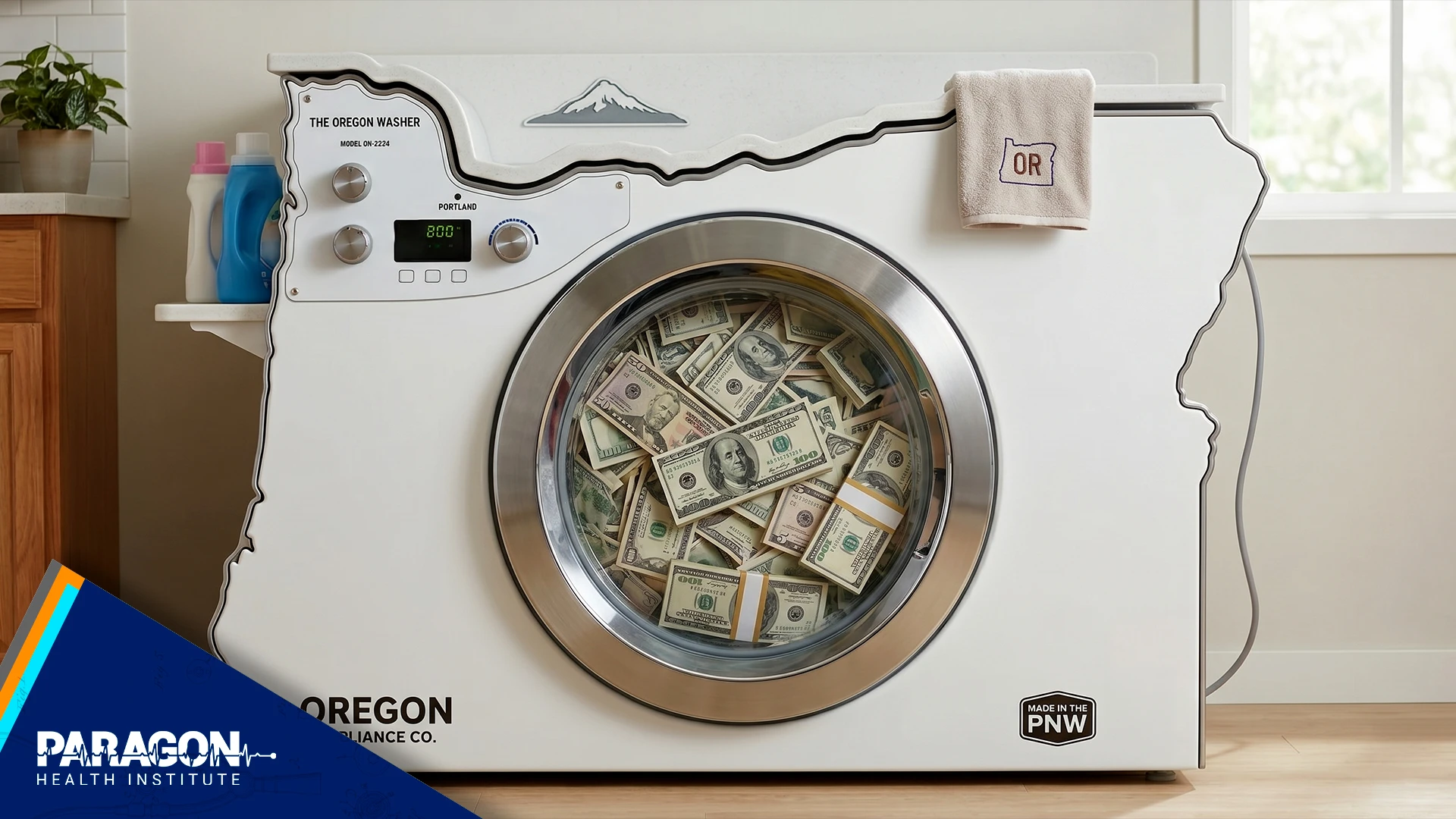
This imbalance is not accidental. States have exploited financing gimmicks such as provider taxes and intergovernmental transfers (IGTs) to inflate their reported expenditures and draw down more federal funds without any commensurate state cost. These schemes allow states to recycle dollars: health providers are “taxed” (with taxes they lobby in support of), and then those funds are funneled back to providers through higher Medicaid payments. This money laundering scheme effectively pads state budgets while shifting costs to the federal taxpayer.

In today’s Paragon Pic, we isolate Medicaid expenditures funded with laundered money using financial shell games from those funded with actual state dollars. The Pic also shows the proportion of Medicaid expenditures funded by the federal government.

The proportion of total federal spending on states’ Medicaid programs doubled in the last 30 years. Meanwhile, the state share of this spending with actual state dollars, meaning those not sourced through money laundering schemes, is flat over time. Today, money laundered funds from provider taxes and IGTs account for roughly 3 percent of all state spending. This amounts to a three-fold increase over the last three decades.

Paragon’s research finds that half of all states financed more than 30 percent of their share of Medicaid through provider tax revenue alone. These financing schemes distort Medicaid’s intent and erode fiscal accountability. Fortunately, in the One Big Beautiful Bill, Congress limited these financing gimmicks through critical reforms—which the Congressional Budget Office estimates will save $366 billion over the next decade. These provisions help restore integrity to the federal-state partnership and shield taxpayers from exploitation by these means.

7AW State Funding Gimmicks A0wUU000003xfGjYAI

State Funding Gimmicks Drive Unequal Ambulance Payments in Medi-Cal

This Paragon Pic demonstrates how states and public providers use intergovernmental transfers (IGTs) to inflate Medicaid spending and inappropriately pass higher costs to federal taxpayers. In 2022, California’s Medicaid program (Medi-Cal) paid both public and private ambulance providers the same rate: $339 per emergency transport.

In 2023, California established the Public Provider Ground Emergency Medical Transport Intergovernmental Transfer (PP-GEMT IGT) program, which resulted in Medicaid payments to public ambulance providers more than tripling. Private providers, who are excluded from the program, continue to receive $339 per transport, while public provider payments increased to $1,065 in 2023 and $1,168 in 2024.

California has proposed further increasing these payments under State Plan Amendment 25-0002, which is currently pending federal approval. If approved by the Centers for Medicare and Medicaid Services, public provider payments would rise to approximately $1,597 per transport in 2025. This means public providers would be paid nearly five times the private provider rate.

California’s public EMT providers are paid more because of the state’s use of IGTs. Through IGTs, public providers send funds to the state, and the state uses those funds to make Medicaid payments back to the provider, essentially using “laundered” funds to claim federal matching dollars—negating any actual state contribution. With those federal matching dollars, the state pays the public provider and often has money left over for unrelated purposes.

In 2023, providers were expected to contribute approximately $321.95 per transport through the IGT. They eagerly provide this amount because the use of recycled dollars to obtain federal funds guarantees them a higher payment.

The IGT contribution is designed to cover the nonfederal, or state, share of a massive add-on payment, plus a 10 percent administrative charge levied by the state on the transferred amount. In return, the state pays public providers a significantly higher total reimbursement, funded in part by the provider’s own contribution and in part by federal matching funds. Comparable data for 2024 and 2025 have not been publicly released, so we don’t know precisely how much provider contributions have changed alongside rising payment rates.

This is just one example of the Medicaid money laundering schemes states use to shift the cost of Medicaid to the federal government. California’s policy creates a stark disparity: public providers benefit from a high-dollar reimbursement mechanism that burdens the federal government, while private providers who deliver the exact same service receive far less. Over time, such payment gaps may weaken the financial viability of private ambulance services and reduce patient access, especially in areas where public providers do not operate. The policy solution is for the federal government to require payment parity and prevent states from paying government providers more than private providers for the same service.

Other Related Content

Related Glossary Terms

Supplemental Payments
A Medicaid supplemental payment is a lump sum payment paid by the Medicaid program to a health care provider in addition to Medicaid payments for specific health care services that have been rendered. These payments are largely received by hospitals and include DSH payments, upper payment limit (UPL) payments, uncompensated care pool (UCP) payments, and delivery system reform incentive (DSRIP) payments. By 2019, these payments grew to 17.5 percent of total Medicaid spending and 27 percent of Medicaid spending on hospitals. The growth in supplemental payments increases lobbying with government officials having discretion to award large Medicaid payments, payments consisting mostly or entirely…
Medicaid Expansion
Medicaid expansion is the Affordable Care Act’s change to broaden Medicaid program eligibility and increase the number of people who qualify for the program. A major component of this expanded eligibility for state Medicaid programs was eligibility for a new category of people—able-bodied, working-age, and generally childless adults. The ACA created a much higher FMAP for this category—equal to 100 percent from 2014-2016, gradually declining until it reached 90 percent in 2020, where it is scheduled to remain. This FMAP policy incentivized states to expand Medicaid because most of the budgetary costs for the population of expanded enrollees were paid…
Federal Medical Assistance Percentage
The Federal Medical Assistance Percentage (FMAP) is the statutory percentage of Medicaid expenditures paid by the federal government. For traditional Medicaid enrollees (low-income pregnant women, children, seniors, and individuals with disabilities), the FMAP is largely a function of state per capita income as states with lower per capita income receive a higher FMAP. No state receives an FMAP below 50 percent. For Medicaid expansion enrollees, the FMAP is equal to 90 percent. The actual percentage of Medicaid expenditures paid by the federal government is substantially higher than the FMAP since states employ numerous accounting gimmicks and financial schemes to minimize…
Average Commercial Rate
The average commercial rate (ACR) refers to the mean payment amount for a medical service as determined by leading commercial insurers’ reimbursement rates for the same service. The ACR may be used to define the maximum limit of a state Medicaid program’s supplemental payments to health care providers that are in excess of the state’s Medicaid standard rates. HHS guidance on ACR payments states when provider payment “is made up to the ACR states must submit data from the top (generally five) third party payers and provide a full explanation of the data that was extracted from providers’ accounts receivable…

Issue Experts

Brian Blase
President at Paragon Health Institute

Brian Blase, Ph.D., is the President of Paragon Health Institute. Brian was Special Assistant to the President for Economic Policy at the White House’s National Economic Council (NEC) from 2017-2019, where he coordinated the development and execution of numerous health policies and advised the President, NEC director, and senior officials. After leaving the White House, Brian founded Blase Policy Strategies and served as its CEO.

Gary Alexander
Director Medicaid and Health Safety Net Reform Initiative at Paragon Health Institute

A nationally recognized health services expert and government reformer, Gary D. Alexander was head of the Medicaid and Health Safety Net Initiative at the Paragon Health Institute from October 2021 to October 2025.

Subscribe

Sign up now for your health policy updates.

This field is for validation purposes and should be left unchanged.
Name(Required)