
Paragon Health Institute Icon White
Paragon Pic

Prescription Drug Prices Drop Even Faster Than in First Trump Administration—Hospital Price Inflation Still Hot

2Mh Prescription Drug Prices Drop Even Faster A0Wuu000005Ptivyai
Click the Pic to expand the image
John Graham Headshot 2 SMALLER Thumbnail

John R. Graham is a Visiting Fellow who contributes nearly three decades of health policy expertise to research across all of Paragon’s initiatives. He worked on Capitol Hill from 2021 to 2024 as a Professional Staff Member on the Senate Special Committee on Aging and the House Committee on Ways & Means. From 2018 to 2021, he served as the U.S. Department of Health & Human Services (HHS) Regional Director for Region 10 (Washington State, Oregon, Idaho, and Alaska), where he managed relationships with state governments and the private sector. In 2017-2018, John was the HHS Acting Assistant Secretary for Planning & Evaluation.

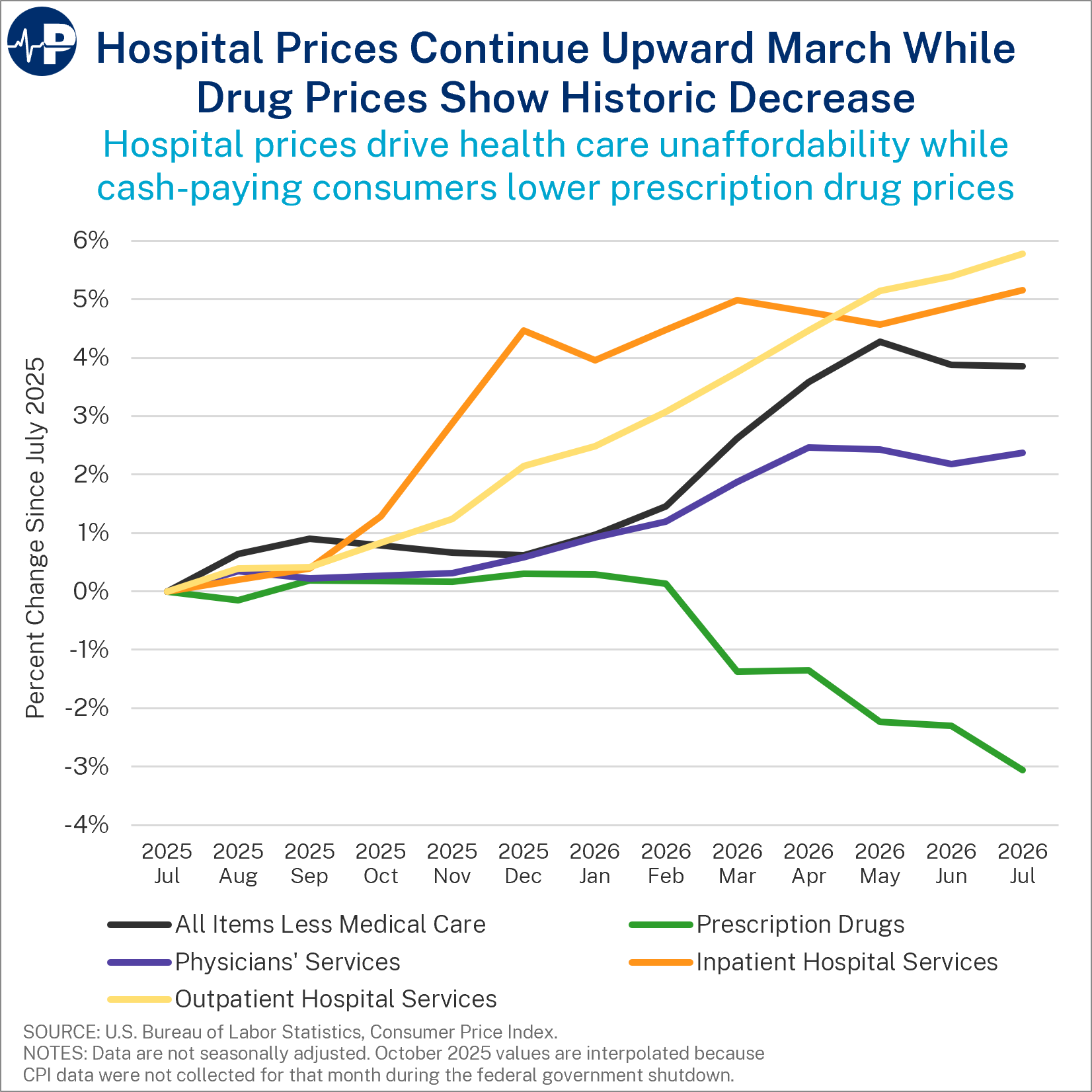
The media described the Consumer Price Index (CPI) report for July as showing inflation cooling for the second month in a row. One major exception is hospital prices, which continue to rise rapidly. Hospitals account for 31 percent of health spending, and prices for inpatient and outpatient services rose 5.2 percent and 5.9 percent respectively over the past year, nearly on par with what we found in last year’s Paragon PIC discussing inflation for the twelve months through July 2025. Prices for physician services grew about one and a half percentage points slower than prices for all items less medical care.

Most remarkable is the significant decline in prescription drug prices, a drop of 3.1 percent over the last twelve months—the largest decline in over six decades.1 Although retail prescription drugs only account for 9 percent of health spending, this is a welcome trend. It’s also reminiscent of the first Trump term. In the March 2019 Economic Report of the President, the Council of Economic Advisers (CEA) explained that “For the first time in 46 years, the Consumer Price Index for prescription drugs fell in both nominal and real terms during a calendar year” (p. 198). The CEA showed that prescription drug prices had been increasing about five percentage points faster than Personal Consumption Expenditures (PCE) from 2013 to the end of 2016. Beginning in 2017, they grew by only one percentage point faster than PCE (p. 236, fig. 4.7).2

The figure shows that the fall in drug prices started in February 2026. One notable development that month was the launch of TrumpRx, the Administration’s direct-to-consumer (DTC) website where patients can buy discounted medicines. TrumpRx launched with 43 branded medicines available and has since added many more drugs, so that it now offers over 800 medicines.

TrumpRx is a storefront that operates through vendors like GoodRx, Mark Cuban’s Cost Plus Pharmacy, and manufacturers’ own discount programs. These cash-pay channels bypass many of the “middlemen” that drive up drug prices and have gradually increased their own market share, up to about 9 percent of transactions in 2022. Even patients who have insurance coverage for outpatient drugs often find it less expensive to pay cash.

According to one market expert, “As cash-pay prices appear on a federally promoted platform, a new layer of public transparency sets in. Patient expectations around what a drug should cost could begin to anchor around those figures, creating internal pressure on manufacturers to rationalize the relationships between list price, net price, and DTC price.” Another industry insider credits a clarification from the U.S. Department of Health and Human Services Inspector General that manufacturers can sell directly to Medicare and Medicaid enrollees without triggering the Anti-Kickback Statute.

The benefit of DTC is most apparent with GLP-1s, the anti-obesity medications that have become very widely used. GLP-1s were among the first drugs available on TrumpRx in February, and the Administration also launched a demonstration called BRIDGE that allows Medicare beneficiaries to access them for a $50 copay. However, Medicare Part D insurers cover GLP-1s for diabetes or some other conditions but not obesity alone. Only 36 percent of employer-sponsored plans cover GLP-1 drugs for obesity—usually only with prior authorization—and that share is falling. The result is that the market for GLP-1 drugs is a consumer-driven market.

It is too early to estimate how much of the recent drug price reduction can be attributed to DTC platforms like TrumpRx. Since generics account for more than 90 percent of prescriptions, the steady approval of generic applications (particularly first generics) is an important driver of lower prices.  Others are attributing a portion of the decline to the Inflation Reduction Act (IRA). Medicare implemented negotiated prices for the first ten drugs subject to the IRA ­in January 2026. However, the timing and persistence of the decline make it difficult to attribute much of the trend to the IRA. The first negotiated prices took effect at a single point in January and applied to only ten drugs, but there was no significant price reduction that month, and the negotiated prices would not have kept trending down.

The precise causes of the historic decline in prescription drug prices will take time to disentangle, but consumers are clearly benefiting from greater competition and new ways to purchase medicines. The contrast with hospital care is striking: while drug prices are falling at their fastest rate in decades, hospital prices continue their relentless rise.

Footnotes

1 The accuracy of the CPI for prescription drugs is limited by a two-year lag in the basket of drugs used to estimate prices. Prices for 2026 are based on a basket of drugs available in 2024, and many new drugs are introduced every year. Prices represent transaction prices between the pharmacy, patient, and third-party payer, if applicable. The index excludes prices for prescriptions with no patient payment, such as hospital inpatient services or outpatient infusions or injections.
2 PCE and CPI are different measures of inflation produced by different federal agencies, the Bureau of Economic Analysis (BEA) in the Department of Commerce (PCE) and the Bureau of Labor Statistics (BLS) in the Department of Labor (CPI). The PCE is mostly compiled from business surveys and the CPI from consumer surveys. The PCE responds more quickly to substitution because it uses a chain-weighted index. So, when consumers switch to less expensive goods, it is reflected in the next month. The BLS updates the basket of goods and services in the CPI annually, with a two-year lag. (The 2026 CPI uses 2024 weights.)
2Mh Prescription Drug Prices Drop Even Faster A0Wuu000005Ptivyai

The media described the Consumer Price Index (CPI) report for July as showing inflation cooling for the second month in a row. One major exception is hospital prices, which continue to rise rapidly. Hospitals account for 31 percent of health spending, and prices for inpatient and outpatient services rose 5.2 percent and 5.9 percent respectively over the past year, nearly on par with what we found in last year’s Paragon PIC discussing inflation for the twelve months through July 2025. Prices for physician services grew about one and a half percentage points slower than prices for all items less medical care.

Most remarkable is the significant decline in prescription drug prices, a drop of 3.1 percent over the last twelve months—the largest decline in over six decades.1 Although retail prescription drugs only account for 9 percent of health spending, this is a welcome trend. It’s also reminiscent of the first Trump term. In the March 2019 Economic Report of the President, the Council of Economic Advisers (CEA) explained that “For the first time in 46 years, the Consumer Price Index for prescription drugs fell in both nominal and real terms during a calendar year” (p. 198). The CEA showed that prescription drug prices had been increasing about five percentage points faster than Personal Consumption Expenditures (PCE) from 2013 to the end of 2016. Beginning in 2017, they grew by only one percentage point faster than PCE (p. 236, fig. 4.7).2

The figure shows that the fall in drug prices started in February 2026. One notable development that month was the launch of TrumpRx, the Administration’s direct-to-consumer (DTC) website where patients can buy discounted medicines. TrumpRx launched with 43 branded medicines available and has since added many more drugs, so that it now offers over 800 medicines.

TrumpRx is a storefront that operates through vendors like GoodRx, Mark Cuban’s Cost Plus Pharmacy, and manufacturers’ own discount programs. These cash-pay channels bypass many of the “middlemen” that drive up drug prices and have gradually increased their own market share, up to about 9 percent of transactions in 2022. Even patients who have insurance coverage for outpatient drugs often find it less expensive to pay cash.

According to one market expert, “As cash-pay prices appear on a federally promoted platform, a new layer of public transparency sets in. Patient expectations around what a drug should cost could begin to anchor around those figures, creating internal pressure on manufacturers to rationalize the relationships between list price, net price, and DTC price.” Another industry insider credits a clarification from the U.S. Department of Health and Human Services Inspector General that manufacturers can sell directly to Medicare and Medicaid enrollees without triggering the Anti-Kickback Statute.

The benefit of DTC is most apparent with GLP-1s, the anti-obesity medications that have become very widely used. GLP-1s were among the first drugs available on TrumpRx in February, and the Administration also launched a demonstration called BRIDGE that allows Medicare beneficiaries to access them for a $50 copay. However, Medicare Part D insurers cover GLP-1s for diabetes or some other conditions but not obesity alone. Only 36 percent of employer-sponsored plans cover GLP-1 drugs for obesity—usually only with prior authorization—and that share is falling. The result is that the market for GLP-1 drugs is a consumer-driven market.

It is too early to estimate how much of the recent drug price reduction can be attributed to DTC platforms like TrumpRx. Since generics account for more than 90 percent of prescriptions, the steady approval of generic applications (particularly first generics) is an important driver of lower prices.  Others are attributing a portion of the decline to the Inflation Reduction Act (IRA). Medicare implemented negotiated prices for the first ten drugs subject to the IRA ­in January 2026. However, the timing and persistence of the decline make it difficult to attribute much of the trend to the IRA. The first negotiated prices took effect at a single point in January and applied to only ten drugs, but there was no significant price reduction that month, and the negotiated prices would not have kept trending down.

The precise causes of the historic decline in prescription drug prices will take time to disentangle, but consumers are clearly benefiting from greater competition and new ways to purchase medicines. The contrast with hospital care is striking: while drug prices are falling at their fastest rate in decades, hospital prices continue their relentless rise.
Footnotes

Related Research

No results found.
John Graham Headshot 2 SMALLER Thumbnail

John R. Graham is a Visiting Fellow who contributes nearly three decades of health policy expertise to research across all of Paragon’s initiatives. He worked on Capitol Hill from 2021 to 2024 as a Professional Staff Member on the Senate Special Committee on Aging and the House Committee on Ways & Means. From 2018 to 2021, he served as the U.S. Department of Health & Human Services (HHS) Regional Director for Region 10 (Washington State, Oregon, Idaho, and Alaska), where he managed relationships with state governments and the private sector. In 2017-2018, John was the HHS Acting Assistant Secretary for Planning & Evaluation.