
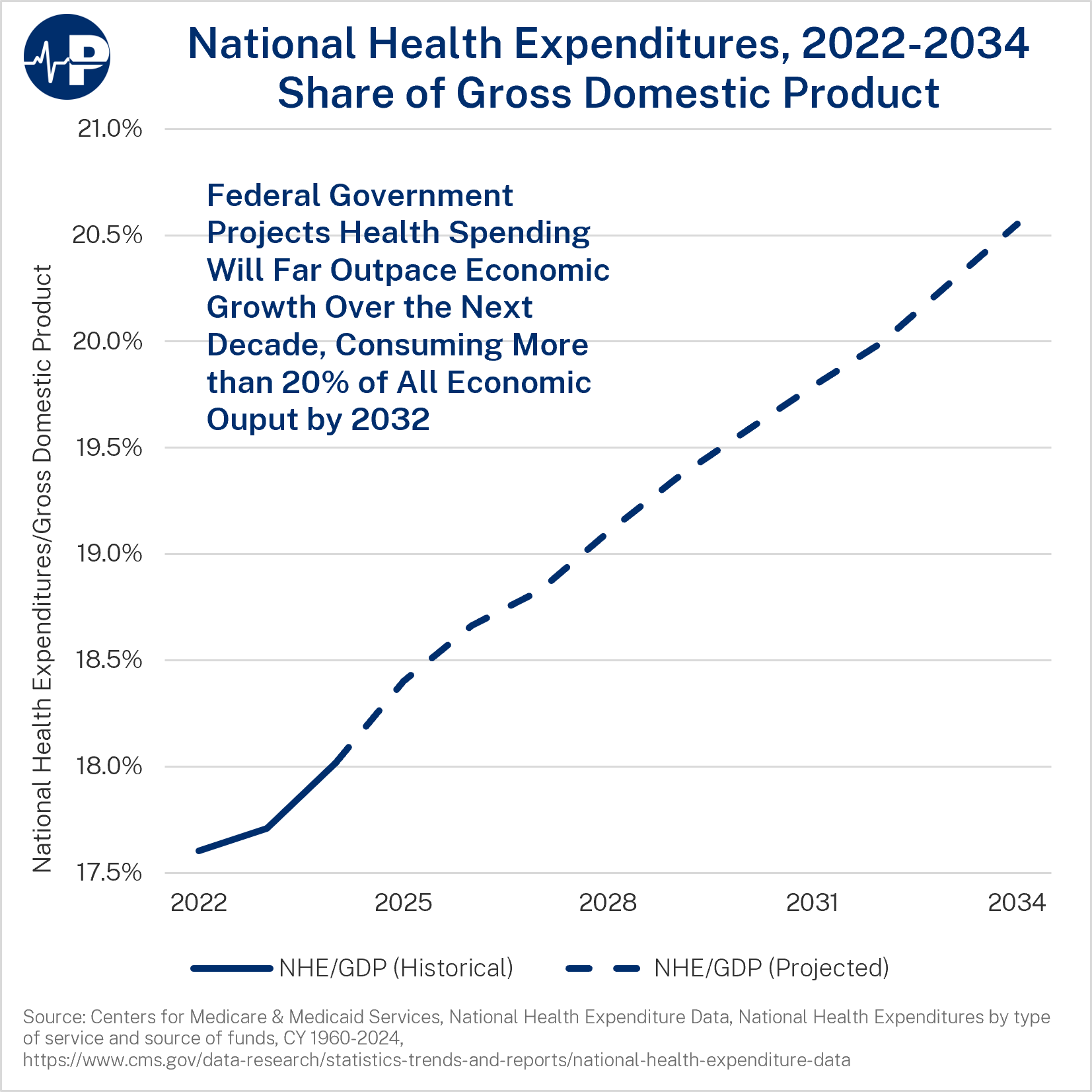

Earlier this summer, the Centers for Medicare and Medicaid Services (CMS) released its latest National Health Expenditures projections, and the outlook is alarming. National health spending is growing at more than 7 percent annually—about two percentage points faster than GDP. When health care consistently grows faster than the economy, it consumes an ever-larger share of national income. CMS projects that health care spending will exceed one-fifth of the U.S. economy early in the next decade.
Much of this growth reflects expanding federal involvement in health care. During the Biden administration, Medicaid enrollment increased dramatically because of pandemic-era continuous eligibility requirements, ACA subsidy expansions, and widespread improper enrollment in both Medicaid and the ACA exchanges. At the same time, states increasingly exploited financing arrangements such as Medicaid state-directed payments to draw down additional federal matching funds, largely to fund corporate welfare for large, politically powerful hospital systems.
Hospital services are the largest driver of spending growth. Hospital expenditures increased 8.9 percent in 2024 and are projected to rise another 8.2 percent in 2025—both well above overall health care spending. As John R. Graham documented in recent Paragon research, hospitals remain the least efficient major sector of American health care, yet they continue to command an ever-larger share of national health spending through market consolidation, government payment policies, and regulatory advantages. These trends reinforce the urgent need for reforms that promote competition, transparency, and more efficient delivery of care.
The implications extend well beyond health policy. Despite historically high federal revenues, annual budget deficits continue to approach $2 trillion because federal spending continues to rise even faster. In a 2023 Paragon research paper, Paul Winfree—now an advisor to Federal Reserve Chairman Kevin Warsh—explained how rapidly growing federal health care programs, together with rising interest costs on the national debt, are steadily consuming America’s fiscal space and limiting policymakers’ ability to respond to future economic, fiscal, and national security challenges. The latest National Health Expenditures projections reinforce that warning.