Dear Administrator Oz,
Paragon Health Institute appreciates the opportunity to comment on the Centers for Medicare & Medicaid Services (CMS) proposed rule, titled “Medicaid Program; Amending the Indirect Hold Harmless Threshold of Health Care-Related Taxes.” Paragon is a non-profit health policy research institute committed to reforming government programs so that Americans have greater control over their health care. We believe empowering consumers, not increasing government rules and subsidies, is the key to lowering costs and improving health outcomes.
For decades, states have used provider taxes to increase receipts of federal Medicaid matching funds without a commensurate state contribution, shifting a growing share of Medicaid costs to the federal government. Historically, the federal government financed roughly 60 percent of Medicaid spending, with states responsible for the remaining 40 percent. Today, the federal share exceeds 70 percent. When states bear a smaller share of Medicaid costs, they have less incentive to ensure that spending is efficient and appropriately targeted. Provider taxes exacerbate this problem by enabling states to draw additional federal funds while bearing little or none of the additional cost.
Concerns about these financing arrangements are neither new nor partisan. The Obama administration proposed reducing the permissible provider-tax threshold, and then-Vice-President Biden criticized provider taxes as a financing “scam” that allowed states to draw additional federal Medicaid funds. Congress has now enacted meaningful limits on these arrangements in the One Big Beautiful Bill Act (OBBB), including a moratorium on new or expanded taxes and a scheduled phase-down of the safe-harbor threshold for most provider classes. These reforms are sound fiscal and health policy because they restore greater state accountability for Medicaid spending and reduce incentives to maximize federal funds rather than efficiently operate the program.
CMS should faithfully implement the law Congress enacted by considering the sound policy principles underlying these reforms. We strongly support the proposed rule’s core provisions that would prevent states from circumventing Congress’s reforms. We recommend several changes to strengthen the final rule, particularly by establishing a single permissible class encompassing health insurers and Medicaid managed care organizations (MCOs) and preventing states from inflating the hold-harmless denominator with revenues from entities that do not pay the tax. The final rule should provide clear and durable rules while reducing opportunities for states to shift costs to federal taxpayers.
Background on Provider Taxes: Increasing Health Care Costs Without Supporting Rural Hospitals
Economic research shows that limiting states’ use of provider taxes will likely lower costs for commercially insured patients. This is because provider taxes generate a unique double windfall for health care providers: they allow hospitals to pass tax costs along to commercially insured patients in the form of higher prices, while simultaneously receiving elevated federal Medicaid matching funds.
In our empirical analysis of California’s 2010 hospital tax, we found the tax was associated with an increase in commercial hospital prices of 3.8 to 4.2 percent relative to prices in neighboring states without hospital taxes (Arizona, Oregon, Nevada). Because patient demand for hospital care is relatively insensitive to price, economic models indicate – and empirical studies have confirmed – that 45 to 80 percent of a provider tax is passed on to commercial payers.
Another reason provider taxes incentivize higher prices is because states use them to finance state-directed Medicaid payments. Because these payments have recently been tied to commercial rates, hospitals are incentivized to negotiate higher commercial rates to garner higher Medicaid reimbursements. A recent report from the Assistant Secretary for Planning and Evaluation (ASPE) at HHS found that the OBBB’s reforms that reduce provider taxes and excessive state-directed payments will reduce non-Medicaid prices by as much as 3.5 percent in markets with provider taxes. ASPE estimates that each single percentage-point reduction in provider tax rates reduces prices paid by non-Medicaid payers by 0.72 percent. This translates into $502 billion to $875 billion in benefits for non-Medicaid consumers over the 2025-2034 period.
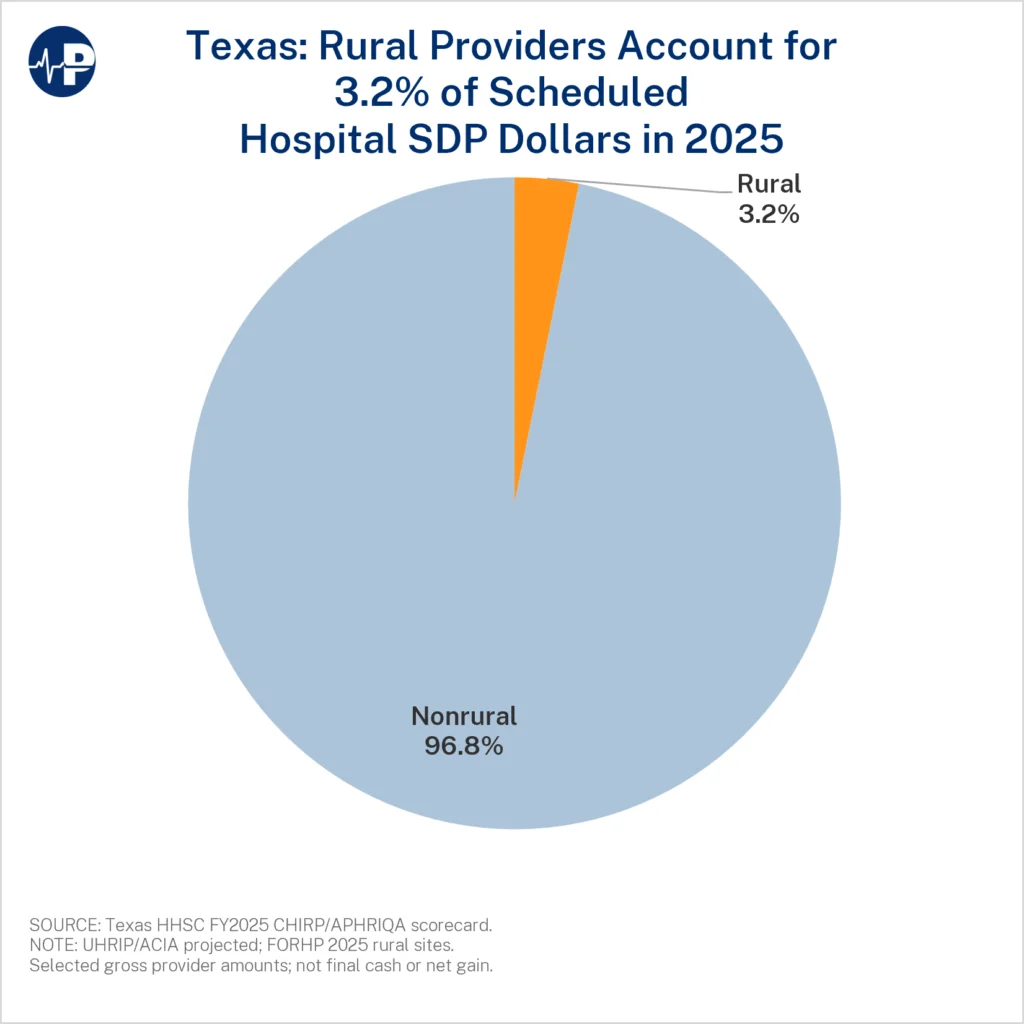
Opponents may argue that reforming provider taxes will harm rural hospitals, and by extension, the patients they serve. The theory is that since provider tax revenues fund SDPs and SDPs support rural hospitals, then curbing provider taxes would reduce support for rural hospitals. The evidence does not support such claims. A Paragon analysis examined rural hospital closures that occurred in the U.S. from 2005 to 2024. If provider taxes improved the financial stability of rural hospitals, closures should have been less common in states with provider taxes. The data show the opposite. States with hospital provider taxes throughout the 2005-2024 period experienced 21 rural hospital closures, while only one rural hospital closed in states without such taxes at any time during the 2005-2024 period. Adjusting for population does not alter this pattern: rural hospital closures in provider tax states were more than three times higher than in non-provider tax states—3.07 vs. 0.99 rural hospital closures per 10 million residents. Moreover, states without hospital provider taxes had more rural hospital employees per capita than states with such taxes. In fact, rural hospital employment declined relative to comparison states after states adopted hospital provider taxes.
One of the reasons for these findings appears to be that provider tax schemes are not well targeted to support rural hospitals. ASPE found that only 5 percent of total SDP spending in 2025 went to inpatient rural hospitals. So, using rural hospitals to defend all provider tax or SDPs generally is unsupported by the evidence.
Provider-tax reform therefore need not come at the expense of rural health care. Instead, it can reduce a distortionary financing mechanism that increases federal Medicaid spending, encourages higher commercial prices, and ultimately raises costs for patients and taxpayers.
Provisions We Strongly Support
- Timeline and Reporting for Applying the Threshold
CMS’s proposed rule provides ample time for states to comply and transition to the new system. States will begin quarterly reporting on October 1, 2026, submit preliminary estimates by December 31, 2026, and submit final reports based on actual data by June 30, 2028. CMS intends to establish final thresholds by September 30, 2028.
Many states will decry the reporting requirements as onerous red tape and seek more time. CMS has ample reason to be skeptical of these arguments because (1) states already have access to much of this information and (2) have had time to prepare in anticipation of these changes.
First, the history of provider tax implementation indicates states are meticulous and likely have much of the information. Because these schemes are lucrative, states regularly hire consultants to tailor each tax to maximize federal funds. As a result of these efforts, many states already have much of the information this rule requires. While states may need to collect some information, the interim timeline combined with the gradual reporting requirements should be enough to provide for this transfer of information.
Second, states have been on notice since July 4, 2025, that Congress restricted new or expanded provider taxes. While states could not anticipate every detail of CMS’s methodology, they had ample notice to begin tracking the information necessary to comply with the new limits.
Because of states’ ample notice and the proposed rule’s generous timeline, CMS should finalize these provisions and resist calls to extend the timeline.
- Limitation on Level of FFP for Revenues from Health Care-Related Taxes
CMS proposes using non-reporting as a basis for disallowance/withholding. If states go above the safe harbor, they would be required to return all federal funds associated with revenues from the impermissible tax, not just the amount above the threshold. Moreover, CMS would require revenues returned for all taxes on a class, not just revenues associated with the one that goes above the threshold.
As CMS notes, this proposal is not new. Rather, it reflects the statute’s language in Section 1903(w)(1)(A) as well as regulations in § 433.70. From a policy perspective, enforcing the return of all revenues signals serious enforcement. Its application to taxes across a class furthers this regulation’s purpose of preventing states from circumventing the safe harbor by breaking up a provider’s tax burden across multiple taxes. CMS should finalize this strong enforcement mechanism.
- Revision of the Second Prong of the Indirect Hold Harmless Test (the 75/75 Test)
This proposed provision eliminates the 75/75 prong, which some states may try to use to circumvent the new HH prohibition and go above the 6% threshold. CMS previously created the 75/75 test as a second level of flexibility. Even if a tax exceeds the 6% threshold, under the 75/75 test, states can still escape scrutiny if fewer than 75% of taxpayers pay less than 75% of the tax—a rather high floor.
Eliminating this test would prevent states from using it to circumvent these new rules. CMS rightfully acknowledges that risk and history validates it. States have often responded to financing reforms in 1991 and 2000 by developing alternative financing mechanisms rather than reducing spending.
We urge CMS to finalize this provision as-is because it would help prevent circumvention.
- Definition of “Enacted”
CMS interprets the phrase “enacted” in Section 71115 of the OBBB, which provides that in non-expansion states, taxes are grandfathered and not required to phase down if CMS determines that the state had enacted and imposed the taxes as of July 4, 2025.
Here, CMS correctly interprets the word “enacted” to mean that the tax’s structure had been approved by the legislative process. This interpretation would rightly exclude taxes that were imposed administratively rather than legislatively. A broader interpretation could allow states to materially modify existing taxes after the statutory cutoff while continuing to characterize them as grandfathered taxes. Such changes would be difficult to monitor. Therefore, CMS rightly interprets “enacted” to mean that the tax’s structure had been approved legislatively. Moreover, it would exclude taxes that states passed after July 4, 2025 and backdated.
Recommended Changes
In considering these changes, CMS should favor uniform federal standards that minimize state discretion and opportunities for states to restructure provider taxes to circumvent Congress’s reforms.
- To prevent circumvention, CMS should either combine MCOs and insurers into a single permissible class or, at a minimum, not finalize the proposed new insurer class.
i. Create one permissible class for both MCOs and insurers.
This proposed rule would add a new permissible class of providers that states can tax and claim federal matching funds. This class would include individual health insurance, employer health insurance, short-term health plans, dental-only coverage, vision-only coverage, certain Medicare insurance plans, and commercial plans used in some Medicaid premium-assistance programs. Because managed care organizations already count as a permissible class under 42 C.F.R. § 433.56(a)(8), they would not be included in this new class.
CMS is making this change because states are already using insurer taxes, as CMS notes that it is “aware that several States utilize taxes imposed on health insurers as the source of non-Federal share . . . despite health insurers not currently being identified as a permissible class . . . .” Since these taxes are not deemed permissible under § 433.56(a), CMS believes it must either “establish a prospective new permissible class or determine in which particular circumstances. . . to initiate compliance actions.”
CMS need not respond to existing noncompliance by creating a separate permissible class for commercial insurers. Instead, CMS should combine commercial insurers and MCOs into a single insurance-related permissible class.
Commercial health insurers and MCOs perform closely related functions. While federal regulations and state practices insulate MCOs from genuine insurance risk, both collect capitated premiums and pay fee-for-service claims for covered medical services. A single class would reduce artificial distinctions between affiliated insurance lines of business and require a state seeking to tax health insurance activity to satisfy the broad-based and uniformity requirements across a broader insurance base. Those requirements would impose real constraints on states’ ability to design taxes that concentrate the burden on particular insurers or lines of business. They are especially important because CMS regulations require state capitation rates to reimburse MCOs for their state premium tax costs. This federally sanctioned, mandatory hold harmless is grossed up based on the benefit FMAP, creating the most lucrative tax for insurers and states. Thus, uniformity across the widest base is the discipline that matters, and only a combined class would impose that necessary discipline.
Moreover, this change would be in line with longstanding Congressional policy. Congress has expressly designated MCO services as a permissible class and authorized the Secretary to include within that class “such other similar organizations as the Secretary may specify by regulation.” This language from Section 6051 of the Deficit Reduction Act of 2005 (DRA) was passed after a long series of efforts to erase the Medicaid-versus-commercial line in this market because states had been exploiting it. A single combined health insurance class subject to one broad-based uniformity test under 42 C.F.R. § 433.68 would be far simpler to administer and far harder to game.
This proposal would be a logical outgrowth of the proposed rule because CMS itself recognizes that there is “potential overlap” between the existing MCO class and the proposed health-insurer class. That overlap is especially significant because MCO and commercial insurance businesses frequently exist within the same corporate enterprise. Creating two separate permissible classes for closely related insurance activities would create an additional classification boundary that states and regulated entities could use to structure taxes differently across affiliated lines of business. A single class would reduce this opportunity and subject insurance-related taxes to the broad-based and uniformity requirements across a broader base.
Moreover, combining the classes would be a logical outgrowth of the proposed rule because CMS expressly solicits “comment on whether there should be a different approach to services of health insurers versus other permissible classes for measuring the indirect hold harmless threshold.” CMS did not present the proposed insurer class as a fixed, binary implementation detail. It specifically solicited alternatives concerning how the new class would operate within the existing provider-tax regime. Also, because the proposed rule repeatedly seeks to prevent states from structuring taxes around regulatory classifications to evade substantive limits, commenters were on notice that CMS could adjust the boundaries of overlapping permissible classes if those boundaries themselves created circumvention opportunities.
ii. Alternatively, CMS should not finalize the proposal.
If CMS concludes that it cannot appropriately combine commercial insurers and MCOs in this rulemaking, it should not finalize the proposed health-insurer class at this time.
There are several risks to finalizing this proposal that may inadvertently increase circumvention. Creating a new standalone class for commercial insurers would expand the universe of private entities subject to health care-related taxes without the guardrails of a combined class. Expanded participation could create additional opportunities for states and private parties to structure taxes and contractual arrangements around the boundaries between the two classes, opening opportunities for abuse and making compliance with the statutory hold-harmless prohibition more difficult to police.
Private redistribution arrangements illustrate the concern. In some provider-tax arrangements, private parties have entered into agreements under which Medicaid payments or other funds are redistributed among providers in a manner that may effectively compensate taxpaying providers for their tax costs. CMS has taken the position that such arrangements can constitute prohibited hold-harmless arrangements even when the State is not itself a party to the private redistribution. Courts, however, have disagreed over the statute’s application. The Eleventh Circuit has accepted CMS’s broader interpretation, while the Eastern District of Texas has concluded that wholly private arrangements fall outside the statutory prohibition absent sufficient State involvement.
That unresolved legal issue creates a practical enforcement problem. So long as the reach of the hold-harmless prohibition remains contested, certain private parties will have incentives to structure financial relationships that result in taxpaying entities being net beneficiaries once federal matching funds are drawn down by the state. Adding commercial insurers to the provider-tax framework as a separate class would expand the universe of entities available for such redistribution arrangements while creating another regulatory boundary around which taxes and related arrangements could be structured. The more entities, classes, and contractual relationships involved, the more difficult it may become for CMS to determine whether taxpayers are ultimately being held harmless for their tax costs.
CMS should also consider that corporate overlap could make such abuse harder to detect. Such overlap is the insurance market’s defining feature, not an edge case. For example, five publicly traded parent companies account for nearly half of national Medicaid MCO enrollment, and each also operates commercial insurance lines of business. As mentioned above, creating two separate permissible classes for closely related insurance activities would create an additional classification boundary that could be exploited.
If CMS concludes that it cannot appropriately combine commercial insurers and MCOs as suggested previously, it should not finalize the proposed health-insurer class at this time. CMS should instead first examine the amount of existing insurer-tax revenue that would become permissible under the proposal, the corporate and contractual relationships between taxed insurers and Medicaid payment recipients, and the safeguards necessary to prevent private arrangements from indirectly holding taxpayers harmless.
- Exclude non-taxed entities from the denominator used to calculate the hold-harmless threshold.
Throughout the rule, CMS takes the unprecedented step of permitting net patient revenue of non-taxpaying providers to count towards the denominator for calculating compliance with the hold harmless threshold.
CMS stated it would not define “net patient revenue” to only include “revenue associated with the providers within the permissible class that are actually taxed.” According to CMS, such a definition would be “inconsistent with our longstanding interpretation of the term and would therefore be disruptive to existing taxes.” CMS reiterates this interpretation several times throughout the rule.
CMS should not finalize this interpretation for several reasons.
First, including the revenue of non-taxed providers in the denominator creates a straightforward opportunity for circumvention. A state can exempt selected providers from the tax while using their revenue to increase the amount it can collect from providers that remain subject to the tax. Currently, Oregon has a provider tax scheme that other states may implement if this proposal is finalized. In Oregon’s scheme, the state exempts the largest hospital system in the state but still uses that system’s net patient revenue in the denominator, allowing the state to tax the other hospitals above the hold harmless threshold. Elsewhere in this proposed rule, CMS acknowledges the harms of such a structure, which is why it would require that states report if they “remove government-owned or government-affiliated providers that are also units of government from the tax obligation”
Second, the interpretation in the proposed rule is at odds with the statute’s purpose and the regulations. The statute’s hold-harmless test is meant to ensure that the state cannot simply promise to repay providers with federal matching funds for their tax revenues. It makes little sense to include revenues from an entity that does not pay the tax in this calculation when determining whether taxed providers are being held harmless.
Third, long-standing CMS regulations expressly state that the provider tax revenues must be less than or equal to 6 percent “of the revenues received by the taxpayer.” Regulatory history confirms that the hold-harmless threshold is calculated by comparing the tax revenue raised by the state to the revenues received by the specific tax-paying providers for the particular items and services subject to the assessment.
For all these reasons, the revenue of an exempt provider should not increase the denominator used to calculate the hold-harmless threshold. CMS should limit the denominator to revenues received by providers actually subject to the tax.
- Establish a uniform, cash-based measurement of net patient revenue in the regulation.
Every threshold in the proposed rule depends on the measurement of net patient revenue. As mentioned above, the proposed 42 C.F.R. § 433.52 defines net patient revenue as “revenues received by the taxpayer” attributable to the assessed class, regardless of payer. But the proposed rule does not clearly specify how those revenues should be measured. They could reflect cash actually collected or revenue recognized on an accrual basis, and the two measures can differ materially. This ambiguity could produce inconsistent thresholds across states and create opportunities for states to select methodologies that maximize permissible tax collections.
A cash approach is more objective and internally consistent with the rest of the system. The numerator of each ratio is the tax actually collected, and federal financial participation claiming and CMS-required quarterly state Medicaid reporting operate on a cash basis. An accrual approach, by contrast, requires judgments about contractual allowances, uncollectible amounts, and the timing of revenue recognition. These judgments can vary across providers and create unnecessary discretion in calculating the denominator. Using cash receipts for net patient revenue would match a cash numerator with a cash denominator while reducing opportunities to manipulate the threshold.
The measurement methodology is particularly important because CMS will use it to establish baselines against which future provider-tax collections are assessed. In states with longstanding taxes based on per-diem or per-unit charges, differences in how net patient revenue is measured could cause the federal threshold to diverge from the tax rate Congress grandfathered or subjected to phase-down. Because these thresholds will govern future compliance, CMS should establish the methodology clearly in the final regulation.
We therefore recommend that CMS specify in the final regulatory text:
- That net patient revenue be measured using a uniform cash-receipts methodology that states must apply consistently across baseline and ongoing reporting for the applicable provider tax and class;
- The data sources that satisfy the measurement requirement, including applicable cost reports and existing state assessment reporting; and
- How the uniform methodology applies to the construction of baselines for provider taxes in effect on July 4, 2025.
A single, objective methodology will make the thresholds easier to administer and enforce while reducing opportunities for states to manipulate the denominator to increase permissible provider-tax collections.
- Prevent states from using the correction period to shield intentional or excessive over-collections.
We agree that the enforcement authority described in the preamble to proposed 42 C.F.R. § 433.70 needs real teeth. CMS reserves the right to act before the correction period ends when over-collection is “excessive” or “intentional,” or when reporting is inaccurate or fraudulent. This authority is essential to prevent states from knowingly exceeding permissible thresholds and then using the correction period to delay the consequences. CMS should define “excessive” and “intentional” clearly enough to ensure that the correction period cannot become a safe harbor for circumvention.
CMS should specify in the regulatory text that:
- Excessive over-collection includes an exceedance beyond a reasonable tolerance for estimation variance, particularly when a state fails to take corrective action after actual data or an audit reveals the overage; and
- Intentional over-collection includes deliberate acts taken with awareness that collections would exceed permissible limits. Examples include setting a per-unit amount above the level a pre-enactment formula produces, altering reporting methodologies to understate the ratio relative to actual collections, or continuing collections without adjustment after the state’s own data or an audit has confirmed a breach.
CMS should retain sufficient discretion to address other arrangements designed to circumvent the thresholds and should make clear that the correction period is intended to remedy good-faith administrative errors, not to protect deliberate or repeated over-collections. Clear standards will strengthen CMS’s ability to enforce the statutory limits while preserving a reasonable correction process for genuine administrative errors.
- Codify the preamble’s three administrative commitments.
The preamble addresses several important administrative issues, including: (a) thresholds carried to nine decimal places, (b) the treatment of interim thresholds, and (c) variances attributable to estimation methods CMS has historically accepted. To the extent CMS retains these policies in the final rule, it should codify them with sufficient safeguards to prevent them from being used to circumvent the statutory limits. CMS should therefore address these policies in the regulatory text and establish uniform standards for their application. These standards should minimize state discretion and preserve CMS’s authority to act against intentional or excessive over-collections.
- Give the two-year correction period its operating instructions.
The correction period described in the preamble to proposed 42 C.F.R. § 433.70(b) is the mechanism that allows a state to correct a good-faith administrative error without destabilizing its program, and it is the feature that makes strict thresholds administrable. In some states, refund authority may require legislation or administrative rules. Legislative sessions vary, and state administrative rulemaking may also be subject to legislative review and moratoriums. These correction procedures should apply only to good-faith administrative errors and should not limit CMS’s authority to act against intentional or excessive over-collections as described above.
Because states need these operating rules now, the final rule should specify in regulatory text:
- How the correction period interacts with the window under proposed 42 C.F.R. § 433.74 for amending prior quarterly reports;
- That, in cases involving good-faith administrative error, a proportional refund distributed uniformly across the taxed class may resolve an overage for the affected period; and
- That a corrective refund made to remedy a good-faith administrative error does not, by itself, constitute a change to the tax structure or a hold-harmless arrangement under 42 C.F.R. § 433.68(f), or trigger waiver review under 42 C.F.R. § 433.68(e).
- Update the RIA to account for the excessive burden of taxation.
This proposed rule would significantly reduce the excess burden of taxation—the deadweight economic loss from the taxes that government must raise to finance its spending. The social loss results from consumers and producers taking inefficient actions to reduce tax exposure. This is a waste of social resources rather than a transfer. OMB guidance, including Circulars A-4 and A-94, as well as HHS guidance for preparing Regulatory Impact Analyses, has long recognized the principle of opportunity cost. Regulatory actions that result in reductions of federal government spending and that reduce federal deficits have additional benefits that improve society’s overall well-being aside from the direct or “transfer” effect of the provisions. HHS should acknowledge this social welfare improvement in the final rule’s regulatory impact analysis.
This proposed rule to implement key provisions of the OBBB represents one of the most economically significant and socially beneficial deregulatory actions in HHS’s history by reducing projected federal government spending by $246 billion over the next decade. The reductions in the excess burden of taxation that result from the lower spending are in addition to the rule’s other benefits, such as lower health costs and improved incentives for better patient care.
The excess burden of taxation can be estimated by multiplying the budgetary effect by the marginal excess burden coefficient. OMB Circular A-94 recommends using a coefficient of 0.25. The White House Council of Economic Advisers estimates that the true coefficient is closer to 0.5. Thus, we expect this rule will reduce the excess burden of taxation by between $61.5 billion and $123 billion over the next decade based on CMS’s estimates of the reduction in government spending. As a result, this rule would significantly improve social welfare.
Conclusion
We encourage CMS to finalize the proposed rule with the refinements described above, particularly those that reduce opportunities to circumvent Congress’s provider-tax reforms. These changes would strengthen enforcement of the statutory limits while providing clear and uniform standards for compliance. Thank you for considering our views on this important matter.
Sincerely,
Brian Blase, Ph.D.
Chris Medrano
Kip Piper