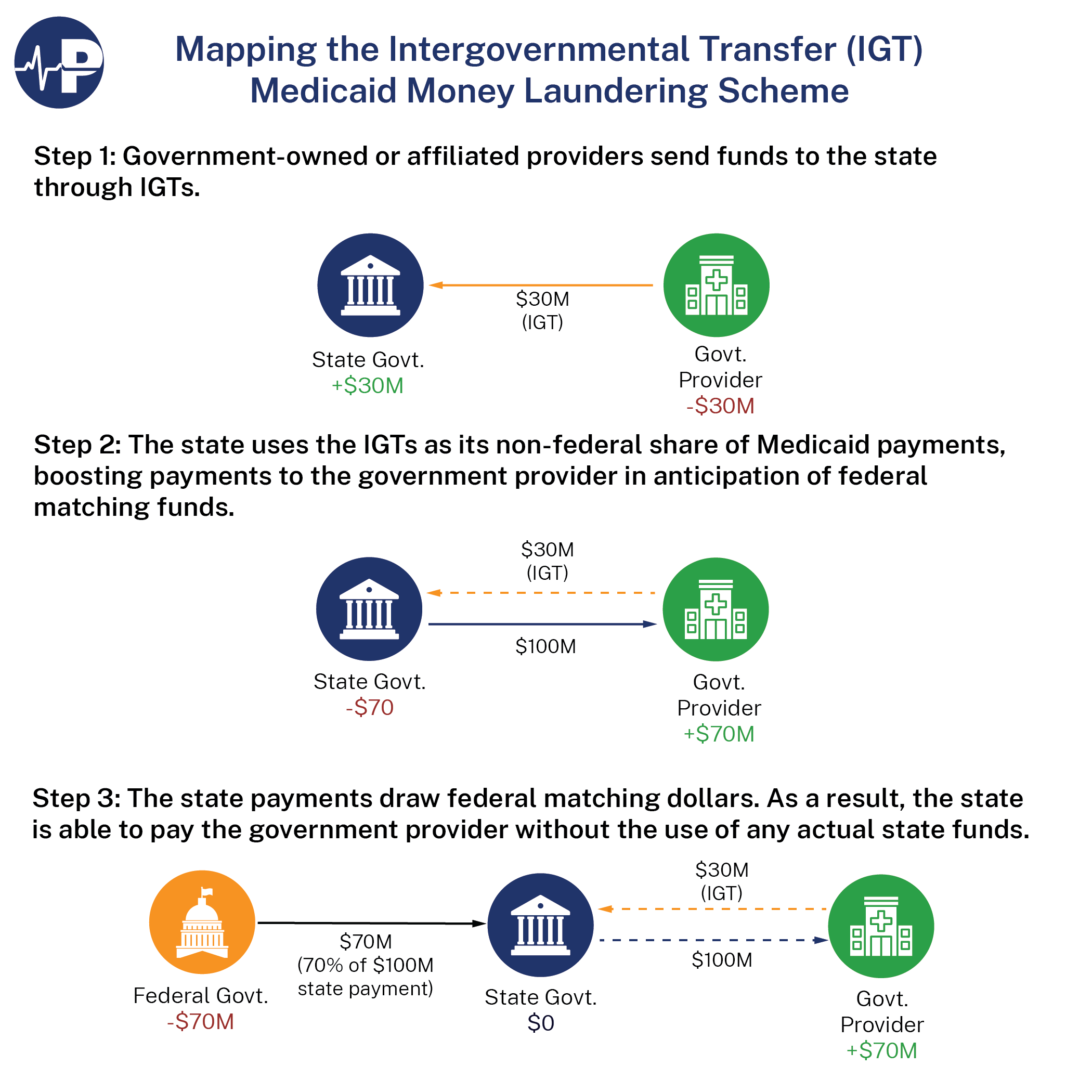
States have long used money-laundering-like tactics to obtain federal Medicaid funding with little actual state contribution. A typical Medicaid provider tax money laundering scheme looks like this:
A state first imposes a $1 million tax on hospitals.
The state then spends that same $1 million back on those hospitals in the form of higher Medicaid payments as its non-federal share (typically 30 percent of the total payments). The state knows that its $1 million payment will generate $2.33 million in federal funding.
The federal government then pays its federal share, which would amount to $2.33 million in this hypothetical scenario. Thus, the hospitals net $2.33 million.
This “tax” thus produces a windfall for hospitals at no net cost to the state. The original $1 million tax simply serves as a circular financing mechanism used to generate higher Medicaid payments. States use hospital tax revenues to cover the nonfederal share of Medicaid payments that benefit hospitals. Because these provider funds substitute for state funds, the state redirects its own money elsewhere, while hospitals still net significant federal funds.
Federal Limits on Provider Tax Schemes
In 1991, Congress sought to curb such Medicaid money laundering tactics by passing the Medicaid Voluntary Contribution and Provider-Specific Tax Amendments (Pub. L. No. 102-234). The law limits the use of state provider taxes as a source of nonfederal match for state Medicaid expenditures.
The Social Security Act and CMS regulations distinguish between provider taxes that serve as permissible state financing mechanisms and those structured to generate excessive federal Medicaid matching funds. CMS reduces federal Medicaid matching funds when provider tax revenues do not meet certain requirements. To avoid these reductions, states must structure their taxes to be broad-based, uniform, and free of hold-harmless arrangements. A hold-harmless agreement means either (a) the state pays providers back for taxes or (b) some providers reimburse other providers for the tax burden.
These requirements prevent states from “money laundering” by imposing taxes only on providers that would benefit most from the resulting higher Medicaid payments. If states wish to use provider taxes to finance the nonfederal share of Medicaid, the tax cannot simply target the providers that receive the largest payments through the program. Instead, states must apply taxes more broadly, which can make these schemes more politically challenging because some providers may be taxed without receiving offsetting increases in Medicaid payments.
CMS, in implementing the statute’s requirements, created what is known as the 6 percent safe harbor for provider taxes. Under the safe harbor, if a tax’s revenue is less than or equal to 6 percent of total net patient revenues, CMS will presume that there is no hold-harmless agreement and will not subject the tax to closer scrutiny. To stay within this safe harbor, states almost always keep provider tax rates at or below 6 percent. The OBBB prohibited federal reimbursement for any new or increased provider taxes effective on July 4, 2025, and enacted a phasedown of the hold-harmless threshold from 6 percent to 3.5 percent from 2028 to 2032, after which it remains at 3.5 percent.