
Reforming Government. Empowering Patients.
Navigation
What Matters for Health
Insurance is Less Important Than You Think

The Paper
Executive Summary
Why We Did This Study
For decades, health policy in the United States has focused on expanding health insurance coverage at enormous cost to taxpayers. Policymakers assumed that coverage would increase access to care, which would improve health. In fact, there is little evidence that expanded government health insurance programs improve most people’s health. Multiple studies show that public insurance expansions increase the amount of health care used. But they generally improve health by much less than is commonly believed. Policymakers need to understand why expanding insurance coverage has had so little impact on health and to focus their efforts on proposals that will successfully improve Americans’ health.
What We Found
Most studies claiming a health benefit for insurance are observational. They may show a correlation between insurance and health outcomes, but they do not establish causation. Observational studies are prone to bias and confounding by unobserved differences between the insured and the uninsured. Evidence from randomized, controlled experiments that avoid these problems indicates that insurance produces little, if any, health benefits. The primary benefits of insurance are to improve people’s sense of well-being, mental health, and financial security.
There are multiple reasons why insurance coverage has so little effect on health. Public insurance expansions such as those within the Affordable Care Act (ACA) often substitute public insurance for private insurance or replace previously uncompensated care with care that is covered by insurance. In addition, many government insurance programs provide limited access to services and focus on low-benefit care. Health care in general has only a modest impact on health: Estimates suggest it contributes no more than 10-20 percent to determining health outcomes. Some care may actually decrease health by exposing patients to medical errors or to over-diagnoses and misdiagnoses. We conclude that individuals’ health behaviors and medical innovation are far more important contributors to health than insurance coverage.
Why It Matters
Life expectancy gains in the United States have stagnated and mortality rates for the major medical causes of death have continued to rise even as public insurance coverage has expanded. Congress is considering extending those coverage programs. The evidence strongly indicates that this would not be a cost-effective strategy for improving Americans’ health.
Policy Suggestions
Instead of continuing to pursue costly expansions of public health insurance and subsidies to insurers that do little to improve health, policymakers should focus on more effective initiatives such as promoting healthy behaviors and increasing medical innovation.
Introduction
Health policymakers have fixated on expanding health insurance coverage. This has been the focus of major government initiatives over the past 60 years, including the 1965 establishment of the Medicare and Medicaid programs, the enactment of Medicare Part D in 2003, the enactment of the Affordable Care Act (ACA) in 2010, and recent expansions of subsidies for ACA insurance exchange plans and efforts to increase the ACA’s Medicaid expansion.
These efforts have succeeded in lowering the number of uninsured Americans. It is commonly assumed that expanding health coverage has improved Americans’ health. But is that true?
Health insurance is a positive factor in people’s lives, providing financial protection and peace of mind in case of serious illnesses that can generate high costs. Yet the evidence suggests that health insurance coverage does little to improve health. It is important to distinguish health care from health. Multiple studies show that public insurance expansions increase the amount of health care used, but they generally improve health much less than is commonly believed.
In this paper we first assess the evidence about the small and uncertain benefit that government insurance expansions have on health. The evidence is clear that gaining health insurance increases health care utilization and spending. But for most people, insurance coverage has little or no impact on objective measures of health. Most studies claiming a health benefit for insurance are observational and mistake correlation for causation. More persuasive evidence from randomized, controlled experiments suggests that insurance has little, if any, health benefits for most people. The primary benefits of insurance are to improve people’s sense of well-being, mental health, and financial security. These are important outcomes. But it is important for policymakers and advocates of expanded coverage to acknowledge health insurance’s minimal connection to health outcomes.
In the next section we examine the reasons why insurance coverage has so little effect on health. Public insurance expansions—such as those that occurred under the ACA—often replace previously uncompensated care with insurance coverage or substitute for private insurance coverage. In addition, many government insurance programs provide limited access to care and impose coverage requirements for care that is of little benefit. In general, the health care that insurance facilitates improves health modestly, if at all. Multiple studies have estimated that health care contributes no more than 10-20 percent to determining health outcomes. While some care may be of little or no benefit, some may actually decrease health.
We conclude that individuals’ health behaviors and medical innovation are far more important contributors to improving health than insurance coverage.
DOES HEALTH INSURANCE IMPROVE HEALTH?
Most initiatives to expand health insurance coverage aim to improve health. The thinking goes that insurance facilitates access to care by decreasing out-of-pocket costs, leading to increased health care consumption, which, in turn, improves health. However, the evidence for this chain of causation is quite thin. It seems clear that gaining health insurance increases health care utilization and spending. But it is less clear that this insurance improves people’s health. As noted health economists Amy Finkelstein and Liran Einav recently wrote, “there is widespread agreement among researchers that variation in medical care or in health insurance is not a major driver of variation in health.”1
Comparisons of the health of insured people versus uninsured people must account for the many differences between the two groups, aside from insurance coverage, that could explain health differences. Healthier people are more likely to be insured because they are more likely to be employed and be covered under employer-sponsored insurance (ESI) or, if not covered by ESI, have the means to purchase their own insurance. Correlations between insurance coverage and better health might be driven by other unobservable or unmeasured factors. People who are motivated to obtain insurance coverage may also be motivated to do other things that improve their health, such as exercise regularly or eat a healthy diet. Conversely, people who forego available ESI or public insurance (Medicaid or ACA plans) may be more risk tolerant and engage in risky health behaviors. One study of over a million individuals, for example, found a large number of genetic variants associated with a person’s general willingness to take risks and with risky behaviors such as smoking, drinking, drug use, and driving.2 These genetic markers are not normally measured or accounted for in observational studies of the effects of insurance coverage.
Most of the literature dealing with the impact of insurance on health has examined government programs to expand coverage. From the start of these government efforts, it became apparent that gaining health insurance does not do much to improve health. In the first 10 years following its passage in 1965, Medicare had no apparent impact on elder mortality.3
A thorough review of studies claiming that health insurance improved health outcomes found that most did not establish a causal relationship. Nearly all were observational studies that are prone to bias and confounding by unobserved factors. They did not adequately address the endogeneity of health insurance—that observed differences in health outcomes may have resulted from unobserved differences between the insured and the uninsured. Insurance increased medical care consumption and modestly improved self-reported health, but outside of a few vulnerable population subgroups (e.g., children), there is little evidence that insurance significantly improves the health of most people.4
A 20-year observational study attempted to counteract the deficiencies of earlier short-term observational studies by using a more complete set of covariates to adjust for differences between insured and uninsured individuals. It found that insured people use more health care services, but there was no significant effect of insurance on health and mortality.5
A study with 16 years of follow-up by Richard Kronick, a former Obama administration official who worked on ACA implementation as HHS Deputy Assistant Secretary for Health Policy (2010-13) and as Director of the Agency for Healthcare Research & Quality (2013-16), found that on nearly every relevant characteristic, uninsured people have higher risk factors compared with privately insured people. After adjusting for high-risk characteristics, being uninsured was not associated with an increased risk of mortality. Kronick concluded that “there would not be much change in the number of deaths in the United States as a result of universal coverage.”6

Kronick’s assertion seems borne out by the fact that life expectancy at birth in the United States peaked in 2014—the year ACA coverage expansions started—at 78.9 years and then declined slightly and plateaued, ending at 78.8 in 2019, the last full year before the mortality losses of the Covid-19 pandemic (see Table 1).7 Much of this is explained by the rapid increase in deaths from drug overdoses between 2014 and 2017. After a brief decline from 2017 to 2019, overdose deaths began an even more rapid rise after 2019.8
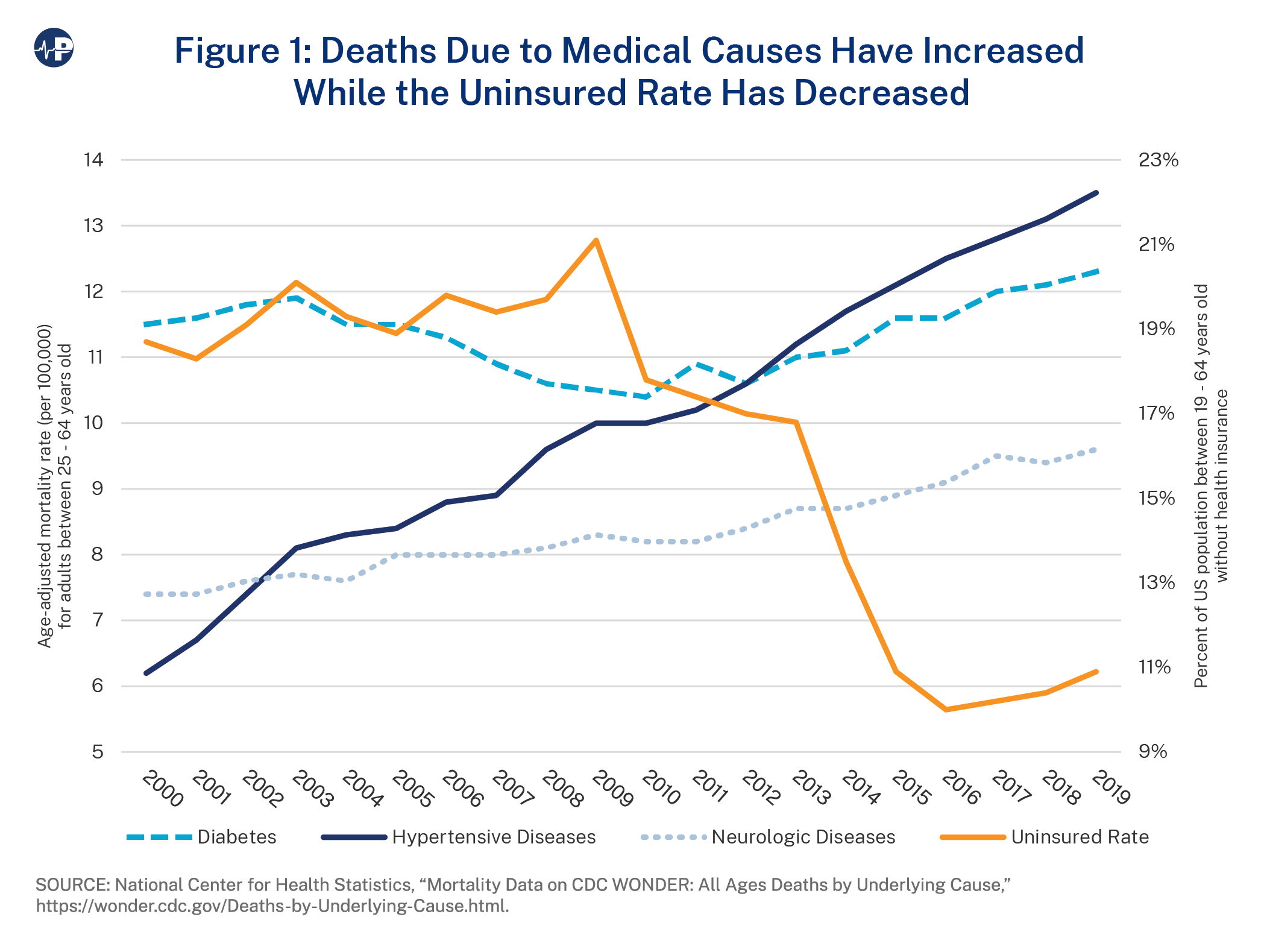
But this decline in life expectancy is not fully explained by the opioid crisis. As Figure 1 shows, deaths among adults ages 25-64 from the leading medical causes of death—as opposed to deaths from intentional or unintentional injuries such as drug overdoses, alcohol related deaths, suicides, accidents, and homicides—rose despite the implementation of the ACA in 2014. (We exclude people 65 and older, as this population already had universal coverage through Medicare.) The ACA expanded coverage primarily through Medicaid expansion and, to a much lesser extent, through exchange plans for adults in the 25-64 age range.9 Yet mortality rates for the major medical causes of death continued to rise for this age group past 2014, even as the uninsured rate trended down. Mortality rates increased during the Covid-19 pandemic, but the increases in mortality began years before the pandemic and have remained elevated even as the pandemic subsided.10
A comparison of crude mortality trends between 2013 and 2017 across states that expanded Medicaid to low-income, non-disabled, working-age adults before the ACA, at the outset or within the first few years of the ACA Medicaid expansion, or never expanded Medicaid, found that overall mortality worsened in all the states, regardless of Medicaid expansion. The increase was the highest in states that participated in the ACA Medicaid expansion.11
What the Best Studies Show
As in most science, the best assessments of the effect of health insurance on health outcomes, use of health care services, and spending come from randomized, controlled trials. Randomizing who gets insurance overcomes a key limitation of observational studies: unobserved differences between groups. The first was the RAND Health Insurance Experiment, conducted from 1974 to 1982, primarily to determine the influence of cost-sharing on health care consumption. It randomly assigned 2,000 families to insurance plans with various levels of coinsurance—the percentage of costs paid by patients—and tracked them for five years. Some were randomly assigned to free care (no coinsurance), and others were required to pay for some of their costs, ranging from 25 percent to 95 percent coinsurance. There was no completely uninsured group, although 95 percent coinsurance comes close.
The study results showed that as the amount of coinsurance declined and the out-of-pocket cost of care decreased, patients used more medical services, including doctors’ visits, hospitalizations, and drug prescriptions. However, having more generous insurance and using more care did not improve health outcomes. With the exception of improved hypertension control, dental care, and vision care for the poorest patients assigned free care, there was little or no measurable impact of receiving more generous insurance on health outcomes.12 Moreover, as economist Robin Hanson observed, because the researchers conducted 80 tests for health indicators, four positive health results could appear by chance alone, given a 5 percent significance level.13
A second, more recent randomized trial was the Oregon Medicaid Experiment. In 2008, the state of Oregon wanted to expand Medicaid to low-income, uninsured adults but lacked the funding to offer coverage to every interested, qualified person. The state conducted a lottery to determine who on the waiting list would be covered. This created an opportunity for researchers to compare the health outcomes of those who were randomly selected through the lottery and gained Medicaid coverage to the outcomes of a control group of those who remained uninsured. Researchers obtained data over two years from 6,387 adults who were randomly selected for Medicaid coverage and 5,842 adults who were not selected. Those newly covered by Medicaid used more medical services across the board—doctor visits, prescription drugs, preventive care, emergency room visits, and hospitalizations all increased. They reported an improved sense of physical and mental well-being. Yet, other than lower depression rates, the Medicaid-covered group had no improvements in objective health measures such as high blood pressure, cholesterol levels, diabetes control, or mortality compared to the uncovered control group.14 The improvements in self-reported health that were reported appear to reflect a general psychological sense of improved well-being due to gaining coverage—a survey conducted just after random assignment lottery but before anyone had received any medical care found improvements in lottery winners’ self-reported health that were already about two-thirds the magnitude of the improvement more than a year later.15
A randomized study in a low-income country, India, had similar findings to U.S. studies. The Karnataka Hospital Insurance Experiment was a large-scale—10,879 households comprising 52,292 people in 435 villages—four-year trial that randomized participants into four groups that varied premiums and subsidies for India’s first national, public hospital insurance program, called RSBY. The study participants were not otherwise eligible for RSBY insurance. One group received free insurance. Two groups were given the opportunity to buy insurance, one at the same price the government pays with no subsidy and a second with an income transfer equal to the insurance premium for RSBY that the government pays. The fourth was the no-insurance access, control group. Insurance uptake was 79 percent for those offered free insurance, 72 percent of those given subsidies to buy insurance, and 60 percent for those eligible to buy insurance without subsidies. Insurance enrollment increased the utilization of hospital care, although this decreased over time.16
The researchers found “that insurance had minimal detectable effects on health.” Insurance coverage resulted in statistically significant treatment effects for only three among 84 health-related outcomes across two waves of surveys. A limitation of the study is that it provided only hospital insurance, not outpatient primary care or drug coverage. In addition, many beneficiaries had difficulty using their insurance cards to pay for care. Finally, the authors expressed concern that based on their estimated standard errors, they could not rule out small, clinically significant health effects, speculating that, despite its large size, the study may have been underpowered to detect many treatment effects.
Quasi-Experiments
Several recent quasi-experimental studies have claimed to find an effect of health insurance on health. Quasi-experiments attempt to identify the causal impact of a particular intervention, program, or event (a “treatment”) by comparing treated groups to untreated control groups, even though the participants were not randomly assigned to either group. While more informative than observational studies, the insurance quasi-experiments suffer from various defects.
One compared cohorts born in different years relative to Medicaid implementation in the years following the program’s original implementation in the 1960s in states with different preexisting welfare-based eligibility. It estimated that early childhood Medicaid eligibility reduced mortality and disability, increased employment, and reduced receipt of disability transfer programs up to 50 years later.17 But the fact that the study attempts to link an exposure (childhood eligibility for Medicaid) over a long time period (up to 50 years) raises the possibility that many other factors could have influenced adult outcomes besides childhood Medicaid eligibility. Moreover, while the paper purports to establish an association between childhood Medicaid and adult outcomes, pinpointing exact causal mechanisms over such a long period is difficult.
Several other studies looked at the impact of the ACA’s insurance expansions. A comparison of counties in states that expanded Medicaid coverage in the first half of 2014 under the ACA with counties in states that did not expand Medicaid found a reduction in all-cause mortality in individuals ages 20-64 equaling 11.36 deaths per 100,000 individuals, a 3.6 percent decrease during the first four years post expansion. The authors attempted to adjust for preexisting differences between these counties by reweighting based on their economic, demographic, and political characteristics together with machine learning techniques to match comparable counties in expansion and non-expansion states.18
Despite the sophisticated modeling used in the study, the design did not account for variations in how states implemented Medicaid expansion. Moreover, as with many observational studies, there is a possibility of unmeasured confounding.
Another study looked at mortality over four years for near-elderly adults in states with and without ACA Medicaid expansions. It claims that there were significant reductions in mortality in expansion states relative to non-expansion states in the first year and that the effect grew over time through 2017, four years after the initial ACA Medicaid eligibility expansions.19 However, the paper focused on individuals ages 55-64, the group with the highest mortality rates. When the authors looked at the entire non-elderly adult population (ages 19-64) as well as various subgroups within that population excluding the near-elderly, they found increased Medicaid enrollment but no statistically significant mortality reduction.
Interestingly, these same authors wrote an earlier study in the prestigious New England Journal of Medicine that reported no difference in the health outcomes of individuals ages 19-64 in Medicaid expansion versus non-expansion states, no significant improvement in self-reported health status, and an increased probability of delay in obtaining care.20 In the later study, the authors tried to distinguish the two studies by saying the earlier one relied on survey data of self-reported health measures with limited information on individual characteristics, while their second study had more detailed information on individual characteristics collected as part of the American Community Survey. Nevertheless, both studies reported no significant results for the entire adult population, and the only significant finding was in the later study for the 55-64 age group.
When a different group of researchers looked at this same 55-64 age group after the ACA’s Medicaid expansion, they found no “statistically significant pattern of results consistent with Medicaid expansion causing mortality changes.” But they could not “rule out large effects in either direction.” because large confidence intervals likely due to the fact that variation in uninsurance rates for Medicaid expansion versus non-expansion states was such a small fraction (around 1 percent) of the population and the “substantial background variation in mortality, and mortality trends, across states and demographic groups.” They also concluded that any effects of insurance on mortality are likely too small to be reliably detected with available datasets. “[E]ven the 50-state natural experiment provided by the ACA is severely underpowered to detect plausible-sized effects on mortality.”21 In other words, there was a low probability of detecting a true effect or difference despite the seemingly large sample size.
Another quasi-experimental study looked at the influence of both the ACA exchange and Medicaid coverage increases. The authors used an IRS experiment that sent a letter to randomly selected people who had paid an income tax penalty under the ACA’s individual mandate for not obtaining insurance coverage and compared them to penalty payers who had not received the letter. Both groups increased coverage, but the treated (letter) group had a small increase in coverage (1.9%) relative to the control group (no letter) over two years. The increase in coverage was primarily driven by increased enrollment in the exchanges and, to a lesser extent, new take-up of Medicaid.22
The mortality rate among previously uninsured 45-64-year-olds was 0.06 percentage points lower in the treatment group than in the control group, although wide confidence intervals led the authors to say that this value was “imprecisely estimated.” Moreover, they found no evidence that the intervention reduced mortality among children or younger adults. The small observed reduction in mortality is not clearly connected to the increase in insurance coverage. The study randomized who received the letter urging people to enroll, not who received coverage. Those who enrolled after receiving the letter may have differed from those who chose not to enroll, allowing confounders to slip into the analysis. In addition, other factors beyond insurance coverage could have influenced the mortality outcomes. For example, receiving a letter from the IRS might have prompted other health-related behaviors that improved the study group’s mortality outcome whether or not they enrolled in insurance. The authors acknowledge that there are “other channels through which the intervention may have reduced mortality” but conclude that “they appear less likely than coverage to explain the intervention’s effect on mortality.”23
WHY DOES INSURANCE NOT IMPROVE HEALTH?
Health insurance seems to have little or no impact on people’s health, on average. What explains this counterintuitive result?
Public Insurance Crowding Out Private Insurance
It could be that expansions of public health insurance largely crowd-out or substitute for existing private insurance coverage, with the result that the net gain in insurance coverage is smaller than expected. A study of a policy that expanded Medicaid to pregnant women and children over the 1987-1992 period found that approximately 50 percent of the increase in Medicaid coverage was associated with a reduction in private insurance coverage.24 A later paper estimated a 60 percent crowd-out rate for Medicaid expansions from 1996 through 2002 for children.25
Another study of states that expanded their income thresholds for Medicaid eligibility over a long period of time (1999-2019)—most, but not all, of which occurred during the ACA Medicaid expansion—found a decrease in private insurance rates that increased with time, peaking about four years post Medicaid expansion.26 Several studies have reported that the ACA Medicaid expansions led to a nearly 50 percent crowd-out rate of private insurance coverage in low-income adults27 and working-age adults with disabilities.28
In many cases, as will be discussed below, the public insurance programs are lower quality than the private coverage plans they replace, with narrower provider networks and poorer access to care. Therefore, crowd-out affects the quality of insurance in the population, not merely its distribution across public and private sources.
Nevertheless, even when there is a clear increase in the number of people covered, the impact on health is, at best, modest. There are several explanations.
Insurance Replacing Free Care
First, the uninsured were often able to obtain medical care despite lacking insurance, and they do not pay for most of it. The Oregon Medicaid study found that the uninsured receive about four-fifths of the medical care they would get if they were insured.29 Yet they pay only about 20 cents on the dollar for that care, with the remainder of the cost covered by external parties.30
The uninsured receive care through multiple channels. The 1986 Emergency Medical Treatment and Labor Act requires that anyone coming to an emergency department must be evaluated, stabilized, and treated regardless of insurance status or ability to pay.31 Other laws require nonprofit and government hospitals—accounting for 70 percent and 15 percent of all hospital beds, respectively32—to provide some charity care for the uninsured who cannot afford to pay, even in non-emergency circumstances. Federally Qualified Health Centers provide primary and preventive care to primarily low-income patients regardless of their ability to pay or health insurance status.33 Moreover, physicians in private practice and privately owned hospitals have historically been willing to care for some uninsured or underinsured charity patients.
Much of this uncompensated care, particularly for hospitals, is indirectly offset by a hodgepodge of federal, state, and local government payment programs.34 But many insurance expansions are accompanied by cutbacks to these programs, because they are expected to reduce the costs of uncompensated care, although the cuts are often delayed.35
In effect, the uninsured enjoy “implicit” coverage. At the extreme, the ability of low-income uninsured people to declare bankruptcy serves as an implicit form of high-deductible insurance. They are exposed to the financial risk from medical bills up to the level of their assets that can be seized in bankruptcy and insured against financial risk above that level. This makes health insurance less valuable to those with fewer assets.36
Insurance expansions pay providers for care that was previously provided at no cost to the patient. The evidence suggests that “a substantial share of the benefits from expanding formal coverage accrue to the health care providers and other parties who would otherwise bear the costs of providing uncompensated care to the uninsured. This is because the uninsured pay only a small fraction of their health care costs, on the order of one-fifth to one-third of their medical expenditures.”37 An examination of the Oregon Medicaid study estimated that 60 percent of every dollar of adult Medicaid spending is a transfer to providers of previously uncompensated care for the low-income uninsured.38 The overall welfare effects of this transfer are beyond the scope of this paper.
Government Expansions Provide Limited Access to Care
A second explanation for the ineffectiveness of insurance in improving health is that government coverage expansions often provide limited access to care. Public expansions generally increase demand for services by lowering demand prices (copays and premiums) for those who are subsidized. At the same time, supply falls because the government payment rates to providers are generally lower than commercial rates. This leads to excess demand for a limited supply of willing providers, resulting in shortages and poor access to care.
Most of the ACA’s increase in coverage came from new Medicaid enrollees.39 Medicaid physician payment rates are, on average, about two-thirds of the rates Medicare pays.40 And Medicare fees are just two-thirds or less of commercial rates.41 These disparities are even wider for primary care physicians, who serve as key points of access into the health care system.42
Not surprisingly, low reimbursement rates mean that many physicians do not elect to participate in Medicaid.43 In addition, in 2017, after the majority of states had expanded Medicaid under the ACA, “physicians were significantly less likely to accept new patients insured by Medicaid (74.3 percent) than those with Medicare (87.8 percent) or private insurance (96.1 percent).”44 Another study of appointment availability found that for every $10 change in Medicaid fees up or down, there was a 1.7 percent change in the same direction in the proportion of patients who could obtain appointments with new primary care physicians.45
Following the ACA Medicaid expansion, patients had increased wait times and difficulty securing appointments. The problem was particularly severe in Medicaid expansion states as compared with non-expansion states, resulting in “significant increases in respondents delaying care because appointments were not available soon enough or because wait times were too long.”46 A 2019 metanalysis of 34 appointment availability audit studies—often called “secret shopper” studies—found that the Medicaid expansion had taken a preexisting access problem for Medicaid patients and made it worse. In studies prior to Medicaid expansion, Medicaid patients had a twofold lower likelihood of securing an appointment compared with privately insured patients, while in post-expansion studies Medicaid patients had a 3.2-fold lower likelihood.47
Access is also affected by the narrow provider networks common in many government insurance programs such as Medicaid, as well as ACA exchange plans.48 On average, exchange enrollees had access to just 40 percent of practicing physicians in their areas, and 23 percent were in plans with no more than a quarter of local doctors. Exchange enrollees were nearly twice as likely as those with ESI to report needing providers who were not covered by their insurance networks.49 Many patients’ regular physicians are not in their networks, the networks do not have physicians available to treat a patient’s problems, or access to appointments with appropriate physicians is decreased and delayed.
Low Value Care in Government Programs
A third reason is that the health care services provided in government insurance expansions are often of low value and have minimal impacts on health. The ACA, for example, mandated that preventive care and annual office visits be covered at no cost to the patient. These services presumably improve health by preventing illnesses or facilitating early detection when diseases can be effectively treated. Yet the benefits of these services are modest. The Stanford Prevention Research Center reviewed randomized trials and meta-analyses of the efficacy of available screening tests for diseases where death is a common outcome and found that “reductions in disease-specific mortality are modest and reductions in all-cause mortality are very rare or nonexistent” with these tests.50 Cancer screening is performed far more commonly in this country than elsewhere and is often overly intensive, of little value, and sometimes even harmful, resulting in additional tests, false positive diagnoses, overdiagnoses, and unnecessary treatments.51 Dr. Ezekiel Emanuel, one of the ACA’s architects, has admitted that routine annual physicals—regular visits which are not prompted by any specific complaint or problem—do not decrease mortality, waste resources, and may lead to harmful additional testing and unnecessary treatments.52 Mandating these low-value medical care measures, at little or no out-of-pocket cost to the patient, leads to overutilization and increased spending and an inefficient allocation of scarce medical resources where low-value care could crowd out high-value care.
Health care in general may contribute far less to health than most presume. One study reviewed a range of empirical methods for measuring the impact of health care services on health and concluded: “The results converge to suggest that restricted access to medical care accounts for about 10% of premature death or other undesirable health outcomes.”53 Another survey of the literature found estimates that medical care is responsible for no more than 10-20 percent of the variation in health.54 Health behaviors such as smoking, drug use, diet, physical activity, and obesity appear to be far more important determinants of health.55
A literature review identified five key determinants of health in industrialized countries: health behaviors, genetics, social circumstances, environmental and physical influences, and medical care. Health behaviors were most important, making a relative contribution of 30-50 percent to health. Genetics—which are not susceptible to policy interventions or individual decisions—account for 20-30 percent. Medical care accounted for only 10-20 percent.56 An earlier study found that up to 40 percent of premature deaths in the United States are due to unhealthful behaviors such as smoking, poor dietary habits, and sedentary lifestyles.57 Over the past two decades, escalating opioid abuse and drug overdoses have exacerbated the toll of behavioral deaths.
Gaining insurance adds only incrementally to peoples’ medical care. Thus, insurance is adding a fraction of a factor that is responsible for a small percentage of what determines health.
Possible Harmful Effects of Health Insurance
Some have posited that gaining health insurance might reduce health by inducing individuals to exert less effort in maintaining their health. Insured individuals may have less incentive to avoid poor health behaviors, as they are protected against the financial costs of treating the resulting illnesses. Insurance against the ill effects of behaviors—ex ante moral hazard—may induce people to overeat, exercise less, use drugs, and smoke more.58
Several economists have questioned the importance of ex ante moral hazard:
The extent of moral hazard in terms of actions that affect health may not be large for health insurance in most instances, since the uncompensated loss of health itself is so consequential.59
In the context of health insurance, the ex ante moral hazard problem may be small because common forms of health insurance in fact offer very incomplete coverage. Even if the consumer has generous coverage for the monetary components of the loss (medical expenditures and foregone earnings), he will be uninsured for the utility loss. In many cases the uninsurable utility losses from health risks far exceed the insurable monetary losses.60
While obtaining insurance might discourage health behaviors, it might also improve behaviors. Gaining insurance increases access to health professionals and might lead to increased awareness of the health consequences of smoking, exercise, and overweight, causing some people to positively change their behavior.
One study found evidence that obtaining Medicare coverage at age 65 reduces prevention behaviors and increases unhealthy behaviors among elderly men. But it also found that health insurance had a countervailing indirect effect on health behaviors resulting from greater, insurance-induced contact with medical professionals whose counseling improved health behaviors.61
A randomized evaluation of the impact of encouraging individuals in some geographic areas of Mexico, but not in others, to enroll in a then-newly introduced health insurance program, found that insurance coverage reduced the demand for self-protection in the form of preventive care. Use of preventive care, such as flu shots and mammograms, declined with greater insurance coverage.62 Similarly, state mandates for insurance to cover diabetes treatments seemed counterproductive, with diabetics exhibiting higher body mass indexes after the adoption of these mandates.63
Yet another study found that gaining health insurance (Medicare) had no significant impact on health behaviors such as smoking, exercise and diet/weight. The result was “unsurprising” considering “the extensive literature on habit persistence in smoking, eating, and other lifestyle choices.”64
Overall, “there appears to be relatively little direct empirical evidence that health insurance leads to less prevention.” In fact, “results from logit models showing the relationships between health insurance and the probability of being sedentary, obese, smoking, heavy drinking (more than 4 drinks on days with any drinking), drunk driving (in the past year), failing to wear seatbelts regularly, and failing to have at least one smoke detector … suggest that health insurance leads to healthier choices, and certainly provide very little evidence for a moral hazard effect where insurance leads to less prevention.”65
The benefits of expanding health insurance eligibility may also be attenuated by the fact that—as economic theory would predict—those in poor health, at highest risk of needing medical care, are most likely to have already obtained insurance either by opting in to ESI or obtaining various public insurance options. Despite expanded Medicaid coverage and enhanced premium subsidies in the ACA marketplaces during the pandemic, a recent analysis found that “six in ten of the uninsured people are eligible for Medicaid (6.4 million or 25%) or subsidized plans (35%) in the Marketplace but are not enrolled in these programs.”66 Some of these eligible but unenrolled people may be counting on the fact that as a practical matter, they could always easily enroll in Medicaid should they become ill with a 90-day retroactive period for services they receive.
There is also the possibility that some of the medical care that health insurance facilitates may be harmful. It is estimated that as much as 20 percent of care provided may be unnecessary.67 Some care, particularly screening services, leads to false positives that generate costly and unnecessary additional procedures and psychological harm and to overdiagnoses resulting in costly and painful treatments for conditions that would have never progressed to threaten patients’ health.68 And multiple studies have estimated that iatrogenic harm or adverse events affect at least 10 percent of patients.69 It is doubtful that the overall harm is substantial—and we are not aware of anyone suggesting that gaining insurance, on average, decreases health. Nevertheless, medical errors and other harms reduce the benefits of increased use of medical care that insurance coverage facilitates.
Finally, in the long run, public insurance coverage may have limited or possibly negative effects on health because of its impact on innovation. Many governments have combined large coverage expansions with price and spending controls. These non-market controls can adversely affect medical innovation, which is arguably one of the most important factors in improving health.70 Decreasing the number of new drugs, devices, and technologies available in the future will make health care less effective and health more costly to obtain.
CONCLUSION
Health insurance is a positive factor in the lives of many Americans—but not for the reasons most people think. It has far more impact on people’s financial health and sense of well-being than it does on their health. That is what insurance is generally for: protecting people from financial disasters.
Focusing health policy primarily on insurance expansions is an inefficient use of resources that risks crowding out other policies that could better improve Americans’ health. Policy efforts should instead focus on improving people’s health behaviors and increasing medical innovation, activities that are more likely to increase overall health.
Footnotes
1↑ Liran Einav and Amy Finkelstein, We’ve Got You Covered: Rebooting American Health Care (New York: Portfolio/Penguin, 2023), 86.
2↑ Richard Karlsson Linnér et al., “Genome-Wide Association Analyses of Risk Tolerance and Risky Behaviors in Over 1 Million Individuals Identify Hundreds of Loci and Shared Genetic Influences,” Nature Genetics 51 (2019): 245-257, https://www.nature.com/articles/s41588-018-0309-3
3↑ Amy Finkelstein and Robin McKnight, “What Did Medicare Do? The Initial Impact of Medicare on Mortality and Out of Pocket Medical Spending,” Journal of Public Economics 92 (2008): 1644-1668, https://economics.mit.edu/sites/default/files/2022-08/What%20Did%20Medicare%20Do%20The%20Initial%20Impact%20of%20Medicar.pdf
4↑ Helen Levy and David Meltzer, “The Impact of Health Insurance on Health,” Annual Review of Public Health 29 (2008): 399-409, https://pubmed.ncbi.nlm.nih.gov/18031224/
5↑ Bernard S. Black et al., “The Long-Term Effect of Health Insurance on Near-Elderly Health and Mortality,” American Journal of Health Economics 3, no. 3 (2017): 281-311.
6↑ Richard Kronick, “Health Insurance Coverage and Mortality Revisited,” Health Services Research 44, no. 4 (2009): 1211-31, https://onlinelibrary.wiley.com/doi/10.1111/j.1475-6773.2009.00973.x
7↑ Shameek Rakshit et al., “How Does U.S. Life Expectancy Compare to Other Countries?,” Peterson-KFF Health System Tracker, January 30, 2024, https://www.healthsystemtracker.org/chart-collection/u-s-life-expectancy-compare-countries/
8↑ Steven H. Woolf, “Increasing Mortality Rates in the US, but Not From COVID-19,” JAMA Network, August 29, 2024, https://jamanetwork.com/journals/jama/fullarticle/2822992
9↑ In 2013, the Congressional Budget Office (CBO) estimated there would be 25 million non-elderly enrollees in the ACA exchanges in 2019. CBO, “Table 1. CBO’s May 2013 Estimate of the Effects of the Affordable Care Act on Health Insurance Coverage,” 2020, https://www.cbo.gov/sites/default/files/recurringdata/51298-2013-05-aca.pdf. In fact, total exchange enrollment was just 46 percent of what was expected (11.4 million). KFF, “Marketplace Enrollment, 2014-2024,” https://www.kff.org/affordable-care-act/state-indicator/marketplace-enrollment/?currentTimeframe=5&sortModel=%7B%22colId%22:%22Location%22,%22sort%22:%22asc%22%7D. The loss of ESI and unsubsidized individual market coverage likely exceeded the number of exchange enrollees. Medicaid enrollment following the ACA expansion increased by 14 million by 2019, a 24.7 percent increase over the 2013, pre-ACA baseline and 2 million more than CBO had forecast. Medicaid and CHIP Payment and Access Commission (MACPAC), “Medicaid Enrollment Changes Following the ACA,” March 31, 2022, https://www.macpac.gov/subtopic/medicaid-enrollment-changes-following-the-aca/.
10↑ Woolf, “Increasing Mortality Rates in the US.”
11↑ Brian Blase and David Balat, “Is Medicaid Expansion Worth It? A Review of the Evidence Suggests Targeted Programs Represent Better Policy,” Texas Public Policy Foundation, April 2020, https://www.texaspolicy.com/wp-content/uploads/2020/04/Blase-Balat-Medicaid-Expansion.pdf
12↑ Joseph P. Newhouse, Free for All? Lessons from the RAND Health Insurance Experiment (Cambridge, MA: Harvard University Press, 1993). “[I]n general, the reduction in services induced by cost sharing had no adverse effect on participants’ health.” Robert H. Brook et al., “The Health Insurance Experiment: A Classic RAND Study Speaks to the Current Health Care Reform Debate,” RAND, December 6, 2006, https://www.rand.org/pubs/research_briefs/RB9174.html
13↑ Robin Hanson, “Fear of Death and Muddled Thinking—It Is So Much Worse Than You Think,” in Death and Anti-Death, Volume 3: Fifty Years After Einstein, One Hundred Fifty Years After Kierkegaard, ed. C. Tandy (Ann Arbor, MI: Ria University Press, 2005).
14↑ Katherine Baicker et al., “The Oregon Experiment—Effects of Medicaid on Clinical Outcomes,” New England Journal of Medicine 368, no. 18 (2013): 1713-1722.
15↑ Amy Finkelstein et al., “The Oregon Health Insurance Experiment: Evidence from the First Year,” Quarterly Journal of Economics 127, no. 3 (August 2012): 1057-1106.
16↑ Anup Malani et al., “Evaluating and Pricing Health Insurance in Lower Income Countries: A Field Experiment in India,” National Bureau of Economic Research, revised July 2024, https://www.nber.org/papers/w32239
17↑ Andrew Goodman-Bacon, “The Long-Run Effects of Childhood Insurance Coverage: Medicaid Implementation, Adult Health, and Labor Market Outcomes,” American Economic Review 111, no. 8 (August 2021): 2550-2593, https://www.aeaweb.org/articles?id=10.1257/aer.20171671
18↑ Mark Borgschulte and Jacob Vogler, “Did the ACA Medicaid Expansion Save Lives?,” Journal of Health Economics 72 (July 2020), https://www.sciencedirect.com/science/article/abs/pii/S0167629619306228
19↑ Sarah Miller et al., “Medicaid and Mortality: New Evidence from Linked Survey and Administrative Data,” Quarterly Journal of Economics 136, no. 3 (August 2021): 1783-1829, https://academic.oup.com/qje/article-abstract/136/3/1783/6124639
20↑ Sarah Miller and Laura R. Wherry, “Health and Access to Care During the First 2 Years of the ACA Medicaid Expansions,” New England Journal of Medicine 376, no. 10 (2017): 947-956, https://www.nejm.org/doi/full/10.1056/NEJMsa1612890
21↑ Bernard Black et al., “The Effect of Health Insurance on Mortality: Power Analysis and What Can We Learn from the Affordable Care Act Coverage Expansions?,” National Bureau of Economic Research, February 2019, https://www.nber.org/system/files/working_papers/w25568/revisions/w25568.rev0.pdf
22↑ Jacob Goldin et al., “Health Insurance and Mortality: Experimental Evidence from Taxpayer Outreach,” Quarterly Journal of Economics 136, no. 1 (February 2021): 1-49, https://academic.oup.com/qje/article/136/1/1/5911132#220022853
23↑ Goldin et al., “Health Insurance and Mortality.”
24↑ David M. Cutler and Jonathan Gruber, “Does Public Insurance Crowd Out Private Insurance?,” Quarterly Journal of Economics 111, no. 2 (May 1996): 391-430, https://academic.oup.com/qje/article-abstract/111/2/391/1938373
25↑ Jonathan Gruber and Kosali Simon, “Crowd-Out 10 Years Later: Have Recent Public Insurance Expansions Crowded Out Private Health Insurance?,” Journal of Health Economics 27 (2008): 201-217.
26↑ Jason Semprini, “Medicaid Expansions and Private Insurance ‘Crowd-Out’ (1999-2019),” Social Science Quarterly 104, no. 7 (December 2023): 1329-1342, https://onlinelibrary.wiley.com/doi/10.1111/ssqu.13318
27↑ Conor Lennon, “Did the Affordable Care Act’s Medicaid Eligibility Expansions Crowd Out Private Health Insurance Coverage?,” Journal of Policy Analysis and Management, December 12, 2023, https://onlinelibrary.wiley.com/doi/epdf/10.1002/pam.22556
28↑ Xiaobei Dong et al., “Effects of the Medicaid Expansion Under the Affordable Care Act on Health Insurance Coverage, Health Care Access, and Use for People with Disabilities,” Disability and Health Journal 15, no. 1 (January 2022):101180, https://pubmed.ncbi.nlm.nih.gov/34404627/
29↑ Finkelstein et al., “The Oregon Health Insurance Experiment.”
30↑ Amy Finkelstein et al., “The Value of Medicaid: Interpreting Results from the Oregon Health Insurance Experiment,” Journal of Political Economy 127, no.6 (December 2019): 2836-2874, https://www.ncbi.nlm.nih.gov/pmc/articles/PMC8081392/
31↑ 42 U.S.C. §1395dd.
32↑ Fredric Blavin and Diane Arnos, “Hospital Readiness for COVID-19: Analysis of Bed Capacity and How It Varies Across the Country,” Urban Institute, March 2020, Table 1, https://www.urban.org/sites/default/files/publication/101864/hospital-readiness-for-covid-19_1.pdf
33↑ Sara Rosenbaum et al., “Community Health Center Financing: The Role of Medicaid and Section 330 Grant Funding Explained,” KFF, March 26, 2019, https://www.kff.org/report-section/community-health-center-financing-the-role-of-medicaid-and-section-330-grant-funding-explained-issue-brief/
34↑ Nonprofit hospitals receive tax breaks in return for charity care, and publicly owned and operated hospitals receive direct government funding. Payments to hospitals (80 percent from the federal government and 20 percent from state and local governments) cover the cost of care for the uninsured through federal Disproportionate Share Hospital (DSH) payments. Teresa A. Coughlin et al., “Sources of Payment for Uncompensated Care for the Uninsured,” KFF, April 6, 2021, https://www.kff.org/affordable-care-act/issue-brief/sources-of-payment-for-uncompensated-care-for-the-uninsured/
35↑ Because the ACA Medicaid expansions were expected to reduce the costs of uncompensated care, they were accompanied by reductions in DSH payments. Robin Rudowitz, “How Do Medicaid Disproportionate Share Hospital (DSH) Payments Change Under the ACA?,” KFF, November 18, 2013, https://www.kff.org/medicaid/issue-brief/how-do-medicaid-disproportionate-share-hospital-dsh-payments-change-under-the-aca/. Massachusetts’s health insurance expansion in 2006 was partially funded by dissolving the state’s uncompensated care pool. Jonathan T. Kolstad and Amanda E. Kowalski, “The Impact of Health Care Reform on Hospital and Preventive Care: Evidence from Massachusetts,” Journal of Public Economics 96, no. 11-12 (2012): 909-929, https://pubmed.ncbi.nlm.nih.gov/23180894/.
36↑ Neale Mahoney, “Bankruptcy as Implicit Health Insurance,” American Economic Review 105, no. 2 (February 2015): 710-746, https://www.aeaweb.org/articles?id=10.1257/aer.20131408
37↑ Amy Finkelstein et al., “What Does (Formal) Health Insurance Do, and for Whom?,” Annual Review of Economics 10 (August 2018): 261-286, https://www.annualreviews.org/content/journals/10.1146/annurev-economics-080217-053608
38↑ Finkelstein et al., “The Value of Medicaid.”
39↑ Namrata Uberoi et al., “Health Insurance Coverage and the Affordable Care Act, 2010-2016,” Department of Health and Human Services, Office of the Assistant Secretary for Planning and Evaluation, March 3, 2016, https://aspe.hhs.gov/sites/default/files/private/pdf/187551/ACA2010-2016.pdf
40↑ MACPAC, “Provider Payment and Delivery Systems,” https://www.macpac.gov/medicaid-101/provider-payment-and-delivery-systems/
41↑ Casey Anderson et al., “Commercial Reimbursement Benchmarking,” Milliman, November 20, 2023, https://www.milliman.com/en/insight/commercial-reimbursement-benchmarking-payment-rates-medicare-fee-for-service; Eric Lopez et al., “How Much More Than Medicare Do Private Insurers Pay? A Review of the Literature,” KFF, April 15, 2020, https://www.kff.org/medicare/issue-brief/how-much-more-than-medicare-do-private-insurers-pay-a-review-of-the-literature/.
42↑ Cindy Mann and Adam Striar, “How Differences in Medicaid, Medicare, and Commercial Health Insurance Payment Rates Impact Access, Health Equity, and Cost,” Commonwealth Fund, August 17, 2022, https://www.commonwealthfund.org/blog/2022/how-differences-medicaid-medicare-and-commercial-health-insurance-payment-rates-impact
43↑ S. Decker, “Two-Thirds of Primary Care Physicians Accepted New Medicaid Patients in 2011-12: A Baseline to Measure Future Acceptance Rates,” Health Affairs 32 (2013): 1183-1187.
44↑ MACPAC, “Physician Acceptance of New Medicaid Patients: Findings from the National Electronic Health Records Survey,” June 2021, https://www.macpac.gov/wp-content/uploads/2021/06/Physician-Acceptance-of-New-Medicaid-Patients-Findings-from-the-National-Electronic-Health-Records-Survey.pdf
45↑ Molly Candon et al., “Declining Medicaid Fees and Primary Care Appointment Availability for New Medicaid Patients,” JAMA Internal Medicine 178, no. 1 (January 1, 2018): 145-146, https://www.ncbi.nlm.nih.gov/pmc/articles/PMC5833510/
46↑ Miller and Wherry, “Health and Access to Care During the First 2 Years of the ACA Medicaid Expansions.”
47↑ Walter Hsiang et al., “Medicaid Patients Have Greater Difficulty Scheduling Health Care Appointments Compared with Private Insurance Patients: A Meta-Analysis,” Inquiry 56 (January-December 2019), https://www.ncbi.nlm.nih.gov/pmc/articles/PMC6452575/
48↑ Daniel Cruz and Greg Fann, “It’s Not Just the Prices: ACA Plans Have Declined in Quality Over the Past Decade,” Paragon Health Institute, September 2024, https://paragoninstitute.org/private-health/its-not-just-the-prices-aca-plans-have-declined-in-quality-over-the-past-decade/
49↑ Matthew Rae et al., “How Narrow or Broad Are ACA Marketplace Physician Networks?,” KFF, August 26, 2024, https://www.kff.org/private-insurance/report/how-narrow-or-broad-are-aca-marketplace-physician-networks/
50↑ Nazmus Saquib et al., “Does Screening for Disease Save Lives in Asymptomatic Adults? Systematic Review of Meta-Analyses and Randomized Trials,” International Journal of Epidemiology 44, no. 1 (February 2015): 264-277, https://pubmed.ncbi.nlm.nih.gov/25596211/
51↑ Joel Zinberg, “Stop Overscreening for Cancer: Too Much Testing of Healthy People Is Wasteful, Misleading, and Potentially Harmful,” City Journal, Spring 2016, https://www.city-journal.org/article/stop-overscreening-for-cancer
52↑ Ezekiel Emanuel, “Skip Your Annual Physical,” New York Times, January 9 2015.
53↑ Robert M. Kaplan and Arnold Milstein, “Contributions of Health Care to Longevity: A Review of 4 Estimation Methods,” Annals of Family Medicine 17, no. 3 (May 2019): 267-272, https://www.ncbi.nlm.nih.gov/pmc/articles/PMC6827626/
54↑ Laura McGovern et al., “The Relative Contribution of Multiple Determinants to Health Outcomes,” Health Policy Brief, August 21, 2014, https://www.healthaffairs.org/do/10.1377/hpb20140821.404487/full/healthpolicybrief_123-1687440743592.pdf
55↑ “[G]eographic differences in life expectancy for individuals in the lowest income quartile were significantly correlated with health behaviors such as smoking (r = −0.69, P < .001), but were not significantly correlated with access to medical care, physical environmental factors, income inequality, or labor market conditions.” Raj Chetty et al., “The Association Between Income and Life Expectancy in the United States, 2001-2014,” JAMA 315, no. 16 (April 26, 2016): 1750-1766; see also Victor R. Fuchs, Who Shall Live? Health, Economics and Social Choice (Singapore: World Scientific Publishing, 1974) (finding substantial variation in the health of the populations in two neighboring states [Utah and Nevada] with similar levels of income and medical care but large differences in health behaviors).
56↑ McGovern et al., “The Relative Contribution of Multiple Determinants to Health Outcomes”; see also Tara O’Neill Hayes and Rosie Delk, “Understanding the Social Determinants of Health,” American Action Forum, September 4, 2018, https://www.americanactionforum.org/research/understanding-the-social-determinants-of-health/#_edn8
57↑ S. Schroeder, “We Can Do Better: Improving the Health of the American People,” New England Journal of Medicine 357 (2007): 1221-1228.
58↑ Issac Ehrlich and Gary S. Becker, “Market Insurance, Self-insurance, and Self-Protection,” Journal of Political Economy 80 (1972): 623-648.
59↑ D. M.Cutler and R. Zeckhauser, “Insurance Markets and Adverse Selection,” in Handbook of Health Economics, ed. Anthony J. Culyer and Joseph P. Newhouse (Elsevier Science B. V., 2000).
60↑ Donald S. Kenkel, “Prevention,” in Handbook of Health Economics.
61↑ Dhaval Dave and Robert Kaestner, “Health Insurance and Ex Ante Moral Hazard: Evidence from Medicare,” International Journal of Health Care Finance and Economics 9 (2009): 367-390, https://link.springer.com/article/10.1007/s10754-009-9056-4
62↑ Jörg L. Spenkuch, “Moral Hazard and Selection Among the Poor: Evidence from a Randomized Experiment,” Journal of Health Economics 31 (January 2012): 72-85, https://www.sciencedirect.com/science/article/abs/pii/S0167629611001706
63↑ Jonathan Klick and Thomas Stratmann, “Diabetes Treatments and Moral Hazard,” Journal of Law and Economics 50, no. 3 (August 2007): 519-538, https://www.jstor.org/stable/10.1086/519813
64↑ David Card et al., “The Impact of Nearly Universal Insurance Coverage on Health Care Utilization: Evidence from Medicare,” American Economic Review 98, no. 5 (December 2008): 2242-2258, https://www.aeaweb.org/articles?id=10.1257/aer.98.5.2242
65↑ Kenkel, “Prevention.”
66↑ Patrick Drake et al., “A Closer Look at the Remaining Uninsured Population Eligible for Medicaid and CHIP,” KFF, March 15, 2024, https://www.kff.org/uninsured/issue-brief/a-closer-look-at-the-remaining-uninsured-population-eligible-for-medicaid-and-chip/
67↑ Heather Lyu et al., “Overtreatment in the United States,” PLOS ONE, September 6, 2017, https://doi.org/10.1371/journal.pone.0181970; Aaron E. Carroll, “The High Costs of Unnecessary Care,” JAMA 318, no. 18 (2017): 1748-1749, https://jamanetwork.com/journals/jama/fullarticle/2662877; Institute of Medicine, Best Care at Lower Cost: The Path to Continuously Learning Health Care in America (Washington, DC: National Academies Press, 2013); Atul Gawande, “Overkill,” The New Yorker, May 4, 2015, https://www.newyorker.com/magazine/2015/05/11/overkill-atul-gawande.
68↑ Zinberg, “Stop Overscreening for Cancer”; Joel Zinberg, Mammograms Are a Mixed Bag: Too Much Money Is Wasted on Unnecessary Breast Cancer Screenings,” U.S. News and World Report, July 23, 2015, https://www.usnews.com/opinion/economic-intelligence/2015/07/23/many-mammogram-breast-cancer-screenings-are-unnecessary
69↑ U.S. Department of Health and Human Services, Office of the Inspector General, “Adverse Events,” updated September 7, 2023, https://oig.hhs.gov/reports-and-publications/featured-topics/adverse-events/; Institute of Medicine Committee on Quality of Health Care in America, “Errors in Health Care: A Leading Cause of Death and Injury,” in To Err is Human: Building a Safer Health System, ed. L. T. Kohn et al. (Washington, DC: National Academies Press, 2000), https://www.ncbi.nlm.nih.gov/books/NBK225187/.
70↑ Joel Zinberg, “The Innovation Imperative: What Adam Smith Can Tell Us About Health,” Competitive Enterprise Institute, October 1, 2024, https://cei.org/studies/the-innovation-imperative/
Authors


Acknowledgements
The authors are grateful to the Paragon team, and to Brian Blase and Robin Hanson, for their exceptional comments and work in review of the paper.