
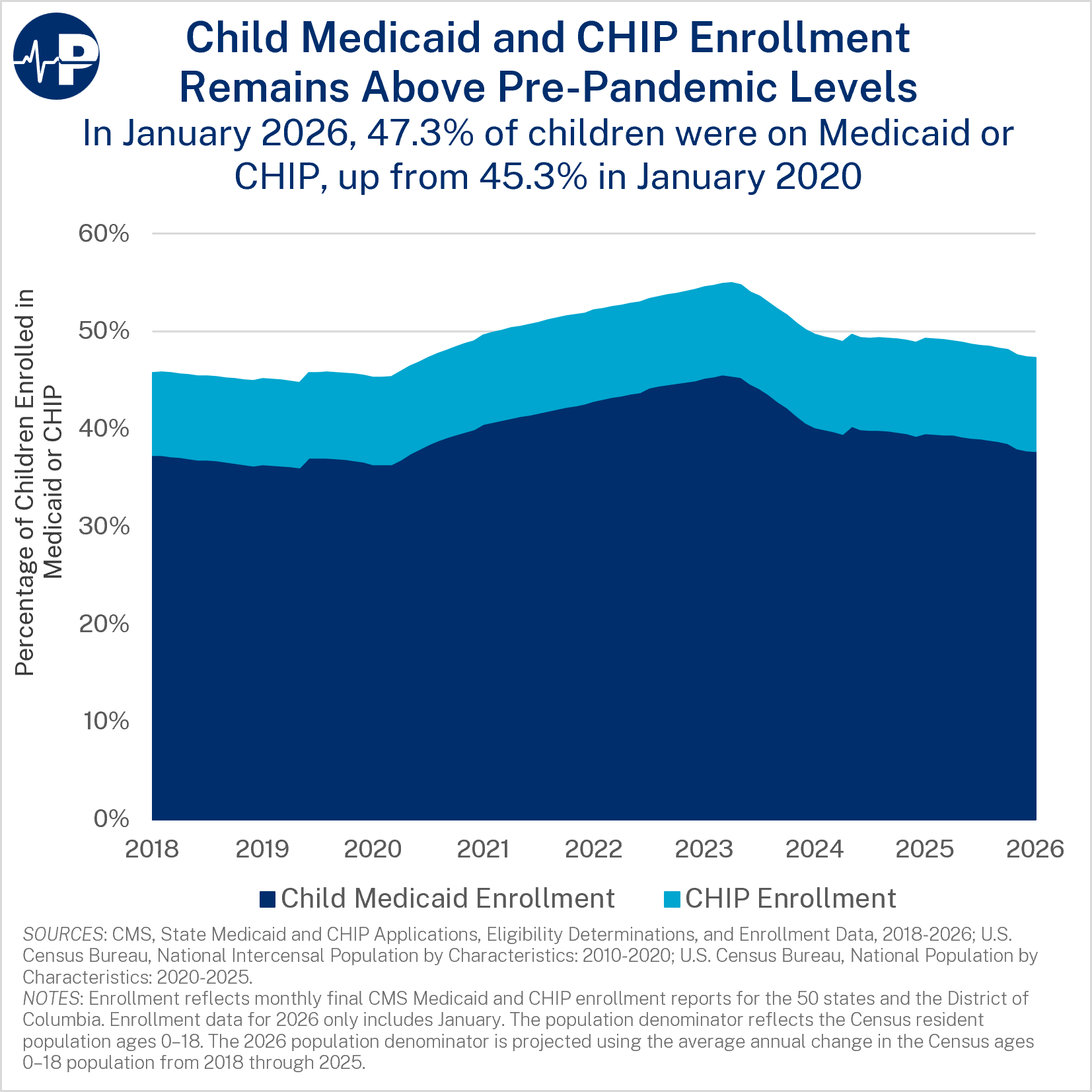


This PIC shows that child enrollment in Medicaid and CHIP remains above its pre-pandemic level as a share of the total population aged 0-18. In January 2020, 45.3 percent of children were enrolled in Medicaid or CHIP, nearly identical to the average level of 45.4 percent from 2018 to 2019. In January 2026, the last month for which complete data is available, that share was 47.3 percent, a two percentage-point increase. Enrollment rose sharply during the pandemic because federal law largely prohibited states from removing Medicaid enrollees, even when they were no longer eligible. This led to dramatic enrollment growth, as shown in the figure. At its peak in 2023, Medicaid child enrollment and CHIP enrollment together covered more than half of all children. Since 2023, the share has declined, but it is still greater than pre-pandemic levels.
This historical perspective is important context for assessing recent claims that declining child enrollment in Medicaid/CHIP reflects children losing health coverage due to “spillover effects” or “chilling effects” from the program integrity reforms in the One Big Beautiful Bill (OBBB) and other actions of the Trump administration. As Paragon has argued, enrollment declines in Medicaid/CHIP after 2023 should be interpreted alongside the unwinding of pandemic-era continuous coverage rules, duplicate enrollment cleanup, demographic change (particularly the decline in the fertility rate and number of children in the U.S. during this period), and normal eligibility redeterminations. Until these common-sense explanations are explored empirically, claims that the OBBB is driving up the number of uninsured children are speculative and unsupported by the available evidence. Moreover, it is crucial not to conflate Medicaid/CHIP enrollment with insurance coverage, access to care, or health outcomes.
(It is also important to note that the population estimates we use from the Census Bureau include all children living in the U.S., regardless of immigration or legal status. Since undocumented children are ineligible for Medicaid/CHIP coverage in most states, the PIC slightly understates the share of eligible children enrolled in Medicaid/CHIP.)
Overall, the figure shows that child Medicaid and CHIP enrollment remains elevated relative to historical averages, even after the decline associated with the unwinding of continuous coverage requirements. Rather than showing a collapse in child coverage in public programs, the data are consistent with enrollment gradually normalizing after the significant pandemic-era expansion.