
Reforming Government. Empowering Patients.
Navigation
Pay and Don’t Chase
How Original Medicare Loses Tens of Billions a Year and How CMS Can Fix It

The Paper
Executive Summary
Why We Did This
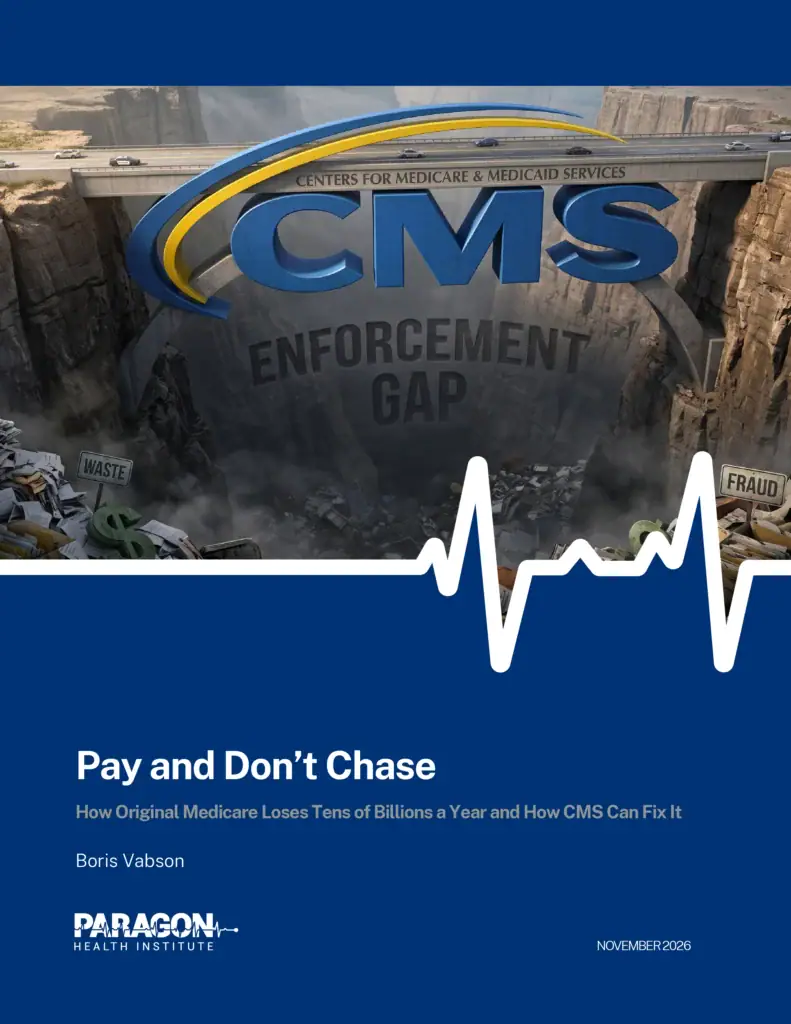
For decades, Original Medicare’s operating model has been one of pay first, review later: Claims are paid essentially automatically, subject only to limited pre-payment review, and enforcement is concentrated on recovering funds after the fact under a “pay-and-chase” model.1 Even at the post-payment stage, substantial enforcement gaps have long persisted, leaving the Medicare program highly vulnerable to systemic billing errors and exploitation by unscrupulous providers.
What We Found
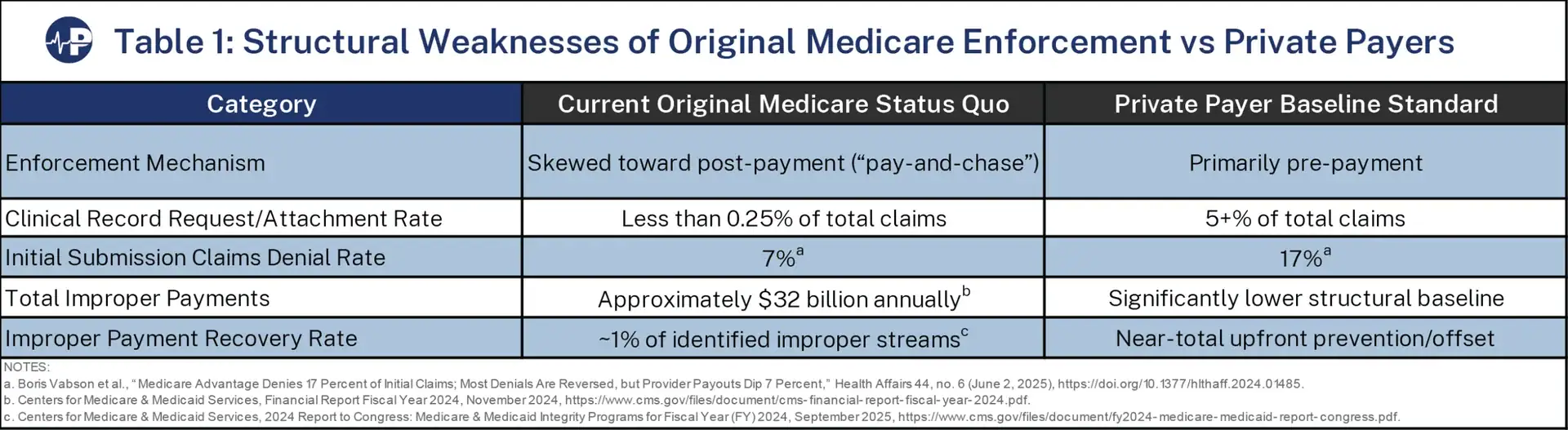
According to the Centers for Medicare & Medicaid Services (CMS), these pervasive pre-payment enforcement gaps result in approximately $32 billion in improper Original Medicare payments distributed annually by the federal government.2 CMS’s own recovery data show that less than 2 percent of these improper payments are ever recouped at the post-payment stage.3
This widespread enforcement failure is in part the product of structural and operational shortcomings in how CMS has managed its enforcement contractors—shortcomings that have persisted for decades—including misaligned institutional incentives, counterproductive regulatory barriers, and chronically insufficient resourcing. These structural deficiencies compromise the efficacy of payment enforcement.
Beyond standard billing errors, the systemic lack of upfront, rigorous claim verification actively subsidizes and invites more insidious forms of fraudulent and wasteful activity. This broader subset of fraud, waste, and abuse is only incidentally captured in CMS’s official $30 billion improper payment estimate, meaning the true economic loss is substantially higher.4
Why It Matters
Closing these gaps warrants prioritization by CMS for four reasons: the sheer magnitude of the fiscal losses, the ease of implementation through administrative channels, clear alignment with the current administration’s stated priorities on health care fraud—reflected most recently in its delegation of permissive exclusion authority to CMS—and the timing. In 2028, CMS’s electronic claims-attachment standard (CMS-0053-F) takes effect, converting medical record exchange from a fax- and paper-based process into a standardized digital transaction. That change mitigates the provider-burden and review-cost rationale that has long justified Medicare’s minimal use of clinical records in claim review, and it makes the pre-payment reforms proposed below operationally feasible for the first time.
By executing these long-overdue administrative improvements, CMS could achieve $10 billion to $15 billion in annual fiscal savings. This estimate represents a conservative lower bound. True savings would likely be significantly greater through effective deterrence of adjacent fraud.
What We Recommend
- Shift enforcement to the pre-payment stage via advanced data integration and strengthened Medicare Administrative Contractors (MAC) incentives. CMS should use quarterly change requests to mandate the inclusion of medical records at the pre-payment stage for services vulnerable to errors or manipulation, or for which these records are necessary for effective enforcement. It should also restructure MAC performance measurement and management to incentivize against improper payments.
- Standardize and rigorously enforce payment rules against clinical attachments. CMS should formally update its rules and claims processing manuals to mandate that clinical attachments are subject to the same review process as electronic data claims, require that MACs standardize their review criteria, and evaluate MAC performance through randomized audits.
- Enable more advanced pre-payment screening technologies through modernization of underlying infrastructure. CMS should accelerate the development and implementation of the ClaimsCore database, digitize all national and local coverage rules, and require explanation of artificial intelligence (AI) tools used for automated claim denials while protecting their operational details.
- Broaden and strengthen universal post-payment enforcement. CMS should allow Recovery Audit Contractors to audit all claims and lift antiquated caps on medical record requests, increase the financial reward for auditing lower-dollar claims, and leverage statistical extrapolation authority to deter bad-faith appeals.
Background
CMS possesses broad statutory authority to regulate, oversee, and enforce existing claim standards and billing criteria within Original Medicare. That authority rests on the general rulemaking power of the Secretary of Health and Human Services under Section 1871 of the Social Security Act and on a set of specific payment-integrity provisions—chiefly Sections 1833(e), 1862(a)(1), 1862(o), 1866(j), 1874A, and 1893—that together allow CMS to condition payment on adequate documentation, deny claims that fail Medicare’s coverage criteria, suspend payment where credible allegations of fraud exist, revoke the enrollment of abusive providers, and direct contractors to review claims before they are paid. These mechanisms are legally designed to safeguard public funds by preventing improper payments, particularly for provider claims that fail to comply with Medicare’s established—and already highly permissive—coverage criteria.5
This administrative authority reaches three distinct categories of improper claims:
- Error: claims featuring unambiguous administrative mistakes; structural omissions; erroneous diagnostic, therapeutic, or procedural coding; or glaring internal inconsistencies. Such basic billing failures typically reflect clear waste and, when persistent, systemic abuse.
- Medical necessity: claims that are correctly coded and fully documented yet bill for services that were not “reasonable and necessary” under Section 1862(a)(1)(A) of the Social Security Act or that fail to meet the coverage conditions set out in applicable National and Local Coverage Determinations.
- Fraud: intentional fabrications such as billing for patient encounters that never occurred, services that were never rendered, or services and supplies deliberately mischaracterized to optimize reimbursement.6 Classic examples include “ghost providers” using stolen credentials, high-volume “script mills,” and willful duplicate submissions for a single service. Here CMS’s role is operational rather than prosecutorial—denying, suspending, and revoking—while the investigation and punishment of fraud run through the Office of Inspector General relying on exclusion and civil monetary penalty authorities under Title XI (Sections 1128 and 1128A, among others) and, for criminal and False Claims Act matters, the Department of Justice.
Despite this clear mandate, decades of legacy CMS practice have systematically prioritized payment speed over accuracy and program integrity. The irony is that the system CMS has inherited exhibits the very problems Congress set out to solve in the last major overhaul of the contracting system, the Medicare Modernization Act of 2003 (MMA). Before the MMA, Medicare claims were paid by several dozen fiscal intermediaries and carriers that had been nominated by provider associations or appointed outright, under cost-reimbursed agreements that were awarded without competition and renewed effectively automatically. CMS had little leverage to demand performance or replace a poor performer, and oversight relied on the contractors’ own reporting—reporting that several of them were found in the late 1990s to have falsified. The MMA replaced them with Medicare Administrative Contractors (MACs) selected through open competition on fixed terms, under performance-based contracts, on the expectation that competition and accountability would improve contractor performance. That potential has largely gone unrealized. In the two decades since, CMS has not made full use of the tools the MMA gave it. Nor has the system been meaningfully updated in that time, apart from piecemeal changes, so CMS is, in fairness, fighting today’s problems with the structure and tools of 20 years ago. The result is large, predictable gaps in frontline enforcement.
For example, historically the preponderance of medical auditing and verification protocols has occurred on a post-payment basis, while limited screening has been applied at the pre-payment phase.7 Given that CMS has delegated pre-payment review to external contractors—the MACs—gaps in that review are ultimately attributable to MAC practices as well as the factors shaping those practices. Specifically, they stem from long-standing features of CMS’s management of the MACs that have remained largely unchanged since the MAC contracts were first awarded in the late 2000s: misguided performance objectives, weak and misaligned incentives, and regulatory and technological barriers, all of which the Government Accountability Office identified more than a decade ago.8 The clearest illustration is the use of medical records. For a significant share of services, claims on their own do not contain enough information to confirm compliance with coverage and payment rules, so records are necessary for effective pre-payment review. However, MACs request these for less than 0.25 percent of claims,9 a far lower rate than what is necessary for effective enforcement and much lower than the 5-plus percent request rate among private payers.10 This is not for want of authority. CMS can direct MACs to require medical attachments for any service through its change request process, and under existing authority each MAC already holds the prerogative to require them on its own initiative, for any services it designates, without instruction from CMS. That so few records are requested under either pathway reflects how MACs are paid and measured rather than what they are permitted to do—which is why the recommendations below pair new CMS mandates with the more fundamental lever of realigning MAC incentives.
Original Medicare’s reliance on post-payment review, in place since the program’s founding, runs completely counter to the standard operating procedures of commercial health plans and private payers, which deploy sophisticated, real-time pre-payment filters to validate claims before funds are disbursed. By operating an archaic “pay-and-chase” architecture, Original Medicare makes the clawback of improper payments exceptionally difficult, as federal funds have already been liquidated and distributed by the time an audit is initiated. In more severe and coordinated fraudulent schemes, these funds are rapidly transferred out of domestic jurisdictions entirely, leaving federal investigators with no viable path toward financial recovery.
Issues with CMS’s pre-payment enforcement approach are compounded by substantial gaps in the agency’s approach to post-payment enforcement. These gaps preclude post-payment enforcement from functioning as an effective backstop and from at least partially offsetting the limited degree of pre-payment enforcement. Specifically, rather than extending universally across all claims, post-payment auditing is limited to isolated instances due to restrictions and incentive structures put in place between 2009 and 2016 and left unchanged since. Under policies adopted in that period and still in force, Recovery Audit Contractors (RACs) are permitted to audit only a narrow, pre-specified subset of billing error types explicitly approved by CMS at any given moment.11 This artificial limitation leaves a high share of payments—including improper payments—entirely excluded from post-payment review.
Additionally, CMS imposes an implicit, highly restrictive cap on the absolute volume of claims that can be subjected to post-payment auditing, primarily through strict limits on Additional Documentation Requests.12 Finally, the financial architecture governing RACs actively discourages contractors from pursuing lower-dollar claims. RACs operate under a legacy contingency-fee structure that pays a uniform percentage of recoveries, with no upward adjustment for claims that are low in dollar value but high in review complexity. As a result, RACs naturally focus their resources on rare, high-dollar institutional claims. Consequently, they deprioritize the extensive “long tail” of low-dollar outpatient, laboratory, and durable medical equipment claims, which collectively comprise an outsized share of improper Medicare spending.13
CMS’s reliance on post-payment rather than pre-payment enforcement positions RACs as the primary gatekeeper for filtering out improper payments. Unfortunately, these compounding limitations substantially compromise RACs’ effectiveness in this role, leading to a post-payment recovery rate of about 1 percent of all improper payments, based on CMS’s own internal estimates.14
Massive Cost to Taxpayers
By CMS’s own calculations, these systemic enforcement gaps at the pre-payment and post-payment stages come at a $32 billion cost in improper payments, equivalent to roughly 7.5 percent of all Original Medicare fee-for-service expenditures.15
A portion of the improper payments included in CMS’s estimate are technicalities, such as a provider’s failure to include correct documentation, which would get corrected under tighter enforcement. Even setting these aside, there is at least $10 billion to $15 billion annually in unambiguous, structurally improper payments.16
Critically, this $10 billion to $15 billion figure is a conservative floor. Setting aside the technicalities addresses overstatement in one direction—documentation lapses that Comprehensive Error Rate Testing (CERT) counts as improper but would be corrected rather than recovered under tighter enforcement—while doing nothing about understatement in the other, because CERT can count only the improper payments its method is built to detect. The figure derives from CMS’s CERT methodology, which reviews a random sample of roughly 37,500 claims for compliance with coverage, coding, and billing rules, relying on documentation supplied by the billing providers.17 That method is designed to measure error, not fraud, and CMS itself cautions that the resulting improper payment rate is not a fraud rate. A fraudulent claim for a service that was never rendered passes CERT review as a proper payment so long as whatever the biller submits is complete, internally consistent, and free of technical errors—nothing in the process verifies that the service occurred. Fraud is included in the estimate only incidentally—and the estimate therefore likely reflects a minority of fraud dollars. An estimate that fully captured fraud would substantially exceed the $10 billion to $15 billion baseline.
A Timely Enabler: Clinical Data Exchange Modernization
Upcoming improvements in clinical data accessibility through the CMS-0053-F rule in 2028 make this a particularly opportune time for bolstering Medicare enforcement efforts.18 Critically, this final rule eliminates a long-standing barrier to robust pre- and post-payment enforcement: the administrative and logistical burdens associated with clinical data exchange, as well as the operational burdens of data review. Because of these burdens, Original Medicare has historically not required submission of medical records alongside claims, even when they are necessary for effective enforcement.
CMS-0053-F establishes standards requiring clinical documentation submitted alongside a claim to be fully digital, adhering to specific structural and exchange guidelines (such as C-CDA architectures). The mandate is designed to apply across all insurance segments, extending to private as well as public coverage. Once fully implemented in 2028, this modernization will transform clinical attachments, which to this day remain largely fax- and paper-based.
Specifically, the shift to standardized electronic documentation reduces provider administrative friction from medical record exchange to near zero while significantly lowering the operational costs of record review by MACs and RACs. Consequently, it eliminates long-standing cost barriers and the primary regulatory justifications for restricting medical record usage, thereby eliminating a long-standing impediment to greater enforcement at both the pre-payment and post-payment stages.
Policy Recommendations: A Multi-Pronged Administrative Strategy
To capitalize on this technical modernization and fully close Original Medicare’s enforcement gaps, CMS should immediately execute a coordinated series of administrative reforms. These recommended interventions are organized under four core pillars. The first three categories focus on shifting more enforcement to the pre-payment stage rather than post-payment and strengthening the efficacy of MAC enforcement activities. The final pillar deals with strengthening post-payment enforcement and auditing activities by RACs.
1. Shift Enforcement to the Pre-Payment Stage via Advanced Data Integration and Strengthened MAC Incentives
As previously noted, one key obstacle to pre-payment enforcement has historically been the absence of necessary clinical data: Many claims cannot be evaluated at face value, and the clinical documentation needed to assess them has not been available at the point of payment. Private commercial payers routinely require clinical medical records to be attached directly to a claim whenever those records are necessary to effectively enforce payment rules.19 However, due to deep structural and financial misalignments, Original Medicare does not require these records even in many cases when they are absolutely essential for effective enforcement. Altogether, Original Medicare requires pre-payment clinical attachments at a fraction of commercial rates—hovering at below 0.25 percent of claims, compared to the 5-plus percent standard maintained by private health plans.
Missing data is not the only constraint. The MACs that adjudicate claims are also insufficiently incentivized—and in some respects insufficiently resourced—to undertake pre-payment enforcement. MACs are paid under cost-based contracts whose award fees turn on operational performance—timely processing, low error rates, provider service—rather than on improper payments prevented, and contract renewal likewise does not hinge on prevention. Medical review, meanwhile, is funded through a separate, capped budget that falls well short of the review volume that effective enforcement would require.
Reform in this area should not take the form of CMS micromanaging the MACs. CMS can set the high-level objectives and align the incentives and then leave the operational details to the MACs themselves, which hold a clear comparative advantage in determining how enforcement should be executed. Delegating in this way also spares CMS an undue administrative burden at a time when its own bandwidth is already limited.
Finally, CMS can undertake reforms that avoid the operational and policy pitfalls that befell previous CMS attempts at pre-payment review, specifically CMS’s previous attempts around home health services.20 That demonstration proved operationally unsustainable in its original form, reviewed every claim uniformly rather than targeting those at greatest risk, and had design limitations that constrained its savings. These proposed reforms are more operationally sound, building on top of an existing MAC operating infrastructure and leveraging modern technologies that were previously unavailable. They are also more targeted, predicated on medical record review for about 10 percent of services rather than 100 percent of them as under the previous home health demonstration.
- Deploy explicit administrative mandates. CMS should aggressively utilize formal change requests and, as described below, reallocate budgets to mandate including medical records at the pre-payment stage for any billing codes or clinical service categories that exhibit elevated error rates or in cases where clinical data is essential for effective enforcement of existing payment rules. CMS is able to issue change requests within the current contract scope on a quarterly basis, which MACs are then required to implement within 90 days, enabling rapid action by CMS.21
- Realign contractor incentives and move beyond cost-plus contracting. Under Section 1874A(b)(1)(D)(ii) of the Social Security Act, the Secretary is expressly directed to provide financial incentives for MACs to reduce improper payment error rates in their jurisdictions. Currently, these performance incentives are extremely weak given the small amount of money at stake: a maximum upside of 3 percent as a share of baseline compensation. Furthermore, these rewards—as minuscule as they are—are also evaluated primarily on claims processing speed and provider satisfaction, with less than 10 percent of performance dollars tied to the improper payment error rate.22 Finally, given that some of these other performance metrics are actually at odds with improper payment rate reductions, these performance incentives may actually deter rather than promote effective enforcement.CMS should consequently restructure how contractor performance is measured, managed, and incentivized. The opportunity runs along three dimensions: (1) how much money rides on performance, (2) what that performance is measured against, and (3) what determines whether a MAC keeps its contract. On the first, performance incentives should be strengthened so that they amount to more than a rounding error. Under the existing cost-plus MAC contract structure, CMS already has the flexibility to raise the performance pool from roughly 3 percent to around 10 percent of contract value and can do so on an annual basis coinciding with the option period exercise. More radically, CMS could move to an entirely new contract structure through a recompete. Although recompetes typically occur every seven to 10 years, CMS can precipitate one within a year by declining to exercise option periods. A new structure—for example, a firm-fixed-price contract with performance-based deductions and gainsharing—would be consistent with this administration’s broader shift away from cost-plus contracting and would allow CMS to put far more than 10 percent of MAC payments at risk.Second, CMS should change what performance is measured against. Existing measures such as CERT-derived improper payment rates should be weighted far more heavily. New measures could also be introduced, including ones capturing alignment between MACs and private payers on dimensions such as clinical documentation requirements.Third, and perhaps most consequentially, the same measures should govern contract renewal. Under Section 1874A(b)(1)(B), CMS may renew a MAC contract without competition only if the contractor has met or exceeded its performance requirements. The annual exercise of options and the eventual recompete are therefore natural points at which improper-payment performance can be made pivotal rather than incidental.Given that the opportunity to implement these changes appears on an annual basis for CMS, they can be executed rapidly.
- Optimize operational resources. CMS should scale up the dedicated medical review budgets allocated to MACs. More importantly, the agency should ensure that the financial rewards built into the updated MAC incentive structure are large enough to completely offset the marginal operational costs of ingesting, parsing, and reviewing high volumes of clinical records. CMS can do so by increasing the share of the Medicare Integrity Program budget that is allocated to medical review. Given that the overall budget amount is set by Congress, increasing the medical review budget sizably—without cannibalizing other key MAC functions—would require congressional action.
2. Standardize and Rigorously Enforce Payment Rules Against Clinical Attachments
Medicare’s existing regulatory coverage and reimbursement frameworks are explicitly engineered to evaluate standard claims data, but they remain highly ambiguous regarding the review of clinical records. This ambiguity leads to gaps in actual enforcement.
- Clarify coverage frameworks. CMS should formally update its rules and claims processing manuals to mandate that clinical attachments are subjected to the same systematic review process as standard electronic data claims.
- Preserve contractor autonomy. To avoid rigid and overly prescriptive federal mandates, CMS should establish the overarching review architecture while allowing individual MACs the opportunity to customize. In doing so, CMS should also require that MACs formally codify their medical attachment review criteria, particularly to ensure adherence to CMS’s newly instituted systematic review requirements. MACs can effectuate this through the development and refinement of Local Coverage Articles.23
- Implement validation audits. CMS should evaluate MAC performance by conducting regular, randomized sample audits of paid claims and their associated medical attachments, holding contractors directly accountable for any issues missed in the course of medical record reviews.
3. Enable More Advanced Pre-Payment Screening Technologies Through Modernization of Underlying Infrastructure
More effective pre-payment screening has also been thwarted by Medicare’s outdated, fragmented technology infrastructure. This infrastructure is unable to support complex and comprehensive screening algorithms, particularly those drawing on disparate historical data sources, including algorithms commonly employed by private payers. For example, while Medicare’s Common Working File checks incoming claims against beneficiary claim history, its pre-payment edits are limited to enforcing explicit categorical rules—duplicate detection, statutory frequency caps, and benefit-period limits.24 Unlike private payers, Original Medicare does not analytically evaluate new claims against a beneficiary’s multiyear utilization and clinical history at the pre-payment stage, leaving it largely unable to detect statistically implausible service patterns, fragmented billing schemes, and, in particular, claims that are incongruent with patients’ previous histories. Such pattern-based analysis is instead relegated to the post-payment stage.25
Already, CMS is planning on eliminating this long-standing problem through its ongoing ClaimsCore modernization initiative. CMS can build on the momentum and opportunities offered up by this initiative to achieve more effective pre-payment screening.26
- Accelerate unified database deployment. CMS should accelerate the development and full implementation of ClaimsCore—which consists of a centralized, high-performance database tier—using it as the core data engine for complex pre-payment adjudication.
- Digitize Medicare coverage criteria. CMS should convert all national and local coverage rules into computable, machine-readable code. Digitizing these rules removes subjective interpretive ambiguity, as well as the gaps in enforcement that can accompany such ambiguity. Instead, it allows automated engines to instantly evaluate claims against established Medicare policies.
- Establish an explainable AI framework. To prevent arbitrary denials and maintain transparency, CMS should mandate that any AI tools used by contractors use an “explainable AI” architecture. When an automated system issues a claim denial, it should be required to generate a structured, machine-readable explanation that explicitly cites the specific coverage rule, documentation omission, or clinical inconsistency that triggered the rejection.
- Protect core algorithmic logic. While the overall logical rules governing automated screening should remain fully transparent, CMS should leverage statutory disclosure exemptions—such as those under the Freedom of Information Act and Section 1889(f) of the Social Security Act—to keep the specific proprietary weights and risk thresholds of its AI models non-public. Protecting these operational details prevents unscrupulous actors from gaming the system and engineering billing workarounds.
4. Broaden and Strengthen Universal Post-Payment Enforcement
While pre-payment screening is critical and should serve as the primary line of defense, post-payment enforcement remains a necessary backstop—and in its current form it is barely functioning. In the early years of the permanent program, the RACs that anchor post-payment review drew intense criticism from providers for overreach—aggressive denials in areas of genuine clinical ambiguity and an audit volume the appeals system could not absorb. CMS’s response was not a single calibrated fix but a succession of constraints layered on over several years: RACs were confined to a CMS-approved list of audit issues, had their medical-record request limits cut sharply, lost the inpatient short-stay reviews that had accounted for the bulk of their findings, and were made to wait until the second level of appeal before earning any contingency fees.
Whatever the merits of each step, the cumulative effect has swung the pendulum well past the point of balance. A program that collected $3.65 billion in overpayments in FY2013 identified just $353 million and recovered $273 million in the most recent year CMS has reported—against Medicare fee-for-service improper payments that CMS estimates at roughly $32 billion a year. For post-payment enforcement to work as a backstop, its design needs to be substantially overhauled—not to revive the problems of the early program but to remove the counterproductive regulatory constraints and misaligned financial incentives that now keep RACs from fulfilling the role Congress assigned them.
- Remove arbitrary and counterproductive limits to post-payment review. CMS should eliminate the requirement that RACs confine their audits to a narrow list of billing issues pre-approved by CMS. Whatever its original rationale, that list has become actively counterproductive: A RAC cannot pursue a pattern of improper billing, however well documented, unless it matches an approved issue, and the approval process gives CMS an advance veto over what may be examined at all. RACs should instead have clear authority to audit any claim type against the entire universe of CMS coverage, coding, and payment rules, with CMS exercising oversight through accuracy and overturn-rate standards rather than by dictating in advance what can be investigated.Concurrently, CMS should lift the antiquated, paper-era caps on medical record requests, known formally as Additional Documentation Requests (ADRs). This cap on ADRs translates—even if indirectly—into a limit on the volume of post-payment review given that medical records are otherwise prerequisites for a large fraction of post-payment review. These caps date back to a time when medical record requests imposed substantial burdens on providers, but in a modern, fully digital ecosystem, the administrative burden on providers disappears. The paradigm shift therefore renders existing ADR caps obsolete and counterproductive.Lifting these constraints would not precipitate a return to the overreach of the program’s early years, because the safeguards that matter most would remain in place. Most notably, the clinical scenarios that historically presented the greatest ambiguity and potential for abuse have been explicitly carved out of RAC jurisdiction. Inpatient short-stay audits, for example, are now handled by separate contractors, while observation stays are largely managed administratively through the bright-line standard of the two-midnight rule. Furthermore, the financial incentives driving audit behavior have been fundamentally reformed. Unlike the early days of the program, RAC contingency fees are now subject to clawback if a denial is overturned on appeal, providing a powerful financial deterrent against aggressive or unfounded denials.27 Together, these guardrails ensure that lifting the caps would enhance program integrity without subjecting providers to arbitrary enforcement.
- Capture the long tail of billing errors. To incentivize RACs to pursue low-dollar payments, which make up a meaningful share of all improper payments, CMS should implement a tiered contingency fee model that increases the financial reward for successfully auditing lower-dollar claims. Additionally, CMS should permit RACs to bundle related lower-dollar claims together into single, high-volume audit cases, making the investigation of widespread billing errors economically viable.
- Deter bad-faith appeals. Even when RACs identify improper payments and request clawbacks, entities are able to delay or entirely forestall payment recovery through abuse of the existing appeals process. To neutralize this strategy and make the existing process less susceptible to bad-faith tactics, CMS should further leverage its existing authority around sampling-based statistical extrapolation. Additional reforms to deter bad-faith appeals—such as a binding arbitration framework or a structured escrow model in which providers post funds pending appeal—would likely require congressional action. Any such legislation should be informed by the No Surprises Act’s Independent Dispute Resolution process, whose implementation has been beset by provider gaming and administrative backlog.
Benefits of Reform
The persistence of massive, unchecked enforcement gaps within Original Medicare constitutes an unsustainable policy failure. It harms American taxpayers and threatens the long-term stability of a program relied upon by millions of beneficiaries. Over recent decades, by allowing trillions of federal dollars to be distributed under an archaic “pay-and-chase” model, CMS has inadvertently subsidized systemic waste, rewarded non-compliant billing behavior, and created susceptibility to sophisticated fraud networks.
Remedying this vulnerability requires no legislative breakthroughs, complex statutory rewrites, or heavy operational lift. The core of the agenda can be undertaken through basic administrative changes by CMS—subregulatory guidance and contractor management—and because the reforms would be executed through CMS’s contractors, they would not require operational reworking of the agency itself. As such, these reforms can be implemented rapidly, readily, and effectively.
Critically, these reforms would not affect beneficiaries or their access to care, nor would they impose undue administrative burdens:
- The proposed changes concern review of claims after a service has already been delivered—not prior authorization before care—so they would never stand between a patient and care.
- They would not affect patients financially: Under Medicare’s limitation-on-liability rules, when a claim is denied as not reasonable and necessary, the provider—not the beneficiary—absorbs the cost, except in the uncommon cases where the provider has furnished the patient an Advance Beneficiary Notice in advance of the service.
- The reforms involve no changes to coverage policy itself and therefore no direct effect on what care beneficiaries can receive.
- By leveraging the technologies and pathways unlocked by the CMS-0053-F rule, they can be implemented at very limited added burden to providers.
Conclusion
Given the substantial benefits of this proposed reform, it is natural to ask why this solution has not been implemented previously or why earlier, narrower efforts—such as home health pre-payment models—ultimately fell flat. The answer is twofold. First, requiring manual medical record submission for more services previously would have added burden to providers. This fundamental barrier is newly mitigated by the implementation of the CMS-0053-F rule, which substantially reduces burden through the introduction of a digital process. The rule is therefore exceptionally timely. Second, historical predecessors suffered from fundamental operational and policy flaws. The current framework is informed by these past isolated failures. The proposed reform avoids these past pitfalls entirely and is instead operationally sound, carefully measured, and protected by proper guardrails.
Ultimately, these recommended interventions offer a rare combination: a structural, highly practical reform that simultaneously benefits taxpayers and program enrollees. Deployed effectively, they would root out systemic billing abuse while protecting honest providers and could deliver more than $10 billion annually in direct savings—a figure grounded in CMS’s own estimate, which excludes most fraud. That exclusion matters, because the same mechanism that catches error also deters fraud. Requiring medical records alongside a far greater share of claims makes fraud harder and costlier to carry out. The resulting deterrent effect on fraud, excluded from the $10 billion savings estimate, could plausibly yield many billions more in additional savings.
Footnotes
1↑ Government Accountability Office (GAO), Medicare: Claim Review Programs Could Be Improved with Additional Prepayment Reviews and Better Data, April 13, 2016, https://www.gao.gov/products/gao-16-394
2↑ CMS, Financial Report Fiscal Year 2024, November 2024, https://www.cms.gov/files/document/cms-financial-report-fiscal-year-2024.pdf
3↑ CMS, 2024 Report to Congress: Medicare & Medicaid Integrity Programs for Fiscal Year (FY) 2024, September 2025, https://www.cms.gov/files/document/fy2024-medicare-medicaid-report-congress.pdf
4↑ GAO, Improper Payments and Fraud: How They Are Related but Different, December 7, 2023, https://www.gao.gov/products/gao-24-106608
5↑ CMS, 2024 Report to Congress: Medicare & Medicaid Integrity Programs for Fiscal Year (FY) 2024.
6↑ CMS, Medicare Program Integrity Manual, https://www.cms.gov/regulations-and-guidance/guidance/manuals/downloads/pim83exhibitspdf.pdf
7↑ GAO, Medicare: Claim Review Programs Could Be Improved.
8↑ GAO, Medicare Administrative Contractors: CMS Should Consider Whether Alternative Approaches Could Enhance Contractor Performance, April 30, 2015, GAO, Medicare: Claim Review Programs Could Be Improved https://www.gao.gov/products/gao-15-372;
9↑ CMS, "Agency Information Collection Activities: Submission for OMB Review; Comment Request," Federal Register 90, no. 167 (September 2, 2025): 42411?13, https://www.govinfo.gov/content/pkg/FR-2025-09-02/pdf/2025-16789.pdf
10↑ Private payers obtain clinical documentation through two channels: prior authorization, where records are reviewed before the service is furnished, and medical record requirements attached to claims outside of prior authorization. On the first, Schwartz et al. applied a large Medicare Advantage insurer's prior authorization rules to 2017 Part B fee-for-service claims and found that 2.2 services per beneficiary per year would have required prior authorization. Against roughly 35?40 claims per fee-for-service beneficiary per year (approximately 1.1 billion claims divided by about 30 million beneficiaries), and assuming prior authorization?subject services generally fall on distinct claims, prior authorization touches on the order of 5 percent of claims. On the second, private payers require medical records for about 2 percent of claims outside of prior authorization. Together, roughly 7 percent of commercial claims are subject to clinical documentation review; the text uses 5 percent as a conservative figure. Aaron L. Schwartz, Troyen A. Brennan, Dorothea J. Verbrugge, and Joseph P. Newhouse, "Measuring the Scope of Prior Authorization Policies: Applying Private Insurer Rules to Medicare Part B," JAMA Health Forum 2, no. 5 (2021): e210859, https://doi.org/10.1001/jamahealthforum.2021.0859
11↑ Centers for Medicare & Medicaid Services. (2023). Medicare Recovery Audit Program Approved Topics. Department of Health and Human Services https://www.cms.gov/data-research/monitoring-programs/medicare-fee-service-compliance-programs/medicare-fee-service-recovery-audit-program/approved-rac-topics
12↑ CMS, Medicare Fee-for-Service Recovery Audit Program: Additional Documentation Request Limits for Institutional Provider Facilities, May 1, 2022, https://www.cms.gov/files/document/adr-limits-institutional-provider-facilities-may-1-2022.pdf
13↑ GAO, Medicare: Claim Review Programs Could Be Improved.
14↑ CMS, 2024 Report to Congress: Medicare & Medicaid Integrity Programs for Fiscal Year (FY) 2024.
15↑ CMS, Financial Report Fiscal Year 2024, November 2024, https://www.cms.gov/files/document/cms-financial-report-fiscal-year-2024.pdf
16↑ CMS, Financial Report Fiscal Year 2024.
17↑ CMS, Financial Report Fiscal Year 2024.
18↑ Department of Health and Human Services, Administrative Simplification; Adoption of Standards for Health Care Claims Attachments Transactions and Electronic Signatures, Final Rule (CMS-0053-F), 91 Fed. Reg. 14350, March 24, 2026, https://www.federalregister.gov/d/2026-05676
19↑ Council for Affordable Quality Healthcare, "2023 CAQH Index: Tracking Electronic Administrative Transactions in Health Care." https://caqh.org/hubfs/43908627/drupal/2024-01/2023_CAQH_Index_Report.pdf
20↑ Jeffrey Marr et al., "Pre-Claim Review and Traditional Medicare Home Health Spending: Evidence from 4 States," Health Affairs 45, no. 6 (June 1, 2026), https://www.healthaffairs.org/doi/10.1377/hlthaff.2025.01356
21↑ CMS, "Quarterly Provider Updates: Mid-Quarter Instructions," last modified September 10, 2024, https://www.cms.gov/regulations-and-guidance/regulations-and-policies/quarterlyproviderupdates/midquarter
22↑ Department of Health and Human Services Office of Inspector General, Medicare Administrative Contractors' Performance, January 2014, https://oig.hhs.gov/documents/evaluation/2756/OEI-03-11-00740-Complete%20Report.pdf
23↑ Local Coverage Articles (LCAs) are MAC-issued companion documents to Local Coverage Determinations that translate coverage policy into operational billing and coding instructions?specifying covered ICD-10 and HCPCS codes, modifiers, documentation requirements, and claim-submission rules.
24↑ CMS, Medicare Claims Processing Manual, Pub. 100-04, chap. 27, "Contractor Instructions for CWF," https://www.cms.gov/regulations-and-guidance/guidance/manuals/downloads/clm104c27.pdf
25↑ CMS, Medicare Claims Processing Manual, Pub. 100-04, chap. 27, "Contractor Instructions for CWF," https://www.cms.gov/regulations-and-guidance/guidance/manuals/downloads/clm104c27.pdf
26↑ Centers for Medicare & Medicaid Services, Fiscal Year 2027 Justification of Estimates for Appropriations Committees, April 2026, https://www.cms.gov/files/document/fy-2027-justification-estimates-appropriations-committees.pdf
27↑ Holly Stockdale, Medicare's Recovery Audit Contractor (RAC) Program: Background and Issues, Congressional Research Service, May 21, 2009, https://www.congress.gov/crs-product/R40592
Author

Acknowledgements
The author is grateful to Brian Blase, Demetrios L. Kouzoukas, and the Paragon team for their exceptional comments and work in review of the paper.