

Brian Blase, Ph.D., is the President of Paragon Health Institute. Brian was Special Assistant to the President for Economic Policy at the White House’s National Economic Council (NEC) from 2017-2019, where he coordinated the development and execution of numerous health policies and advised the President, NEC director, and senior officials. After leaving the White House, Brian founded Blase Policy Strategies and served as its CEO.
Did the OBBB Cut Medicaid? Not if You Apply KFF’s 2012 Logic

When Congress slows the growth of an entitlement program, is that a cut? The answer should not depend on which party wrote the bill. Yet much of the health policy community, including reporters, has applied different standards to the Democratic-enacted Affordable Care Act (ACA) and the Republican-enacted One Big Beautiful Bill (OBBB).
KFF is a leading source of health policy information—and illustrates the double standard. In 2012, KFF Health News (then called Kaiser Health News) explicitly rejected the characterization that the ACA cut Medicare even though it reduced Medicare payments by an estimated $716 billion over 10 years. Medicare spending would continue to rise, just more slowly. But KFF, like much of the health press, now routinely refers to the OBBB’s Medicaid reforms as “cuts,” even though federal Medicaid spending will continue to rise.

A screenshot of the story “FAQ: Decoding The $716 Billion In Medicare Reductions“, published August 12, 2012 by KFF.
The 2010 and 2025 laws share a central feature: both reduce projected federal spending relative to prior law, yet spending continues to grow. Both limit federal payments to providers and insurers, although the OBBB also includes Medicaid eligibility and financing reforms. The difference is how these laws are described depending on which party enacted them.
The ACA Reduced Medicare’s Trajectory and the OBBB Reduced Medicaid’s Trajectory
The ACA lowered projected Medicare spending mainly by paying hospitals, other providers, and Medicare Advantage plans less than prior law allowed. The OBBB limits excessive state-directed Medicaid payments to hospitals and other providers and restricts provider-tax financing arrangements that states have used to draw down additional federal Medicaid funds with little additional state contribution. It also requires more frequent eligibility verification and establishes community engagement requirements for able-bodied, working-age adults in the Medicaid expansion population.
| ACA: Medicare (2010) | OBBB: Medicaid (2025) | |
|---|---|---|
| 10-year federal reduction vs. prior law | $716 billion, 2013–2022 | $887 billion, 2025–2034 |
| Provider payments | Smaller annual payment updates for hospitals, nursing homes, home health, and hospice | State-directed payments capped at 100–110 percent of Medicare rates |
| Plan and financing payments | Medicare Advantage benchmarks cut toward traditional Medicare costs | Limits on provider taxes used to draw down federal matching funds |
| Eligibility | No change | Work requirements and more frequent eligibility checks |
| Does spending keep growing? | Yes | Yes |
KFF’s coverage of the ACA emphasized Medicare savings and reductions in projected payment growth. Its coverage of the OBBB repeatedly describes Medicaid cuts, including when discussing reforms that primarily affect provider payments. The relevant comparison is spending under prior law versus spending under the reforms. In both cases, federal spending continues to increase, but at a slower rate than previously projected.
| ACA Medicare reductions | OBBB Medicaid reductions |
|---|---|
| KFF Health News, Aug. 17, 2012: Asked whether Washington was cutting Medicare spending, it answered: “No. Medicare spending will increase each year but at a slower rate.” | KFF Health News, Sept. 10, 2025: Headline: “Trump’s Medicaid Cuts Were Aimed at ‘Able-Bodied Adults.’ Hospitals Say Kids Will Be Hurt.” |
| KFF issue brief, Sept. 10, 2012: Files the ACA’s Medicare payment reductions under the heading “Savings provisions.” | KFF policy watch, July 1, 2026: Describes the drop in projected spending as stemming from “Medicaid cuts in the 2025 reconciliation law.” |
| KFF issue brief, Dec. 13, 2016: Describes the ACA’s provisions as “reductions in the growth in Medicare payments.” | KFF Quick Take, June 10, 2025: “The estimated Medicaid cuts in the One Big Beautiful Bill Act totaling $793 billion.” |


KFF’s own 2012 numbers made the same point for Medicare: annual growth of 6.8 percent before the ACA versus 5.6 percent after. KFF was right in 2012 to distinguish between reductions in projected spending and actual declines in spending.
The Last Two-Term Democratic President Forcefully Argued for Reducing the Federal Trajectory of Medicare and Medicaid Spending
On September 9, 2009, President Obama told a joint session of Congress that slowing Medicare and Medicaid spending was a fiscal necessity:
“When health care costs grow at the rate they have, it puts greater pressure on programs like Medicare and Medicaid. If we do nothing to slow these skyrocketing costs, we will eventually be spending more on Medicare and Medicaid than every other Government program combined. Put simply, our health care problem is our deficit problem. Nothing else even comes close.”

U.S. President Obama delivers a speech on healthcare before a joint session of Congress in Washington. September 9, 2009.
Photo credit: Reuters
Obama also argued that reducing “waste and inefficiency in Medicare and Medicaid will pay for most of this plan,” while telling seniors not to believe claims that their benefits would be cut. He was right that entitlement spending growth needed to be restrained. Yet reforms defended as necessary fiscal discipline when Democrats enacted the ACA are routinely characterized as damaging cuts when Republicans pursue similar changes.
Federal Medicaid Spending Exploded Before the OBBB
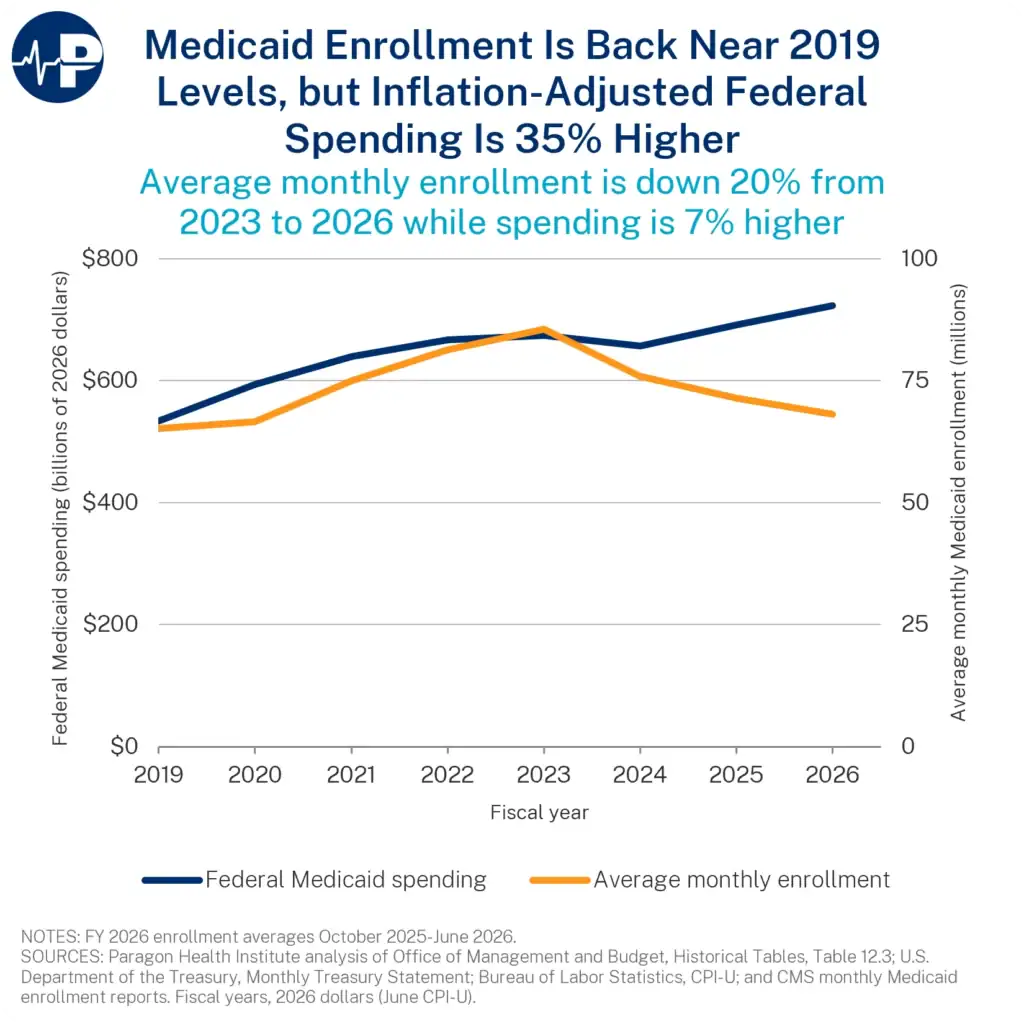
The OBBB also needs to be understood in the context of Medicaid’s extraordinary spending growth. Federal Medicaid spending increased 63 percent between fiscal years 2019 and 2025, partly because of pandemic-era policies. But spending remained elevated even as enrollment declined, with state-directed payments and financing arrangements becoming increasingly important drivers of federal costs.
The OBBB includes important reforms, but federal spending is projected to keep increasing significantly. CBO projects federal Medicaid spending of $845 billion in 2034, 37 percent above the 2024 level.
The timing also runs opposite to what the “cuts” framing implies. When the ACA’s Medicare payment reductions took effect, Medicare spending growth was already moderating: CBO found that per-beneficiary spending in traditional Medicare grew about 7 percent a year from 2000 to 2005, but closer to 4 percent from 2007 to 2010. The OBBB’s reforms, by contrast, take effect after a historic surge in federal Medicaid spending. And unlike Medicare, Medicaid is a shared financing program between Washington and states. States can replace reduced federal payments with their own funds, and the federal match remains open-ended: when a state spends more on covered services, Washington still pays its share.
A Consistent Standard for Describing Entitlement Changes
No one needs to take a side on these laws to describe them accurately. It takes a rule, and the discipline to apply it no matter which party enacted the policy change. A reduction in the projected rate of spending growth is not the same as a reduction in spending, and readers deserve to know which one the policy has produced.
If slowing Medicare’s growth under the ACA was “savings,” slowing Medicaid’s growth under the OBBB is savings too. If it is a “cut” now, it was a cut then. These policies should be debated on their merits, not through terminology that changes depending on which party enacted them. Paragon holds itself to the same rule: we do not—and will never—call slower growth in a program’s spending a cut, whichever party enacts it. We said so when Congress passed the OBBB. Calling slower growth a cut also does not serve the public well when the greatest threat to future American prosperity is the explosive trajectory of federal health program expenditures.
The OBBB’s Medicaid reforms address real problems: excessive payments to politically powerful providers, financing schemes that shift costs to federal taxpayers, and inadequate eligibility verification. Those problems deserve serious attention, particularly after Medicaid’s extraordinary spending growth during the Biden administration. Critics are free to argue that the reforms go too far. But that debate depends on accurate, consistent language.
Anyone describing these laws, whether a lawmaker, an analyst, or a reporter, should follow a few simple standards. State the baseline: say whether a reduction is measured against prior-law projections or against current spending. Report the trajectory, including whether spending will still rise. Use the same terms for the same policy tools, regardless of which party proposes them. KFF Health News had it right in 2012 when it refused to call the ACA’s Medicare payment reforms a “cut.” And because KFF was right in 2012, it is wrong today when it calls the OBBB’s Medicaid changes “cuts.”
Related Content

Subscribe
Sign up now for your health policy updates.