


Brian Blase, Ph.D., is the President of Paragon Health Institute. Brian was Special Assistant to the President for Economic Policy at the White House’s National Economic Council (NEC) from 2017-2019, where he coordinated the development and execution of numerous health policies and advised the President, NEC director, and senior officials. After leaving the White House, Brian founded Blase Policy Strategies and served as its CEO.
Closing Medicare’s Enforcement Gaps, KFF’s Double Standard, and Medicaid’s Spend

This week, Boris Vabson examines Original Medicare’s “pay-and-chase” model, under which at least $32 billion in improper payments goes out the door each year, and recommends reforms to save $10–$15 billion a year. The Centers for Medicare & Medicaid Services (CMS) also proposed its CRUSH anti-fraud rule, projected to save nearly $90 billion over a decade.
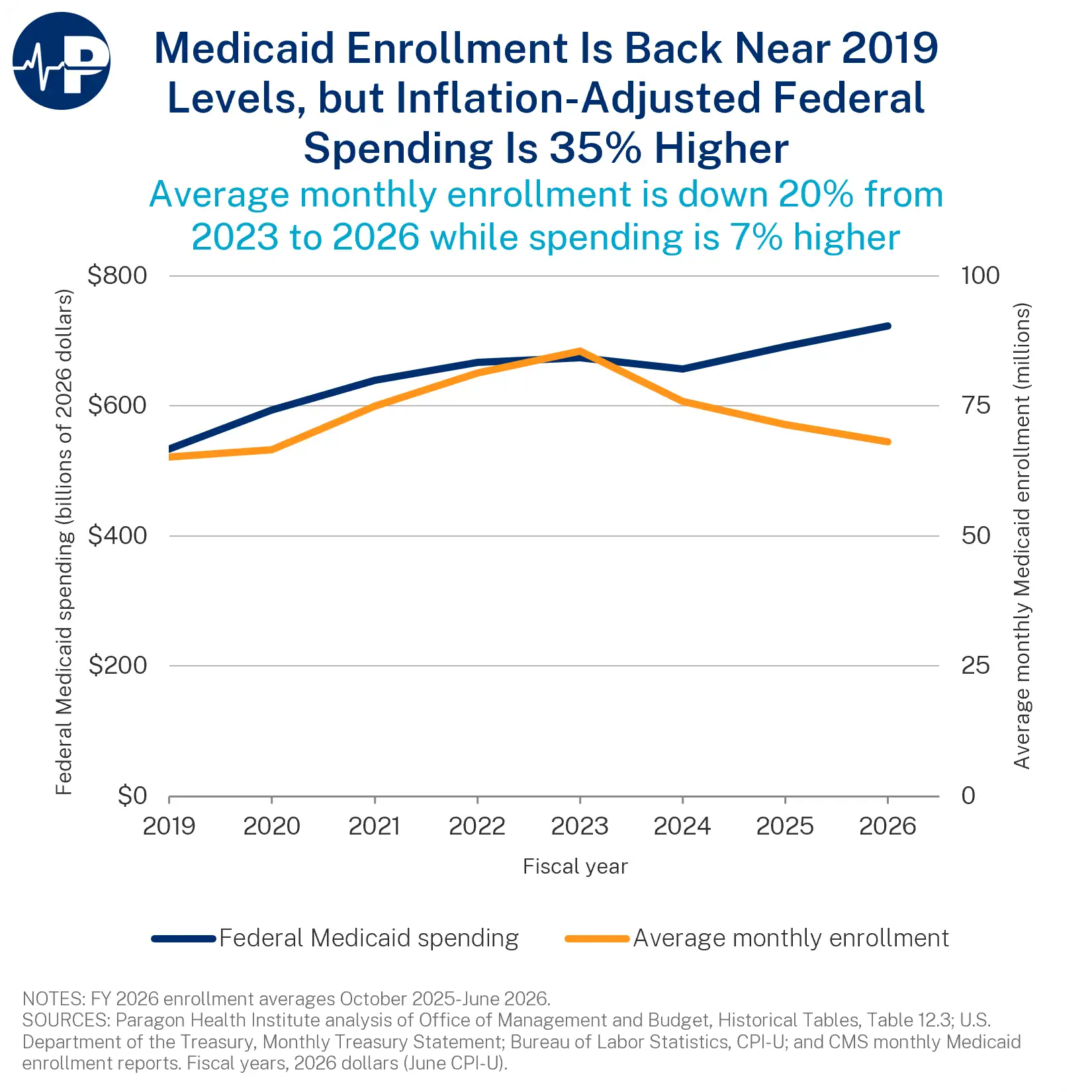
In a new Prognosis, I examine a double standard in how entitlement reforms are described. In 2012, KFF explicitly rejected calling the Affordable Care Act’s (ACA) Medicare payment reductions “cuts.” Today, it routinely uses that word for the One Big Beautiful Bill’s (OBBB) Medicaid reforms. A new Paragon PIC shows that inflation-adjusted federal Medicaid spending remains 35 percent above 2019 levels despite enrollment returning to near its pre-pandemic level.
In RealClearHealth, Ryan Long and Atticus Vernacchio expose how urban hospitals exploit Medicare’s rural designations. And Joel Zinberg joined C-SPAN to discuss the implications of Democrats taking control of Congress. Watch the conversation here.
CMS Can Close Original Medicare’s Enforcement Gaps—and Save $10–$15 Billion a Year
Original Medicare pays claims almost automatically and almost never gets improper payments back. Its “pay-and-chase” model relies on recovering that money after the fact, yet less than 1 percent of improper payments is ever recovered. By CMS’s own estimate, Original Medicare makes about $32 billion in improper payments each year. In a new paper, Pay and Don’t Chase: How Original Medicare Loses Tens of Billions Every Year and How CMS Can Fix It, Boris examines the problem and makes recommendations.
The problem is not a lack of authority. The problem lies in weak contractor oversight, misaligned incentives, and outdated CMS technology:
- Medicare Administrative Contractors face weak incentives. Less than 10 percent of their performance pay is tied to improper payment rates. They request medical records for fewer than 0.25 percent of claims, versus more than 5 percent for private payers, even though records are often needed for effective enforcement.
- Recovery Audit Contractors may audit only CMS-approved error types. Caps on record requests and flat contingency fees push them toward rare, high-dollar hospital claims and away from the low-dollar claims where much of the waste occurs.
- Contractors screen claims on outdated IT systems that CMS supplies. Those systems can catch only the most obvious problems, such as the same bill submitted twice, and cannot run the screening tools private insurers routinely use to spot suspicious claims before paying them.
The $32 billion estimate misses much fraud because CMS primarily measures billing errors; even claims for services never provided can escape detection if the paperwork appears complete. A March 2026 rule requiring electronic clinical attachments by 2028 will make stronger claims review more feasible.
Boris recommends that CMS:
- Shift enforcement to the pre-payment stage by realigning contractors’ objectives and incentives and requiring records for error-prone services.
- Standardize how contractors review clinical attachments and audit their performance.
- Modernize claims infrastructure, including digitizing all coverage rules.
- Strengthen post-payment auditing as a backstop by letting auditors review all claims, lifting caps on record requests, and paying more for auditing lower-dollar claims.
CMS can make these reforms without Congress. Together, they would likely prevent a conservatively estimated $10–$15 billion in improper payments annually. They would not come between patients and care because they apply to claims for services already delivered.
CMS’s CRUSH Proposal Targets Fraud Across Federal Health Programs
On November 16, CMS proposed its Comprehensive Regulations to Uncover Suspicious Healthcare (CRUSH) rule, which CMS estimates would save taxpayers nearly $90 billion over 10 years. The rule would strengthen Medicare provider enrollment screening and Medicare Advantage audits, tighten oversight of Medicaid eligibility and overpayments, and allow CMS to suspend ACA exchange brokers credibly accused of abusive conduct. CRUSH is a welcome step. Pairing it with Boris’s claims-review reforms would stop even more improper payments before they go out the door.
Did the OBBB Cut Medicaid? Not if You Apply KFF’s 2012 Logic
When Congress passes legislation that is projected to slow the growth in entitlement program spending, is that a cut? The answer shouldn’t depend on which party wrote the bill. Yet, as I explain in a new Prognosis, much of the health policy community applies one standard to the ACA and another to the OBBB.
Recent reporting by KFF illustrates this double standard. In August 2012, KFF Health News published an FAQ on the ACA’s Medicare reductions. Asked whether the federal government was cutting Medicare spending, it answered: “No. Medicare spending will increase each year but at a slower rate.” KFF was right: the ACA did not cut Medicare; it reduced projected Medicare payments by $716 billion over 10 years.
Yet KFF routinely calls the OBBB’s Medicaid reforms “cuts,” even though CBO projects federal Medicaid spending will reach $845 billion in 2034—37 percent above the 2024 level. Both laws reduce projected spending relative to prior law, largely through changes in provider and insurer payments. KFF described one as slowing spending growth and the other as cutting spending.
Medicare spending growth was already slowing when the ACA’s Medicare payment changes took effect. By contrast, the OBBB’s reforms come after federal Medicaid spending jumped 63 percent in nominal terms between 2019 and 2025. Trimming growth after an unprecedented spending surge is hardly austerity. States can also replace lost federal funding with their own resources. And Medicaid’s open-ended federal matching structure continues to reward states for increasing program spending.
President Obama argued in 2009 that slowing Medicare and Medicaid spending was a fiscal necessity. He was right, and reform is even more urgent today.
Health policy reporters and outlets should apply consistent standards when describing the projected fiscal effects of policy changes. State the baseline, report whether spending will still rise, and use the same words for the same policy tools regardless of party. Slower spending growth is not the same as a reduction in spending, and readers deserve to understand that distinction. KFF was right in 2012 when it said the ACA did not cut Medicare—which is why it is wrong today to say that the OBBB cuts Medicaid.
Medicaid Enrollment Is Back Near 2019 Levels, but Inflation-Adjusted Federal Spending Is 35 Percent Higher
A new Paragon PIC shows that growth in inflation-adjusted federal Medicaid spending has far outpaced enrollment growth. Average monthly Medicaid enrollment rose from 65 million in 2019 to a peak of nearly 86 million in 2023 under pandemic-era continuous enrollment rules. As eligibility redeterminations resumed, enrollment fell back to about 68 million in 2026—just 4 percent above the 2019 level.
Urban Hospitals Are Gaming Medicare’s Rural Designations
In RealClearHealth, Paragon’s Ryan Long and Atticus Vernacchio show how large urban hospital systems claim to be rural to tap benefits meant for small rural hospitals while keeping their urban advantages.
Medicare previously barred hospitals from combining rural reclassification with higher urban wage-index payments. After court rulings, CMS reversed that policy in 2016, and the number of urban hospitals also classified as rural rose from 3 in 2017 to 425 in 2023.
Rural designation lowers 340B eligibility thresholds and raises hospitals’ Medicare Indirect Medical Education caps by 30 percent. Cleveland Clinic, which would not qualify for 340B without its rural designation, accounts for an estimated 57 percent of Ohio’s 340B revenue from physician-administered drugs. At an April Ways and Means hearing, NewYork-Presbyterian’s CEO acknowledged that eight of its New York City–area campuses are not geographically rural—yet they qualify as rural referral centers.
Restoring the pre-2016 rule requiring a hospital to be either rural or urban, not both, would fix this absurdity.
Recent Newsletters

Subscribe
Sign up now for your health policy updates.