

Brian Blase, Ph.D., is the President of Paragon Health Institute. Brian was Special Assistant to the President for Economic Policy at the White House’s National Economic Council (NEC) from 2017-2019, where he coordinated the development and execution of numerous health policies and advised the President, NEC director, and senior officials. After leaving the White House, Brian founded Blase Policy Strategies and served as its CEO.
The State of the ACA, Finding Common Ground, and the Case Against Medicare for All

Today, we released a comprehensive assessment of the Affordable Care Act (ACA) exchanges heading into 2027, documenting soaring premiums, exploding subsidies, and widespread improper enrollment. The paper follows Dana P. Goldman, the director of USC’s Leonard D. Schaeffer Center for Health Policy and Economics, recanting his support for the ACA: “The [cost] curve did not bend, and I now wish I hadn’t signed my name to that letter [supporting the ACA].” I also highlight my new Washington Post op-ed with Dr. Ezekiel Emanuel on areas of health reform agreement, an important piece from Dave Steffy on the case against Medicare for All, and a proposed CMS rule to curb improper enrollment. Yesterday, Paragon also hosted a virtual event on fixing the No Surprises Act.
The State of the ACA Heading into 2027: Rising Premiums, Exploding Subsidies, and Fewer Phantoms
Ahead of the 2027 open enrollment period, Mark Howell and I authored a new paper, State of the Affordable Care Act Exchanges Heading into 2027: Rising Premiums, Exploding Subsidies, and Fewer Phantoms. Using 17 figures, we document the exchanges’ soaring premiums, large deductibles, narrow provider networks, growing taxpayer subsidies, and substantial improper enrollment.
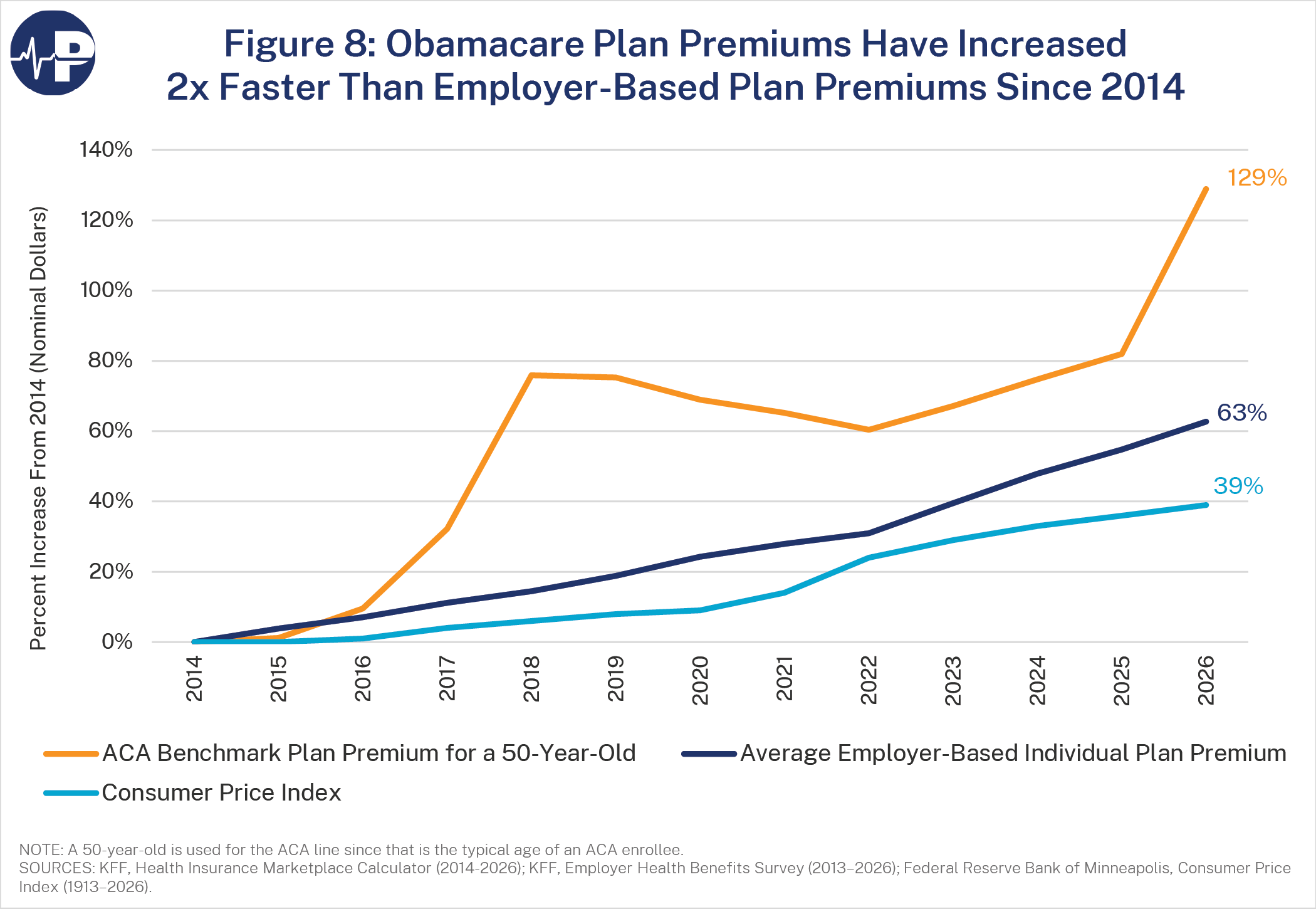
- The ACA caused individual-market premiums to soar. From 2014 to 2026, benchmark premiums for a 50-year-old increased 129 percent, compared with 63 percent for employer-sponsored insurance (ESI) premiums and 39 percent for overall inflation.
- ACA coverage provides less financial protection and more limited provider access than typical employer coverage. The combined premium and deductible for an ACA benchmark plan was approximately equal to that for ESI in 2014 but substantially higher by 2026. In 2023, 83 percent of individual-market enrollees had closed-network plans, compared with 18 percent of ESI enrollees.
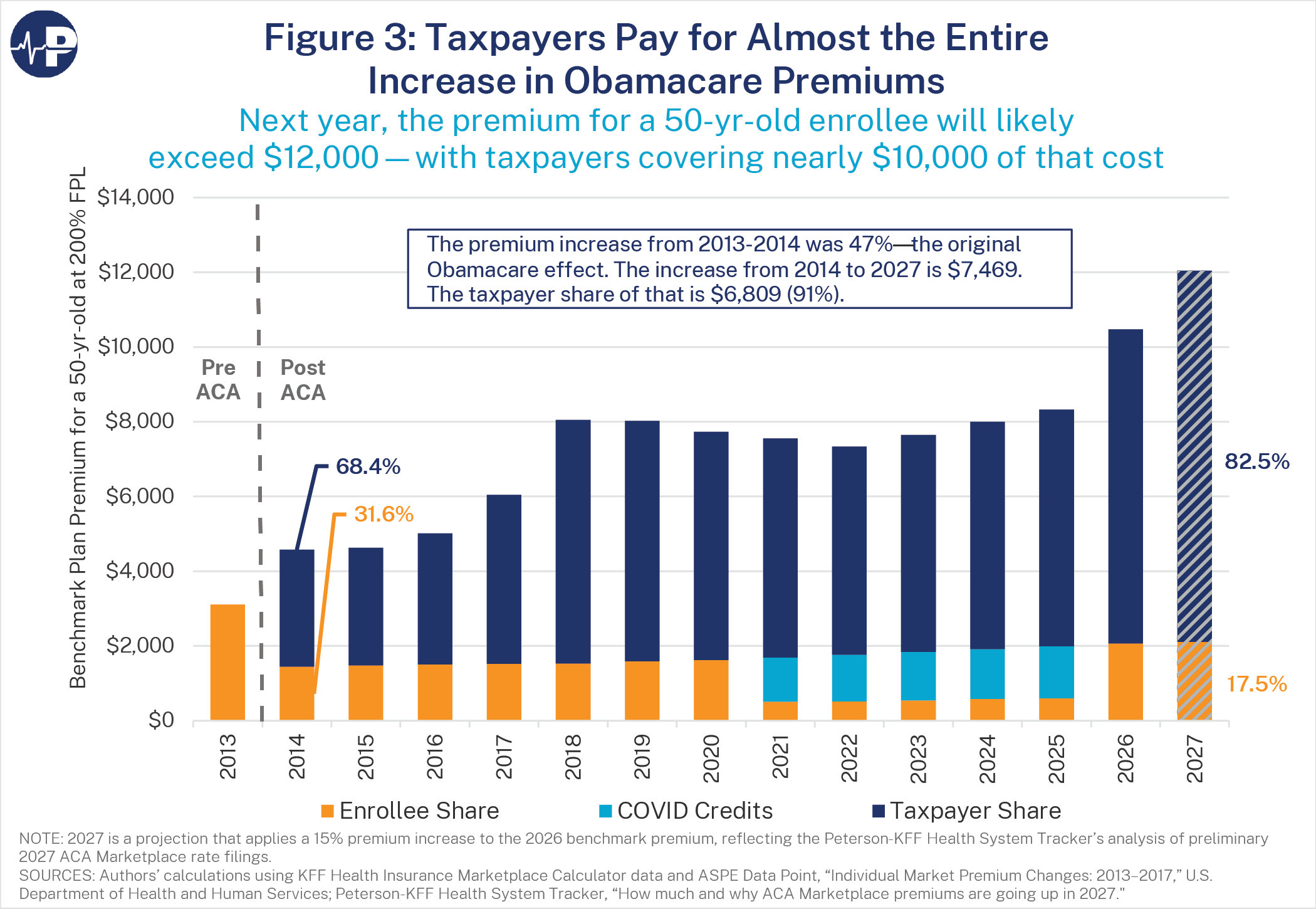
- Taxpayers bear nearly all the increase in subsidized premiums. For a 50-year-old at 200 percent of the federal poverty level (FPL), taxpayers will finance approximately $10,000 of a $12,000 benchmark premium in 2027, absorbing more than 90 percent of the premium increase since 2014.
- The exchanges are overwhelmingly taxpayer-financed. Federal subsidies accounted for approximately 77 percent of premium revenue in HealthCare.gov states before the pandemic, increasing to 86 percent in 2025.
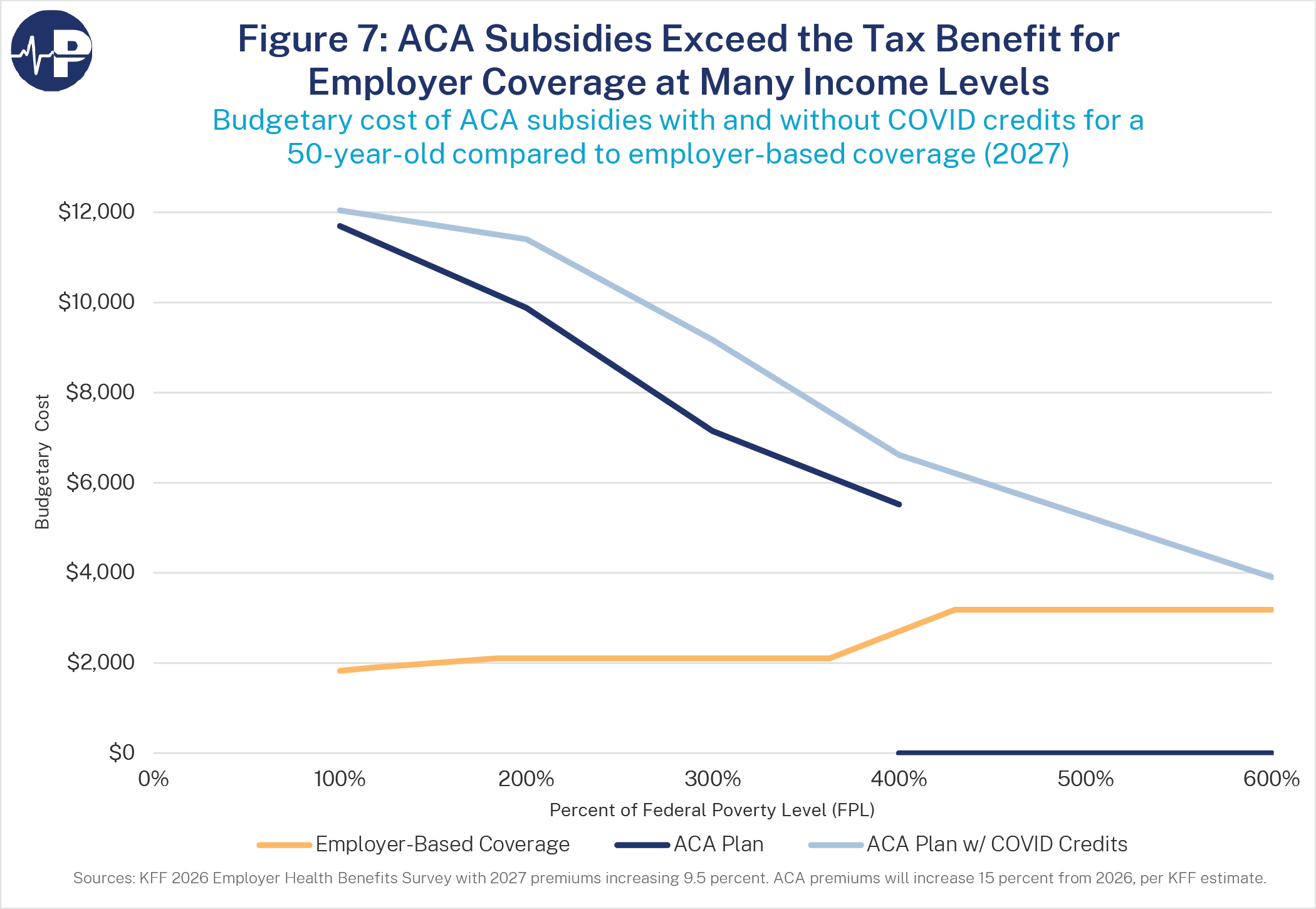
- ACA subsidies increasingly favor exchange coverage over employer coverage. For many lower- and middle-income households, ACA subsidies substantially exceed the tax benefits for employer coverage, creating incentives for workers and employers to shift coverage to the exchanges and impose additional costs on federal taxpayers.
- Exchange enrollment surged only after Congress expanded subsidies. Enrollment was less than half of the Congressional Budget Office’s original projection in 2016 and remained far below expectations for years. Enrollment increased substantially after the COVID-era subsidy expansions, which made coverage fully subsidized for millions and contributed to widespread improper and phantom enrollment.
- Evidence of improper and phantom enrollment is substantial. In 2026, 56 percent of HealthCare.gov plan selections reported incomes between 100 and 150 percent of FPL. In 13 states, enrollment in this category was more than twice the estimated eligible population, exceeding three times that population in several states. Paragon estimates that more than 6 million individuals were improperly enrolled following both the 2025 and 2026 open enrollment periods. The share of individual-market enrollees without medical claims increased from 19 percent in 2021 to 35 percent in 2024, while the rate in the unsubsidized small-group market remained around 20 percent.
The paper also shows that states with higher rates of zero-claim enrollment in 2024 generally experienced larger enrollment declines through February 2026. This pattern is consistent with the earlier enrollment surge including substantial improper and phantom enrollment.
The overall picture is troubling. ACA premiums have increased much faster than those for employer coverage, even as exchange plans generally provide less financial protection and more limited access to providers. Federal taxpayers now finance the overwhelming majority of premiums, and the COVID-era subsidy expansions contributed to widespread improper enrollment. As policymakers consider the future of the ACA, they should examine how its regulations have increased costs and reduced plan quality, the value enrollees and taxpayers receive from exchange coverage, the extent to which the ACA disadvantages employer-sponsored insurance, and the effectiveness of efforts to reduce improper and phantom enrollment.
Finding Common Ground with Zeke Emanuel on Health Reform
Zeke Emanuel and I have substantial disagreements about health policy, but in a new Washington Post op-ed, we explain that we agree on many of the key drivers of high health care costs, as well as a set of reforms that could reduce wasteful spending and improve outcomes. Among our areas of agreement are expanding site-neutral payments so Medicare does not pay hospitals more than independent physician practices for the same services, repealing certificate-of-need laws that restrict competition, expanding antitrust investigations, putting Medicare and Medicaid on a budget, increasing means-testing in Medicare, and reforming Medicare Advantage and Medigap. We also see opportunities to make health insurance more portable, encourage longer-term insurance arrangements, incorporate artificial intelligence, and reduce administrative costs through technology and simpler billing.
These reforms would help address high and rising hospital prices, a principal driver of health care costs. Despite our disagreements, we have identified meaningful common ground on reforms that promote competition, reduce waste, and improve incentives created by government policies.
The Case Against Medicare for All
Paragon board member Dave Steffy has a new RealClearHealth article, “The Case Against Medicare for All,” making a moral and economic argument against government-run single-payer health care. Dave challenges the premise that health care is an unconditional right that government must provide, arguing that such a right necessarily imposes claims on the labor and resources of others. He warns that replacing voluntary charity and individual responsibility with government mandates undermines personal freedom and civic virtue. Drawing on Alexis de Tocqueville, Dave argues that a government assuming responsibility for everyone’s health would foster dependency, weaken personal responsibility, and increasingly intrude into private decisions. He also warns that concentrating control over health care in Washington would replace voluntary cooperation with bureaucratic rationing and political competition for scarce medical resources.
Dave also argues that Medicare for All would require unprecedented tax increases and tens of trillions of dollars in additional federal spending. Higher taxes would discourage work, saving, and investment, while government price controls would undermine medical innovation by reducing returns on research and development. He characterizes the resulting debt and diminished opportunities for future generations as an intergenerational injustice. His central argument is that Medicare for All would undermine individual liberty, civic responsibility, economic prosperity, and medical progress. Genuine reform should instead empower patients, promote price transparency, and strengthen competition.
CMS Proposes Ending Automatic ACA Subsidy Renewals
The Centers for Medicare and Medicaid Services (CMS) has proposed a rule implementing the One Big Beautiful Bill Act’s new eligibility verification requirements for ACA exchange subsidies, beginning in 2028. The proposal would effectively end automatic subsidy renewal by requiring enrollees to actively provide or confirm their eligibility information before receiving subsidies for the following year. Although consumers could still be automatically re-enrolled in coverage, their subsidies generally could not continue without the required confirmation and verification. This annual verification would help prevent improper subsidy payments, protect consumers from unexpected tax liabilities, and restore accountability to the exchanges.
This proposal represents an important step toward ending one of the largest drivers of improper ACA spending: automatic re-enrollment in taxpayer-subsidized coverage. In 2025, 45 percent of exchange enrollees were automatically re-enrolled. This practice has allowed subsidies to continue flowing to insurers on behalf of individuals who may have obtained employer-sponsored insurance, moved, become ineligible, or never knowingly enrolled in the first place. COVID-era enhanced subsidies, which have now expired, made many plans free. Individuals enrolled in free coverage without their consent received no premium bill that might have alerted them to the unauthorized enrollment. Paragon estimates that improper enrollment amounted to 6.2 million individuals in 2026.
Recent Newsletters

Subscribe
Sign up now for your health policy updates.