

Brian Blase, Ph.D., is the President of Paragon Health Institute. Brian was Special Assistant to the President for Economic Policy at the White House’s National Economic Council (NEC) from 2017-2019, where he coordinated the development and execution of numerous health policies and advised the President, NEC director, and senior officials. After leaving the White House, Brian founded Blase Policy Strategies and served as its CEO.
Testimony of Brian Blase before the Senate Committee on the Budget — Medicaid: The Reality

Full Hearing Video
Oral Testimony
Chairman Johnson, Ranking Member Merkley, and Members of the Committee, thank you for the opportunity to testify.
Medicaid is an important welfare program.
But too often, it fails the truly vulnerable—children, pregnant women, the elderly, and people with disabilities.
The federal-state Medicaid partnership is broken.
Over the past dozen years, states have shifted hundreds of billions of Medicaid costs to the federal government.
Washington now pays more than 70 percent of Medicaid spending—up from the historic 60 percent.
I will focus my remarks on two major problems: the Affordable Care Act’s expansion of Medicaid to able-bodied, working-age adults and the legalized money-laundering apparatus that results in massive corporate welfare through Medicaid.
The ACA created a powerful financial incentive for states to prioritize expansion enrollees over traditional enrollees.
On average, when a state spends one dollar of its own money on a traditional Medicaid enrollee—the federal government contributes about $1.33.
But for one dollar of state spending on expansion enrollees, the federal government contributes $9.
Thus, Washington pays states seven times more for each state dollar on expansion adults than for the people Medicaid was created to serve.
Multiple studies show that Medicaid expansion has made it harder for traditional enrollees to obtain physician appointments. It increased wait times and forced more patients to rely on emergency rooms for routine care.
Medicaid should prioritize the most vulnerable. Instead, its financing formula discriminates against them.
These same misguided incentives also explain the surge in improper Medicaid enrollment.
Yesterday, Paragon released a study by Liam Sigaud estimating that nearly half of the 20 million Medicaid expansion enrollees were likely ineligible in 2024. This imposed roughly $33 billion in improper federal costs—with a major cost shift from states to the federal government.
A few states like California and New York have exceptionally high improper enrollment, but the problem exists in virtually all expansion states.
Congress should end the discrimination against the most vulnerable and equalize federal reimbursement rates for all enrollees within each state.
President Obama proposed equalizing reimbursement rates after the ACA became law.
A second major problem is Medicaid money laundering.
The clearest example is provider taxes. Former Oregon State Representative Mitch Greenlick called these dream taxes for states. “We collect the tax from the hospitals, we put it up as a match for federal money, and then we give it back to the hospitals.”
To be clear—this is not a tax. It is a legalized money laundering mechanism for shifting costs from states to Washington, while generating windfalls for politically powerful providers.
In 2011, then-Vice President Joe Biden called provider taxes “a scam” and said that they should be eliminated. Senator Dick Durbin called them “a charade.” The Simpson-Bowles commission, set up by President Obama, recommended ending them.
President Obama proposed limiting provider taxes, and the One Big Beautiful Bill basically adopted his proposal.
Broken Medicaid incentives have led to a new form of corporate welfare: state-directed payments.
Under the Biden administration, CMS allowed Medicaid insurers to pay hospitals up to average commercial rates, or more than two-and-a-half times Medicare.
Medicaid should not pay hospitals more than Medicare. Such excessive Medicaid payments distort the program’s purpose and threaten seniors’ access to care. In the One Big Beautiful Bill, Congress was right to limit Medicaid payments through insurers to Medicare rates.
Most Medicaid spending now runs through health insurance companies, generating enormous revenues for them. Yet, there is remarkably little evidence that Medicaid managed care has improved access, health outcomes, or reduced costs. Increasingly, Medicaid managed care functions as a financing intermediary for corporate welfare.
Medicaid’s perverse incentives have also created a lucrative consulting industry devoted to helping states maximize federal reimbursement by gaming Medicaid’s financing formula rather than improving care.
Medicaid is an essential program. But Congress must improve the core incentives.
Reward states for serving the most vulnerable—not for maximizing federal reimbursement.
End the financial discrimination against the most vulnerable.
Eliminate the money-laundering schemes.
Root out the corporate welfare.
Those reforms will help return balance to the federal-state Medicaid partnership and improve Medicaid for America’s most vulnerable.
Written Testimony
Chairman Johnson, Ranking Member Merkley, and Members of the Committee:
Before I begin my testimony, I want to express my deepest condolences on the passing of Chairman Lindsey Graham. Chairman Graham devoted decades of his life to public service and to strengthening our nation. My thoughts and prayers are with his family, his friends, his colleagues, and his dedicated staff.
Thank you for the opportunity to testify today regarding the reality of Medicaid.
The central fiscal challenge confronting the United States is the rapid growth of federal health care spending. Rising deficits, growing debt, and escalating interest costs are no longer abstract concerns.1 They increasingly threaten our nation’s economic strength, national security, and ability to finance other important priorities. To place the federal budget on a sustainable path, reforming federal health care programs must be at the center of that effort.
The United States has a health care financing problem because federal health programs reward maximizing expenditures rather than improving value for patients and taxpayers. Across Medicaid, the Affordable Care Act (ACA) exchanges, and many parts of Medicare, government programs incentivize spending, weaken accountability, and encourage states, insurers, providers, and other participants to maximize federal payments rather than maximize value for patients and taxpayers.
Fraud, waste, and abuse are often portrayed as the product of a few bad actors. Although bad actors certainly exist, the much larger problem is that federal health programs create numerous incentives that reward waste, tolerate abuse, and invite fraud. This issue is important for at least three reasons.
First, hardworking American families increasingly finance government spending arrangements that would never survive scrutiny in private-sector businesses. Americans who work, pay taxes, and follow the rules increasingly find themselves financing improper payments, abusive financing schemes, and spending arrangements that reward political influence and the ability to game government programs rather than better health care.
Second, Medicaid was created to serve our nation’s most vulnerable citizens—low-income children, pregnant women, seniors, and people with disabilities. Diverting money to wasteful expenditures can mean lower quality care and worse health outcomes for those who most need Medicaid. Every dollar diverted through improper enrollment, financing gimmicks, or inflated payments is a dollar unavailable for individuals the program was originally designed to protect.
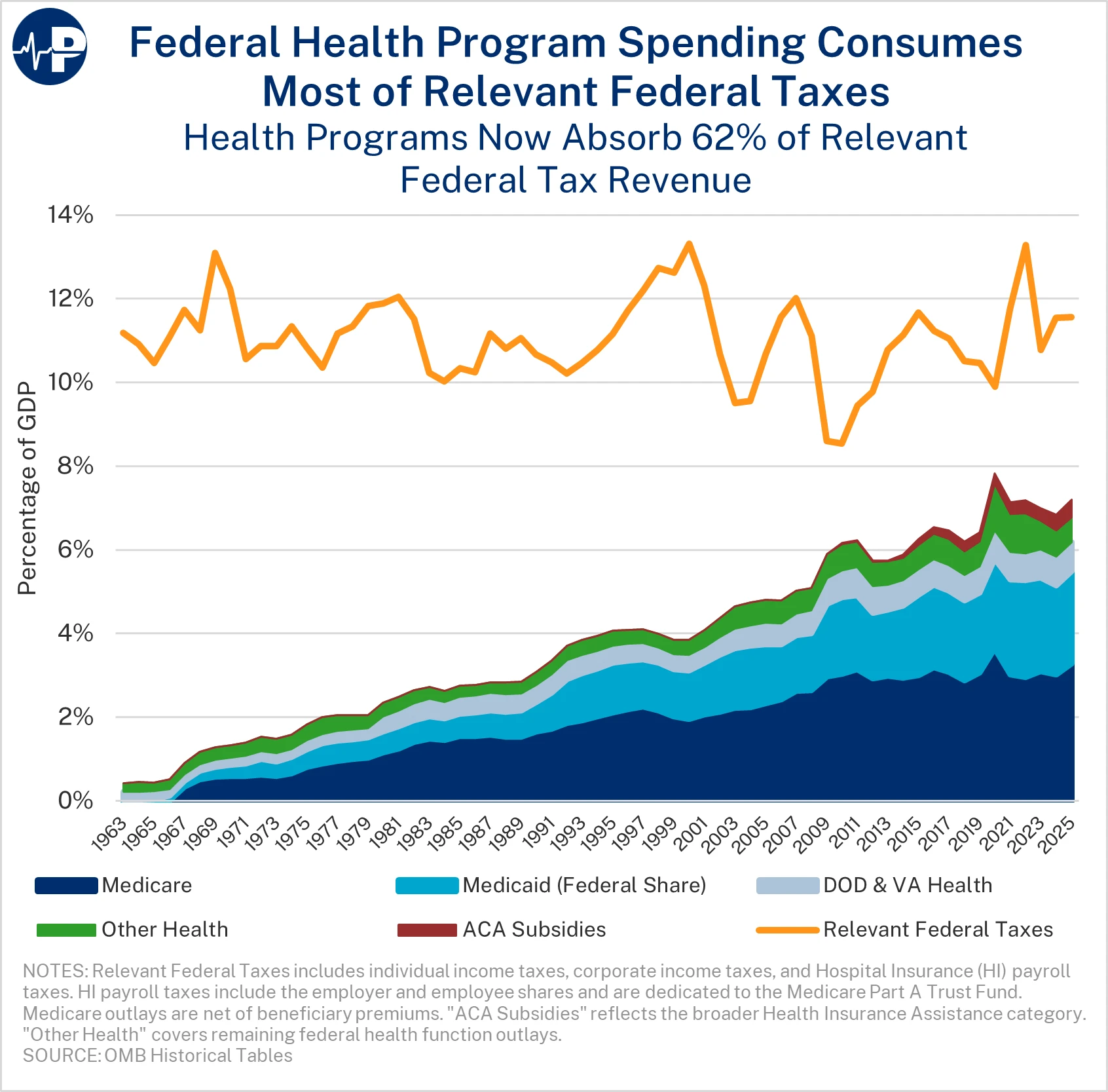
Third, federal health care spending has become the principal driver of America’s long-term fiscal imbalance. Federal health programs consumed roughly 62 percent of all individual income tax revenue, corporate income tax revenue, and Medicare payroll tax revenue in 2025, up significantly from roughly 29 percent in 2000. Unless Congress addresses the structural incentives embedded within these programs, federal health care spending will continue to place growing pressure on taxpayers and future generations of Americans.
The purpose of my testimony today is not to catalogue individual examples of fraud or abuse, which now appear regularly in the news. Rather, my purpose is to explain how Medicaid’s financing structure rewards excessive spending, discriminates against the most vulnerable, encourages improper enrollment, facilitates state financing gimmicks, and increasingly subsidizes corporate welfare at the expense of quality care. I also discuss how the reforms enacted in the One Big Beautiful Bill (OBBB) represent an important first step toward restoring incentives for value, accountability, and fiscal sustainability. I conclude with additional policy reforms that are needed to improve Medicaid for enrollees and taxpayers and restore the intended balance between federal-state financing responsibilities.
I. Medicaid’s Financing Structure Rewards Spending Rather Than Value
Medicaid spending and enrollment have grown dramatically over the past few decades, with little to show in terms of improvement in health outcomes.
Inflation-adjusted Medicaid spending growth crowds out other state spending priorities, like education and transportation. The next figure illustrates how Medicaid spending growth outpaces all other major spending categories in state budgets. In 1988, aggregate state spending on primary, secondary, and higher education was four times Medicaid spending. Medicaid consumed an increasing share of state budgets in the ensuing decades, with real spending growing nearly sevenfold from 1988 through 2025. Medicaid spending now exceeds combined spending on primary, secondary, and higher education.

Medicaid is no longer principally limited to the low-income populations for whom it was originally designed—children, pregnant women, seniors, and people with disabilities—as a majority of the program’s recent enrollment growth has come from able-bodied, working-age adults. More than twice as many people are enrolled in Medicaid now as live in poverty, as the figure below shows. The percentage of the U.S. population enrolled in Medicaid has tripled since the late 1980s. Nearly one-quarter of Americans are now enrolled in Medicaid.

One important measure of the sustainability of the safety net is the number of workers available to support each enrollee. In 1988, more than five workers financed a single Medicaid enrollee. That number shrank to fewer than three workers in 2004, and to fewer than two workers in 2024.

States Have Incentives to Obtain More Federal Money, Not to Obtain Value for Enrollees and Taxpayers
Financing health care for vulnerable Americans is an important public purpose. The problem is the way Congress chose to finance Medicaid. Unlike virtually every other major grant program, the federal government provides an open-ended reimbursement of state Medicaid expenditures. The more states spend, the more federal money they receive.
This financing structure fundamentally changes the incentives facing state policymakers. Rather than asking how to provide the best care at the lowest cost, states increasingly have incentives to identify additional ways to increase federal dollars. Too often, states measure success not by improved health outcomes or greater efficiency, but by maximizing the amount of federal money they obtain through the Medicaid matching grant structure.
These incentives have become so ingrained that New York officials famously turned Medicaid into a verb. As discussed in a bipartisan House Committee on Oversight and Government Reform report, state officials described their budgeting approach with the phrase: “If it moves, Medicaid it; if it doesn’t, depreciate it.”2 The Committee explained that “Medicaid became a verb” because policymakers increasingly sought to shift additional services and expenditures under Medicaid to maximize federal reimbursement.
Economists Amy Finkelstein, Nathaniel Hendren, and Erzo Luttmer found that “Medicaid’s value to recipients is lower than the government’s costs of the program, and usually substantially below.”3 They estimated that recipients receive only 20 to 40 cents in benefit for each dollar of spending. Institutions, primarily hospitals, receive most of Medicaid’s benefits rather than lower-income people, as Medicaid largely replaces implicit coverage provided to the low-income uninsured.
Medicaid also illustrates a broader problem in American fiscal federalism. Over the past three decades, states have become increasingly reliant on federal funds. Federal funds increased from 22.0 percent of total state government revenue in FY 1993 to 36.1 percent in FY 2022—an increase of more than 60 percent.4 As Washington finances a growing share of state budgets, maximizing federal revenue naturally becomes a more important objective of state policymaking. Medicaid exemplifies this broader trend because its open-ended matching formula directly rewards states for increasing spending rather than increasing value. The program has increasingly become one of the largest revenue-generating mechanisms available to state governments.
Federal Medicaid Spending Increased Dramatically During the Biden Administration, and Will Continue to Rise Under the One Big Beautiful Bill
Federal Medicaid spending increased dramatically during the Biden administration—largely due to a surge in enrollees during the COVID public health emergency (which the Biden administration extended until the spring of 2023) and increased corporate welfare through SDPs. As a result of continuous coverage requirements, nearly 18 million people who were no longer eligible remained enrolled in the program by the spring of 2023.5 The unwinding of the excessive enrollments took much longer than expected—and expansion enrollment remained well above pre-pandemic levels by the end of 2024. In addition, starting in the Biden administration, many states aggressively turned to SDPs, discussed in greater depth below, to increase federal spending and make much larger Medicaid payments to providers, particularly hospital systems.6
Medicaid spending has continued to increase despite inaccurate claims that the OBBB cut Medicaid. According to the Congressional Budget Office’s (CBO) June Monthly Budget Review, preliminary federal Medicaid outlays for the first nine months of fiscal year (FY) 2026 were $49 billion higher than during the corresponding period of FY 2025—a 10 percent increase in spending.7 The figure below compares CBO’s successive Medicaid spending projections. Even after incorporating the OBBB reforms, CBO’s current projection remains substantially above the trajectory it projected before the Biden administration.
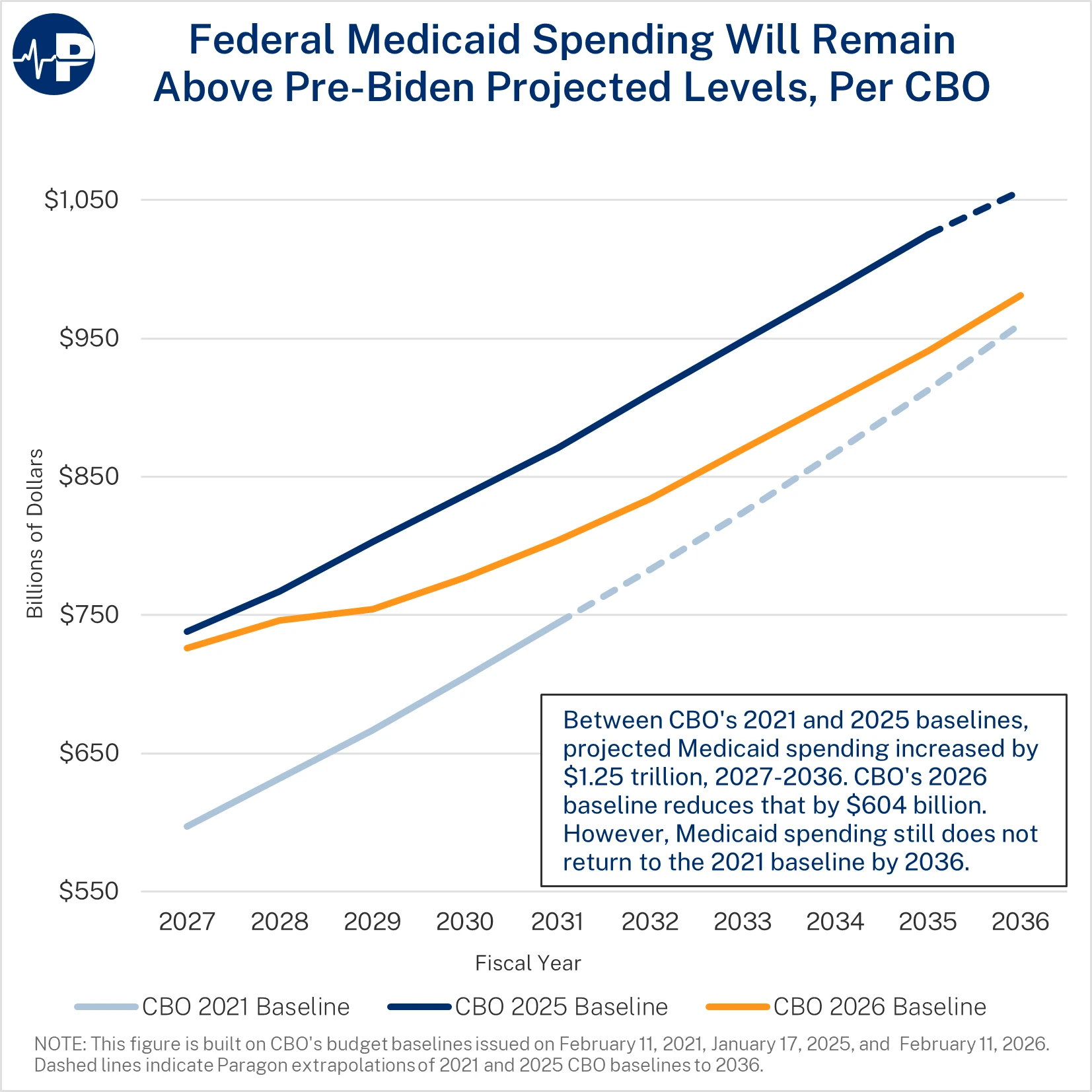
CBO projects that federal Medicaid spending will continue to rise each year, and that the reforms simply reduced the growth rate of federal Medicaid spending from about 5 percent to about 3 percent.8
A Huge Medicaid Cost Shift from States to the Federal Government
Historically, the federal government financed roughly 60 percent of Medicaid expenditures while states financed 40 percent. In the financial crisis of 2008-2009, the federal government sent aid to states through an elevated federal Medicaid reimbursement. That increased the federal share for a brief period. But the main factors that have altered the historic ratio were the ACA’s Medicaid expansion (and the much higher rate for able-bodied, working-age adults) and states’ increased use of legalized money laundering tactics (such as provider taxes and intergovernmental transfers) to shift costs to the federal government and finance corporate welfare for insurers and hospitals. These changes have increased the federal share of Medicaid to more than 70 percent. In the figure below, the top line represents the actual federal share of Medicaid spending, accounting for the state financing gimmicks that result in illusory state expenditures that are nonetheless reimbursed by the federal government.9 (The bottom line shows the federal share under the assumption that all state expenditures were real.)

As states bear less of the financial consequences of additional Medicaid spending, they have correspondingly weaker incentives to scrutinize costs, reduce waste, and maximize value for patients and taxpayers. Consistent with these weak incentives for states to be judicious Medicaid spenders, our research suggests that improper payments represented about one-quarter of total program expenditures—amounting to more than $1.1 trillion from 2015 to 2024 alone.10
II. The ACA and State Financing Gimmicks Worsened Medicaid’s Incentives
The ACA Expansion Reallocates Resources Away from Medicaid’s Most Vulnerable Beneficiaries
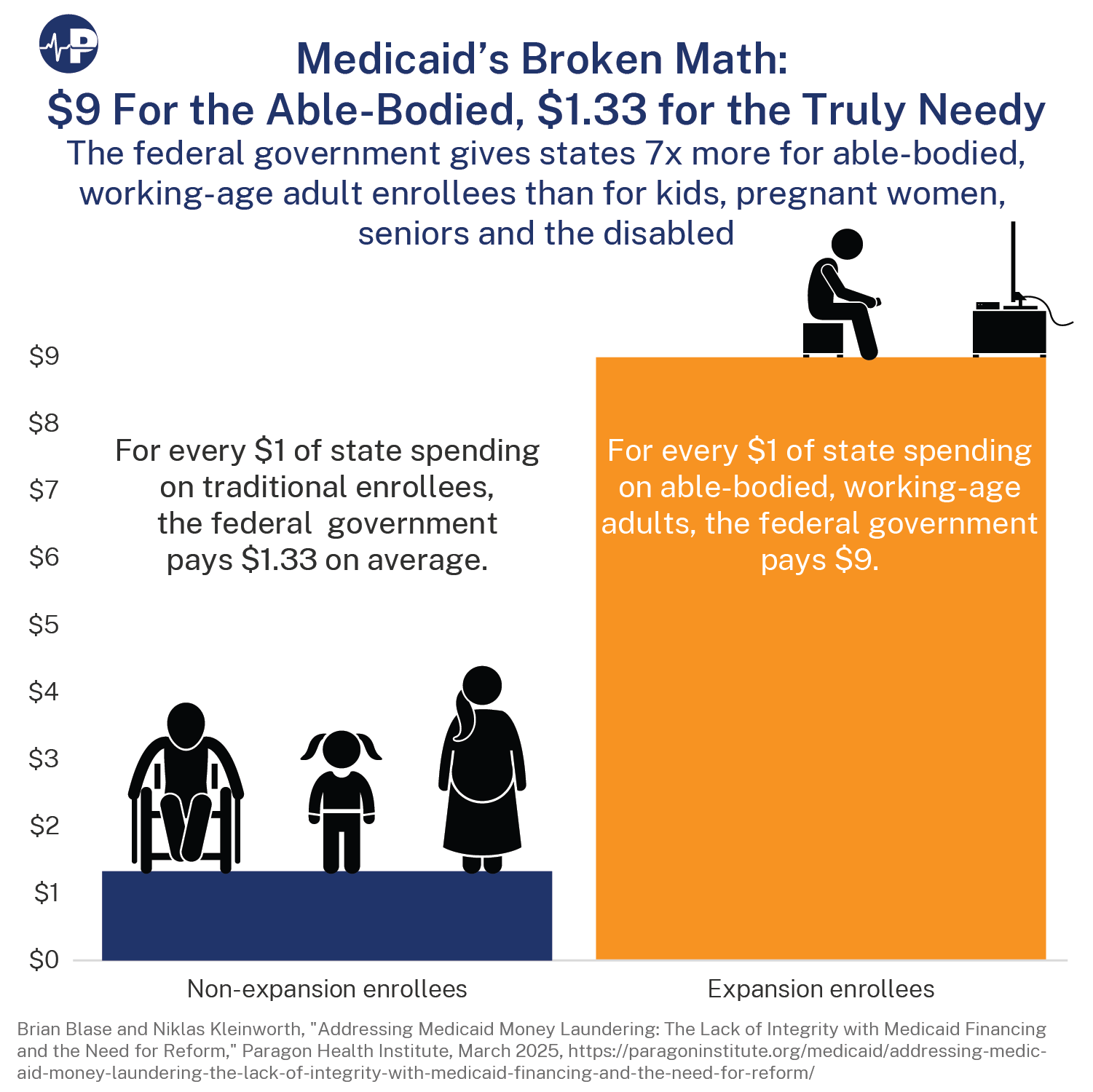
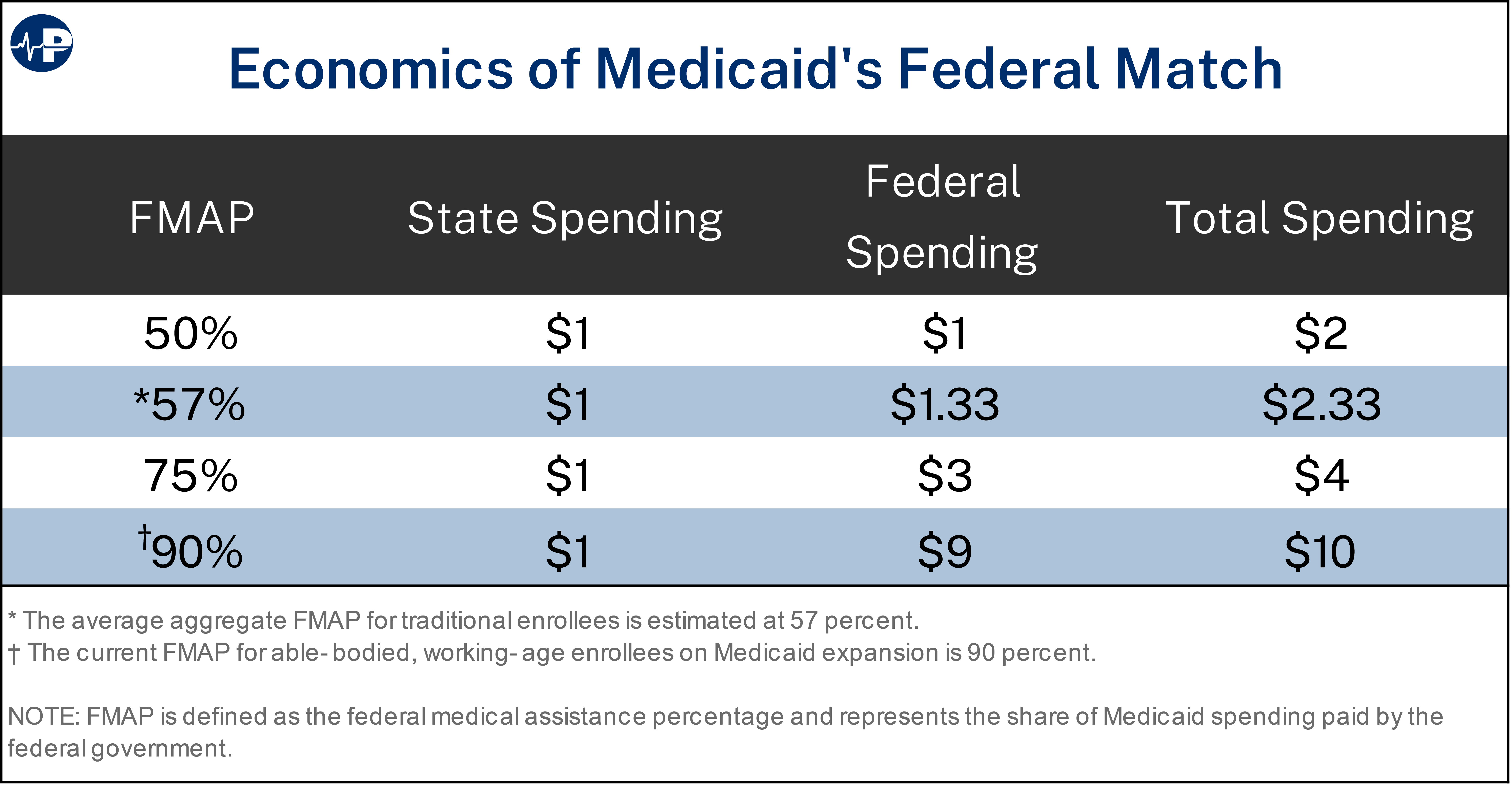
The next figure illustrates Medicaid’s most fundamental financing distortions. On average, for every $1 that a state spends on traditional Medicaid populations from state revenue—children, pregnant women, seniors, and people with disabilities—the federal government contributes about $1.33, reflecting the program’s average 57 percent federal matching rate for traditional enrollees. By contrast, for every $1 that a state spends on able-bodied, working-age adults covered through the ACA’s expansion, the federal government contributes $9 because it pays 90 percent of the total cost. Viewed another way, a state needs to receive only ten cents of value to justify one dollar of total spending on an expansion enrollee because the federal government pays the remaining ninety cents. For traditional Medicaid enrollees, a state must receive approximately 43 cents of value to justify one dollar of total spending. The matching-rate disparity therefore gives states much stronger incentives to expand spending on able-bodied adults than on the populations Medicaid was originally designed to serve.
In other words, states receive roughly seven times more federal funding for each state dollar devoted to expansion adults than they do for the program’s most vulnerable populations. These dramatically different matching rates encourage states to prioritize enrollment and spending for the expansion population and to incorrectly categorize traditional enrollees as expansion enrollees, rather than pursue actions that deliver the greatest value or best serve the most vulnerable. The table below the figure illustrates the math behind the numbers.
The Obama administration recognized these distorted incentives. In his FY 2013 budget, President Obama proposed replacing Medicaid’s multiple matching rates with a single blended federal matching rate for Medicaid and the Children’s Health Insurance Program beginning in 2017, implicitly acknowledging that there was little policy justification for paying states a substantially higher federal reimbursement for able-bodied, working-age adults than for children, pregnant women, seniors, and people with disabilities.11
By offering states a much higher federal matching rate for able-bodied, working-age adults than for children, pregnant women, seniors, and people with disabilities, the ACA encourages states to devote increasing resources and provider capacity to individuals with relatively fewer health needs. A growing body of research finds that expansion has diverted resources away from children and other vulnerable populations while increasing wait times and reducing Medicaid enrollees’ access to care.
- Resources shifted away from children. Expansion states experienced much slower growth in Medicaid spending per child than non-expansion states, suggesting that resources were diverted from traditional beneficiaries.12
- Mental health worsened. Expansion increased symptoms of depression among existing Medicaid enrollees, particularly in rural and provider-shortage areas.13
- Appointment wait times increased. Medicaid expansion increased delays and led to longer wait times to receive medical services.14
- Access to physicians has declined. A meta-analysis of 34 secret-shopper studies found that Medicaid patients were substantially less likely than privately insured patients to obtain physician appointments, with a larger disparity among studies conducted after the ACA expansion.15
- Transportation barriers increased. Expansion increased delays in care due to transportation shortages and reduced the ability of existing enrollees to find physicians.16
- Ambulance response times slowed. Medicaid expansion increased average ambulance response times by roughly 24 percent.17
- Emergency departments became more crowded. Expansion increased emergency room utilization, wait times, and the share of patients leaving before being seen.18
The ACA’s Medicaid Expansion Produced Limited, If Any, Overall Health Benefits
Supporters of the ACA’s Medicaid expansion often point to increased insurance coverage as evidence of success. But the much more important policy question is whether the expansion produced meaningful improvements in health that justified its substantial cost, particularly given that those resources could be used in other ways.
The Oregon Health Insurance Experiment provides the strongest causal evidence on Medicaid’s effects because coverage was assigned through a lottery. After two years, Medicaid increased health care utilization and improved financial protection and lowered rates of depression. But it produced no statistically significant improvements in measured physical health outcomes, including blood pressure, cholesterol, or blood sugar.19 A separate analysis of the experiment also found that Medicaid increased emergency-department use rather than reducing it.20
The ACA’s Medicaid expansion took effect in 2014. Since then, federal and state governments have spent hundreds of billions of additional dollars covering able-bodied, working-age adults. Yet the expected improvements in population health did not materialize. U.S. life expectancy had generally been increasing before the ACA’s Medicaid expansion took effect in 2014. It reached 78.9 years that year, then fell to 78.6 years by 2017. Although it partially recovered thereafter, life expectancy in 2019 remained below its 2014 peak and was no higher than it had been in 2013.21 Broad population-health measures did not improve more in expansion states than in non-expansion states.22 In fact, the opioid epidemic—which became one of the nation’s most significant public health crises during this period—was generally more severe in states that expanded Medicaid than in states that did not.23
None of this proves that Medicaid expansion caused poorer health outcomes. Rather, it demonstrates a more fundamental point: insurance coverage is only one determinant of health, and increasing government health program spending does not necessarily produce commensurate improvements in health outcomes.24 Medicaid enrollees generally face greater difficulty obtaining physician appointments than commercially insured patients, making timely non-emergency care more difficult to obtain.25 Medicaid expansion further strained limited provider capacity, as the studies discussed above indicate.
In Expansion States, Enrollment and Spending Were Much Higher Than Expected
The ACA’s Medicaid expansion has proven considerably more expensive than policymakers anticipated. In previous research, I found that enrollment in expansion states was roughly 50 percent higher than the CBO projected, while spending per expansion enrollee was approximately 50 percent higher than federal actuaries originally estimated.26 These forecast errors suggest that policymakers substantially underestimated how states would respond to a financing system that reimbursed expansion spending at far higher rates than traditional Medicaid spending.
Subsequent research has reinforced this conclusion. A 2024 Paragon analysis found that Medicaid expansion adults were more expensive to taxpayers than the lowest-income enrollees receiving subsidized exchange coverage.27
Medicaid Improper Enrollment Is a Massive Problem and a Symptom of Misaligned Incentives
States are responsible for determining eligibility, processing applications, verifying income, conducting periodic eligibility redeterminations, and removing individuals who no longer qualify for coverage. The perverse financing incentives underpinning the ACA’s Medicaid expansion help explain another troubling development: the rapid growth of improper Medicaid enrollment, particularly the incorrect classification of enrollees as eligible for the expansion.
In a March 2025 analysis that I coauthored with Rachel Greszler, we found that the federal government has substantially understated Medicaid improper payments by excluding the program’s largest source of errors—eligibility determinations—from most official audits.28 Although CMS reported $543 billion in Medicaid improper payments between 2015 and 2024, those estimates largely omitted eligibility errors. During the only two audit cycles over the past decade that included comprehensive eligibility reviews, improper payment rates exceeded 25 percent. Applying those rates to total federal Medicaid spending suggests that actual improper payments likely approached $1.1 trillion over the decade—roughly double CMS’s official estimate. Every dollar spent on an ineligible enrollee is a dollar unavailable for a child with disabilities, an elderly nursing home resident, or an individual with severe medical needs who genuinely qualifies for assistance.
My colleague Liam Sigaud estimates that approximately 9.2 million Medicaid expansion enrollees in 2024 were improperly enrolled, resulting in roughly $33 billion in improper federal expenditures during that year alone.29 Using Census Bureau American Community Survey data and CMS Medicaid enrollment data, Liam compared the number of people enrolled in the ACA Medicaid expansion with the number who were plausibly eligible, allowing him to estimate improper enrollment and its fiscal costs at both the national and state levels. The analysis found that improper enrollment was concentrated in a handful of expansion states—particularly California, which accounted for roughly one-third of all ineligible expansion enrollees and an estimated $10.4 billion in inappropriate federal costs in 2024—while New York, Louisiana, Oregon, and Washington also had especially large improper enrollment in the ACA expansion.
Provider Taxes and Other Forms of Legal Medicaid Money Laundering, and How They Endanger Quality
Congress intended Medicaid to operate as a federal-state partnership, with both levels of government sharing responsibility for financing the program. Instead, states have taken advantage of the federal government’s design through creative financing, which increases spending and can reduce quality of care.
Perhaps no financing mechanism better illustrates the perversities with the open-ended federal Medicaid reimbursement than provider taxes. While legal under current law, these financing arrangements function like money laundering because states recycle funds to generate federal reimbursement.
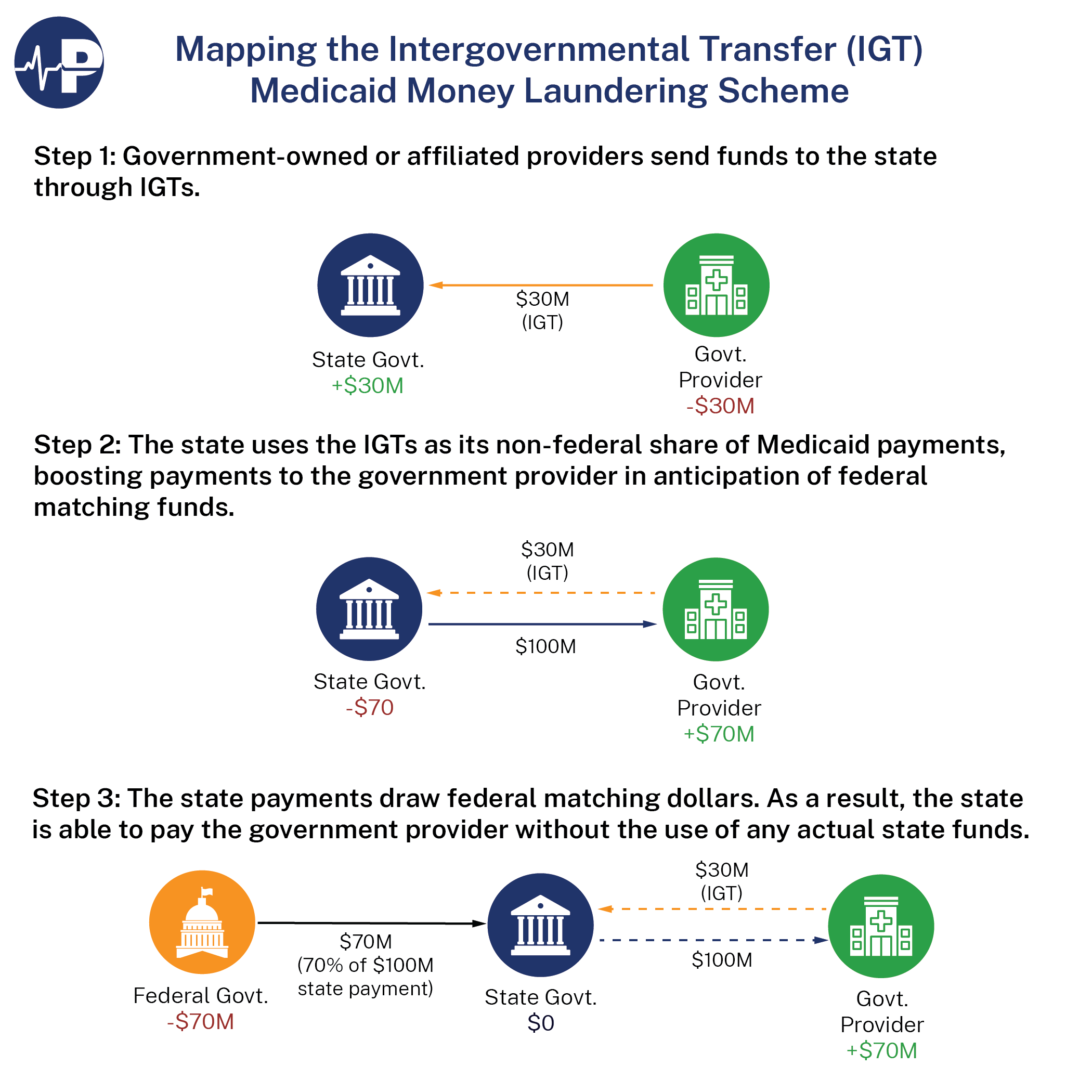
Provider taxes weaken the fiscal partnership by allowing states to recycle money in ways that dramatically increase federal reimbursement while substantially reducing states’ own financial contributions. Here is how provider taxes work: a state imposes a tax on hospitals or managed care organizations and then uses those tax revenues as the state’s share of Medicaid spending. Because Medicaid operates as an open-ended matching program, every dollar of qualifying state spending generates additional federal matching funds. States subsequently return much or all the provider tax revenue back to the taxed providers through higher Medicaid payments.
Over time, these financing arrangements have become increasingly sophisticated. States now combine provider taxes with intergovernmental transfers (IGTs), certified public expenditures,30 and other financing mechanisms that further increase federal reimbursement while reducing state financial responsibility. IGTs allow government-owned or affiliated providers to transfer funds to the state, which the state then counts as its share of Medicaid spending to draw down much larger federal matching payments—often without any new state contribution.31 These arrangements create windfalls for government providers while shifting costs to federal taxpayers.
Although Medicaid has grown dramatically, the increase relative to total state spending has been financed overwhelmingly by the federal government rather than through additional genuine state contributions. As the following figure shows, actual state Medicaid spending has remained essentially flat as a share of total state spending for more than three decades after accounting for provider taxes and IGTs. In contrast, the federal share has doubled, while the amount of reported state spending attributable to financing gimmicks has steadily increased, highlighting how states have increasingly relied on mechanisms that maximize federal matching funds without increasing their own fiscal commitment.

Indiana’s nursing home financing arrangement illustrates how these incentives may even have contributed to earlier nursing home deaths. County hospitals acquired ownership interests in nursing homes, allowing those facilities to qualify for financing that generated much larger federal Medicaid payments. Although participating nursing homes received higher revenues, much of the additional funding did not translate into greater clinical spending. Instead, subsequent research found that the financing scheme steered Medicaid beneficiaries—particularly dementia patients—toward lower-quality nursing homes. This negatively affected health outcomes. One study’s authors note “about 50 [nursing home] patients die earlier” due to these inefficiencies from “creative financing.”32
California’s governmental ambulance program provides another example of how Medicaid financing rules—not differences in medical care—can determine payment levels. Government-owned ambulance providers receive Medicaid payments several times larger than private providers for identical transport because the payment structure is designed to maximize federal reimbursement through IGTs rather than reflect differences in the services provided.33
Federal matching funds are intended to support the delivery of medical care to eligible beneficiaries—not to reward states that develop increasingly sophisticated financing arrangements. These mechanisms also weaken states’ incentives to negotiate lower prices, eliminate waste, improve efficiency, or pursue reforms that reduce spending.
These financing incentives also divert substantial resources away from improving care and toward maximizing federal reimbursement. States increasingly hire consultants who specialize in designing provider taxes, intergovernmental transfers, certified public expenditures, and other financing arrangements that increase federal Medicaid payments. Rather than competing to deliver care more efficiently or improve outcomes, states devote resources to identifying new ways to draw additional federal dollars into their Medicaid programs.
Provider taxes also raise costs on Americans who are not in Medicaid. A new Paragon study shows how provider taxes create a double windfall for hospitals: hospitals pass much of the tax on to commercially insured patients through higher negotiated prices, and they then receive the tax revenue back through higher Medicaid payments. Drawing on detailed hospital claims data, the analysis finds that an increase in California’s hospital tax in 2010 led commercial prices to rise by approximately 4 percent relative to neighboring states.34 Higher hospital prices almost certainly translate into higher health insurance premiums and lower wages for workers.
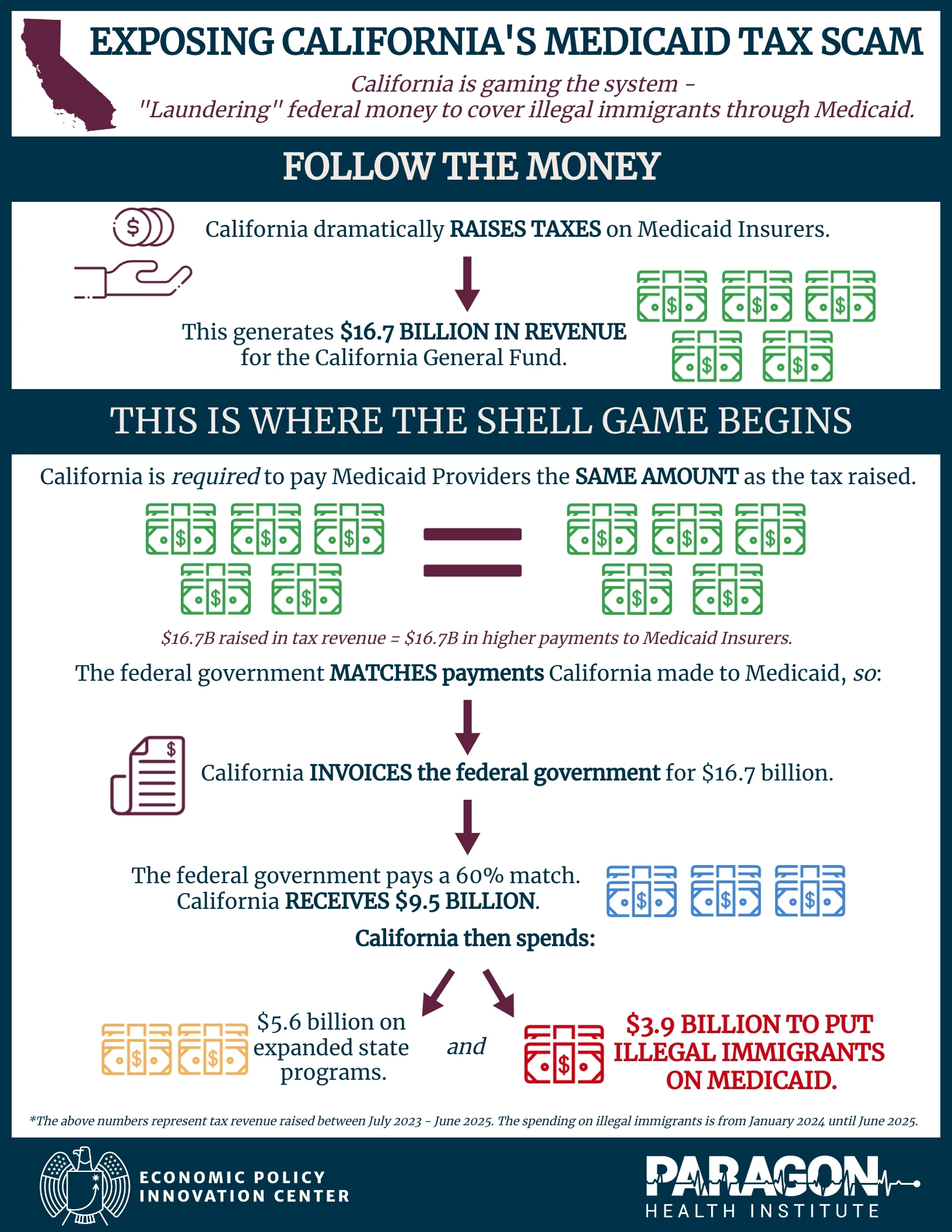
Loopholes in provider tax rules permitted states like California to design taxes on Medicaid insurers at more than 100 times the rate imposed on commercial insurers. The reason was to limit the tax to insurers and providers that would benefit from the much higher federal payments that the tax generates. In a circular fashion, California spent this tax money on insurers—and then claimed federal reimbursement. Without using any actual state dollars, California has received more than $10 billion in federal funding through this financial maneuvering that exploited federal reimbursement rules.35 This additional federal funding arrived as California was assuming substantial new state costs to expand Medicaid coverage to unauthorized immigrants.
Long-standing Bipartisan Support to Limit the Medicaid Provider Tax “Scam”
For decades, Republican and Democratic policymakers and administrations have recognized that provider taxes undermine the fiscal partnership Congress intended when it created Medicaid. These concerns long predate the current debate. In 2011, then Vice President Joseph Biden called provider taxes a “scam” and advocated for their elimination. Investigative journalist Bob Woodward reports that during the 2011 budget and debt ceiling negotiations between the Obama administration and congressional Republicans and Democrats, congressional Republicans proposed reforming provider taxes as a way to put the federal budget on a more sustainable path.36 Biden agreed that provider taxes needed reform—referred to them as a “scam,” saying, “If we can’t do this—come on!”37
Democratic Senator Richard Durbin referred to provider taxes as a “bit of a charade.”38 Then-Oregon state representative Mitch Greenlick referred to provider taxes as a “dream tax” for states—a strong indication of their appeal for state politicians. According to Greenlick, “We collect the tax from the hospitals, we put it up as a match for federal money, and then we give it back to the hospitals.”39
The National Commission on Fiscal Responsibility and Reform, established by President Obama through executive order, also recommended eliminating them.40 The major Medicaid recommendation was to “eliminate state gaming of [the] Medicaid tax gimmick.” According to the commission’s plan:
Many states finance a portion of their Medicaid spending by imposing taxes on the very same health care providers who are paid by the Medicaid program, increasing payments to those providers by the same amount and then using that additional “spending” to increase their federal match. We recommend restricting and eventually eliminating this practice.
In 2002, Urban Institute senior research fellows Teresa Coughlin and Stephen Zuckerman argued that the failure of the state to make a real financial contribution “is contrary to a basic tenet of Medicaid: That is, it is a program in which the federal government and states or localities share the financial burden.”41 John Holahan, another fellow at the Urban Institute, has said that states’ use of provider taxes is “egregious,” “a national disgrace [that] is not as understood as well as it should be,” and “needs to be dealt with.”42
In his 2013 budget, President Obama proposed limiting states’ ability to utilize provider taxes. Specifically, he proposed limiting the provider tax “safe harbor”43 from 6 percent to 3.5 percent.44 A Washington Post editorial endorsed the Obama proposal as a “much needed Medicaid reform.”45
History shows that concern about state financing gimmicks and support for limits on them are shared by people across the ideological spectrum. Reforming these arrangements is therefore not a novel or partisan objective but a longstanding effort to preserve the integrity of the federal-state partnership.
The Growth of State-Directed Payments
In recent years, state-directed payments (SDPs) have emerged as perhaps the fastest-growing financing arrangements that exploit Medicaid’s open-ended financing structure while also fundamentally changing the role of Medicaid managed care. Rather than allowing managed care organizations to negotiate payment rates, states increasingly direct plans to make extra payments to hospitals and other providers. Those payments are largely financed by state financing gimmicks such as provider taxes.
The Biden administration issued a rule that clarified that states could use SDPs to make payments up to average commercial rates (ACR).46 Because hospital commercial rates average more than 2.5 times Medicare rates,47 these SDPs can make Medicaid a substantially more generous payer than Medicare for the affected hospital services—a disparity that may reduce seniors’ access to care. Basing Medicaid payments on commercial rates may also put upward pressure on commercial prices. Hospitals that negotiate higher commercial rates can thereby increase the benchmark used to determine their Medicaid payments, weakening incentives to restrain prices in the commercial market.
SDPs have grown from a relatively limited financing mechanism into one involving an estimated $145 billion in payments in FY 2026.48 A recent KFF analysis estimates that 84 percent of SDPs flow to hospitals.49
SDPs often function as mechanisms for rewarding politically powerful hospitals and insurers with corporate welfare. SDPs also circumvent Medicaid upper payment limits (UPL) that have been placed on fee-for-service Medicaid payments. Those rules generally limit aggregate fee-for-service payments for specified classes of providers to an estimate of what Medicare would have paid for the same services. Until the OBBB, no comparable limits existed for Medicaid payments through managed care organizations. In essence, the OBBB established a comparable payment constraint on the Medicaid managed care side.
Managed Care in Medicaid Has Not Improved Outcomes or Lowered Costs
While states started relying on managed care to reduce costs, doing so has not solved these incentive problems, and with the rise of SDPs, Medicaid managed care is contributing to escalating costs. Medicaid managed care organizations increasingly function as financing intermediaries rather than organizations primarily responsible for managing care. With the growth of SDPs, Medicaid managed care has increasingly become a vehicle for channeling additional federal dollars to providers and insurers. This arrangement generates substantial corporate welfare while doing little to improve accountability, value, or program integrity.
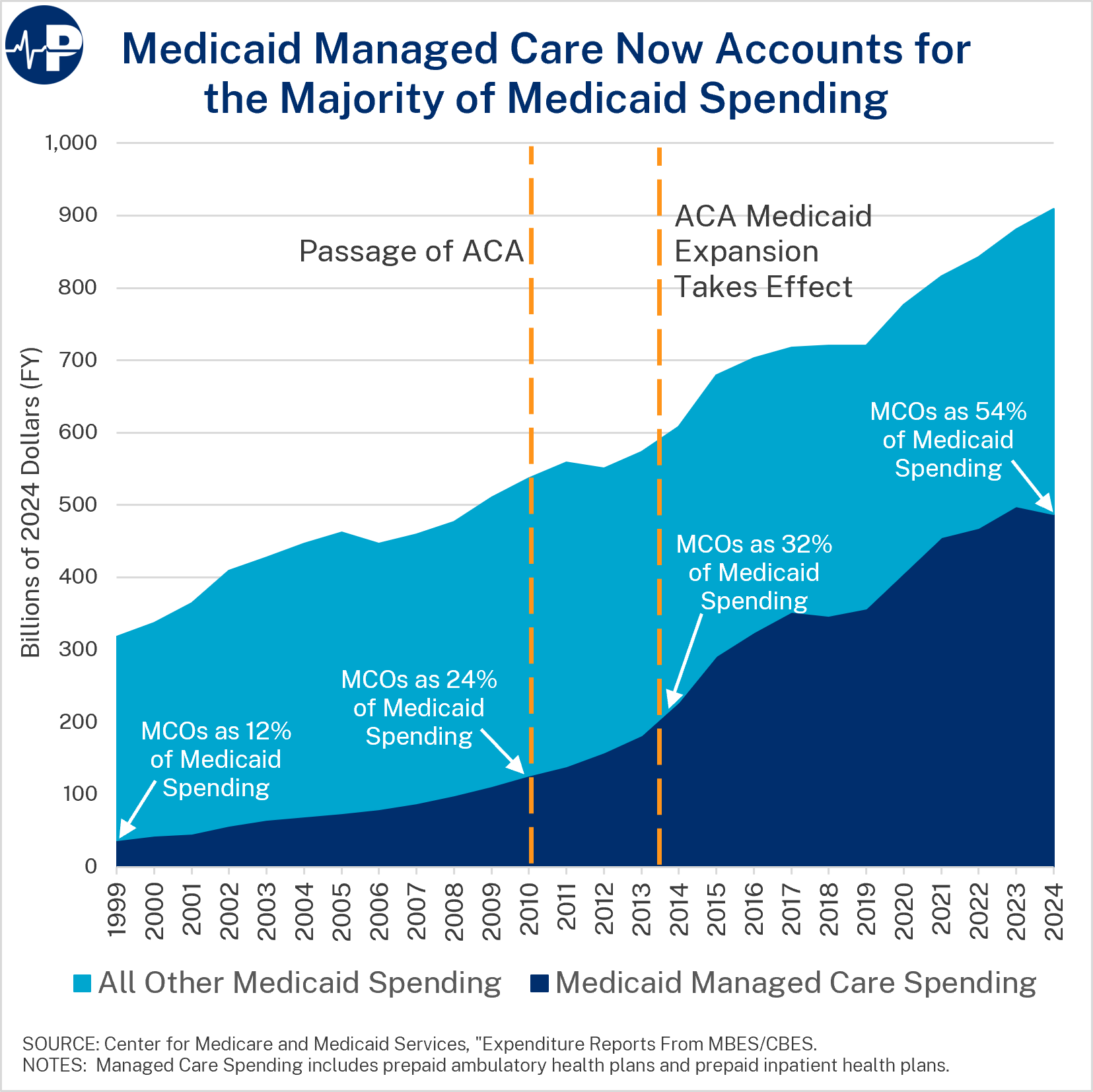
The ACA’s Medicaid expansion dramatically expanded the role—and profitability—of Medicaid managed care organizations. In 1999, managed care plans accounted for just 12 percent of Medicaid spending. By 2024, they received 54 percent of all Medicaid spending—roughly $490 billion annually—with growth accelerating after the expansion took effect. And health insurance companies’ profits increased substantially after the Medicaid expansion took effect.50
The evidence that Medicaid managed care has improved the program is weak. In a 2018 report, the Congressional Budget Office concluded that studies had not found consistent evidence that Medicaid managed care improves beneficiaries’ access to care or health outcomes.51 Chris Pope of the Manhattan Institute similarly concludes that, after more than three decades, Medicaid managed care has largely failed to deliver on its original promises of better care coordination, improved quality, or lower costs.52
Federal Medicaid Funds Are Inequitably Distributed Across the Country
Medicaid’s financing structure is inequitable not only across eligibility groups but also across states. The current formula for traditional enrollees was designed to provide greater federal assistance to states with lower per capita incomes. Under that formula, the wealthiest states receive $1 in federal funds for every $1 in state funds, and the poorest states receive $3 in federal funds for every $1 in state funds. However, as the below figures show, higher-income states tend to receive more federal Medicaid funding per person in poverty because they have larger and more expansive programs. If the Medicaid formula was working as intended, the correlation line would be negative, not positive, as poorer states would receive greater federal spending per person in poverty than wealthier states would.
The first figure includes spending on ACA Medicaid expansion enrollees, and the second figure excludes that spending—showing that excluding expansion spending makes very little difference in the overall trend of greater federal Medicaid support in wealthier states. One feature contributing to this inequity is the statutory 50 percent federal reimbursement floor.


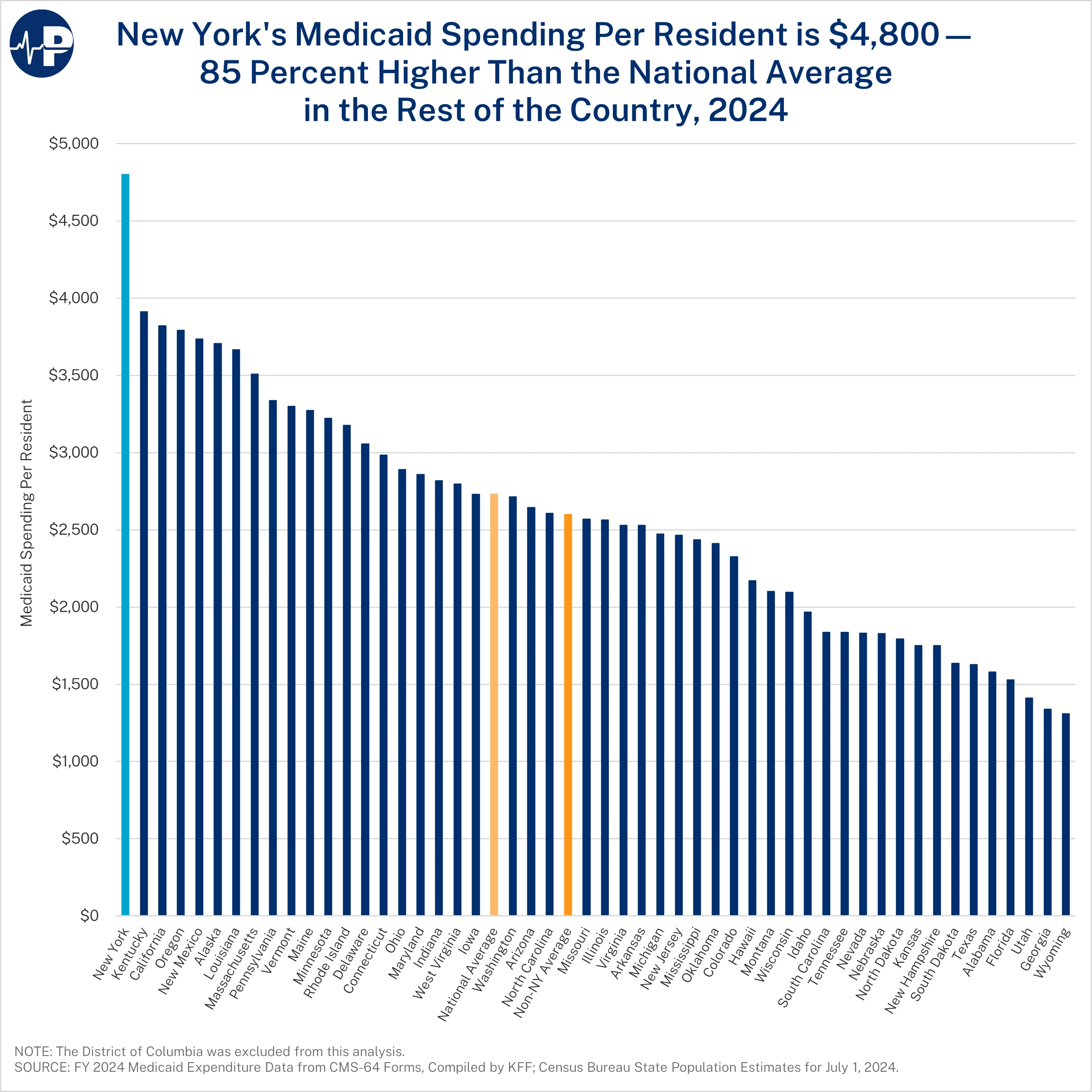
The figure below shows another measure of the large disparity—Medicaid spending per resident by state. New York’s Medicaid spending per resident was $4,800 in 2024—85 percent higher than the average for the other 49 states. Although Medicaid spending varies substantially across states, New York is an extreme outlier. Its extraordinarily high spending is particularly concerning given the state’s long record of documented Medicaid waste, weak oversight, and abusive financing practices. Medicaid waste, fraud, and abuse have long been rampant in New York. In March 2013, the House Oversight and Government Reform Committee released a bipartisan report following a year-long investigation into New York’s program.53 The report documented extensive problems, including weak eligibility controls, poor oversight of long-term care services, abusive financing constructs, and political corruption.
New York’s unusually high Medicaid spending is also reflected in the size of its home health and personal care workforce. In 2024, New York employed 314 home health and personal care aides per 10,000 residents—three times the average of 105 in the other 49 states.54 The result is a Medicaid program that supports a much larger workforce than exists elsewhere in the country, raising important questions about whether federal dollars are financing medically necessary care or sustaining an unusually large publicly financed workforce—which includes paying family members and friends to take care of Medicaid enrollees.
New York also illustrates how Medicaid spending can become intertwined with organized labor and political advocacy. From 2015 through 2024, at least $233 million from a Medicaid initiative ostensibly intended to train nursing-home workers was routed to benefit funds affiliated with 1199 SEIU.55 One of those funds also transferred money to an advocacy organization jointly operated by the union and hospital industry.
Important Reforms in the One Big Beautiful Bill
The OBBB contains significant reforms to limit Medicaid’s most abusive financing arrangements, reduce corporate welfare flowing through provider taxes and SDPs, strengthen program integrity, better align federal resources with Medicaid’s original mission of serving the nation’s most vulnerable populations, and promote work and community engagement among able-bodied, working-age adults.
The OBBB prohibited new or expanded provider taxes based on the rates in effect on July 4, 2025, and phases down the provider tax safe harbor threshold in Medicaid expansion states from 6.0 percent by 0.5 percentage points annually until it reaches 3.5 percent in 2032, where it remains thereafter.56 (The provider tax changes did not apply to nursing homes or intermediate care facilities). The Obama administration had proposed a reduction in the provider tax safe harbor threshold to 3.5 percent in its 2012 budget proposal—the exact level adopted by the OBBB.57 The OBBB sensibly distinguished between expansion states and non-expansion states because the money laundering schemes are amplified under the nine-to-one ACA Medicaid expansion match rate. The OBBB also shut down the particularly egregious tax scam that California used to direct the entire tax burden of its insurer tax on Medicaid plans. CMS estimates that its proposed rule implementing these provider-tax reforms will reduce federal expenditures by $246 billion from 2026 through 2035.58
The OBBB capped payment rates for most services through Medicaid managed care organizations at 110 percent of Medicare rates in non-expansion states and 100 percent of Medicare rates in expansion states. In essence, these provisions established a comparable Medicare-based payment constraint on the managed-care side. CMS estimates that its proposed rule implementing and modestly extending these SDP limits to new categories will reduce federal Medicaid spending by $510 billion from 2026 through 2035.59
Congress also appropriately enacted community engagement requirements for able-bodied, working-age Medicaid expansion adults. Because the federal government finances 90 percent of the cost of expansion enrollees, it has a uniquely strong equity in ensuring that Medicaid coverage for able-bodied, working-age adults is limited to those who work, engage in community service or other qualifying activities, or qualify for an exemption. The community engagement requirements also reflect an important policy objective. Work, education, job training, and community engagement are generally associated with better health, greater economic self-sufficiency, and upward mobility.60 Congress appropriately sought both to strengthen program integrity and to encourage greater labor force participation among adults capable of working.
Critics contend that community-engagement requirements deprive vulnerable populations of needed health care. The one large-scale natural experiment available does not support that claim. A recent Paragon analysis examined Arkansas’ 2018 Medicaid work requirement and compared preventable hospitalization and emergency department visit rates between adults subject to work requirements and those exempt due to age.61 The results showed no statistically significant effects on health care utilization among affected populations.
Congress also appropriately required more frequent eligibility redeterminations for ACA expansion enrollees. CMS recently identified approximately 1.2 million individuals each month potentially enrolled in Medicaid programs in multiple states and another 1.6 million potentially enrolled simultaneously in Medicaid and subsidized exchange plans.62 These findings demonstrate that annual eligibility reviews are insufficient to maintain program integrity. More frequent eligibility determinations will reduce duplicate coverage, improve the accuracy of enrollment, and better protect taxpayers while ensuring Medicaid serves eligible beneficiaries.
The OBBB Better Targets Federal Resources to Rural Hospitals
Critics of the OBBB argued that limiting provider taxes and SDPs would threaten access to care in rural communities, but the evidence does not support this claim. In an analysis last year, Paragon experts Liam Sigaud and Niklas Kleinworth examined two decades of data and found no indication that hospital provider taxes support rural facilities.63 States without a hospital provider tax had markedly higher population-adjusted rural hospital employment than states that operated these schemes. The analysis also showed that rural hospital employment declined in states after they adopted a hospital provider tax, relative to states that did not, and that these effects grew over time.
A subsequent Paragon analysis examining every rural hospital closure between 2005 and 2024 reached the same conclusion.64 States with hospital provider taxes in place throughout that period experienced 21 rural hospital closures, while states that never imposed such a tax collectively experienced a single closure. Even adjusting for population, rural closures were more than three times higher in provider tax states. A statistical model tracking rural closures for up to 14 years after the adoption of provider taxes found no discernible reduction in closures attributable to the tax. These results suggest that the funds generated from provider taxes tend to favor large, urban, politically connected health systems.
Rural hospital closures and service reductions are a genuine concern for many communities that rely on them for essential care. Congress addressed those concerns through the Rural Health Transformation Program, which provides more targeted assistance to rural hospitals and other providers that face genuine financial challenges. While corporate welfare concerns remain an issue,65 this fund represents a far better approach than continuing nationwide financing arrangements that primarily benefit large health systems with states inappropriately shifting costs to the federal government.
The scale of the rural hospital financing challenge is far smaller than the rhetoric surrounding it. The Center for Healthcare Quality and Payment Reform estimates that eliminating the operating losses of every rural hospital currently at risk of closure would cost roughly $3.2 billion per year.66 The Rural Health Transformation Program provides $10 billion per year for five years—more than three times that amount.
Importantly, the Rural Health Transformation Program substantially exceeds estimates of the financial impact that the OBBB’s Medicaid financing reforms are expected to have on rural hospitals. Rather than preserving inefficient financing schemes that reward states for maximizing federal reimbursement and channel billions of dollars to large hospital systems, Congress chose to provide direct, transparent, and targeted assistance where it is most needed. That approach better protects access to care while restoring greater integrity to Medicaid’s financing structure.
Guarding Against New Opportunities for Scams
An emerging area of vulnerability is the result of Medicaid increasingly financing services that are difficult to observe, measure, and verify. Home- and community-based services have grown rapidly across many states. Programs that pay family members, friends, and neighbors to provide services are often motivated by good intentions. But they also create significant program integrity challenges. Every expansion of Medicaid into non-clinical activities creates new opportunities for waste, abuse, and fraud.
Verifying whether surgery occurred is relatively straightforward. Verifying whether thousands of hours of personal assistance services were actually delivered inside private residences is virtually impossible. Whenever government finances services that are difficult to verify, opportunities for waste, abuse, and fraud increase.
The recent New York Consumer Directed Personal Assistance Program scandal illustrates these challenges. The program expanded dramatically in recent years and became one of the largest personal care programs in the country. The Justice Department has alleged serious misconduct involving the program’s administration, billing practices, contractual limits, and representations to the public.67 Federal and state authorities have also pursued numerous fraud cases involving home-based services, including schemes involving phantom caregivers, inflated hours, and services that were never provided.
Medicaid’s Damage to Responsible Long-Term Care Planning
A fundamental flaw in America’s long-term care system is that Medicaid has evolved from a safety net for the poor into an inheritance protection program for many households with substantial assets. Through generous asset exemptions, home equity exclusions, trusts, and estate-planning strategies, many individuals can qualify for taxpayer-financed long-term care while preserving significant wealth for their heirs. Rather than requiring families to use accumulated assets to finance their own care before relying on public assistance, current policy often allows Medicaid to pay first while inheritances remain largely intact. This is inequitable to taxpayers who save responsibly and distorts the program’s original purpose.
These policies also create powerful disincentives for individuals to prepare for their own long-term care needs. When people expect Medicaid to cover nursing home costs or home-based care after modest planning or asset restructuring, they have less reason to purchase long-term care insurance, accumulate dedicated savings, or otherwise plan for a predictable risk associated with aging. The result is a classic moral hazard: private financing declines because public financing is readily available. As more people rely on Medicaid, the program consumes more taxpayer resources while providers become increasingly dependent on low Medicaid reimbursement rates, contributing to workforce shortages, limited access to high-quality care, and persistent financial pressures throughout the long-term care system.68
The irony is that these policies often harm the very people they are intended to help. By encouraging reliance on Medicaid rather than personal planning, they weaken the market for private long-term care financing and reduce the resources available to improve care quality for the most vulnerable. A system that requires individuals with sufficient means to finance more of their own long-term care before turning to Medicaid would better preserve the program for those with genuine financial need while encouraging greater personal responsibility and a stronger private market for long-term care services.
III. Recommendations to Improve the Medicaid Program
Congress should recognize that states respond rationally to the incentives created by federal law. Reform should therefore focus on redesigning the program’s financing structure so that states have stronger incentives to promote efficiency, program integrity, and better care rather than simply increasing expenditures.
Eliminate Medicaid’s discriminatory financing structure by equalizing the federal matching rates for ACA expansion adults and traditional Medicaid enrollees
In 2024, Paragon proposed gradually lowering the enhanced ACA expansion match to each state’s traditional matching rate over eight years while preserving coverage by allowing adults with incomes between 100 and 138 percent of the federal poverty level to receive subsidized coverage through the ACA exchanges.69 We estimated that this proposal would save the federal government roughly $250 billion even if all expansion states maintained expansion and all affected enrollees retained coverage. Accounting for likely behavioral responses—including some states modifying expansion and some individuals choosing not to enroll in subsidized exchange coverage—the federal savings could exceed $500 billion over the budget window.
Build on the financing reforms enacted in the One Big Beautiful Bill
The provider tax and SDP reforms must be preserved and strengthened by further reducing the provider tax safe harbor and ensuring that existing SDPs are brought into compliance with the law’s new limits. Congress should also further limit states’ ability to shift costs to the federal government through IGTs, including preventing states from paying government-owned providers substantially more than comparable private providers solely to increase federal reimbursement.
Have federal funds better reflect states’ fiscal capacity
Lowering the statutory federal payment floor from 50 percent to 40 percent while maintaining the existing sliding-scale formula would improve equity among states, better align federal assistance with states’ ability to finance their own programs, and reduce federal Medicaid spending. Paragon previously estimated that this reform would reduce federal spending by approximately $60 billion over the budget window.70
Strengthening program integrity and recovering improper payments
Congress should impose meaningful financial consequences on states with persistently excessive eligibility and payment error rates. States that repeatedly fail to conduct adequate eligibility reviews or maintain acceptable error rates should be required to repay a larger share of resulting improper federal expenditures. CMS should also aggressively recover federal funds when negligent state administration contributes to improper spending and ensure that Medicaid managed-care capitation rates exclude known fraud, impossible billing patterns, and other improper expenditures. Recent enforcement actions involving Minnesota and California are encouraging first steps, but they should become standard practice nationwide.
Increase transparency in state Medicaid financing
Congress should also require comprehensive and standardized public reporting of Medicaid financing arrangements. CMS should publish, in a searchable database, every provider tax, intergovernmental transfer, certified public expenditure, and state-directed payment, including the entities supplying the nonfederal share, the providers receiving the resulting payments, and the payment amounts. Importantly, CMS should also publish preprint addendums, which states often exclude from their applications. Greater transparency would allow Congress, federal regulators, researchers, and taxpayers to identify circular financing arrangements and determine whether additional federal spending is reaching patients or primarily benefiting politically influential institutions.
Prevent the diversion of Medicaid funds to political activities
Congress should strengthen oversight of Medicaid financing to ensure that federal funds intended for patient care are not diverted to finance union organizing, lobbying, or other political activities. Federal Medicaid funding should be used to improve patient care—not to finance political constituencies.
Prevent federal Medicaid dollars from going toward consultants who seek to maximize federal expenditures
Congress should prohibit federal Medicaid funds from paying consultants whose business is helping states maximize federal Medicaid reimbursement through financing gimmicks such as provider taxes, intergovernmental transfers, certified public expenditures, and state-directed payments. Medicaid dollars should finance patient care—not consultants who profit from increasing federal spending. Congress should also prohibit contingency-fee arrangements under which consultants are paid based on the additional federal Medicaid funding they generate.
Reform Medicaid long-term care
Medicaid should not be used to preserve inheritances for wealthy heirs. Congress should ensure that people with sizeable assets are not able to use Medicaid to finance their long-term care expenses.
These reforms will reduce waste, fraud and abuse and provide Medicaid a responsible fiscal trajectory to ensure we continue to have the ability to care for our most vulnerable.
I thank the Committee for its attention to these issues and look forward to your questions.
Footnotes
1↑ Paul Winfree, "The Contribution of Federal Health Programs to U.S. Fiscal Challenges and the Need for Reform," Paragon Health Institute, January 2023, https://paragoninstitute.org/medicare/post-the-contribution-of-federal-health-programs-to-us-fiscal-challenges-and-the-need-for-reform/
2↑ U.S. House Committee on Oversight and Government Reform, "Billions of Federal Tax Dollars Misspent on New York's Medicaid Program," committee report, February 14, 2013, 9, https://oversight.house.gov/wp-content/uploads/2013/02/Bipartisan-Medicaid-Oversight-Report-ordered-reported-by-Committee.pdf
3↑ Amy Finkelstein, Nathaniel Hendren, and Erzo F. P. Luttmer, "The Value of Medicaid: Interpreting Results from the Oregon Health Insurance Experiment," National Bureau of Economic Research Working Paper no. 21308, June 2015, https://www.nber.org/papers/w21308
4↑ Adam G. Levin, "Federal Grants to State and Local Governments: Trends and Issues," Congressional Research Service Report R40638, updated June 26, 2025, table 4, https://www.congress.gov/crs_external_products/R/HTML/R40638.html#_Toc201932518
5↑ Brian Blase, Drew Gonshorowski, and Niklas Kleinworth, "The Cost of Good Intentions: The Harm of Delaying the Disenrollment of Medicaid Ineligibles," Paragon Health Institute, July 2023, https://paragoninstitute.org/state-health-reform/the-cost-of-good-intentions/
6↑ Alice Burns, Scott Hulver, Jessica Mathers, Robin Rudowitz, and Patrick Drake, "Spending on Medicaid State Directed Payments Before New Limits Take Effect," KFF, June 15, 2026, https://www.kff.org/medicaid/spending-on-medicaid-state-directed-payments-before-new-limits-take-effect/
7↑ Congressional Budget Office, "Monthly Budget Review: June 2026," July 9, 2026, https://www.cbo.gov/publication/61982
8↑ Phillip L. Swagel, Sean Dunbar, Sarah Masi, and Sarah Sajewski, "CBO's Baseline Projections of Federal Subsidies for Health Insurance," Congressional Budget Office, May 11, 2026, slides 12?15, https://www.cbo.gov/publication/62380; Congressional Budget Office, The Budget and Economic Outlook: 2025 to 2035 (January 2025), https://www.cbo.gov/publication/61172
9↑ Brian Blase and Niklas Kleinworth, "Addressing Medicaid Money Laundering: The Lack of Integrity with Medicaid Financing and the Need for Reform," Paragon Health Institute, March 2025, https://paragoninstitute.org/medicaid/addressing-medicaid-money-laundering-the-lack-of-integrity-with-medicaid-financing-and-the-need-for-reform/
10↑ Brian Blase and Rachel Greszler, "Medicaid's True Improper Payments Double Those Reported by CMS," Paragon Health Institute and Economic Policy Innovation Center, March 3, 2025, https://paragoninstitute.org/medicaid/medicaids-true-improper-payments-likely-double-those-reported-by-cms/
11↑ Brian Blase, "Learning from Obama's Medicaid Reform Proposals," Paragon Health Institute, February 19, 2025, https://paragoninstitute.org/newsletter/learning-from-obamas-medicaid-reform-proposals
12↑ Charles Blahous and Liam Sigaud, "The Affordable Care Act's Medicaid Expansion Is Shifting Resources Away from Low-Income Children," Mercatus Center, December 13, 2022, https://www.mercatus.org/research/research-papers/affordable-care-acts-medicaid-expansion-shifting-resources-away-low-income
13↑ Markus Bjoerkheim, Kofi Ampaabeng, and Liam Sigaud, "The Effect of the Affordable Care Act's Medicaid Expansion on the Mental Health of Already-Enrolled Medicaid Beneficiaries," Mercatus Center, July 19, 2023, https://www.mercatus.org/research/working-papers/effect-affordable-care-acts-medicaid-expansion-mental-health-already
14↑ Sarah Miller and Laura R. Wherry, "Health and Access to Care during the First 2 Years of the ACA Medicaid Expansions," New England Journal of Medicine 376, no. 10 (March 9, 2017): 947?956, https://www.nejm.org/doi/full/10.1056/NEJMsa1612890
15↑ Walter R. Hsiang et al., "Medicaid Patients Have Greater Difficulty Scheduling Health Care Appointments Compared with Private Insurance Patients: A Meta-Analysis," INQUIRY: The Journal of Health Care Organization, Provision, and Financing 56 (April 5, 2019), https://pmc.ncbi.nlm.nih.gov/articles/PMC6452575/
16↑ Stacey McMorrow and Genevieve M. Kenney, "How Did the Affordable Care Act Medicaid Expansion Affect Coverage and Access to Care for Low-Income Parents Who Were Eligible for Medicaid Before the Law Was Passed?," INQUIRY: The Journal of Health Care Organization, Provision, and Financing 58 (October 14, 2021), https://journals.sagepub.com/doi/10.1177/00469580211050213
17↑ Charles Courtemanche, Andrew I. Friedson, Andrew P. Koller, and Daniel I. Rees, "The Affordable Care Act and Ambulance Response Times," Journal of Health Economics 67 (September 2019): 102213, https://www.sciencedirect.com/science/article/abs/pii/S0167629618300523
18↑ Sarah L. Taubman et al., "Medicaid Increases Emergency-Department Use: Evidence from Oregon's Health Insurance Experiment," Science 343, no. 6168 (January 17, 2014): 263?268, https://pmc.ncbi.nlm.nih.gov/articles/PMC3955206/; Lindsay Allen, Cong T. Gian, and Kosali Simon, "The Impact of Medicaid Expansion on Emergency Department Wait Times," Health Services Research 57, no. 2 (April 2022): 294?299, https://onlinelibrary.wiley.com/doi/10.1111/1475-6773.13892
19↑ Katherine Baicker et al., "The Oregon Experiment?Effects of Medicaid on Clinical Outcomes," New England Journal of Medicine 368, no. 18 (May 2, 2013): 1713?1722, https://doi.org/10.1056/NEJMsa1212321
20↑ Sarah L. Taubman et al., "Medicaid Increases Emergency-Department Use: Evidence from Oregon's Health Insurance Experiment," Science 343, no. 6168 (January 17, 2014): 263?268, https://doi.org/10.1126/science.1246183
21↑ Elizabeth Arias, Jiaquan Xu, and Kenneth Kochanek, "United States Life Tables, 2023," National Vital Statistics Reports 74, no. 6 (Hyattsville, MD: National Center for Health Statistics, July 15, 2025), table 19, https://dx.doi.org/10.15620/cdc/174591
22↑ Brian Blase and David Balat, "Is Medicaid Expansion Worth It? A Review of the Evidence Suggests Targeted Programs Represent Better Policy," Texas Public Policy Foundation, April 2020, https://www.texaspolicy.com/wp-content/uploads/2020/04/Blase-Balat-Medicaid-Expansion.pdf
23↑ Id.
24↑ Joel Zinberg and Liam Sigaud, "What Matters for Health: Insurance is Less Important Than You Think," Paragon Health Institute, December 2024, https://paragoninstitute.org/public-health/what-matters-for-health-insurance-is-less-important-than-you-think/
25↑ Walter R. Hsiang et al., "Medicaid Patients Have Greater Difficulty Scheduling Health Care Appointments Compared with Private Insurance Patients: A Meta-Analysis," INQUIRY: The Journal of Health Care Organization, Provision, and Financing 56 (April 5, 2019), https://pmc.ncbi.nlm.nih.gov/articles/PMC6452575/
26↑ Brian Blase, "Evidence Is Mounting: The Affordable Care Act Has Worsened Medicaid's Structural Problems," Mercatus Center, September 2016, https://www.mercatus.org/research/research-papers/evidence-mounting-affordable-care-act-has-worsened-medicaids-structural
27↑ Brian Blase & Drew Gonshorowski, "Medicaid Financing Reform: Stopping Discrimination Against the Most Vulnerable and Reducing Bias Favoring Wealthy States," Paragon Health Institute, July 2024, https://paragoninstitute.org/medicaid/medicaid-financing-reform-stopping-discrimination-against-the-most-vulnerable-and-reducing-bias-favoring-wealthy-states/
28↑ Brian Blase and Rachel Greszler, "Medicaid's True Improper Payments Double Those Reported by CMS," Paragon Health Institute and Economic Policy Innovation Center, March 3, 2025, https://paragoninstitute.org/medicaid/medicaids-true-improper-payments-likely-double-those-reported-by-cms/
29↑ Liam Sigaud, "Medicaid Expansion's Growing Improper Enrollment Crisis: Nearly Half of Expansion Enrollees Likely Do Not Meet Eligibility Requirements," Paragon Health Institute, August 2026, https://paragoninstitute.org/medicaid/medicaid-expansions-growing-improper-enrollment-crisis-nearly-half-of-expansion-enrollees-likely-do-not-meet-eligibility-requirements/
30↑ Certified public expenditures allow a governmental provider to certify its actual, incurred Medicaid costs as the nonfederal share of Medicaid expenditures. The state may then claim federal matching funds without first transferring an additional state cash payment to the provider.
31↑ Chris Medrano and Brian Blase, "The Local Loop: How States Turn Medicaid into a Government Provider Payday Scheme," Paragon Health Institute, December 15, 2025, https://paragoninstitute.org/state-health-reform/the-local-loop-how-states-turn-medicaid-into-a-government-provider-payday-scheme/
32↑ Martin B. Hackmann, Juan S. Rojas, and Nicolas R. Ziebarth, "Creative Financing and Public Moral Hazard: Evidence from Medicaid and the Nursing Home Industry," National Bureau of Economic Research Working Paper no. 34118, August 2025, https://doi.org/10.3386/w34118
33↑ Chris Medrano and Brian Blase, "The Local Loop: How States Turn Medicaid into a Government Provider Payday Scheme," Paragon Health Institute, December 15, 2025, https://paragoninstitute.org/state-health-reform/the-local-loop-how-states-turn-medicaid-into-a-government-provider-payday-scheme/
34↑ Liam Sigaud and Eric Sun, "The Hidden Cost of Medicaid Provider Taxes: Higher Prices in the Commercial Market," Paragon Health Institute, June 2026, https://paragoninstitute.org/medicaid/the-hidden-cost-of-medicaid-provider-taxes-higher-prices-in-the-commercial-market/
35↑ Paul Winfree and Brian Blase, "California's Insurance-Tax Shuffle: How Federal Money Ends Up Paying for Medicaid for Illegal Immigrants," Paragon Health Institute and Economic Policy Innovation Center, March 2025, https://paragoninstitute.org/medicaid/californias-insurance-tax-shuffle-how-federal-money-ends-up-paying-for-medicaid-for-illegal-immigrants/
36↑ Bob Woodward, The Price of Politics (New York: Simon & Schuster, 2012).
37↑ Id.
38↑ Washington Post Editorial Board, "A Much-Needed Medicaid Reform," Washington Post, November 29, 2012, https://www.washingtonpost.com/opinions/a-much-needed-medicaid-reform/2012/11/29/b091d86e-399f-11e2-a263-f0ebffed2f15_story.html
39↑ Peter Wong, "Oregon House Extends Hospital Tax," Portland Tribune, March 11, 2015, http://portlandtribune.com/pt/9-news/253422-123198-oregon-house-extends-hospital-tax
40↑ National Commission on Fiscal Responsibility and Reform, "The Moment of Truth: Report of the National Commission on Fiscal Responsibility and Reform," December 2010, https://
www.fiscalcommission.gov/sites/fiscalcommission.gov/files/documents/TheMomentofTruth12_1
_2010.pdf.
41↑ Teresa A. Coughlin and Stephen Zuckerman, "States' Use of Medicaid Maximization Strategies to
Tap Federal Revenues: Program Implications and Consequences," Urban Institute, June 2002, https://www.urban.org/research/publication/states-use-medicaid-maximization-strategies-tap-federal-revenues
42↑ American Enterprise Institute, "Improving Health and Health Care: An Agenda for Reform," panel discussion, December 9, 2015, 1:55:00ff., https://www.youtube.com/watch?v=NQo-EeYPhEs
43↑ The Medicaid provider-tax "safe harbor" refers to the indirect hold-harmless threshold under federal provider tax rules. Before the OBBB, this threshold generally allowed states to use provider tax revenues to draw down federal Medicaid matching funds so long as the tax did not exceed 6 percent of a provider's net patient revenue. Taxes above that threshold could trigger the federal hold harmless test, which is intended to prevent states from taxing providers and then guaranteeing that those same providers are repaid through higher Medicaid payments. The OBBB lowered the safe harbor threshold for Medicaid expansion states by 0.5 percentage points per year beginning in fiscal year (FY) 2028, reaching 3.5 percent in FY 2032 and thereafter, while generally freezing existing provider taxes and preventing new or increased provider taxes above the new thresholds.
44↑ President Obama's fiscal year (FY) 2013 budget proposed reducing the safe harbor threshold from 6 percent to 3.5 percent between FY 2015 and FY 2017 and then keeping it at 3.5 percent in the future. Office of Management and Budget, "Fiscal Year 2013 Budget of the U.S. Government," February 2012, 36, https://obamawhitehouse.archives.gov/sites/default/files/omb/budget/fy2013/assets/budget.pdf
45↑ Washington Post Editorial Board, "A Much-Needed Medicaid Reform," Washington Post,
November 29, 2012, https://www.washingtonpost.com/opinions/a-much-needed-medicaid-reform/2012/11/29/b091d86e-399f-11e2-a263-f0ebffed2f15_story.html
46↑ Centers for Medicare & Medicaid Services, "Medicaid Program; Medicaid and Children's Health Insurance Program (CHIP) Managed Care Access, Finance, and Quality," final rule, 89 Fed. Reg. 41002, May 10, 2024, https://www.federalregister.gov/documents/2024/05/10/2024-08085/medicaid-program-medicaid-and-childrens-health-insurance-program-chip-managed-care-access-finance
47↑ Christopher M. Whaley et al., "Prices Paid to Hospitals by Private Health Plans: Findings from Round 5.1 of an Employer-Led Transparency Initiative," RAND Corporation, December 10, 2024, https://www.rand.org/pubs/research_reports/RRA1144-2-v2.html
48↑ Centers for Medicare & Medicaid Services, "CMS Issues Guidance to Strengthen Oversight of Medicaid State Directed Payments," September 9, 2025, https://www.cms.gov/newsroom/press-releases/cms-issues-guidance-strengthen-oversight-medicaid-state-directed-payments
49↑ Alice Burns, Scott Hulver, Jessica Mathers, Robin Rudowitz, and Patrick Drake, "Spending on Medicaid State Directed Payments Before New Limits Take Effect," KFF, June 15, 2026, https://www.kff.org/medicaid/spending-on-medicaid-state-directed-payments-before-new-limits-take-effect/
50↑ White House Council of Economic Advisers, "The Profitability of Health Insurance Companies," March 2018, https://trumpwhitehouse.archives.gov/wp-content/uploads/2018/03/The-Profitability-of-Health-Insurance-Companies.pdf
51↑ Congressional Budget Office, "Exploring the Growth of Medicaid Managed Care," August 7 2018, https://www.cbo.gov/system/files/2018-08/54235-MMC_chartbook.pdf
52↑ Chris Pope, "Reining in Medicaid Managed Care," Manhattan Institute, May 2026, https://media4.manhattan-institute.org/wp-content/uploads/reining-in-medicaid-managed-care.pdf
53↑ U.S. House of Representatives Committee on Oversight and Government Reform, "Billions of Federal Tax Dollars Misspent on New York's Medicaid Program," March 2013, https://oversight.house.gov/wp-content/uploads/2013/03/Bipartisan-Medicaid-Oversight-Report-Final.pdf
54↑ John R. Graham and Liam Sigaud, "New York's Per Capita Home Health Aide Workforce Is Three Times Greater Than Other States' Average," Paragon Health Institute, January 14, 2026, https://paragoninstitute.org/paragon-pic/new-yorks-per-capita-home-health-aide-workforce-is-three-times-greater-than-other-states-average/
55↑ Niklas Kleinworth, "How Medicaid Funds for Nurse Training Were Diverted to Union Benefits and Lobbyists," Paragon Health Institute, June 8, 2026, https://paragoninstitute.org/paragon-pic/how-medicaid-funds-for-nurse-training-were-diverted-to-union-benefits-and-lobbyists/
56↑ The Medicaid provider-tax "safe harbor" refers to the indirect hold-harmless threshold under federal provider tax rules. Before the OBBB, this threshold generally allowed states to use provider tax revenues to draw down federal Medicaid matching funds so long as the tax did not exceed 6 percent of a provider's net patient revenue. Taxes above that threshold could trigger the federal hold harmless test, which is intended to prevent states from taxing providers and then guaranteeing that those same providers are repaid through higher Medicaid payments. The OBBB lowered the safe harbor threshold for Medicaid expansion states by 0.5 percentage points per year beginning in fiscal year (FY) 2028, reaching 3.5 percent in FY 2032 and thereafter, while generally freezing existing provider taxes and preventing new or increased provider taxes above the new thresholds.
57↑ Office of Management and Budget, Fiscal Year 2013 Budget of the U.S. Government, February 2012,https://obamawhitehouse.archives.gov/sites/default/files/omb/budget/fy2013/assets/budget.pdf; See also Brian Blase, "Learning from Obama's Medicaid Reform Proposals," Paragon Health Institute, February 19, 2025, https://paragoninstitute.org/newsletter/learning-from-obamas-medicaid-reform-proposals/
58↑ Centers for Medicare & Medicaid Services, "Amending the Indirect Hold Harmless Threshold of Health Care-Related Taxes Proposed Rule (CMS-2452-p)," July 21, 2026, https://www.cms.gov/newsroom/fact-sheets/amending-indirect-hold-harmless-threshold-health-care-related-taxes-proposed-rule-cms-2452-p
59↑ Centers for Medicare & Medicaid Services, "Medicaid Program; Medicaid Managed Care State Directed Payments and Medicaid Fee-for-Service Targeted Medicaid Practitioner Payments," proposed rule, Federal Register, May 22, 2026, https://www.federalregister.gov/documents/2026/05/22/2026-10292/medicaid-program-medicaid-managed-care-state-directed-payments-and-medicaid-fee-for-service-targeted
60↑ Michael Greibrok, "Universal Work Requirements for Welfare Programs Are a Win for All Involved," Foundation for Government Accountability, May 17, 2023, https://thefga.org/research/universal-work-requirements/
61↑ Eric Sun and Liam Sigaud, "Arkansas' Medicaid Work Requirements Associated with No Significant Changes in Health Measures," Paragon Health Institute, August 2025, https://paragoninstitute.org/state-health-reform/arkansas-medicaid-work-requirements-associated-with-no-significant-changes-in-health-measures/
62↑ Centers for Medicare & Medicaid Services, "CMS Finds 2.8 Million Americans Potentially Enrolled in Two or More Medicaid/ACA Exchange Plans," press release, July 17, 2025, https://www.cms.gov/newsroom/press-releases/cms-finds-2-8-million-americans-potentially-enrolled-two-or-more-medicaid-aca-exchange-plans
63↑ Liam Sigaud and Niklas Kleinworth, "Will Congress' Reforms to Medicaid Financing Hurt Rural Health Care? No. Debunking the Myth that Provider Taxes Support Rural Hospitals," Paragon Health Institute, July 15, 2025, https://paragoninstitute.org/medicaid/will-congress-reforms-to-medicaid-financing-hurt-rural-health-care-no-debunking-the-myth-that-provider-taxes-support-rural-hospitals/
64↑ Liam Sigaud, "Provider Taxes Do Not Save Rural Hospitals," Paragon Health Institute, March 6, 2026, https://paragoninstitute.org/paragon-prognosis/provider-taxes-do-not-save-rural-hospitals/
65↑ Sarah Jane Tribble, "Big Companies Position Themselves for Payday From $50B Federal Rural Health Fund," KFF Health News, April 28, 2026, https://kffhealthnews.org/rural-health/rural-health-transformation-program-cms-state-contractors-ehr-patients/
66↑ Liam Sigaud, "Targeting fraud can help rural hospitals," The Center Square, June 1, 2026, https://www.thecentersquare.com/opinion/article_b42fb9ee-8f4f-43c7-953f-e681b8e99a44.html; Center for Healthcare Quality and Payment Reform, "How to Prevent Rural Hospital Closures," Saving Rural Hospitals, https://ruralhospitals.chqpr.org/Solutions.html
67↑ Department of Justice, "Department of Justice Files Suit to Stop Ongoing Medicaid Fraud Related to New York's $10 Billion Home-Care Program," June 16, 2026, at https://www.justice.gov/opa/pr/department-justice-files-suit-stop-ongoing-medicaid-fraud-related-new-yorks-10-billion-home
68↑ Stephen Moses, "Long-Term Care: The Problem," Paragon Health Institute, October 2022, https://paragoninstitute.org/medicaid/long-term-care-problem/
69↑ Brian Blase and Drew Gonshorowski, "Medicaid Financing Reform: Stopping Discrimination Against the Most Vulnerable and Reducing Bias Favoring Wealthy States," Paragon Health Institute, July 2024, https://paragoninstitute.org/medicaid/medicaid-financing-reform-stopping-discrimination-against-the-most-vulnerable-and-reducing-bias-favoring-wealthy-states/
70↑ Id.
Subscribe
Sign up now for your health policy updates.