
Paragon Health Institute Icon White
Paragon Pic

How Medicaid Funds for Nurse Training Were Diverted to Union Benefits and Lobbyists

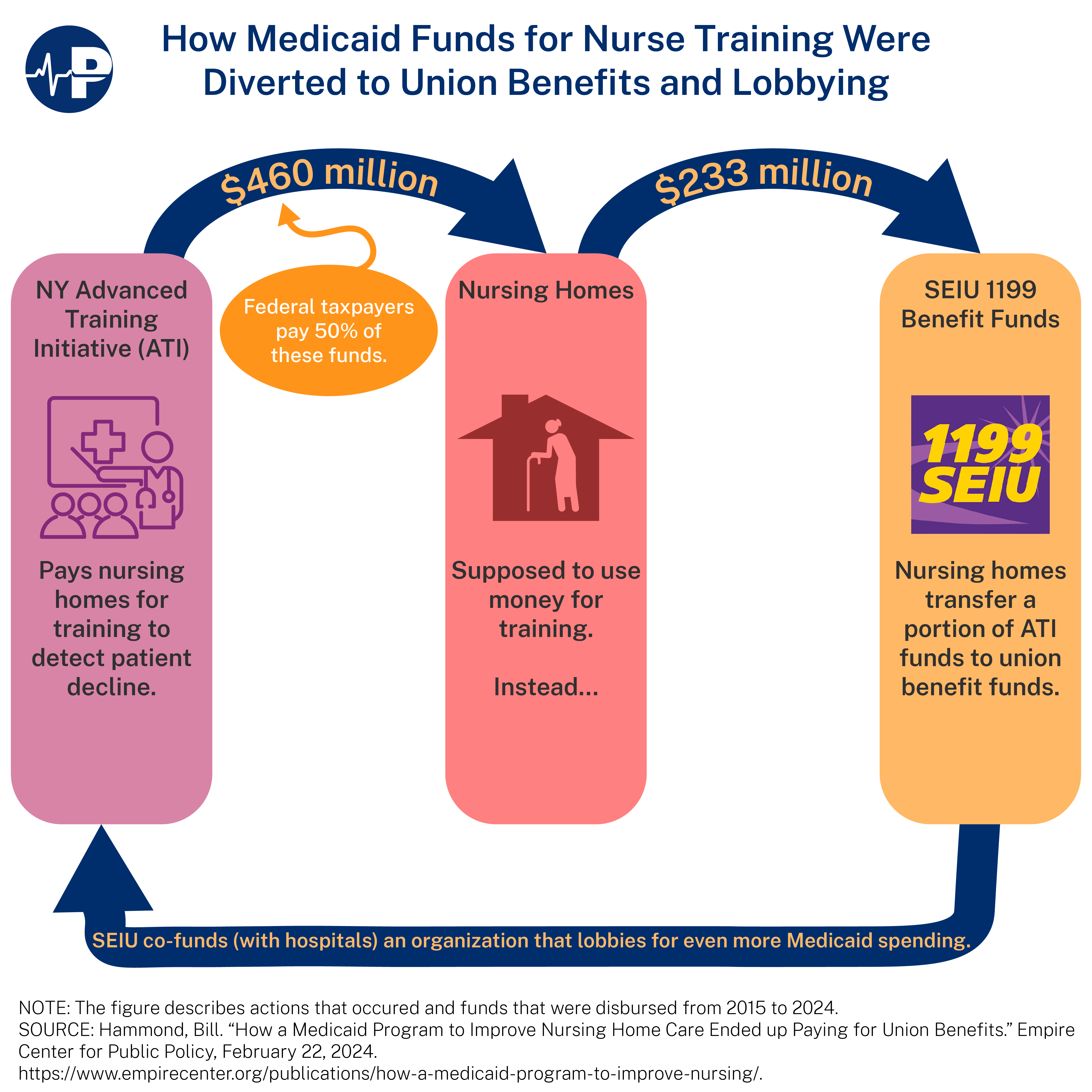
8.1MH SEIU New York Diagram A0wUU000005KTJ7YAO
Click the Pic to expand the image
Niklas Kleinworth Headshot SMALLER V2
Director, State Health Reform Initiative; and Policy Analyst

Niklas Kleinworth is the Director of the State Health Reform Initiative and a Policy Analyst at the Paragon Health Institute, focusing on Medicaid and state policy initiatives. He has served in state and federal policy roles since 2021.

Waste, fraud, and abuse in Medicaid benefit bad actors at a steep cost to the truly vulnerable and hard-working Americans. But as CMS Director, Dr. Oz recently noted, the spoils of this manipulation often benefit the politically connected, like unions.

New York State offers a prime example of how unions leverage Medicaid dollars for their own gain. As Bill Hammond of the Empire Center has documented, hundreds of millions of Medicaid dollars intended to improve nursing home care were diverted to increase union benefits instead.

Hammond first examined the annual benefit reports, audits, and state plan amendments (SPAs) and found that New York nursing homes worked with a labor union to redirect funds for improving patient care into employee benefit funds. This money was meant for “training,” but instead, the nursing homes sent a large portion of the money to a benefit fund affiliated with the 1199 Service Employees International Union (SEIU). In exchange, the union reduced how much the nursing homes would have to spend on their employees’ benefits. One of those funds even redirected some of that money to an advocacy group through which unions and hospitals collude to push for more Medicaid funding to feed this arrangement.

How do we know? It’s all in the audits.

How federal taxpayer dollars end up in New York union hands

The federal government and states both finance Medicaid. The federal government reimburses states at a percentage known as the federal medical assistance percentage (FMAP). In the case of New York, its FMAP is 50 percent for traditional enrollees—the elderly, the disabled, children, and pregnant women. During this period, the effective aggregate federal share of New York Medicaid spending was over 60 percent.

In 2015, New York created the “Advanced Training Initiative” (ATI). On paper, the program sounded reasonable: train nursing home workers to identify early signs of patient decline. New York’s 2015 SPA states that the “participating providers” would have to “develop (or continue) a training curriculum” to “help staff identify changes in a resident’s [status] that could lead to hospitalization.” The SPA only mentions unions in its appendix, noting the programs would be “developed in cooperation between Nursing Home providers and union representatives.” But the SPA appendix makes no mention of benefit funds. The state told federal officials it would spend $46 million annually and sought the 50 percent federal match.

But that’s not where all the money went.

Large portions of ATI money were routed into union-affiliated benefit funds. Specifically, both funds are affiliated with 1199 SEIU, the largest health care union in the United States, which Stephen Eide and Daniel DiSalvo referred to as the “union that rules New York.” Those funds’ own financial filings show the money wasn’t primarily used for training. It was used to offset nursing homes’ contributions to their employees’ benefits through two funds.

The Greater New York Benefit Fund (GNYBF) received $207 million from ATI from 2015 to 2024. The National Benefit Fund for Health and Human Service Employees (NBF) received at least $26 million from 2015 to 2018, with additional amounts likely received in subsequent years. Combined, these two funds received at least $233 million from 2015 to 2024—more than half of the ATI’s cumulative $460 million funding during that period.

Nursing homes sent ATI money to the union benefit funds in exchange for lower required contributions to employee benefit plans. The money then showed up on balance sheets as assets available to pay benefits, not as expenditures on training programs. One of those funds, NBF, even spent an unknown amount on the Healthcare Education Project (HEP)—a lobbying and advertising operation jointly run by the union and the hospital industry. HEP has engaged in multimillion-dollar ad buys as well as political campaigns and advocacy efforts to push for increased Medicaid spending.

To recap: Medicaid dollars meant for training were routed into union benefit funds. But that’s not what CMS approved. The SPAs described a straightforward training initiative to improve patient care. It mentioned unions only as partners in developing training programs and said nothing about routing hundreds of millions of dollars into union benefit funds.

As part of its war on fraud, CMS should investigate whether New York used Medicaid funds in a manner inconsistent with the SPA approved by the federal government. Medicaid dollars should improve patient care—not subsidize union benefit funds or finance political advocacy.


8.1MH SEIU New York Diagram A0wUU000005KTJ7YAO

Waste, fraud, and abuse in Medicaid benefit bad actors at a steep cost to the truly vulnerable and hard-working Americans. But as CMS Director, Dr. Oz recently noted, the spoils of this manipulation often benefit the politically connected, like unions.

New York State offers a prime example of how unions leverage Medicaid dollars for their own gain. As Bill Hammond of the Empire Center has documented, hundreds of millions of Medicaid dollars intended to improve nursing home care were diverted to increase union benefits instead.

Hammond first examined the annual benefit reports, audits, and state plan amendments (SPAs) and found that New York nursing homes worked with a labor union to redirect funds for improving patient care into employee benefit funds. This money was meant for “training,” but instead, the nursing homes sent a large portion of the money to a benefit fund affiliated with the 1199 Service Employees International Union (SEIU). In exchange, the union reduced how much the nursing homes would have to spend on their employees’ benefits. One of those funds even redirected some of that money to an advocacy group through which unions and hospitals collude to push for more Medicaid funding to feed this arrangement.

How do we know? It’s all in the audits.

How federal taxpayer dollars end up in New York union hands

The federal government and states both finance Medicaid. The federal government reimburses states at a percentage known as the federal medical assistance percentage (FMAP). In the case of New York, its FMAP is 50 percent for traditional enrollees—the elderly, the disabled, children, and pregnant women. During this period, the effective aggregate federal share of New York Medicaid spending was over 60 percent.

In 2015, New York created the “Advanced Training Initiative” (ATI). On paper, the program sounded reasonable: train nursing home workers to identify early signs of patient decline. New York’s 2015 SPA states that the “participating providers” would have to “develop (or continue) a training curriculum” to “help staff identify changes in a resident’s [status] that could lead to hospitalization.” The SPA only mentions unions in its appendix, noting the programs would be “developed in cooperation between Nursing Home providers and union representatives.” But the SPA appendix makes no mention of benefit funds. The state told federal officials it would spend $46 million annually and sought the 50 percent federal match.

But that’s not where all the money went.

Large portions of ATI money were routed into union-affiliated benefit funds. Specifically, both funds are affiliated with 1199 SEIU, the largest health care union in the United States, which Stephen Eide and Daniel DiSalvo referred to as the “union that rules New York.” Those funds’ own financial filings show the money wasn’t primarily used for training. It was used to offset nursing homes’ contributions to their employees’ benefits through two funds.

The Greater New York Benefit Fund (GNYBF) received $207 million from ATI from 2015 to 2024. The National Benefit Fund for Health and Human Service Employees (NBF) received at least $26 million from 2015 to 2018, with additional amounts likely received in subsequent years. Combined, these two funds received at least $233 million from 2015 to 2024—more than half of the ATI’s cumulative $460 million funding during that period.

Nursing homes sent ATI money to the union benefit funds in exchange for lower required contributions to employee benefit plans. The money then showed up on balance sheets as assets available to pay benefits, not as expenditures on training programs. One of those funds, NBF, even spent an unknown amount on the Healthcare Education Project (HEP)—a lobbying and advertising operation jointly run by the union and the hospital industry. HEP has engaged in multimillion-dollar ad buys as well as political campaigns and advocacy efforts to push for increased Medicaid spending.

To recap: Medicaid dollars meant for training were routed into union benefit funds. But that’s not what CMS approved. The SPAs described a straightforward training initiative to improve patient care. It mentioned unions only as partners in developing training programs and said nothing about routing hundreds of millions of dollars into union benefit funds.

As part of its war on fraud, CMS should investigate whether New York used Medicaid funds in a manner inconsistent with the SPA approved by the federal government. Medicaid dollars should improve patient care—not subsidize union benefit funds or finance political advocacy.
Related Research

No results found.
Niklas Kleinworth Headshot SMALLER V2
Director, State Health Reform Initiative; and Policy Analyst

Niklas Kleinworth is the Director of the State Health Reform Initiative and a Policy Analyst at the Paragon Health Institute, focusing on Medicaid and state policy initiatives. He has served in state and federal policy roles since 2021.