


Brian Blase, Ph.D., is the President of Paragon Health Institute. Brian was Special Assistant to the President for Economic Policy at the White House’s National Economic Council (NEC) from 2017-2019, where he coordinated the development and execution of numerous health policies and advised the President, NEC director, and senior officials. After leaving the White House, Brian founded Blase Policy Strategies and served as its CEO.
The Reality of Medicaid + New Study on Improper Expansion Enrollment
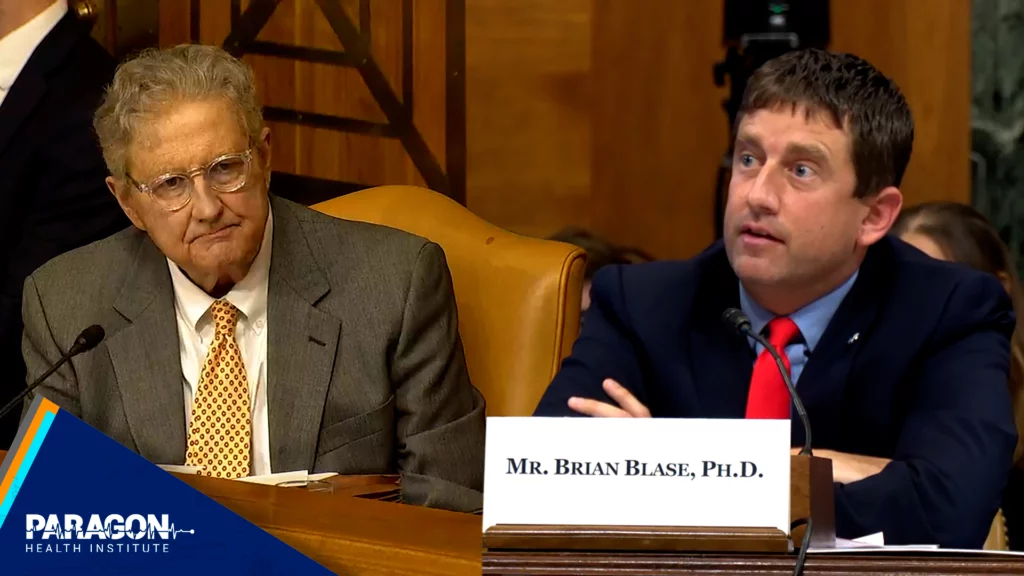
On Tuesday, I testified on Medicaid before the Senate Budget Committee. My testimony focused on how the program’s financing structure encourages states to maximize federal Medicaid reimbursement, fuels improper enrollment, results in massive corporate welfare, and diverts resources away from children, seniors, pregnant women, and people with disabilities—those Medicaid was originally created to serve. Although the One Big Beautiful Bill (OBBB) began addressing many of these structural problems, much work remains.
I also testified about a new Paragon report on large-scale improper Affordable Care Act (ACA) Medicaid expansion enrollment. We estimate that there were about 9 million improper expansion enrollees in 2024, costing federal taxpayers nearly $33 billion. I had an exchange with Senator John Kennedy that has been circulated widely about how states are actively cheating to get as much federal money through Medicaid as possible. Fox News covered the report, as did Fox Business and many other outlets.
This week’s newsletter highlights my Senate testimony, our new research, and our comment letter on the Centers for Medicare and Medicaid Services’ (CMS) interim final rule implementing Medicaid community-engagement requirements.
Senate Budget Committee Hearing
“Medicaid: The Reality” was the first Senate Budget Committee hearing under Chairman Ron Johnson’s leadership. My oral testimony focused on Medicaid’s fundamentally broken financing incentives. I explained that the ACA created a financing formula that pays states roughly $9 in federal funds for every $1 they spend on able-bodied, working-age Medicaid expansion adults, compared to an average of $1.33 for every $1 spent on traditional enrollees. That sevenfold disparity encourages states to prioritize expansion adults over the populations Medicaid was originally created to serve—and has resulted in worse health care access for traditional enrollees. I also described how provider taxes, state-directed payments, and other financing arrangements have evolved into a legalized Medicaid money-laundering apparatus that shifts costs from states to federal taxpayers while generating tens of billions of dollars in corporate welfare for politically powerful providers, insurers, and consultants.
My written testimony explores these issues in greater depth, documenting why America’s growing fiscal imbalance is increasingly driven by federal health care programs and arguing that Medicaid’s problems are primarily structural. It details the massive growth of the program and examines the major inequities in federal Medicaid expenditures—exemplified by the fact that New York’s Medicaid spending per resident exceeds the average among other states by 85 percent.
I discuss how improper Medicaid payments likely exceeded $1 trillion over the past decade and how states are increasingly dependent on the federal government. I explain how the OBBB begins to restore proper incentives by encouraging work among able-bodied adults, strengthening program integrity, protecting resources for eligible beneficiaries, and limiting the financing gimmicks and corporate welfare that have increasingly distorted Medicaid’s purpose.
To open the hearing, Johnson provided compelling figures showing the massive growth in Medicaid expenditures, particularly since 2019. “The problem-solving process always begins with admitting you have a problem,” he stated. “The next step is you have to define the problem. You have to agree on common facts. Once we do that, we can start doing root-cause analysis.” Johnson then showed how the successive expansions of Medicaid have led to dramatically higher spending.
Johnson highlighted that federal Medicaid spending is up 10 percent this year relative to last year and repeatedly knocked down the false claims that the OBBB cut Medicaid. According to the Congressional Budget Office (CBO), federal Medicaid spending will continue to grow every year and will be higher in 10 years than CBO originally projected at the beginning of the Biden administration.
New Study: Nearly Half of Medicaid Expansion Enrollees Likely Do Not Meet Eligibility Requirements
This week, Paragon released a new report by Liam Sigaud examining improper enrollment in the ACA’s Medicaid expansion. Using Census Bureau survey data matched with state Medicaid enrollment records, Liam estimates that roughly 9 million of the 20 million adults enrolled through Medicaid expansion in 2024 likely did not satisfy federal eligibility requirements. Those improper enrollments cost federal taxpayers nearly $33 billion in 2024 alone. The report demonstrates that improper enrollment is not a marginal administrative problem—it has become a defining feature of Medicaid expansion in many states.
The report finds that improper enrollment is not evenly distributed across states. California alone accounted for more than three million likely improper expansion enrollees—roughly one-third of the national total. The problem is rooted in a financing system that pays states far more generously for Medicaid expansion adults than for traditional Medicaid populations. Those incentives encourage states to maximize expansion enrollment, misclassify traditional enrollees as expansion enrollees, inadequately verify eligibility, and tolerate improper enrollment.
Liam and I summarized these findings in a Wall Street Journal piece, “How California Cheats ObamaCare’s Medicaid Expansion.” We argue that while the OBBB takes important steps to improve eligibility verification—including six-month eligibility reviews, more frequent data matching, and stronger program integrity provisions—the most important long-term reform is to eliminate the discriminatory financing that favors able-bodied expansion adults over Medicaid’s traditional beneficiaries.
Implementing Medicaid Community Engagement Requirements Correctly
Last week, Paragon submitted comments to CMS regarding implementation of the Medicaid community engagement requirements enacted in the OBBB. We strongly support the interim final rule and believe community engagement requirements should accomplish two objectives.
First, they should encourage greater workforce participation among able-bodied adults receiving coverage through Medicaid expansion. Work remains one of the strongest predictors of improved financial stability, physical health, and mental well-being, and Medicaid policy should reinforce rather than undermine employment for those who can work.
Second, consistent with our work on improper enrollment, they should substantially improve Medicaid program integrity by strengthening eligibility verification. States will need to verify eligibility more frequently, update enrollee information, and remove individuals who no longer qualify for coverage.
CMS made the correct decision to adopt a focused definition of medical frailty. Congress intended the exemption to protect individuals whose medical conditions genuinely prevent them from meeting the community engagement requirement—not to create a loophole broad enough to swallow the rule. The interim final rule appropriately requires that an individual’s medical condition significantly impair their ability to satisfy the community engagement requirement in order for the individual to qualify for the medical frailty exemption. This ensures that the exemption remains targeted to those Congress intended to protect. This approach is also consistent with the law’s broader objective of restoring program integrity and encouraging workforce participation among able-bodied adults.
This disciplined approach is especially important because some states are already signaling plans to stretch the exemption far beyond Congress’s intent. As The New York Times reported in April, New York officials had begun exploring ways to classify large numbers of expansion enrollees as medically frail in order to shield them from the new requirements, illustrating precisely why clear federal standards were necessary. Rather than allowing states to drive a “Mack truck” through the exemption, CMS adopted a definition that protects truly vulnerable beneficiaries while preserving the effectiveness of the law’s community engagement requirements. If implemented effectively, the community engagement requirements will strengthen Medicaid by improving program integrity and preserving resources for the children, seniors, pregnant women, and people with disabilities the program was designed to serve.
Recent Newsletters

Subscribe
Sign up now for your health policy updates.