

Brian Blase, Ph.D., is the President of Paragon Health Institute. Brian was Special Assistant to the President for Economic Policy at the White House’s National Economic Council (NEC) from 2017-2019, where he coordinated the development and execution of numerous health policies and advised the President, NEC director, and senior officials. After leaving the White House, Brian founded Blase Policy Strategies and served as its CEO.
Fixing the No Surprises Act’s Broken Arbitration System

Today’s newsletter starts with a major new Paragon study examining the federal arbitration system created by the No Surprises Act (NSA). Although the law, enacted in 2020, has protected patients from surprise medical bills, its arbitration system has produced far more disputes and much higher payments than expected, creating a powerful government incentive for providers to stay out of network. The result: costs and insurance premiums are rising and will continue to escalate if Congress does not reform the NSA.
The newsletter also summarizes testimony I gave yesterday at a House Judiciary Committee field hearing in Charlotte, North Carolina, and concludes with a new Paragon PIC explaining why projected savings from limits on state-directed payments (SDPs) have grown so significantly.
No Surprises Act Failures—What We Found
Jackson Hammond and Katherine Hall authored this new study, which contains a comprehensive review of the data as well as a set of policy recommendations that resulted from a Paragon working group. Here are three key findings.
- There are far more disputes than expected—and dispute volume continues to grow. When the federal departments implemented independent dispute resolution (IDR), they projected about 22,000 disputes per year. In 2025, there were 2.56 million—115 times their projection. The number of individual disputed services decided through IDR increased roughly 17-fold from 2023 through 2025.

- Providers are winning the vast majority of the time. Providers prevailed in 86 percent of disputed line items in 2025, up from 78 percent in 2023.
- Arbitration payments are much higher than expected, and they are growing rapidly. CBO expected arbitration awards to converge toward the qualifying payment amount (QPA), which is approximately the median in-network rate. Instead, in 2025, the median arbitration award was 3.9 times the QPA and 5.5 times the Medicare rate for the same service. More than 91 percent of awards exceeded the QPA. Median awards increased from just over four times Medicare rates in early 2023 to nearly six times Medicare rates by the second half of 2025. Average awards approached ten times Medicare rates.

No Surprises Act—A Government-Created Incentive for Providers to Avoid Networks
A provider with a more than 85 percent chance of winning an arbitration award far above the in-network rate has little incentive to join an insurer’s network. And even providers that remain in-network gain leverage to demand higher prices by threatening to leave.
That means the largest cost of IDR may ultimately occur outside the arbitration system itself. Higher out-of-network awards put upward pressure on in-network prices, which translates into higher insurance premiums and lower worker wages. Recent research finds that the NSA reduced network participation among several specialties most affected by the law.
There is also significant evidence that sophisticated organizations have learned how to exploit IDR. Four organizations filed roughly half of all provider-initiated disputes determined in 2025, while the top 10 accounted for about 70 percent. Many of the largest provider organizations using IDR are backed by private equity or other corporate investors.
This was never what Congress intended. IDR was supposed to be a backstop for relatively rare payment disputes. It is increasingly becoming a federally created business model.
What We Recommend
The most important reform is to remove elective services from federal arbitration. Patients receiving scheduled care can make choices—if they are given upfront information about network status and prices. For elective procedures, patients should receive meaningful advance notice that an out-of-network provider will participate in their care, be told what they will be charged, and affirmatively consent. Only if they consent would a provider be permitted to send the patient a medical bill for the difference between the provider’s full charge and the amount the patient’s insurance pays. This eliminates the “surprise” in surprise billing and allows patients to make informed decisions about their care.
Congress already required much of this transparency through the NSA’s Advanced Explanation of Benefits provisions, but those requirements have yet to be fully implemented. The administration should finish that work. Once patients have meaningful advance information about networks and prices, there is no justification for a federal arbitration system setting payments for elective care.
For emergency services, a different approach is needed, and Congress has two reasonable options. It could eliminate federal IDR entirely while maintaining the prohibition on balance billing, leaving insurers and providers to settle payment disputes through private arbitration, litigation, or state law.
Alternatively, Congress could retain IDR solely for emergency services but impose meaningful guardrails. Awards should have a reasonable upper limit so arbitration does not continue producing payments wildly disconnected from market prices. Congress should also reform how arbitrators are paid, and if an upper limit is implemented, insurers should face penalties when they fail to pay awards on time.
The administration can make additional improvements now: require arbitrators to explain their decisions, audit firms with unusually high provider win rates or awards, strengthen eligibility reviews, improve arbitrator training, prohibit conflicts of interest and forum shopping, and restore a meaningful filing fee.
The No Surprises Act solved a real problem by protecting patients from bills they could neither anticipate nor avoid. Those protections should remain. But protecting patients from surprise bills does not require a federal arbitration system that rewards providers for staying out of network and raises health care costs for everyone.
Testifying Before Congress on Health Care Fraud
Yesterday, I testified before the House Judiciary Committee’s Subcommittee on the Administrative State, Regulatory Reform, and Antitrust. The subcommittee asked me to focus on fraud and improper enrollment in the Affordable Care Act (ACA) exchanges and Medicaid expansion. The central problem is bad incentives that lead to large amounts of wasteful spending.
In the exchanges, fully subsidized coverage created powerful incentives for insurers, brokers, and applicants to maximize enrollment. Insurers receive the entire premium from taxpayers, brokers receive monthly commissions, and applicants can qualify for larger subsidies by misreporting income. The Government Accountability Office recently tested these controls by submitting 24 applications using fictitious identities. Twenty-three received subsidized coverage.
Medicaid expansion has an even more fundamental incentive problem. Washington pays $9 for every $1 a state spends on expansion enrollees, roughly seven times the federal contribution for traditional Medicaid enrollees. States therefore bear very little cost for improper expansion enrollment.
We estimate 14.3 million improper enrollees across the exchanges and Medicaid expansion in 2024, costing federal taxpayers approximately $65 billion.
In my testimony, I also discussed how high and growing hospital prices are the number one reason American health care is increasingly unaffordable, along with reforms that would increase competition and encourage hospitals to become more efficient.
Bigger Medicaid Savings Result from SDP Spending Far Above Expectations
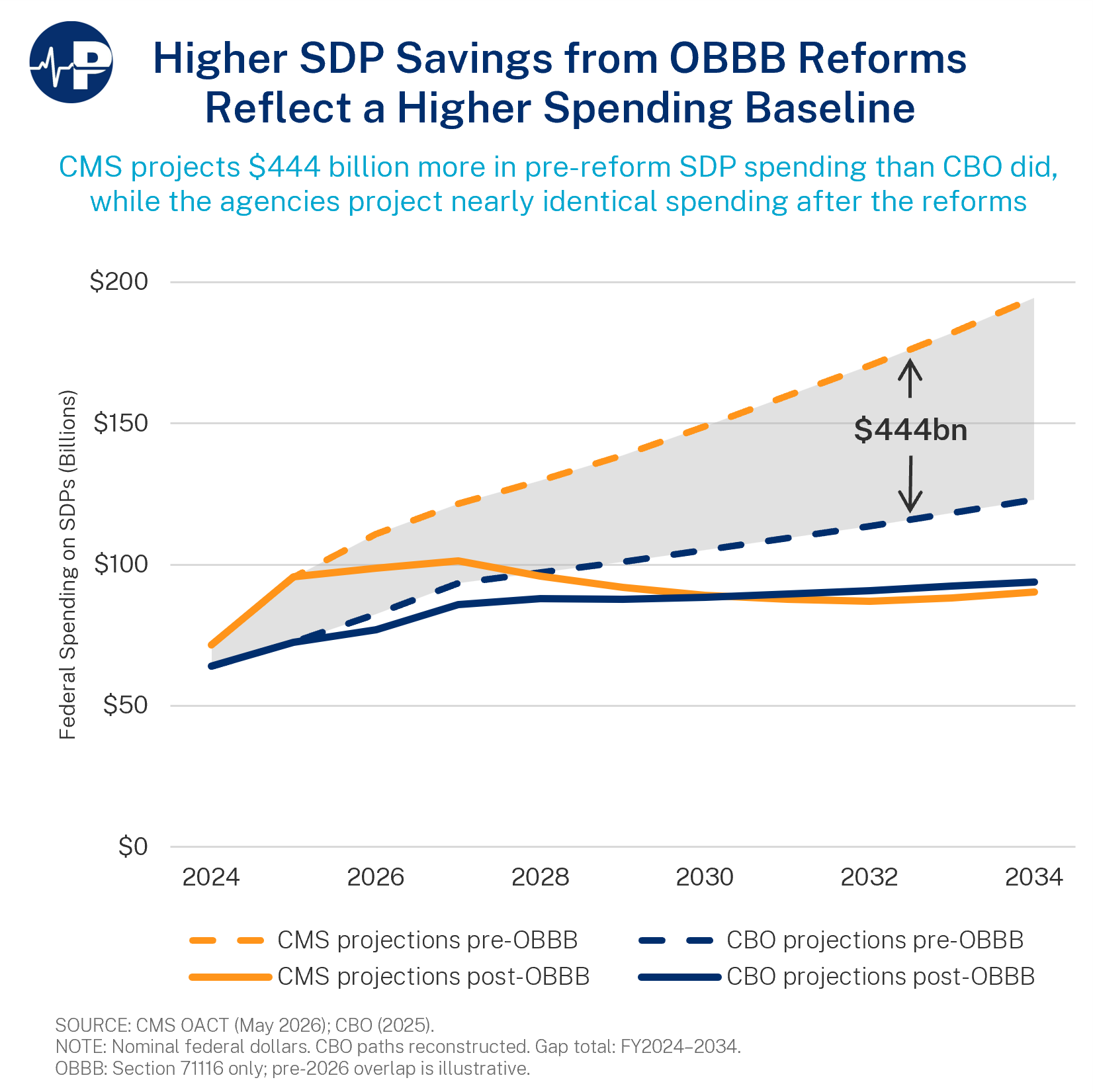
Hospital lobbyists are arguing that CMS went beyond the One Big Beautiful Bill (OBBB) when implementing Congress’s limits on Medicaid state-directed payments (SDPs). Their evidence is that CBO originally estimated the reforms would save about $149 billion, while CMS’s actuaries now estimate roughly $510 billion in savings.
Our latest Paragon PIC shows why that argument gets the causation backwards.
The difference is overwhelmingly attributable to the baseline. SDP spending exploded while Congress was debating reform, and CMS had newer data showing much higher spending than CBO had anticipated. In fact, after accounting for the OBBB reforms, CBO and CMS project virtually identical SDP spending by 2034.
The larger savings are evidence that the underlying corporate welfare was much larger than policymakers realized—and that Congress was right to limit the legal Medicaid money laundering apparatus.
Medicare Physician Fee Schedule
Paragon submitted a comment letter supporting a CMS proposed rule for the Physician Fee Schedule (PFS) that advances market-based pricing and program integrity in Medicare. Because Medicare’s administered prices are a large source of distortion in health care markets, we focused on two reforms in the proposed rule that would reduce these distortions. First, CMS proposes to modernize the practice expense methodology, phasing out its reliance on outdated 2007 physician survey data—which lets providers influence their own payment rates—in favor of more objective, auditable, market-derived cost data. Second, CMS proposes to strengthen guardrails on certain types of remote monitoring, requiring an initiating visit and established-patient relationship to curb documented waste and abuse.
Recent Newsletters


Subscribe
Sign up now for your health policy updates.