Paragon Health Institute Icon White
Paragon Pic

Higher SDP Savings from OBBB Reforms Reflect a Higher Spending Baseline

6Aw Cms Cbo Sdp Federal Before After A0Wuu000005Vb9Dyaa
Click the Pic to expand the image
Atticus Vernacchio Headshot SMALLER 20260429

Atticus Vernacchio is a Research Assistant at Paragon Health Institute. Before joining Paragon, he worked at Americans for Tax Reform and the National Taxpayers Union Foundation, where he wrote on state, domestic, and international policy issues. His writing on AI policy and strategic infrastructure has appeared in outlets including The American Mind and The Alliance for Innovation and Infrastructure. Atticus holds a B.A. in International Studies from American University’s School of International Service and has an AWS Associate-level certificate in Machine Learning.

Chris Medrano 20240917 Headshot SQUARE

Chris Medrano is the Legal Research Analyst at the Paragon Health Institute. His work focuses on administrative rule making and policy analysis. Previously, he served as a Legislative Assistant to Senator Mike Lee (R-UT), where he managed the Health, Education, Labor, and Pensions (HELP) portfolio, including legislative reforms for the FDA and CMS. Before that, Chris was a Health Policy Fellow for Representative Tim Walberg (R-MI). He holds a Bachelor of Arts in Political Science and English from James Madison University and is currently pursuing a Juris Doctor at George Mason University’s Antonin Scalia Law School.

Hospitals and their lobbyists are falsely implying that the Centers for Medicare and Medicaid Services (CMS) is going beyond its statutory authority by imposing steeper Medicaid payment reductions than Congress intended.

In 2025, Congress passed limits on state-directed payments (SDPs), through which states override negotiated payment rates and direct Medicaid managed care plans to pay providers specified amounts. These arrangements have pushed Medicaid payments well above what Medicare pays for the same services. In response to this problem, the OBBB ties payment limits for certain services to Medicare rates (and 110 percent of Medicare rates in non-Medicaid expansion states). Though the bill temporarily allows some existing arrangements to remain above those limits, these grandfathered arrangements must begin phasing down in 2028.

As we argued in our comment letter supporting CMS’s rule implementing these reforms, they will ultimately benefit seniors and incentivize lower costs. These reforms are also projected to save taxpayers hundreds of billions of dollars. Herein lies the controversy.

When the OBBB was being debated, the Congressional Budget Office (CBO) estimated that the SDP limits would reduce federal Medicaid spending by roughly $149 billion over ten years. However, in May 2026, CMS’s Office of the Actuary estimated that CMS’s proposed rule would reduce federal Medicaid spending by $510 billion over ten years. Hospitals have pointed to that difference as evidence that CMS is going beyond the statute.

Hospitals’ argument is wrong.

The different estimates primarily reflect that CBO significantly underestimated the federal cost of SDPs before the reform and did not anticipate their explosive growth from 2024 to 2026.

CBO and CMS OACT measured savings against substantially different spending projections. CBO used its January 2025 Medicaid managed care baseline, while CMS’s actuaries used newer budget projections incorporating SDP data through December 2025. In 2025, states submitted new SDPs that raised the baseline. The newer information available to CMS showed massive SDP growth. OACT estimates total SDP spending at $143.8 billion in fiscal year (FY) 2025 and projects $167.4 billion in FY 2026 absent the new restrictions. CMS’s higher estimate of spending without the OBBB, therefore, better reflects reality.

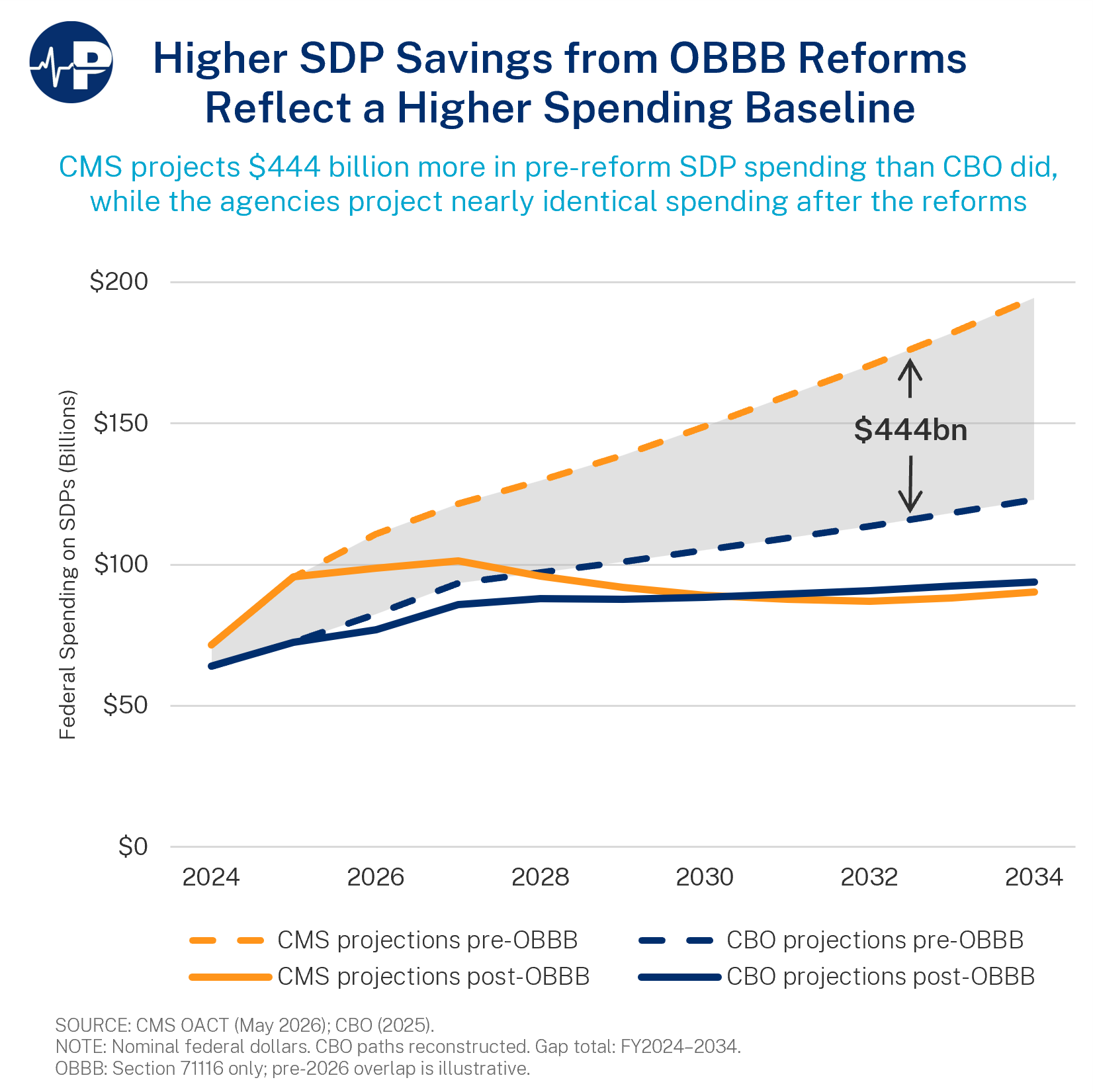
This PIC shows a $444 billion gap over fiscal years 2024–2034 between CMS OACT’s 2026 baseline projection—the spending trajectory without the reforms—and CBO’s 2025 projection. It also shows projected SDP spending after the reforms. Those post-OBBB projections are virtually identical. That is strong evidence that the underlying policy is the same and that the larger savings estimate results from CMS having more up-to-date information about what SDP spending would otherwise have been. After applying each agency’s estimated savings from the OBBB, projected annual SDP spending is nearly the same by 2034.

CMS’s proposed also extended its reforms beyond the OBBB by also applying limits to fee-for-service supplemental payments and some additional SDP categories not specifically mentioned by the bill. Those extensions were small, only accounting for about $5 billion in additional savings from 2029 to 2035. More importantly, CMS had clear legal authority to enact these extensions given its long-standing statutory authority under the Social Security Act to oversee fee-for-service supplemental payments as well as SDPs.

Ultimately, hospital lobbyists have causation backwards. The wide gap between CBO’s earlier score and OACT’s estimate is not evidence that CMS departed from the OBBB statute. Rather, it is evidence of just how rapidly SDPs grew while policymakers were debating and implementing reforms—and proof that those limits were essential to restore fiscal integrity to Medicaid and reduce rampant corporate welfare in the program.

6Aw Cms Cbo Sdp Federal Before After A0Wuu000005Vb9Dyaa

Hospitals and their lobbyists are falsely implying that the Centers for Medicare and Medicaid Services (CMS) is going beyond its statutory authority by imposing steeper Medicaid payment reductions than Congress intended.

In 2025, Congress passed limits on state-directed payments (SDPs), through which states override negotiated payment rates and direct Medicaid managed care plans to pay providers specified amounts. These arrangements have pushed Medicaid payments well above what Medicare pays for the same services. In response to this problem, the OBBB ties payment limits for certain services to Medicare rates (and 110 percent of Medicare rates in non-Medicaid expansion states). Though the bill temporarily allows some existing arrangements to remain above those limits, these grandfathered arrangements must begin phasing down in 2028.

As we argued in our comment letter supporting CMS’s rule implementing these reforms, they will ultimately benefit seniors and incentivize lower costs. These reforms are also projected to save taxpayers hundreds of billions of dollars. Herein lies the controversy.

When the OBBB was being debated, the Congressional Budget Office (CBO) estimated that the SDP limits would reduce federal Medicaid spending by roughly $149 billion over ten years. However, in May 2026, CMS’s Office of the Actuary estimated that CMS’s proposed rule would reduce federal Medicaid spending by $510 billion over ten years. Hospitals have pointed to that difference as evidence that CMS is going beyond the statute.

Hospitals’ argument is wrong.

The different estimates primarily reflect that CBO significantly underestimated the federal cost of SDPs before the reform and did not anticipate their explosive growth from 2024 to 2026.

CBO and CMS OACT measured savings against substantially different spending projections. CBO used its January 2025 Medicaid managed care baseline, while CMS’s actuaries used newer budget projections incorporating SDP data through December 2025. In 2025, states submitted new SDPs that raised the baseline. The newer information available to CMS showed massive SDP growth. OACT estimates total SDP spending at $143.8 billion in fiscal year (FY) 2025 and projects $167.4 billion in FY 2026 absent the new restrictions. CMS’s higher estimate of spending without the OBBB, therefore, better reflects reality.

This PIC shows a $444 billion gap over fiscal years 2024–2034 between CMS OACT’s 2026 baseline projection—the spending trajectory without the reforms—and CBO’s 2025 projection. It also shows projected SDP spending after the reforms. Those post-OBBB projections are virtually identical. That is strong evidence that the underlying policy is the same and that the larger savings estimate results from CMS having more up-to-date information about what SDP spending would otherwise have been. After applying each agency’s estimated savings from the OBBB, projected annual SDP spending is nearly the same by 2034.

CMS’s proposed also extended its reforms beyond the OBBB by also applying limits to fee-for-service supplemental payments and some additional SDP categories not specifically mentioned by the bill. Those extensions were small, only accounting for about $5 billion in additional savings from 2029 to 2035. More importantly, CMS had clear legal authority to enact these extensions given its long-standing statutory authority under the Social Security Act to oversee fee-for-service supplemental payments as well as SDPs.

Ultimately, hospital lobbyists have causation backwards. The wide gap between CBO’s earlier score and OACT’s estimate is not evidence that CMS departed from the OBBB statute. Rather, it is evidence of just how rapidly SDPs grew while policymakers were debating and implementing reforms—and proof that those limits were essential to restore fiscal integrity to Medicaid and reduce rampant corporate welfare in the program.
Related Research

No results found.
Atticus Vernacchio Headshot SMALLER 20260429

Atticus Vernacchio is a Research Assistant at Paragon Health Institute. Before joining Paragon, he worked at Americans for Tax Reform and the National Taxpayers Union Foundation, where he wrote on state, domestic, and international policy issues. His writing on AI policy and strategic infrastructure has appeared in outlets including The American Mind and The Alliance for Innovation and Infrastructure. Atticus holds a B.A. in International Studies from American University’s School of International Service and has an AWS Associate-level certificate in Machine Learning.

Chris Medrano 20240917 Headshot SQUARE

Chris Medrano is the Legal Research Analyst at the Paragon Health Institute. His work focuses on administrative rule making and policy analysis. Previously, he served as a Legislative Assistant to Senator Mike Lee (R-UT), where he managed the Health, Education, Labor, and Pensions (HELP) portfolio, including legislative reforms for the FDA and CMS. Before that, Chris was a Health Policy Fellow for Representative Tim Walberg (R-MI). He holds a Bachelor of Arts in Political Science and English from James Madison University and is currently pursuing a Juris Doctor at George Mason University’s Antonin Scalia Law School.