

Brian Blase, Ph.D., is the President of Paragon Health Institute. Brian was Special Assistant to the President for Economic Policy at the White House’s National Economic Council (NEC) from 2017-2019, where he coordinated the development and execution of numerous health policies and advised the President, NEC director, and senior officials. After leaving the White House, Brian founded Blase Policy Strategies and served as its CEO.
Escalating U.S. Health Costs, a Growing Safety Net, Medicare Reforms, and CMS Rejecting Arkansas’ Medicaid Expansion Waiver

This week’s newsletter highlights the continued rise in U.S. health care spending; Medicare’s enormous contribution to the nation’s long-term fiscal imbalance; new evidence contradicting claims that the One Big Beautiful Bill (OBBB) is causing the health care safety net to collapse; important Medicare reforms proposed by the Trump administration; and the Trump administration’s wise decision to reject the Arkansas Medicaid expansion waiver. As a reminder, we are having a virtual event tomorrow with Abe Sutton (invited), the director of the Center for Medicare and Medicaid Innovation at the Centers for Medicare and Medicaid Services (CMS) at 1 p.m. You can register for that event here.
U.S. Health Spending Pulls Away from Other Developed Countries
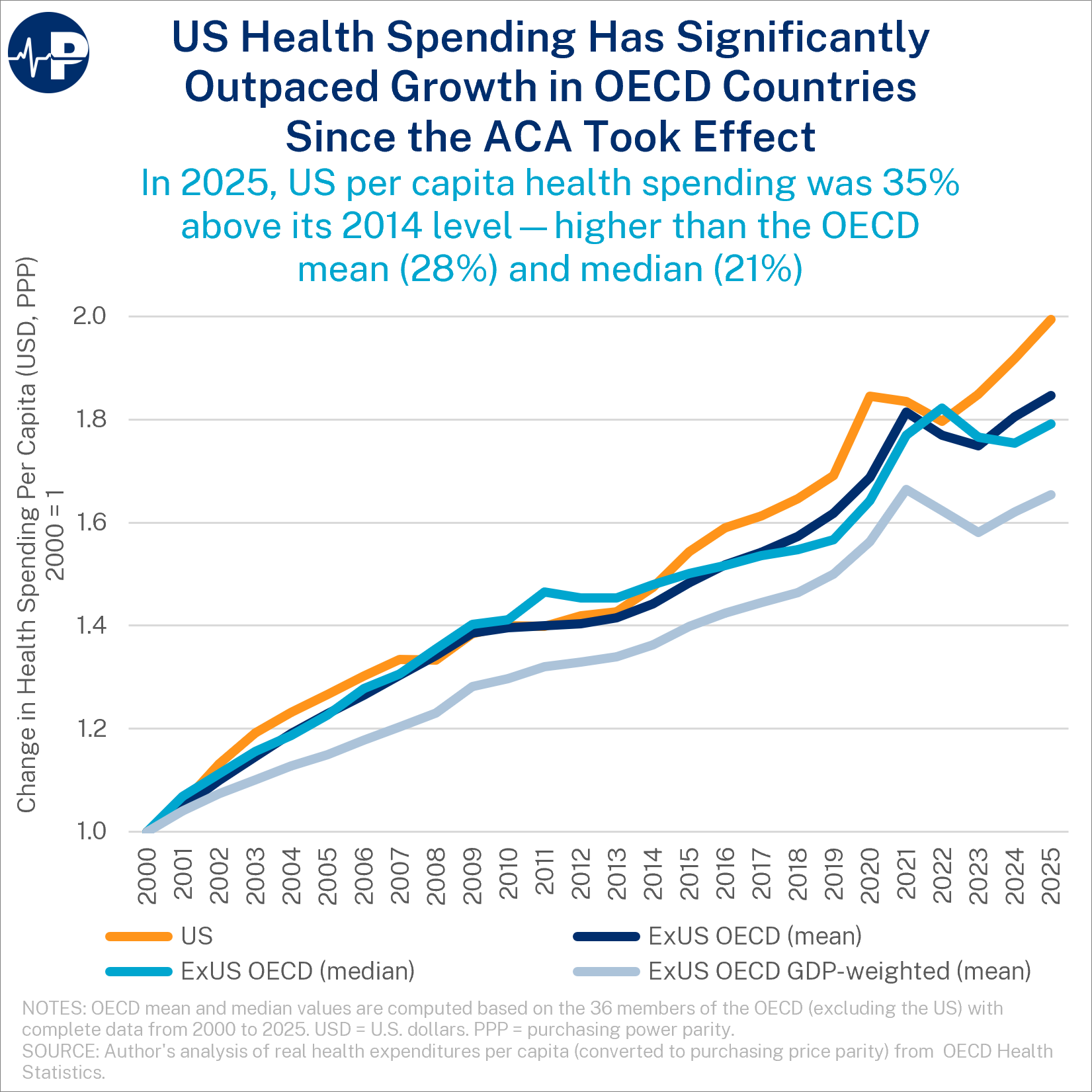
A new Paragon PIC contains more evidence that the Affordable Care Act (ACA) did not bend the cost curve. From 2000 through 2010, real per-capita health spending increased almost identically in the United States and other OECD countries—40 percent in both. The trajectories remained remarkably similar through 2013. Then, the trajectories diverged.
Beginning in 2014, when the ACA’s major coverage provisions took effect, U.S. health spending accelerated relative to other developed countries. By 2025, real U.S. health spending per person had roughly doubled from its 2000 level. By comparison, spending increased about 85 percent for the mean OECD country, 80 percent at the median, and only about 65 percent when other OECD countries are weighted by GDP.
Medicare’s $85 Trillion Debt Problem
The health care cost problem is also a federal budget problem. Cato’s Romina Boccia and Ritvik Thakur estimate that Medicare Parts B and D will add roughly $9 trillion to federal debt over the next decade and $10.7 trillion including resulting interest costs. Those two parts of Medicare alone account for an estimated 44 percent of the entire federal deficit over the coming decade.
The long-run numbers are staggering. Automatic debt financing for Parts B and D is projected to rise from 2.1 percent of GDP in 2026 to 3.3 percent in 2055. Over 30 years, that means $52 trillion in additional borrowing and roughly $85 trillion once interest is included. As I’ve written many times, there is no credible path to putting the federal budget on a sustainable trajectory without restraining the growth of Medicare and other federal health spending.
The Health Care Safety Net is Growing, Counter to Claims
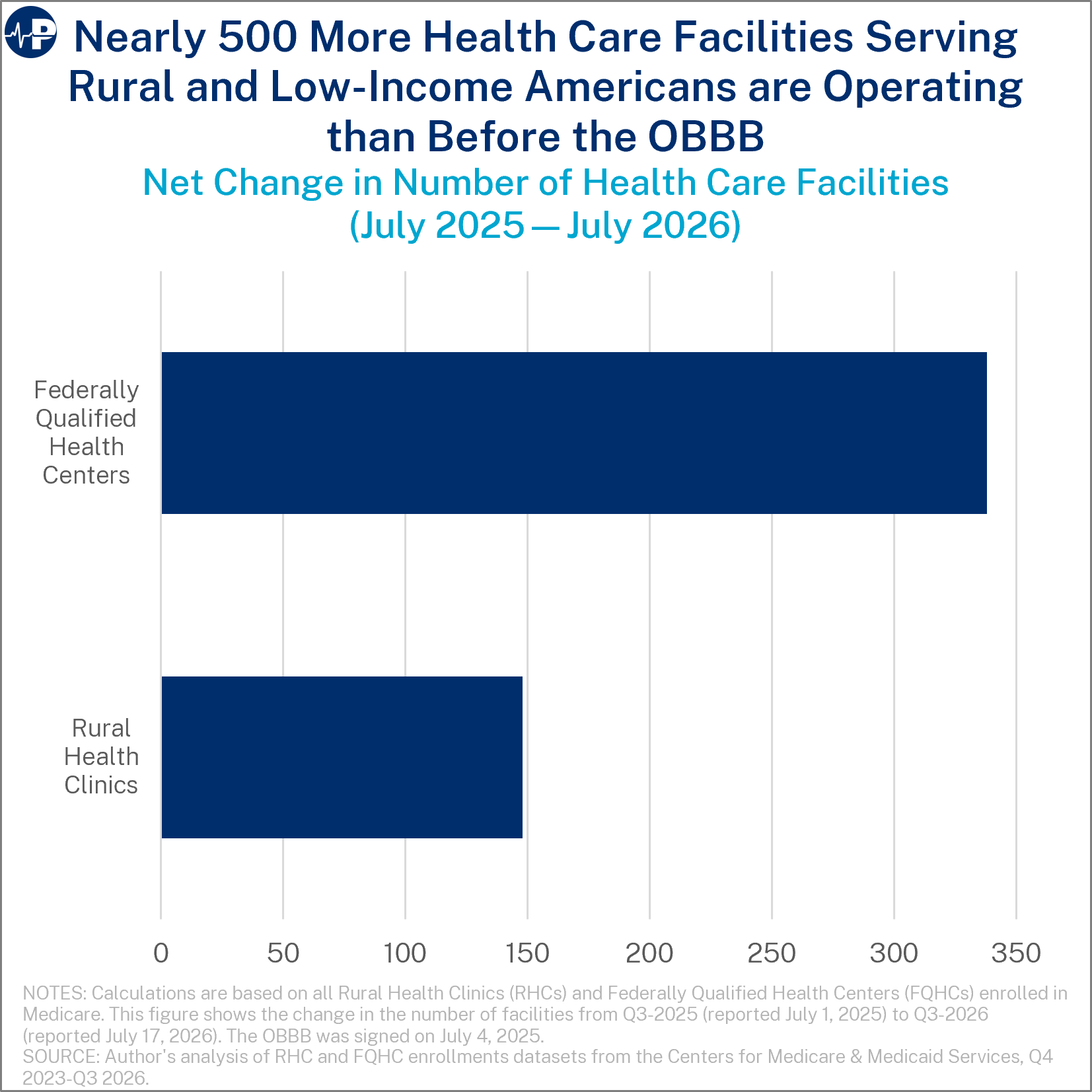
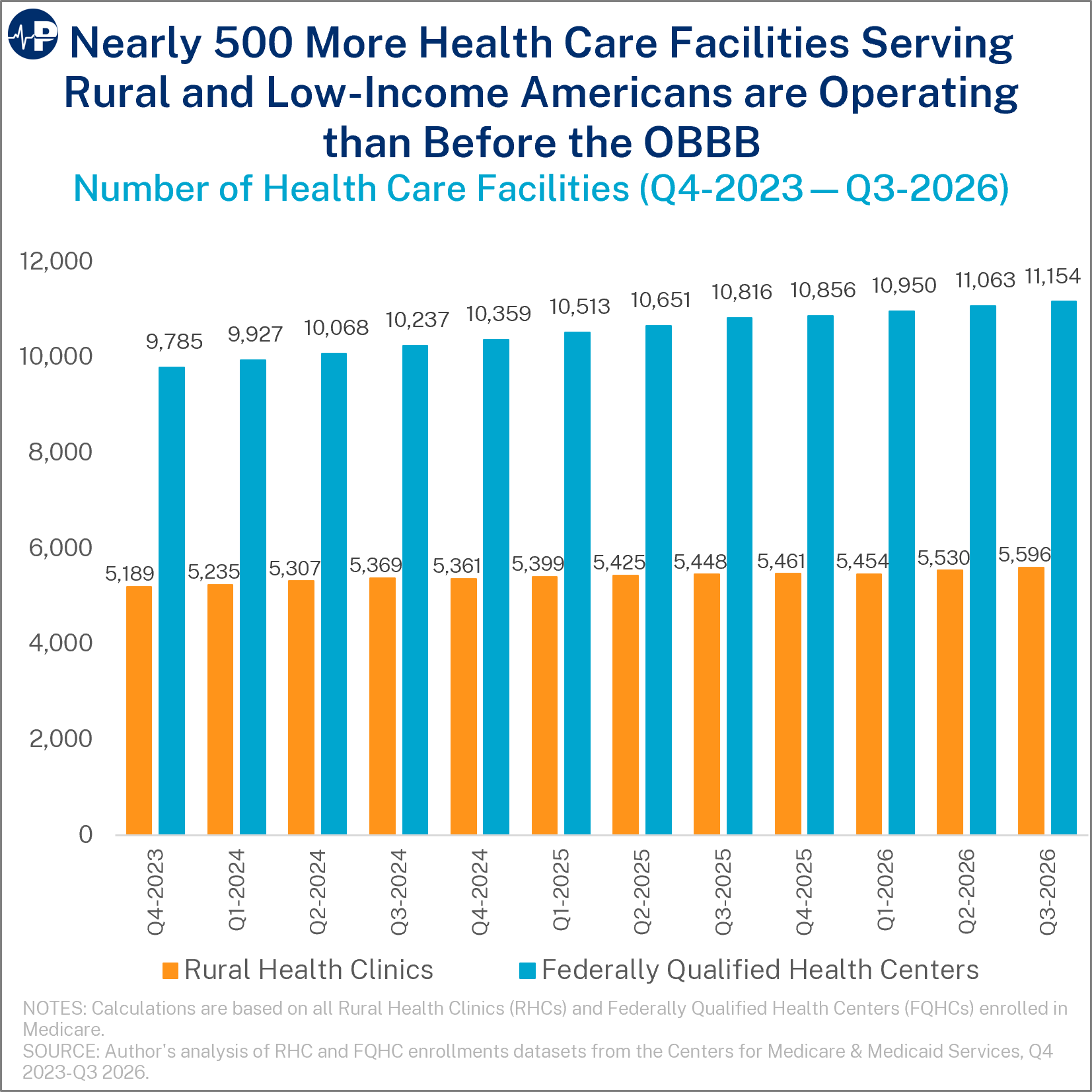
Critics predicted that the OBBB would devastate rural and low-income health care providers. New CMS data tell a very different story, as a new Paragon PIC shows.
Between July 1, 2025—three days before OBBB was signed—and July 17, 2026, the number of Medicare-enrolled Rural Health Clinics (RHCs) increased by 148, or 2.7 percent. The number of Federally Qualified Health Centers (FQHCs) increased by 338, or 3.1 percent. That is a net increase of nearly 500 safety-net facilities since the law’s enactment.
Our Comment Letter Supporting Key Elements of CMS’s OPPS Rule
On Monday, we submitted a comment letter supporting several important provisions of the Trump administration’s proposed 2027 Medicare outpatient prospective payment (OPPS) rule. The proposals would reduce distorted Medicare payments, strengthen competition, and lower costs for beneficiaries and taxpayers.
First, we strongly support CMS’s proposal to reform payments for drugs purchased through the 340B program. Medicare generally pays for physician-administered drugs based on average sales price even though 340B hospitals purchase those drugs at substantial discounts. CMS’s new acquisition-cost survey supports paying 340B hospitals ASP minus 33.4 percent. CMS estimates that the change would reduce Medicare drug spending by $4.55 billion in its first year and beneficiary out-of-pocket costs by $1.15 billion, with the savings redistributed within OPPS under budget-neutrality requirements. Eliminating excessive 340B margins would reduce a government-created incentive for hospitals to purchase more expensive drugs and to acquire physician practices and shift care into more expensive hospital outpatient settings.
Second, we strongly support CMS’s continued movement toward site-neutral payments. Medicare often pays substantially more for the same service when it is performed in a hospital-owned outpatient department rather than an independent physician office. These payment differences increase taxpayer and beneficiary costs while encouraging hospital consolidation. Comprehensive site-neutral reform could save taxpayers and beneficiaries hundreds of billions of dollars over a decade. CMS proposes applying physician-office rates to additional imaging services, continuing the phase-out of the inpatient-only list, and expanding procedures that can be performed in ambulatory surgical centers.
Third, we support CMS’s proposal to require prior authorization for eight botulinum toxin injection codes, which account for about $102 million in annual Medicare spending. CMS found that utilization of these services increased 42.8 percent between 2017 and 2024 without an apparent clinical explanation. Targeted prior authorization can reduce improper spending while preserving access to medically necessary care, and we encourage CMS to apply similar data-driven program integrity tools when unusual utilization growth or evidence of improper billing warrants them.
Although these proposals are important steps, CMS should go further in future rulemaking. We encourage the agency to continue expanding site-neutral payments to additional services that can safely be provided in lower-cost settings and to use its existing authority as aggressively as possible to eliminate payment differentials that reward hospital ownership rather than better care. Medicare should generally pay the same amount for the same service, regardless of where it is delivered.
CMS’s Wise Rejection of Arkansas’ Medicaid Expansion Waiver
CMS recently rejected Arkansas’ Medicaid expansion experimental waiver for failing to meet budget neutrality requirements. The OBBB established stronger budget-neutrality enforcement standards for 1115 waivers. CMS was right to reject Arkansas’ waiver and should reject calls to extend it.
Arkansas’ approach to Medicaid expansion—dubbed the Arkansas Health and Opportunity for Me (ARHOME)—put enrollees on exchange plans, with taxpayers covering premiums and cost sharing expenses. ARHOME is very expensive for federal taxpayers. A new actuarial analysis revealed ARHOME was nearly twice as expensive as covering enrollees under a fee-for-service (FFS) arrangement—an average of $951 per enrollee per month under the waiver, compared with $501 under FFS.
Under previous rules, baselines for 1115 waivers could be too easily gamed. This made enforcement difficult and commonly misrepresented the true cost of these waivers. With the reforms in the OBBB, actuarially verified budget neutrality is a condition of 1115 waiver approval.
Arkansas is currently seeking a two-year extension of ARHOME, despite CMS’s initial rejection. Rejecting the ARHOME waiver is a significant win for prudent government and establishes a precedent for other states seeking waivers that add to federal costs. CMS should reject any extension, particularly given the excessive federal subsidies the program has received for more than a decade.
Recent Newsletters


Subscribe
Sign up now for your health policy updates.