


Brian Blase, Ph.D., is the President of Paragon Health Institute. Brian was Special Assistant to the President for Economic Policy at the White House’s National Economic Council (NEC) from 2017-2019, where he coordinated the development and execution of numerous health policies and advised the President, NEC director, and senior officials. After leaving the White House, Brian founded Blase Policy Strategies and served as its CEO.
ACA Improper Enrollment Cost Taxpayers $65 Billion in 2024

In today’s newsletter, I share the latest Paragon Prognosis. Written by Mark Howell, Liam Sigaud, and me, the piece demonstrates that Affordable Care Act (ACA) improper enrollment is a massive problem in both the exchanges and Medicaid expansion.
Before that, I’d like to invite you to a discussion on September 3 that Paragon will host with Abe Sutton, the Director of the Center for Innovation at the Centers for Medicare and Medicaid Services. Sign up for the event here.
New Prognosis: Obamacare Enrollment Abuse Update: $65 Billion Cost in 2024
The ACA expanded health insurance in two main ways: 1) the creation of the government-sponsored exchanges that provide federal subsidies to purchase private health insurance plans and 2) the expansion of Medicaid to able-bodied, working-age adults with incomes up to 138 percent of the federal poverty level (FPL). The exchanges use federal premium tax credits (PTC) to subsidize plans, while the federal government pays at least 90 percent of the cost of Medicaid expansion enrollees.
Paragon has conducted studies of improper enrollment in both the ACA exchange and Medicaid expansion. Improper exchange enrollees are those who report income that qualifies them for the lowest-income and highest-subsidy category (100–150 percent of FPL) but whose actual income does not qualify them for that category. Improper Medicaid expansion enrollees are those who are not eligible for the expansion program, mainly due to having income that exceeds the 138 percent FPL threshold. Although we have estimates of improper exchange enrollment through 2026, Medicaid data limitations mean that the most recent year we have reliable data to estimate improper Medicaid enrollment is 2024.
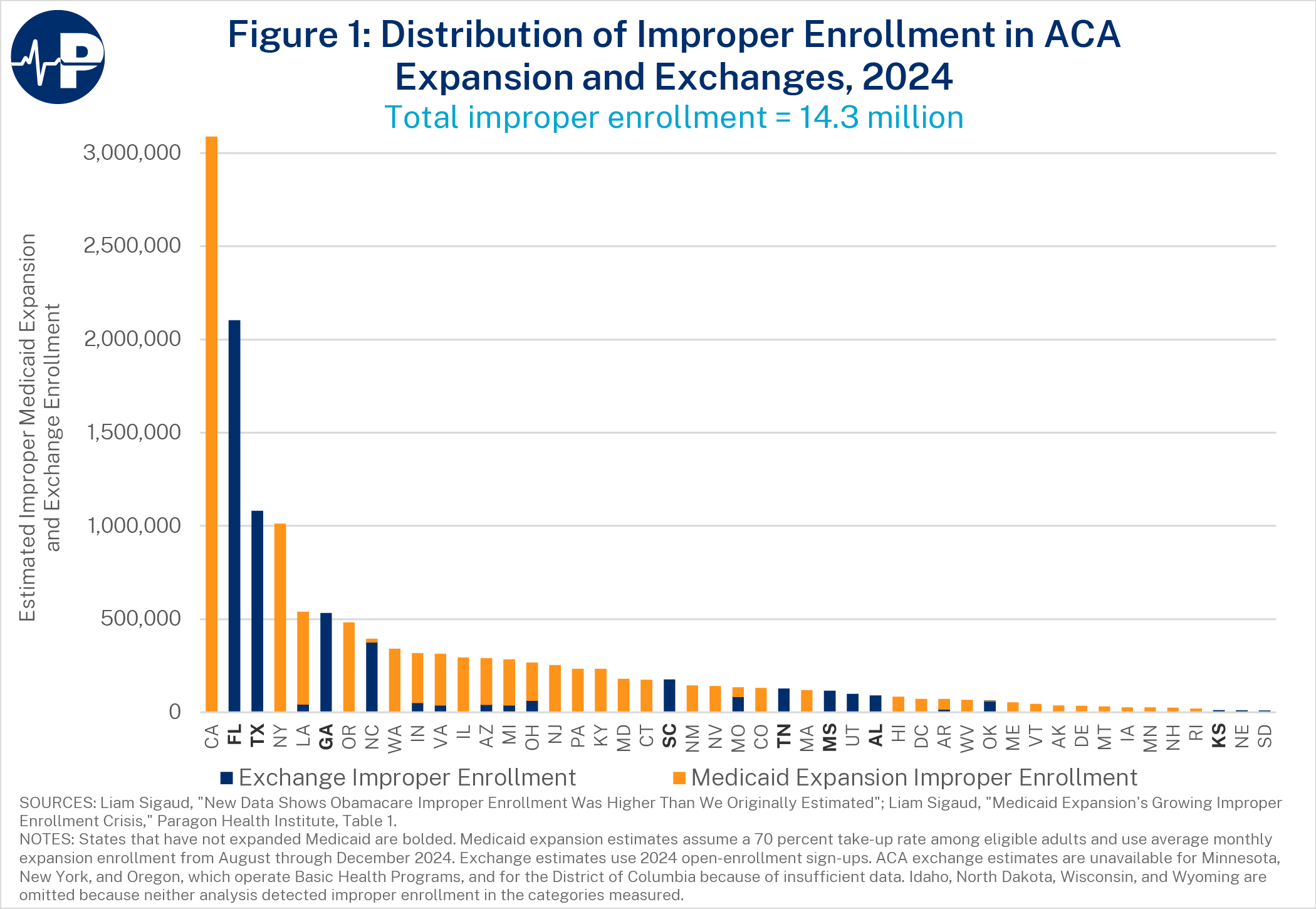
Combining Paragon’s estimates of improper exchange and Medicaid expansion enrollment indicates that 14.3 million people enrolled in those programs in 2024—or 34 percent of all ACA enrollees—were not eligible. We estimate improper enrollment in the two ACA programs cost the federal government approximately $65 billion in 2024. Improper exchange enrollment increased by more than 26 percent from 2024 to 2025—up to an estimated 6.5 million enrollees. Thus, it is likely that total ACA improper enrollment and associated improper expenditures exceeded 14.3 million people and $65 billion in 2025.
The $65 Billion Improper ACA Enrollment Problem
Paragon’s 2024 study, The Great Obamacare Enrollment Fraud, documented how fully subsidized plans and weak eligibility controls created widespread improper enrollment. Using updated data, we estimated 5.1 million improper exchange enrollees in 2024. Applying Paragon’s cost assumptions (detailed here) to the enrollment estimate yields roughly $22.3 billion in improper federal spending.
For several reasons, the exchange improper enrollment estimate is conservative. First, in states with detectable improper enrollment, we assume that every plausibly eligible individual actually enrolled in exchange coverage. This is implausible, given that the proportion of eligible adults who participate in public assistance programs is generally under 80 percent. Second, we estimate improper enrollment only in the 28 states where observed enrollment exceeds plausible eligibility estimates. Third, we exclude New York, Minnesota, and Oregon because they operate the Basic Health Program for this population.
In early August, Paragon published a report from Liam Sigaud entitled Medicaid Expansion’s Growing Improper Enrollment Crisis. Using federal survey, enrollment, and spending data, the study estimated that 9.2 million expansion enrollees—46 percent of total expansion enrollees—were likely ineligible in 2024. Liam estimated the net federal cost at $32.9 billion.
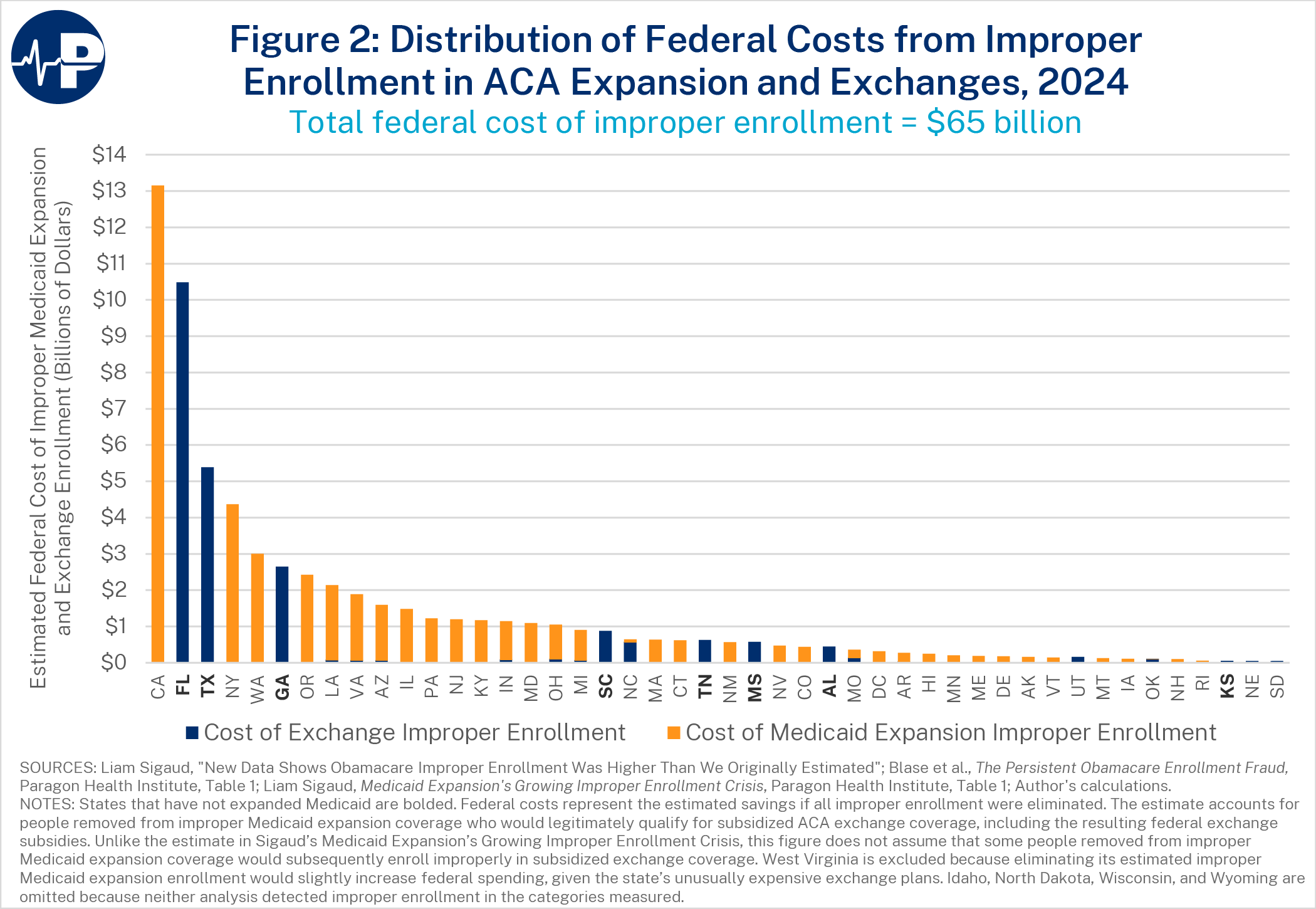
Combining these two estimates produces 14.3 million improper ACA enrollments and $65.0 billion in improper federal spending in 2024—approximately 24 percent of total ACA Medicaid expansion and exchange subsidy spending. These estimates include people whose income or other circumstances made them ineligible, people who were misclassified into the Medicaid expansion group despite qualifying through a traditional Medicaid pathway (thereby increasing federal costs and reducing state costs), exchange enrollees classified as making income between 100–150 percent FPL who do not have that income, people with duplicative coverage, and unauthorized immigrants. Many improper enrollees are also phantom enrollees—people who are unaware of their enrollment or fictional.
The combined federal cost of improper enrollment in Medicaid expansion and the exchanges is $65.0 billion—greater than the $55.2 billion sum of our separate estimates for the two programs. The reason is that our Medicaid estimate assumes that some people removed from Medicaid would instead improperly enroll in subsidized exchange coverage, reducing the net federal savings from eliminating improper Medicaid enrollment alone. When estimating the savings from eliminating improper enrollment in both programs simultaneously, that offset disappears.
A National Problem
Figure 1 demonstrates that improper ACA enrollment is a nationwide problem, but it manifests differently across states. In the 41 states that expanded Medicaid, improper enrollment overwhelmingly stems from Medicaid expansion: California alone accounts for more than one-third of all improper Medicaid expansion enrollment—an estimated 3.1 million improper expansion enrollees. The other four states with the highest numbers of improper expansion enrollees are New York, Louisiana, Oregon, and Washington. In states that did not expand, improper enrollment necessarily falls entirely on the exchanges, with Florida and Texas posting the largest improper exchange enrollment.
Oregon Is an Outlier in Improper ACA Enrollment
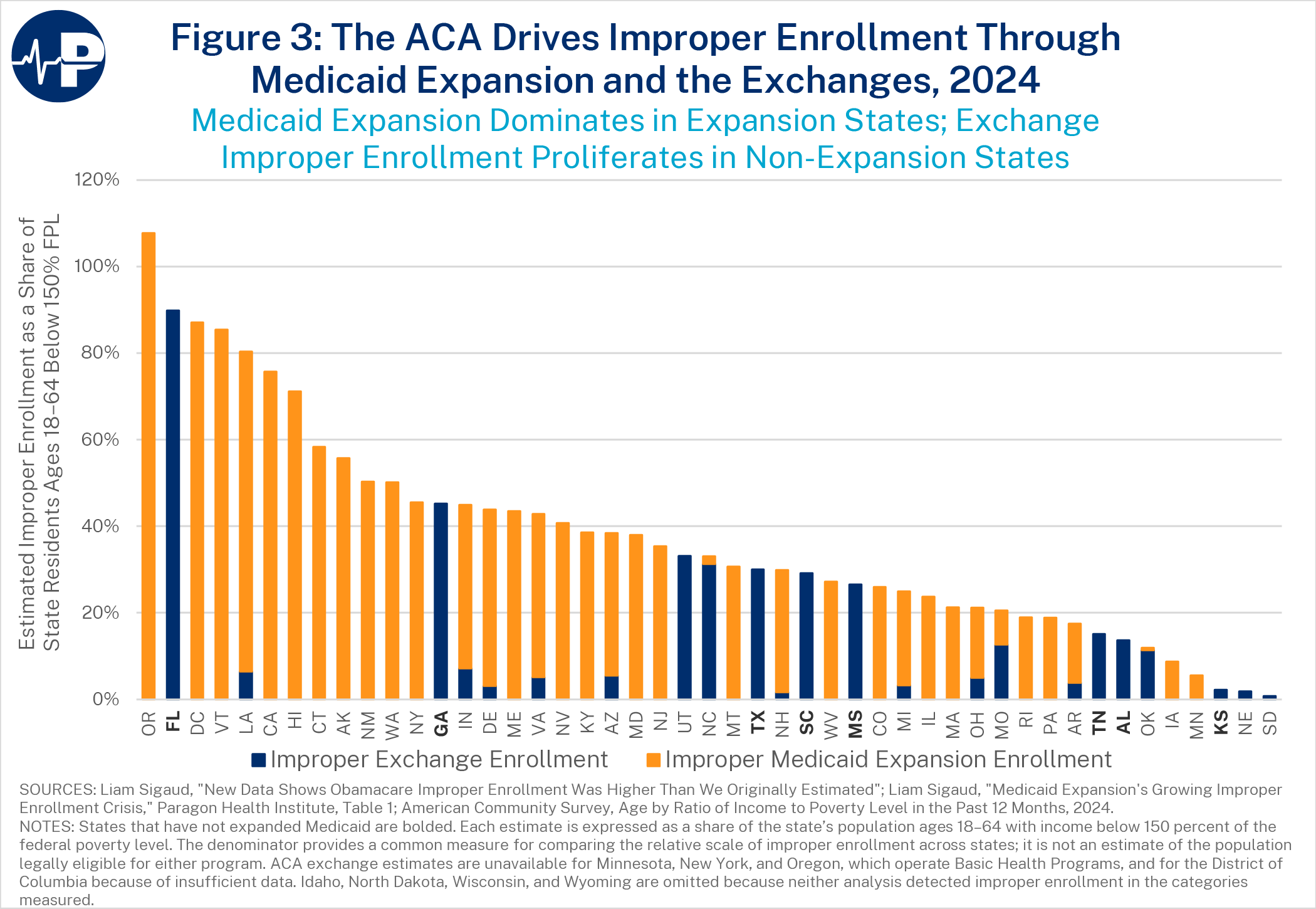
We estimate that more people are improperly enrolled in Medicaid expansion in Oregon than there are 18-to-64-year-olds below 150 percent of FPL in the state. As a point of comparison, Oklahoma—another expansion state with an overall population very similar to Oregon—had barely one-third the number of Medicaid expansion enrollees in 2024: 235,832 in Oklahoma vs. 662,695 in Oregon. This difference is especially stark given that Oklahoma has a higher poverty rate and lower median household income than Oregon, meaning a larger share of its population qualifies for Medicaid expansion.
Oregon’s unique policies may explain part of this result. Since July 2023, a Section 1115 waiver has permitted Oregon to provide most adults with 24 months of continuous Medicaid eligibility, allowing people to remain enrolled even if their incomes rise above the eligibility threshold. Another potential factor is that Oregon conducted final post-pandemic eligibility reviews through February 2025, later than all other states and beyond the August–December 2024 period used to calculate expansion group enrollment in our main analysis. However, substituting post-unwinding expansion enrollment data (from June 2025) as the baseline, the estimated number of improper Medicaid expansion enrollees in Oregon actually grows from 482,343 to 508,645. Moreover, Oregon’s program integrity challenges predate the 24-month continuous coverage waiver and COVID-era policies: the state already had the nation’s highest estimated improper expansion enrollment rate (57 percent) in 2019.
Structural Flaws of the ACA, Worsened by COVID-Era Policies, Drove Mass Improper Enrollment
On the ACA exchanges, the temporary COVID-era subsidy boosts made benchmark plans fully subsidized for people reporting income between 100 and 150 percent of FPL from 2021 through 2025. Insurers prefer to have plans fully paid by the government because they do not need to provide value to collect premium payments from enrollees. Brokers also benefit from higher enrollment—and therefore larger commissions—when consumers owe no premium, an incentive that leads to the phantom enrollee problem that Paragon has previously documented. Along with the expanded subsidies, Biden administration policies prioritized enrollment over program integrity, including expanding self-attestation of income, tolerating weak pre-enrollment verification, implementing a year-round special enrollment period for this income group, and encouraging automatic re-enrollment. These measures made improper sign-ups pervasive.
Improper enrollment on the ACA exchanges is generally concentrated in states using the HealthCare.gov platform, due to particularly weak controls on unscrupulous brokers, and is especially severe in states that have not expanded Medicaid.
Similarly bad incentives lead to significant improper Medicaid expansion enrollment. States determine eligibility and administer the program, but the federal government pays at least 90 percent of expansion costs, compared with roughly 57 percent on average for traditional Medicaid enrollees. As we have demonstrated, states receive nearly seven times more funding for $1 of state spending on expansion enrollees relative to traditional enrollees. States actually profit when a person eligible under the traditional criteria instead enrolls in the expansion group, since states are then able to receive the higher federal matching rate.
Recent Reforms Help, but More Work Needed to Improve Core Incentives
Congress and the Trump administration have taken steps to restore program integrity in the exchanges and Medicaid expansion. The most important is that Congress allowed the COVID-era subsidy boosts that drove much of the improper exchange enrollment to expire after 2025. For the administration, enforcement has proved more effective so far than regulatory reforms: CMS ended subsidies for nearly 1.5 million people found ineligible for financial assistance or enrolled without authorization, while its 2025 Marketplace Integrity and Affordability rule was largely undone when a federal court vacated eight of its provisions in June 2026.
The One Big Beautiful Bill also added important Medicaid guardrails. Beginning in 2027, states must conduct eligibility redeterminations every six months for expansion adults rather than once a year. The law also addresses duplicative enrollment, financing schemes, and high eligibility-related error rates. Enforcement of the community engagement requirements—which only apply to Medicaid expansion enrollees—should also help cull improper enrollment.
These reforms have improved program integrity in the ACA’s key programs, but policymakers should go further.
On Medicaid expansion, Congress should end the perverse preferential federal matching rate that favors able-bodied expansion adults over traditional enrollees such as children, pregnant women, the elderly, and people with disabilities. Ending the enhanced 90 percent match would force states to bear a meaningful share of the cost of their own eligibility errors and remove the incentive to misclassify traditional enrollees into the higher-paying expansion group. Federal rules should also require real-time verification of income, residency, and cross-state enrollment before coverage begins and end the automatic, ex parte renewals that keep ineligible people on the rolls.
On the ACA exchanges, lawmakers and regulators should require that applicant income be verified prior to subsidy determination instead of relying on self-attestation, and they should end automatic re-enrollment. Zero-premium plans should be eliminated by requiring a minimum premium for every enrollee, since free coverage invites phantom enrollees. Brokers, insurers, and other repeat bad actors should face real financial consequences for facilitating improper enrollment, and subsidy reconciliation should be tightened so that excess advance payments are recovered from the people who received them.
The combined $65 billion cost shows that improper enrollment is not a trivial administrative error. It is the predictable result of programs that reward enrollment while weakening incentives to verify eligibility. Until policymakers change those incentives, improper enrollment will persist in both the ACA exchanges and Medicaid expansion.
Recent Newsletters


Subscribe
Sign up now for your health policy updates.