


Brian Blase, Ph.D., is the President of Paragon Health Institute. Brian was Special Assistant to the President for Economic Policy at the White House’s National Economic Council (NEC) from 2017-2019, where he coordinated the development and execution of numerous health policies and advised the President, NEC director, and senior officials. After leaving the White House, Brian founded Blase Policy Strategies and served as its CEO.
Health Care Spending, Government Control, and Medicare for All’s Return

Over the past week, Paragon’s latest research generated significant national attention following the release of Medicaid Expansion’s Growing Improper Enrollment Crisis, authored by Liam Sigaud. The report estimates that nearly half of Medicaid expansion enrollees likely did not meet eligibility requirements in 2024, costing taxpayers more than $30 billion in that year alone. Yesterday, I also appeared on C-SPAN’s Washington Journal to discuss Medicaid, the Affordable Care Act, and broader health care reform.
This week’s newsletter examines three important developments that are closely connected. First, so-called Medicare for All is back in the national political conversation. Second, the latest National Health Expenditures projections show that health care spending continues to outpace economic growth, placing even greater pressure on American families. Finally, new analysis from the Committee for a Responsible Federal Budget (CRFB) largely corroborates Paragon’s previous warnings that the Inflation Reduction Act’s redesign of Medicare Part D is proving dramatically more expensive than Congress anticipated.
Medicare for All Returns
With Abdul El-Sayed winning the Democratic nomination for the U.S. Senate in Michigan, Medicare for All has once again entered the national political discussion. While the issue faded following the 2020 Democratic presidential primary, many of its underlying policy proposals remain influential within the progressive wing of the Democratic Party.
Medicare for All is frequently described as eliminating private health insurance. But replacing America’s mixed public-private system with a federally managed single-payer program would do far more than change how care is financed. It would transfer unprecedented financial resources—and unprecedented authority over how health care resources are allocated—to the federal government.
A comprehensive analysis by former Paragon research fellow Theo Merkel and Paragon public advisor Steve Parente estimated that then-Senator Kamala Harris’s Medicare for All proposal would increase federal spending by roughly $44 trillion over its first decade while also extending taxpayer-funded coverage to individuals residing in the country illegally, with approximately $1.8 trillion in additional federal costs to cover them.
The enormous fiscal cost is reason enough for concern. But Medicare for All would also dramatically centralize decisions over which services expand, which specialties attract resources, and how scarce medical capacity is deployed. Those choices would increasingly be shaped by federal payment rules, lobbying, and political and bureaucratic processes in Washington.
I argued during the 2020 presidential campaign that Medicare for All would ultimately lead to lower-quality health care—not simply because government would finance more care, but because government would increasingly determine how health care resources are allocated. Examples of this dynamic already exist within Medicare, particularly with respect to end-stage renal disease. Medicare’s near-monopoly over dialysis financing illustrates the problem. For more than fifty years, the federal government has largely determined how kidney care is financed. The result has been a delivery system that relies far more heavily on dialysis and far less on kidney transplantation and home-based therapies than many peer nations. Medicare for All would extend this type of government resource allocation across the entire health care system.
Perhaps the clearest example is geriatrics. Medicare is the dominant payer for seniors’ health care, yet the country still lacks enough geriatricians to provide the comprehensive, coordinated care older Americans increasingly need. As Atul Gawande has observed, the system rewards procedures and interventions far more than the holistic management of aging. That is a striking example of government financing failing to direct resources toward one of the most obvious needs of the population it serves. Medicare for All would extend these distortions across the entire health care system.
The United States unquestionably needs health care reform. But concentrating ever more authority over health care financing and resource allocation in Washington moves us further away from a patient-driven system.
Health Care Spending Continues to Outpace the Economy
Earlier this summer, the Centers for Medicare and Medicaid Services (CMS) released its latest National Health Expenditures projections, and the outlook is alarming. National health spending is growing at more than 7 percent annually—about two percentage points faster than GDP. When health care consistently grows faster than the economy, it consumes an ever-larger share of national income. CMS projects that health care spending will exceed one-fifth of the U.S. economy early in the next decade.
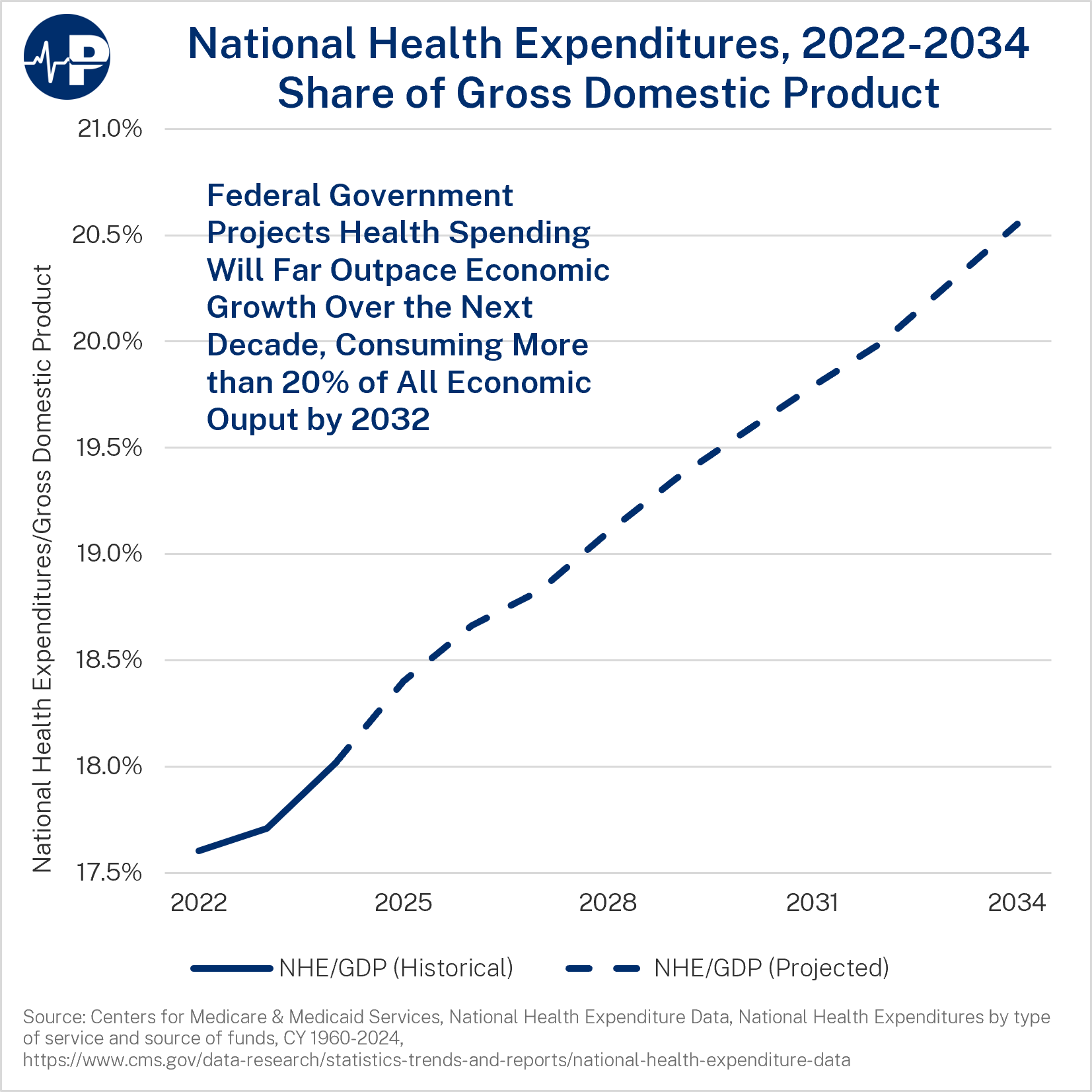
Much of this growth reflects expanding federal involvement in health care. During the Biden administration, Medicaid enrollment increased dramatically because of pandemic-era continuous eligibility requirements, ACA subsidy expansions, and widespread improper enrollment in both Medicaid and the ACA exchanges. At the same time, states increasingly exploited financing arrangements such as Medicaid state-directed payments to draw down additional federal matching funds, largely to fund corporate welfare for large, politically powerful hospital systems.
Hospital services are the largest driver of spending growth. Hospital expenditures increased 8.9 percent in 2024 and are projected to rise another 8.2 percent in 2025—both well above overall health care spending. As John R. Graham documented in recent Paragon research, hospitals remain the least efficient major sector of American health care, yet they continue to command an ever-larger share of national health spending through market consolidation, government payment policies, and regulatory advantages. These trends reinforce the urgent need for reforms that promote competition, transparency, and more efficient delivery of care.
The implications extend well beyond health policy. Despite historically high federal revenues, annual budget deficits continue to approach $2 trillion because federal spending continues to rise even faster. In a 2023 Paragon research paper, Paul Winfree—now an advisor to Federal Reserve Chairman Kevin Warsh—explained how rapidly growing federal health care programs, together with rising interest costs on the national debt, are steadily consuming America’s fiscal space and limiting policymakers’ ability to respond to future economic, fiscal, and national security challenges. The latest National Health Expenditures projections reinforce that warning.
Medicare Part D’s Costs Continue to Escalate
Paragon hasrepeatedlywarnedthat the Inflation Reduction Act’s redesign of Medicare Part D would prove substantially more expensive than advertised. Last week, new analysis from the Committee for a Responsible Federal Budget largely corroborated those concerns.
When Congress enacted the IRA, supporters emphasized lower out-of-pocket costs for Medicare beneficiaries. But lower cost sharing did not reduce the underlying cost of prescription drug coverage. In fact, the redesign significantly increased total premiums and spending—with the greater burden borne by future taxpayers through more federal debt. CRFB estimates that the IRA’s Part D benefit redesign is now projected to cost taxpayers roughly 10 times what the Congressional Budget Office originally estimated.
The Biden administration compounded these costs through its temporary Part D Premium Stabilization Demonstration, a blatantly political bailout program that transferred billions of additional taxpayer dollars to insurers in advance of the 2024 election in order to suppress visible premium increases. The Trump administration was right to protect taxpayers and end that demonstration rather than extending yet another costly federal bailout.
This reflects a broader approach that characterized much of the Biden administration’s health care agenda. Whether through enhanced ACA subsidies or the Medicare Part D demonstration, policymakers tried to make coverage look more affordable by increasing federal subsidies to insurers. Those policies lower the premiums consumers see, but they increase total premiums, federal spending, and the ultimate burden on taxpayers. Real affordability comes from improving incentives for consumers, providers, and insurers—not from shifting more of the bill to taxpayers.
As always, thank you for reading.
NOTE: This post uses an image credited to Christopher J. Dean / Shutterstock.com
Recent Newsletters


Subscribe
Sign up now for your health policy updates.