

In the weeks surrounding the passage of the One Big Beautiful Bill (OBBB) in July 2025, some critics of the law predicted an immediate crisis for health care providers who serve low-income and rural patients. The National Association of Community Health Centers warned that “[m]any [community health centers] are already making tough decisions about cutting back services, reducing essential staff, and closing sites” and claimed that the OBBB would worsen these trends.
Last fall, House Minority Leader Hakeem Jeffries asserted that “hospitals and nursing homes and community-based health centers are closing all throughout America,” blaming the OBBB.
Some media reporting has reinforced this narrative with misleading and incomplete information. A piece in Axios in September 2025 stated that “a string of recent rural health clinic closures is threatening to further reduce access to care in outlying areas as health systems brace for cuts in the in the Republican budget law,” listing several examples of providers shutting down or consolidating.
It is true, of course, that some providers have exited the market over the past year. But individual closures are a normal feature of any economic sector, including this one. An accurate accounting must consider both sides of the ledger – the facilities opening as well as the closures. By that measure, there is no evidence the law has undermined access to safety-net providers.
This PIC, drawing from comprehensive CMS enrollment data on Rural Health Clinics (RHCs) and Federally Qualified Health Centers (FQHCs), does not support the picture of a smaller health care safety net. Together, these facilities deliver outpatient medical services to millions of low-income and rural Americans. RHCs are specifically designated to address health care provider shortages in rural areas, while FQHCs are community-based centers that provide comprehensive care to primarily to low-income patients and communities with limited access to health care.
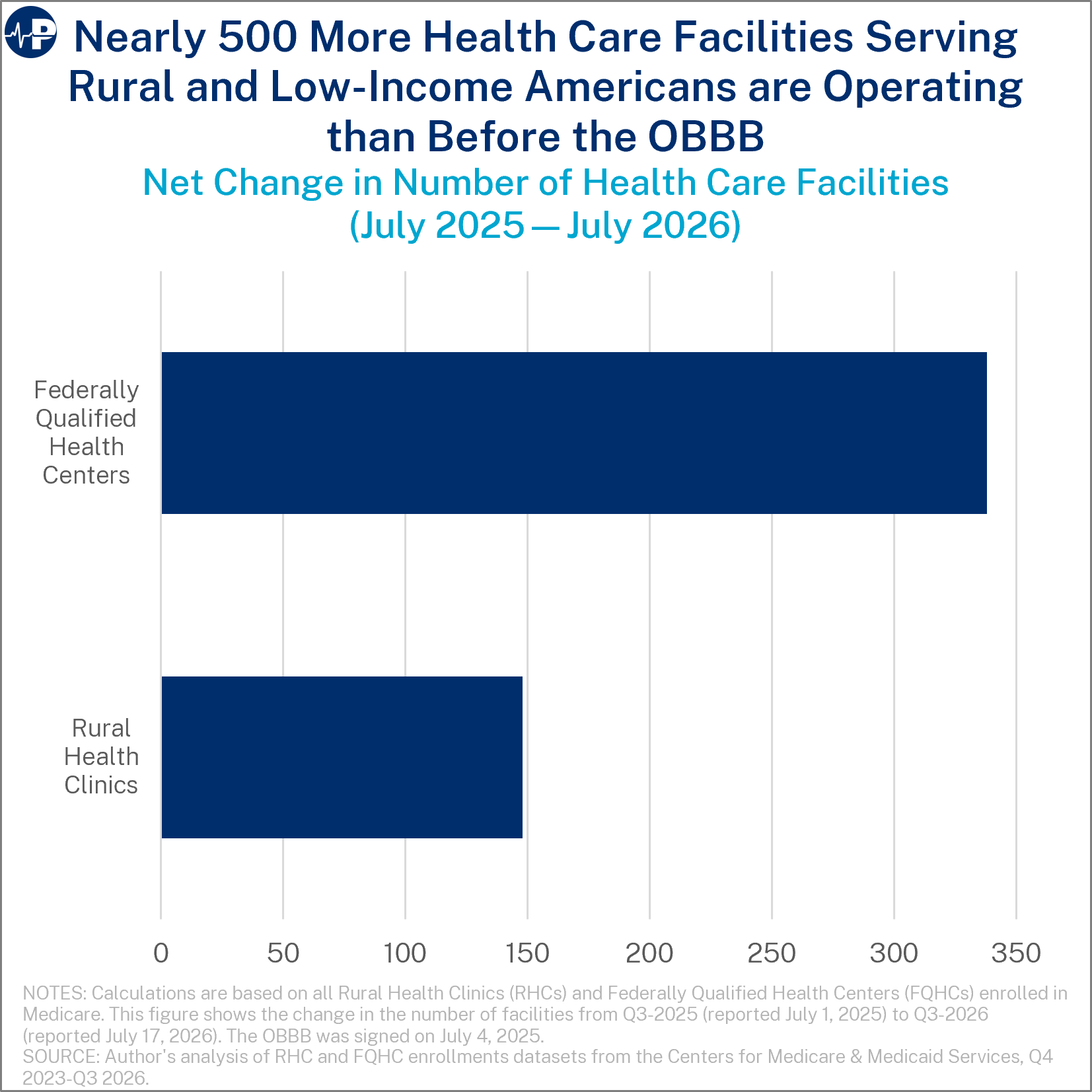
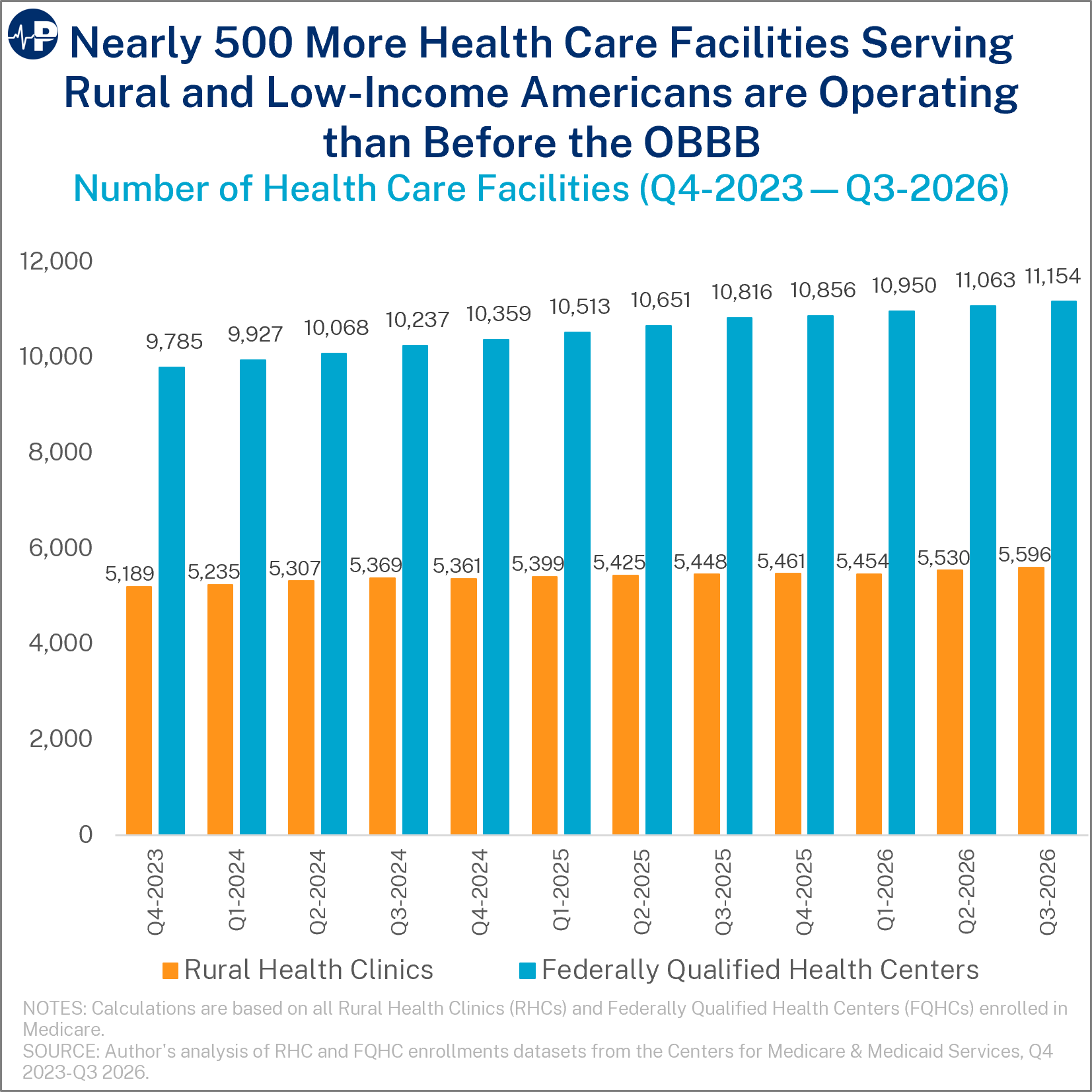
Since the OBBB’s passage, the number of RHCs and FQHCs nationwide has grown. According to CMS data, between July 1, 2025 — three days before the OBBB was signed — and July 17, 2026, the latest data release, the number of RHCs enrolled in Medicare rose by 148 (or 2.7 percent), and the number of FQHCs increased by 338 (or 3.1 percent). That is a net gain of nearly 500 facilities serving rural and lower-income communities. The data also show that the increase in the number of RHCs and FQHCs pre-dated the OBBB and has continued at a similar pace since the law’s passage. Compared to the fourth quarter of 2023, the earliest available data from CMS, the number of RHCs has grown more than 400 and the number of FQHCs has increased by nearly 1,400.
In part, the recent increase in safety-net facilities may reflect a core feature of the OBBB, the Rural Health Transformation Program, which began distributing $10 billion in annual federal funds to states in early 2026. Many states have begun soliciting grant applications and disbursing funds to clinics and hospitals.
To be sure, some of the OBBB’s biggest reforms — community engagement requirements and limits on state-directed payments — have yet to take effect, and it is premature to empirically judge the law’s long-run impact. But alarmist claims that the law’s passage caused the collapse of safety-net providers are simply untethered from reality.