

Paragon Health Institute Icon White
Paragon Pic

CBO’s New Budget Baseline Confirms: One Big Beautiful Bill Did Not Cut Medicaid; Biden-Era Profligacy Even Higher Than First Thought

8AW Federal Medicaid Spending CBO 2026 2036 A0wUU00000563UzYAI
Click the Pic to expand the image
John Graham Headshot 2 SMALLER Thumbnail

John R. Graham is a Visiting Fellow who contributes nearly three decades of health policy expertise to research across all of Paragon’s initiatives. He worked on Capitol Hill from 2021 to 2024 as a Professional Staff Member on the Senate Special Committee on Aging and the House Committee on Ways & Means. From 2018 to 2021, he served as the U.S. Department of Health & Human Services (HHS) Regional Director for Region 10 (Washington State, Oregon, Idaho, and Alaska), where he managed relationships with state governments and the private sector. In 2017-2018, John was the HHS Acting Assistant Secretary for Planning & Evaluation.

On February 11, the Congressional Budget Office released the latest Budget and Economic Outlook which incorporates technical changes and legislative changes from last year. For Medicaid, the main legislative changes were key provisions of the One Big Beautiful Bill Act, which President Trump signed last summer and which included work and community engagement requirements for able-bodied, working-age adults, increased eligibility reviews, and reductions in the legalized Medicaid money laundering mechanisms and corporate welfare. The technical changes are higher behavioral health, home health, and prescription drug spending that CBO projected the year before.

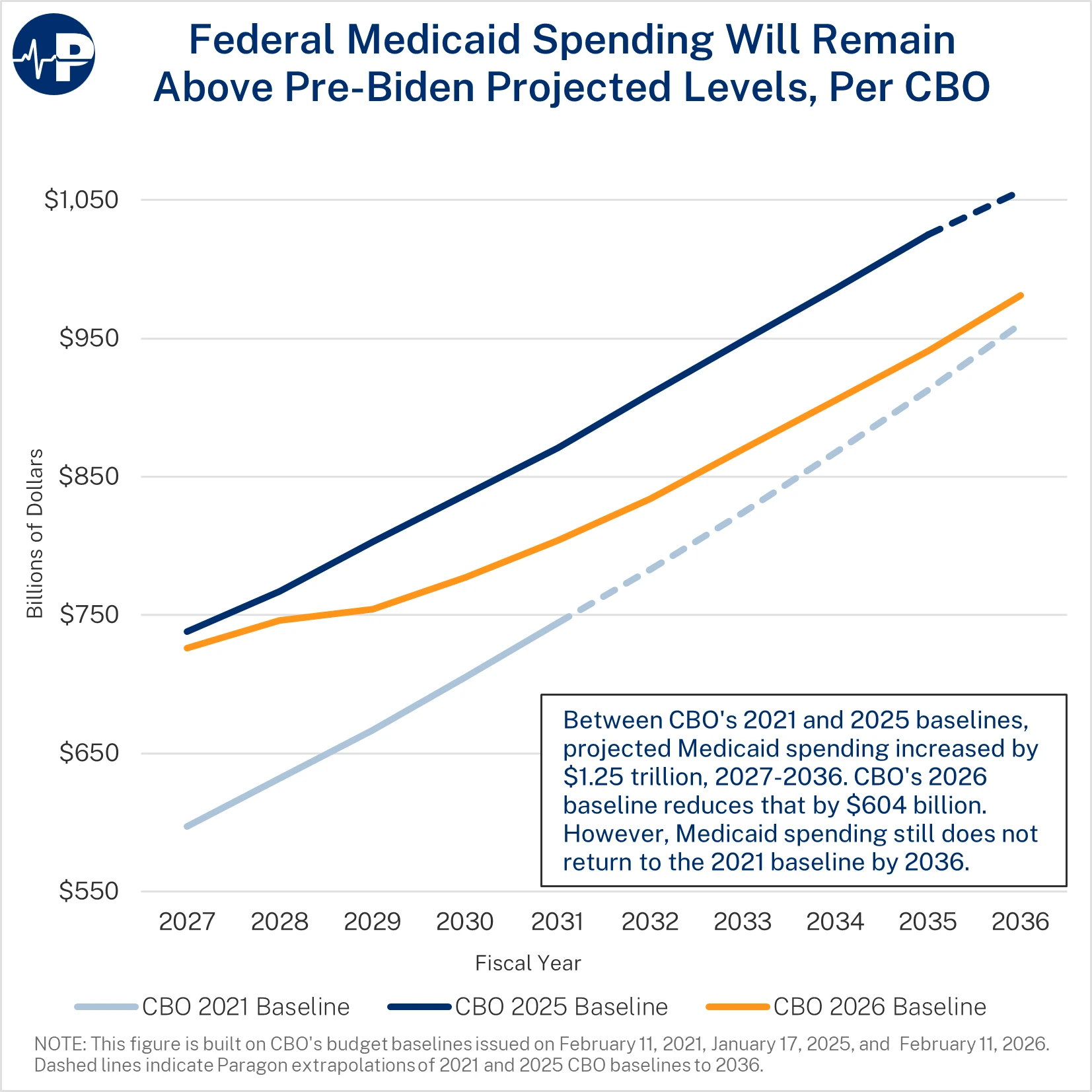
The new Medicaid baseline confirms significant projected savings to Medicaid spending from the CBO’s baseline forecast one year ago. The new baseline also confirms there are no “cuts” to Medicaid. Indeed, even by 2036, federal Medicaid spending remains above the trajectory projected in CBO’s 2021 baseline—prior to President Biden taking office.

Medicaid spending surged during the Biden administration. One of the prime reasons is that the administration relaxed eligibility rules, leading to millions of ineligible people being enrolled in Medicaid—many with other sources of coverage. The Biden administration also presided over a massive increase in money-laundering tactics and corporate welfare, with many states developing programs to pay hospital systems Medicaid rates at or near average commercial rates (ACR), which average 2.5 times Medicare rates.

The 2025 baseline projected $8.9 trillion in federal Medicaid spending over 10 years (2027-2036), up $1.2 trillion from the 2021 baseline of $7.7trillion over that period. (The 2021 baseline stops in 2031; and the 2025 baseline stops in 2035.  For consistency with the 2026 baseline, those baselines are extrapolated through 2036 according to a linear trend.) The 2026 federal Medicaid baseline is about $600 billion lower than last year’s projection. CBO estimates that technical updates increased projected spending by roughly $500 billion, but the OBBB reforms reduced projected spending by approximately $1.1 trillion—more than offsetting those upward revisions.

As a result, federal Medicaid spending in 2036 will still be about $20 billion higher than it would have been if the 2021 baseline had remained unchanged. In other words, even with the OBBB reforms, federal Medicaid spending is still on a higher baseline than it was at the start of the Biden administration.

Indeed, the 2026 baseline shows that even last year’s baseline underestimated the Biden-era spending binge. Two of the areas with higher-than-expected spending (behavioral health and home health) are highly susceptible to waste, fraud, and abuse. CBO now estimates that combined federal Medicaid spending in 2025 and 2026 will be $25 billion more than it estimated just one year ago.

8AW Federal Medicaid Spending CBO 2026 2036 A0wUU00000563UzYAI

On February 11, the Congressional Budget Office released the latest Budget and Economic Outlook which incorporates technical changes and legislative changes from last year. For Medicaid, the main legislative changes were key provisions of the One Big Beautiful Bill Act, which President Trump signed last summer and which included work and community engagement requirements for able-bodied, working-age adults, increased eligibility reviews, and reductions in the legalized Medicaid money laundering mechanisms and corporate welfare. The technical changes are higher behavioral health, home health, and prescription drug spending that CBO projected the year before.

The new Medicaid baseline confirms significant projected savings to Medicaid spending from the CBO’s baseline forecast one year ago. The new baseline also confirms there are no “cuts” to Medicaid. Indeed, even by 2036, federal Medicaid spending remains above the trajectory projected in CBO’s 2021 baseline—prior to President Biden taking office.

Medicaid spending surged during the Biden administration. One of the prime reasons is that the administration relaxed eligibility rules, leading to millions of ineligible people being enrolled in Medicaid—many with other sources of coverage. The Biden administration also presided over a massive increase in money-laundering tactics and corporate welfare, with many states developing programs to pay hospital systems Medicaid rates at or near average commercial rates (ACR), which average 2.5 times Medicare rates.

The 2025 baseline projected $8.9 trillion in federal Medicaid spending over 10 years (2027-2036), up $1.2 trillion from the 2021 baseline of $7.7trillion over that period. (The 2021 baseline stops in 2031; and the 2025 baseline stops in 2035.  For consistency with the 2026 baseline, those baselines are extrapolated through 2036 according to a linear trend.) The 2026 federal Medicaid baseline is about $600 billion lower than last year’s projection. CBO estimates that technical updates increased projected spending by roughly $500 billion, but the OBBB reforms reduced projected spending by approximately $1.1 trillion—more than offsetting those upward revisions.

As a result, federal Medicaid spending in 2036 will still be about $20 billion higher than it would have been if the 2021 baseline had remained unchanged. In other words, even with the OBBB reforms, federal Medicaid spending is still on a higher baseline than it was at the start of the Biden administration.

Indeed, the 2026 baseline shows that even last year’s baseline underestimated the Biden-era spending binge. Two of the areas with higher-than-expected spending (behavioral health and home health) are highly susceptible to waste, fraud, and abuse. CBO now estimates that combined federal Medicaid spending in 2025 and 2026 will be $25 billion more than it estimated just one year ago.
Related Research

No results found.
John Graham Headshot 2 SMALLER Thumbnail

John R. Graham is a Visiting Fellow who contributes nearly three decades of health policy expertise to research across all of Paragon’s initiatives. He worked on Capitol Hill from 2021 to 2024 as a Professional Staff Member on the Senate Special Committee on Aging and the House Committee on Ways & Means. From 2018 to 2021, he served as the U.S. Department of Health & Human Services (HHS) Regional Director for Region 10 (Washington State, Oregon, Idaho, and Alaska), where he managed relationships with state governments and the private sector. In 2017-2018, John was the HHS Acting Assistant Secretary for Planning & Evaluation.