Brian Blase, Ph.D., is the President of Paragon Health Institute. Brian was Special Assistant to the President for Economic Policy at the White House’s National Economic Council (NEC) from 2017-2019, where he coordinated the development and execution of numerous health policies and advised the President, NEC director, and senior officials. After leaving the White House, Brian founded Blase Policy Strategies and served as its CEO.

Paragon Pic
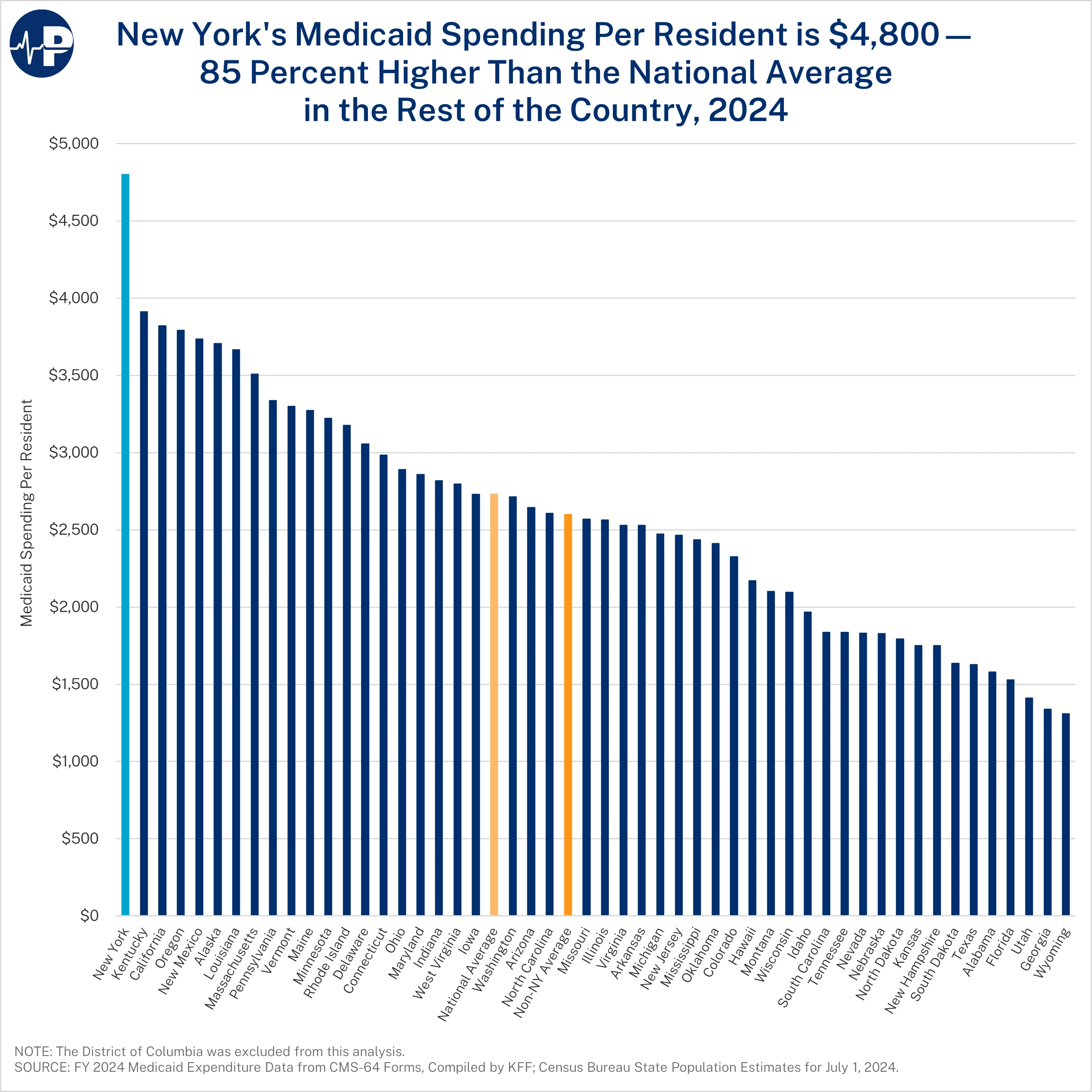
New York’s Medicaid Spending Per Resident is $4,800—85 Percent Higher Than the National Average in the Rest of the Country, 2024
Click the Pic to expand the image
The Trump administration has begun scrutinizing New York’s Medicaid program—an overdue step given the state’s long history of excessive spending, weak oversight, and fraud. CMS Administrator Dr. Mehmet Oz recently sent a letter to Governor Kathy Hochul raising concerns about program integrity in several high-risk service areas, including personal care services, home health, adult day care, non-emergency medical transportation, and behavioral health services. These services are particularly vulnerable because they are delivered outside traditional clinical settings, where verification is difficult and billing for services that were never delivered is a persistent risk. A recent policy brief I coauthored with Chris Medrano identified four areas of Medicaid particularly vulnerable to fraud and abuse and recommended stronger CMS enforcement.
Medicaid is a joint federal-state program in which the federal government reimburses states for a large share of their spending. Because federal funding is open-ended—states receive additional federal dollars whenever spending increases—the program is highly vulnerable to waste, fraud, and abuse. CMS therefore has a critical responsibility to safeguard the program both for the vulnerable individuals who rely on Medicaid and for the taxpayers who finance it.
New York’s Medicaid program is disproportionately large, even for the state’s size. As the figure below shows, New York’s Medicaid spending per resident is nearly $4,800—a staggering 85 percent higher than the national average of roughly $2,600 excluding New York. New York’s per-resident Medicaid spending is 23 percent higher than that of the next highest state, Kentucky.
Medicaid waste, fraud, and abuse are rampant in New York—and have been for almost the entire 60-year history of the program. In March 2013, the House Oversight and Government Reform Committee released a bipartisan report following a year-long investigation into New York’s Medicaid program. The report documented extensive problems, including weak eligibility controls, poor oversight of long-term care services, excessive administrative costs, and political corruption. The investigation also highlighted how Medicaid had become deeply embedded in the state’s fiscal and political structure—so much so that officials referred to the practice of “Medicaiding it,” referring to the state tactic of shifting as many services and costs as possible into the Medicaid program to maximize federal funding.




The Trump administration has begun scrutinizing New York’s Medicaid program—an overdue step given the state’s long history of excessive spending, weak oversight, and fraud. CMS Administrator Dr. Mehmet Oz recently sent a letter to Governor Kathy Hochul raising concerns about program integrity in several high-risk service areas, including personal care services, home health, adult day care, non-emergency medical transportation, and behavioral health services. These services are particularly vulnerable because they are delivered outside traditional clinical settings, where verification is difficult and billing for services that were never delivered is a persistent risk. A recent policy brief I coauthored with Chris Medrano identified four areas of Medicaid particularly vulnerable to fraud and abuse and recommended stronger CMS enforcement.
Medicaid is a joint federal-state program in which the federal government reimburses states for a large share of their spending. Because federal funding is open-ended—states receive additional federal dollars whenever spending increases—the program is highly vulnerable to waste, fraud, and abuse. CMS therefore has a critical responsibility to safeguard the program both for the vulnerable individuals who rely on Medicaid and for the taxpayers who finance it.
New York’s Medicaid program is disproportionately large, even for the state’s size. As the figure below shows, New York’s Medicaid spending per resident is nearly $4,800—a staggering 85 percent higher than the national average of roughly $2,600 excluding New York. New York’s per-resident Medicaid spending is 23 percent higher than that of the next highest state, Kentucky.
Medicaid waste, fraud, and abuse are rampant in New York—and have been for almost the entire 60-year history of the program. In March 2013, the House Oversight and Government Reform Committee released a bipartisan report following a year-long investigation into New York’s Medicaid program. The report documented extensive problems, including weak eligibility controls, poor oversight of long-term care services, excessive administrative costs, and political corruption. The investigation also highlighted how Medicaid had become deeply embedded in the state’s fiscal and political structure—so much so that officials referred to the practice of “Medicaiding it,” referring to the state tactic of shifting as many services and costs as possible into the Medicaid program to maximize federal funding.
Related Research
No results found.

President at Paragon Health Institute
Brian Blase, Ph.D., is the President of Paragon Health Institute. Brian was Special Assistant to the President for Economic Policy at the White House’s National Economic Council (NEC) from 2017-2019, where he coordinated the development and execution of numerous health policies and advised the President, NEC director, and senior officials. After leaving the White House, Brian founded Blase Policy Strategies and served as its CEO.