


Brian Blase, Ph.D., is the President of Paragon Health Institute. Brian was Special Assistant to the President for Economic Policy at the White House’s National Economic Council (NEC) from 2017-2019, where he coordinated the development and execution of numerous health policies and advised the President, NEC director, and senior officials. After leaving the White House, Brian founded Blase Policy Strategies and served as its CEO.
The Case Against Medicaid Managed Care

For more than three decades, policymakers from both parties have increasingly relied on managed care organizations (MCOs)—another term for health insurance companies—to administer Medicaid. Approximately 75 percent of Medicaid enrollees are enrolled in MCOs.
After decades of expansion, there is little evidence that Medicaid managed care has improved outcomes, coordinated care more effectively, or lowered costs relative to traditional Medicaid. At the same time, managed care has become the vehicle for some of Medicaid’s most significant financing abuses, enrollment integrity problems, and cost growth.
Today’s newsletter highlights new research examining Medicaid managed care, reviews the importance of recent reforms to Medicaid financing gimmicks, highlights a new Bill Spotlight on Utah’s enacted Medicaid managed care transparency legislation, and covers two recent Paragon PICs on Medicaid.
June 23 Events
I will be participating in a Capitol Hill event organized by the Cato Institute titled “Fixing Medicaid’s Financing Structure to Reduce Waste, Fraud, and Overspending” to discuss Medicaid reform alongside Chris Pope of the Manhattan Institute and Michael Cannon of Cato. The event is in person and registration information is available here.
Paragon will also host a virtual event on June 23 at 1:30 p.m. EDT — “A Conversation About The Persistent Obamacare Enrollment Fraud” — to discuss our new research on improper enrollment in the ACA exchanges. Allysia Finley of The Wall Street Journal Editorial Board will moderate the discussion. I recently responded in The Washington Post to criticism of our report from a senior executive at the Blue Cross Blue Shield Association and explained that our estimate of widespread improper enrollment in the ACA exchanges is likely conservative. We will discuss these findings and the ongoing debate over exchange enrollment integrity during the event, which you can register for here.
Has Medicaid Managed Care Worked?
When states began shifting Medicaid enrollees into managed care plans, advocates argued that private insurers would bring efficiencies to Medicaid, including better coordinated care, reductions in unnecessary spending, and improved quality. A new paper by Chris Pope of the Manhattan Institute, Reining in Medicaid Managed Care, raises an extremely important health policy question: Has Medicaid managed care actually worked? According to Pope’s research, the evidence supporting Medicaid managed care is remarkably weak given its dominance within the program. Worse, recent evidence suggests that Medicaid managed care has facilitated cost growth through phantom enrollment and state-directed payments.
Bad Incentives
In a 2018 report, the Congressional Budget Office noted that studies had not found consistent evidence of a positive effect of Medicaid managed care. After three decades of experimentation and expansion, this failure should not be surprising. Given managed care’s dominance in Medicaid, the lack of clear evidence of success should itself be concerning.
As Pope documents, unlike commercial insurance, Medicaid MCOs do not compete primarily on premiums because enrollees generally pay nothing for coverage. Benefits are heavily standardized by government rules. These features significantly reduce the mechanisms through which competition can generate innovation and efficiency.
The financing structure also creates problematic incentives. Under federal actuarial soundness requirements, states must pay plans enough to cover expected medical costs and administrative expenses. These requirements lock in higher spending and make it difficult for states to reduce costs once waste becomes embedded in managed care contracts. In essence, waste, fraud, and abuse become embedded in future payment rates.
Improper and Phantom Enrollment
Medicaid managed care creates strong incentives to maximize enrollment, as plans are generally paid a fixed amount for each enrollee. Improper enrollment, duplicate enrollment, and phantom enrollment increase payments flowing to MCOs. We know that erroneous and incomplete eligibility determinations are the number one reason for staggering improper payments in the program—with an improper payment rate that likely exceeds 25 percent. Although the problem of phantom enrollment in the ACA exchanges has garnered a lot of attention, phantom enrollment in Medicaid managed care may be an even larger problem.
Insurers continue receiving monthly payments for enrollees who receive little or no medical care. In Medicaid managed care, the government sends payments to insurers to cover the cost of care for individuals who not only do not use any services but also are unaware of their enrollment. Because plans generally must spend premium revenue or issue rebates, phantom enrollment does not meaningfully reduce overall program costs.
State-Directed Payments and the Growth of Corporate Welfare
From their introduction in just two states in 2016, state-directed payments (SDPs) grew to a projected $124 billion across 39 states by 2025. Rapid SDP growth suggests that Medicaid managed care has become a mechanism for increasing corporate welfare to politically powerful providers at taxpayers’ expense. Using SDPs, states have dramatically increased Medicaid payments to providers, in some cases pushing payment rates well above Medicare levels. This trend risks seniors’ access to health care services; under fee-for-service Medicaid, payments have been capped at Medicare rates since the 1980s. If pre-SDP payment rates were actuarially sound, it is fair to ask how dramatically higher post-SDP payment rates can also be actuarially sound for the same services.
Time to Reconsider Managed Care in Medicaid?
Misaligned incentives, phantom enrollees, and corporate welfare schemes are the result of a system that is extraordinarily complex, difficult to oversee, and increasingly disconnected from the original promise that managed care would reduce costs.
That complexity should prompt a fundamental question: If managed care has increased costs, failed to improve outcomes, reduced transparency, and enabled financing schemes that drive federal spending higher, should it continue to dominate Medicaid? Paragon intends to explore that question in future work.
Why Recent Medicaid Financing Reforms Matter
The One Big Beautiful Bill (OBBB) contained the most significant reforms to Medicaid financing in decades. These reforms target financing arrangements that rewarded states for maximizing Medicaid spending rather than maximizing value for enrollees and taxpayers. The OBBB limits states’ ability to use provider taxes and SDPs. These limits will eventually cap Medicaid payments through SDPs at Medicare rates in states that adopted the ACA Medicaid expansion and at 10 percent above Medicare rates in states that did not adopt the expansion. For more on the OBBB reforms, see here.
If successfully implemented, the OBBB reforms will improve incentives for states to obtain value from Medicaid rather than simply maximize spending.
The Centers for Medicare and Medicaid Services (CMS) recently proposed a rule to implement the SDP limits from the OBBB. CMS estimates that these reforms will reduce federal spending by roughly $510 billion over 10 years, with additional reductions in state spending as states scale back financing arrangements that depend on federal matching funds.
Bill Spotlight: Medicaid Managed Care Transparency
A new Bill Spotlight highlights legislation in Utah designed to improve transparency in Medicaid managed care contracting. Given that states are increasingly relying on insurers to administer Medicaid, policymakers need greater visibility into how payment rates are developed and how taxpayer dollars flow through the system. Specifically, the bill focuses on improving public reporting of MCO data and information previously hidden, including a public dashboard of claims and spending, payment error reports, and financial performance and service utilization reviews.
The Utah legislation moves in the right direction by improving transparency and oversight. The legislation could be further improved, particularly by including provisions addressing potential conflicts of interest involving actuaries who help establish Medicaid payment rates. States should also ensure that identified fraud, abuse, and improper payments are excluded from the claims experience used to establish future payment rates. Under current arrangements, insurers often have limited incentives to aggressively identify fraud and abusive billing because higher claims can ultimately flow through into future payment rates.
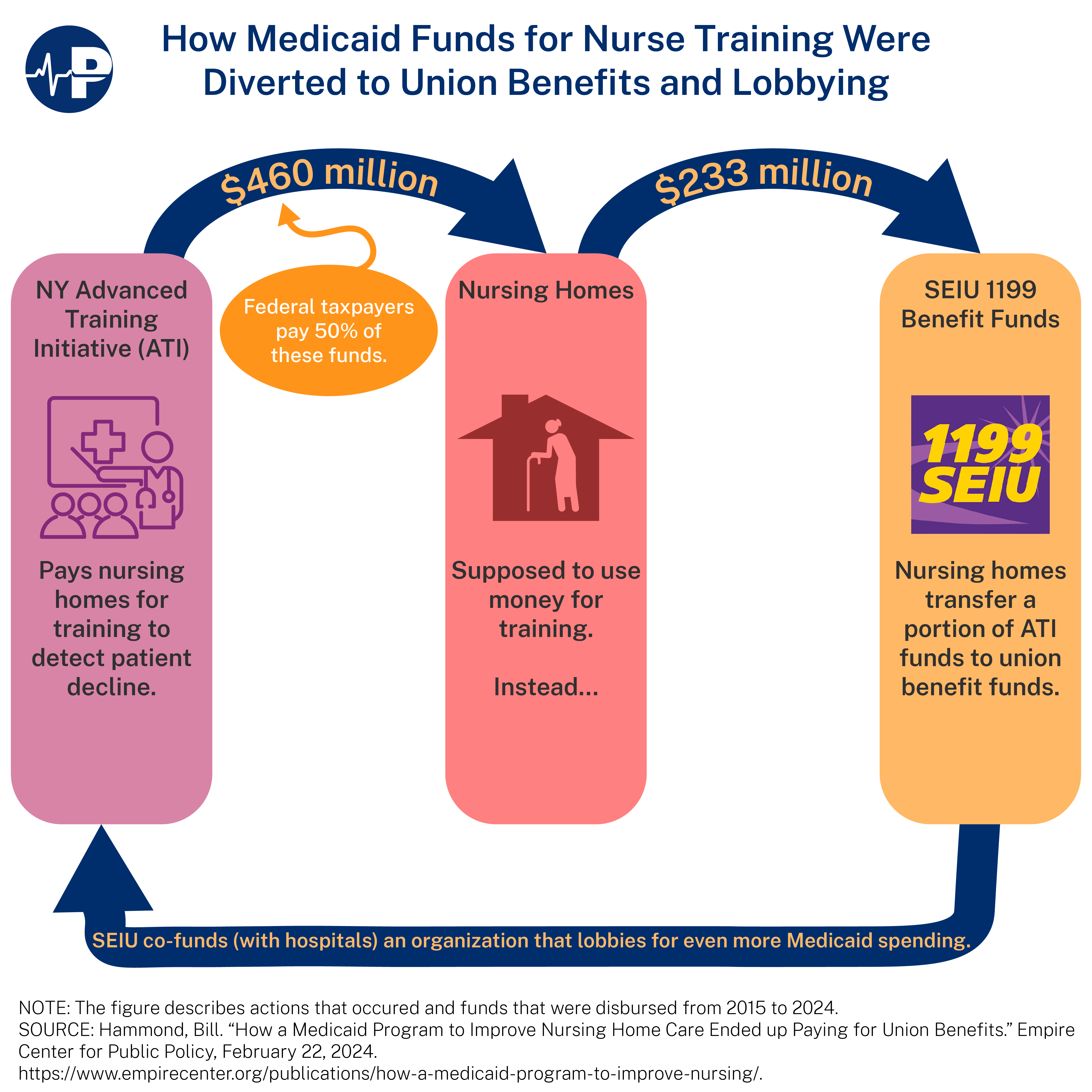
How Medicaid Funds for Nurse Training Were Diverted to Union Benefits and Lobbyists
Medicaid funds intended for nurse workforce development were redirected toward purposes far removed from patient care, including union member health benefits, as a new PIC shows. This case illustrates how Medicaid financing arrangements can divert taxpayer dollars far from their intended purpose.
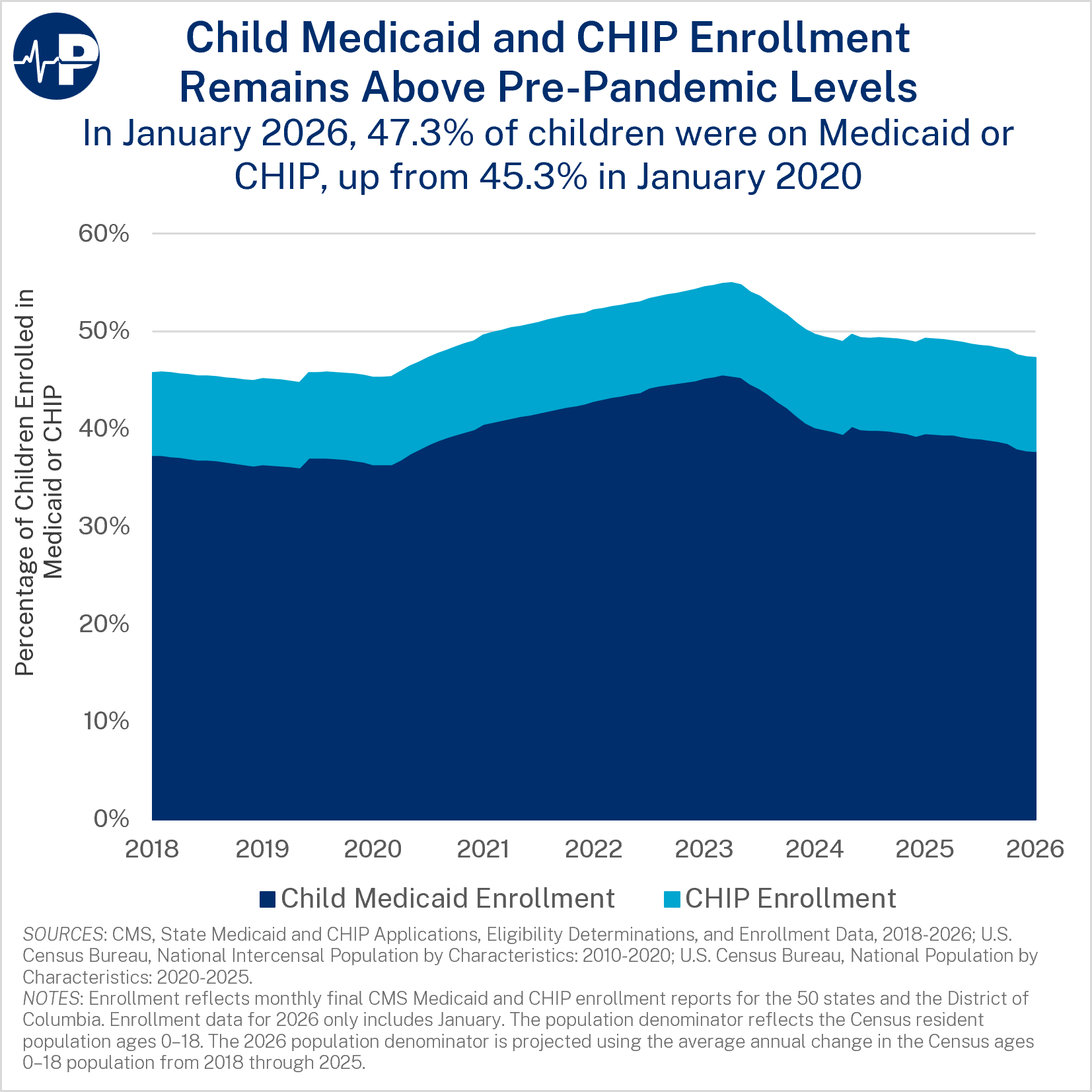
Child Medicaid and CHIP Enrollment Remains Above Pre-Pandemic Levels
Recent commentary has suggested that large numbers of children are losing public coverage. The data do not support that conclusion. As a share of all children, Medicaid and CHIP enrollment remained roughly two percentage points higher in January 2026 than in January 2020, as a new PIC shows. Although total Medicaid and CHIP enrollment among children was virtually unchanged, the child population is smaller today because of declining fertility.
Recent Newsletters


Subscribe
Sign up now for your health policy updates.