


Brian Blase, Ph.D., is the President of Paragon Health Institute. Brian was Special Assistant to the President for Economic Policy at the White House’s National Economic Council (NEC) from 2017-2019, where he coordinated the development and execution of numerous health policies and advised the President, NEC director, and senior officials. After leaving the White House, Brian founded Blase Policy Strategies and served as its CEO.
The Persistent Obamacare Enrollment Fraud: Two Years of Following the Data
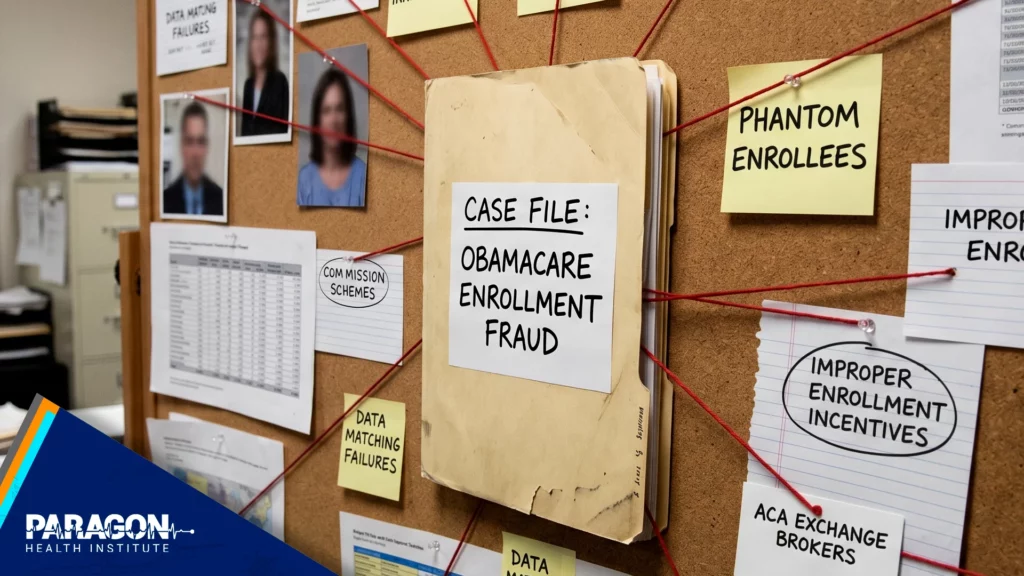
One of Paragon’s core missions is to evaluate how government programs actually work and whether benefits are reaching the people they were designed to help, whether programs are improving lives, and whether taxpayer costs are justified. Our research and analysis show that program outcomes often differ substantially from policymakers’ stated objectives and that incentives frequently benefit organized interests at the expense of enrollees and taxpayers.
For the third straight year, we produced a study of improper enrollment in the exchanges. In The Persistent Obamacare Enrollment Fraud, we estimate that there were 6.2 million improper enrollees after the 2026 open enrollment period. On Friday, after analyzing our findings, the Washington Post editorial page wrote: “The scale of the fraud might seem implausible, but the evidence supporting it is compelling.” On June 23 at 1 p.m. EDT, we will discuss the findings of our new study and the evidence of fraud at a virtual event with Allysia Finley of The Wall Street Journal editorial page.
Today’s newsletter starts with an explanation of the methodology behind our improper enrollment estimates, along with a key timeline and additional evidence showing that improper enrollment and fraud are pervasive. The newsletter then highlights a piece from Liam Sigaud on the relatively small financial vulnerabilities of rural hospitals and concludes by welcoming Boris Vabson as Paragon’s newest fellow.
Simple and Straightforward Methodology
The analysis underlying our estimate of 6.2 million improper Obamacare enrollments is straightforward. It is based on publicly available enrollment and Census Bureau data. The methodology, described in detail in an appendix of our report, is transparent and easily replicable.
We compared the number of people claiming incomes between 100 and 150 percent of the federal poverty level (FPL)—the income range that qualifies for the largest Obamacare subsidies—to the number of people who could plausibly be eligible for subsidized exchange coverage in this income range in each state.
Timeline of Obamacare Fraud, Improper Enrollment, and Phantom Enrollment
May 2024: At a Texas legislative hearing at which I testified, policymakers raised concerns about manipulation of exchange applications to obtain excessive subsidies. The question prompted Paragon’s initial analysis of improper enrollment.
June 2024: We published The Great Obamacare Enrollment Fraud, estimating nearly 5 million improper enrollees. This paper describes the incentives for enrollment intermediaries, insurers, and applicants to misstate information in order to generate greater subsidies and commissions.
August 2024: After receiving a flood of information following our publication of the original report, we published Unpacking The Great Obamacare Enrollment Fraud, which detailed the mechanics of the fraud schemes and why the problem was so much more severe in HealthCare.gov states.
October 2024: CMS suspended 850 agents and brokers “for reasonable suspicion of fraudulent or abusive conduct related to unauthorized enrollments or unauthorized plan switches.”
June 2025: After the 2025 open enrollment period, we published The Greater Obamacare Enrollment Fraud with an estimate of about 6.5 million improper enrollees, representing more than one in four exchange enrollees. Bloomberg published a major investigation detailing the South Florida-based schemes that fueled improper enrollment. The article described big-money operations that produced daily commissions for brokers of more than $6,000 and quoted one customer service agent who remarked that half of sign-ups had no idea they were enrolling in health insurance.
August 2025: CMS released data showing the number of exchange enrollees who never used their insurance during the year. We released an analysis of that data, showing that zero-claim enrollment surged as improper enrollment did. The increase was concentrated among 100-150 percent FPL enrollees with fully subsidized plans. We coined the term “phantom enrollee” to describe individuals who appear in enrollment statistics but are not functioning participants in the market—including fictitious enrollees, individuals unknowingly enrolled in coverage, and people with duplicative coverage.
November 2025: I testified before the Senate Finance Committee and the Senate Homeland Security Permanent Subcommittee on Investigations about the problems with Obamacare, emphasizing our research on improper and phantom enrollment and our recommendation against extending the pandemic-era subsidy boosts that fueled these problems.
December 2025: I testified at a House Judiciary Committee hearing on Obamacare enrollment fraud, alongside an official from the Government Accountability Office (GAO). GAO testified about its undercover work in which it successfully obtained subsidized exchange coverage for 23 of 24 fictitious applications. GAO also reported that $21 billion in advance subsidies was not properly reconciled for HealthCare.gov enrollees in 2023.
April 2026: The Department of Justice obtained a third major conviction involving Obamacare enrollment fraud. This case followed two others, each of which resulted in more than $100 million in improper subsidy payments, underscoring the scale of the fraud and corroborating broader evidence of widespread improper enrollment.
June 2026: We released The Persistent Obamacare Enrollment Fraud, with the main finding of 6.2 million improper enrollees in 2026 at a total cost of approximately $25 billion in improper subsidies, along with a discussion of how improper enrollment evolved and persisted over time, particularly with a move from zero-premium silver plans to zero-premium bronze and gold plans in HealthCare.gov states.
More Evidence of Structural Vulnerabilities and Fraud
As we study this problem, we continue to uncover additional evidence about the scope and mechanics of Obamacare enrollment fraud. Fraudulent schemes took off from 2022 through 2024, and much of the improper enrollment was simply automatically renewed from one year to the next—a key part of its persistence.
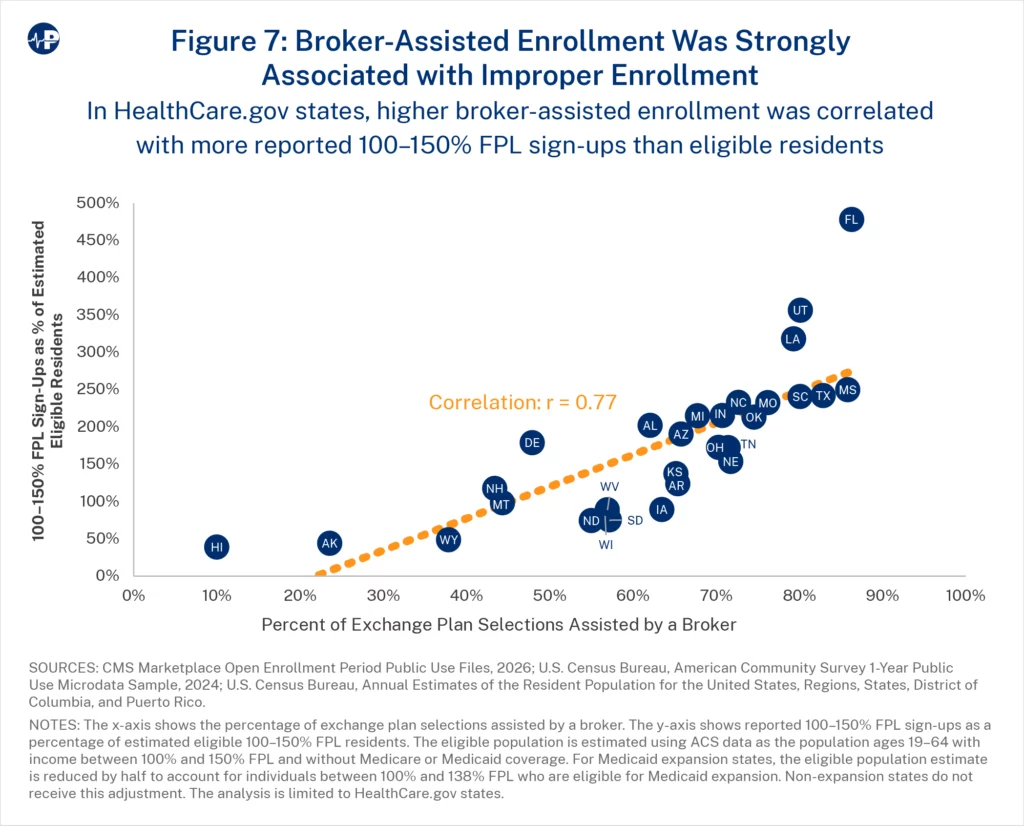
Our analysis also finds an extremely strong relationship between improper enrollment and the share of applications handled by brokers. States relying more heavily on broker-mediated enrollment generally experience substantially higher levels of improper enrollment. That pattern is exactly what one would expect if intermediaries were playing a central role in the problem.
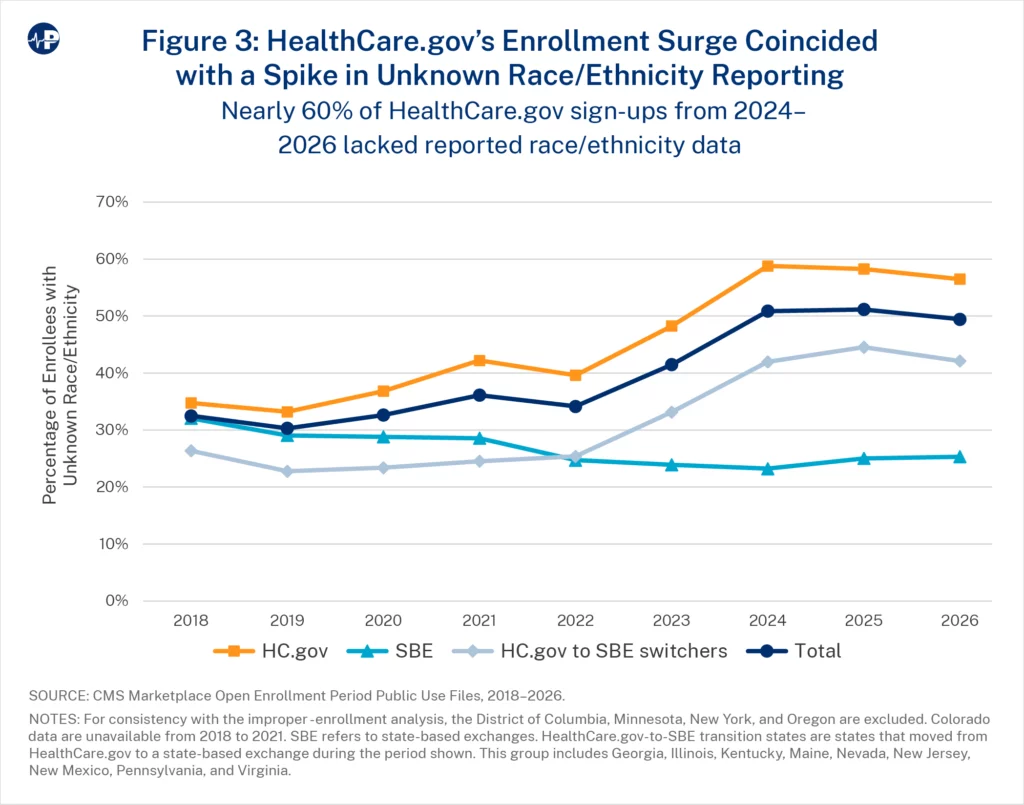
Another striking finding involves race and ethnicity reporting. Historically, roughly 30 percent of applications in the exchanges omitted race/ethnicity information. Following the subsidy expansions enacted in 2021, the share of applications with unknown race/ethnicity surged to nearly 60 percent in HealthCare.gov states while remaining relatively stable in states operating their own exchanges. As the Washington Post editorial observed, “It’s hard to know the race of a fake applicant.”
Rural Hospital Financial Vulnerabilities Are Small Compared to Medicaid Improper Payments
Hospital systems and their lobbyists routinely invoke the plight of financially struggling rural hospitals to oppose efforts to reduce waste, fraud, and abuse in federal health programs. But a new analysis by Paragon adjunct scholar Liam Sigaud shows that the financial vulnerabilities of rural hospitals are far smaller than commonly portrayed—and tiny when viewed alongside the scale of Medicaid improper payments.
According to estimates from the Center for Healthcare Quality and Payment Reform, eliminating the financial losses of every rural hospital currently at risk of closure would cost about $3.2 billion annually. While rural hospital closures are a legitimate concern, that figure represents just 2 percent of the estimated $152 billion in Medicaid improper payments in 2024. Put differently, recovering a small fraction of Medicaid waste, fraud, and abuse could offset the losses of every rural hospital identified as financially vulnerable.
The analysis provides important context for claims that reforms aimed at improving Medicaid program integrity threaten rural health care. Rather than protecting vulnerable rural providers, many hospital systems are using rural hospitals as a shield to preserve a status quo that tolerates enormous levels of improper spending. The real challenge is not a lack of taxpayer funding but ensuring that existing taxpayer dollars are spent appropriately and reach patients who need care.
Welcoming Boris Vabson to Paragon
I am extremely pleased to announce that economist Boris Vabson has joined Paragon as a visiting fellow, focusing on Medicare policy. Prior to joining Paragon, Boris served as a senior advisor at the Centers for Medicare and Medicaid Services (CMS), leading Medicare Advantage (MA) policy at the Center for Medicare and Medicaid Innovation (CMMI), and overseeing key administration efforts related to MA program modernization. He has previously been a faculty member and researcher at Harvard Medical School, along with past positions as a nonresident fellow at the American Enterprise Institute and the USC-Schaeffer Center.
Boris’s policy research has looked at opportunities for improving program performance, cost efficiency, and health outcomes in Medicare. Boris’s work has been published in leading journals and has been cited extensively by CMS, Congress, and MedPAC. He received his PhD in Applied Economics from the University of Pennsylvania’s Wharton School and his undergraduate degree in Mathematics and Economics from Dartmouth.
Recent Newsletters


Subscribe
Sign up now for your health policy updates.