

Brian Blase, Ph.D., is the President of Paragon Health Institute. Brian was Special Assistant to the President for Economic Policy at the White House’s National Economic Council (NEC) from 2017-2019, where he coordinated the development and execution of numerous health policies and advised the President, NEC director, and senior officials. After leaving the White House, Brian founded Blase Policy Strategies and served as its CEO.
Combating Health Care Fraud
This week, the Trump administration announced the largest health care fraud takedown in history and launched a major investigation into New York’s troubled Medicaid personal care program. These actions are vitally important.
Yet endemic fraud, waste, and abuse in our government health care programs are symptoms of a broader disease. The larger problem is that federal health programs create incentives that reward excessive spending, tolerate abuse, and invite fraud.
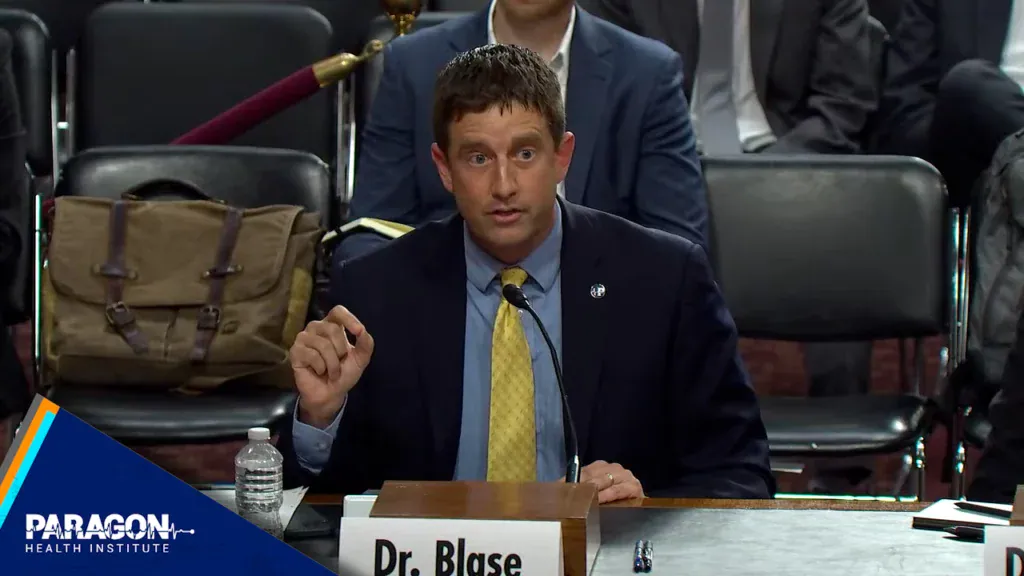
That was the central theme of my testimony yesterday before the Joint Economic Committee at a hearing entitled, “Protecting Patients and Taxpayers: Combating Healthcare Fraud and Leakage to Strengthen Program Integrity.” In my testimony (written and oral), I explained how the Affordable Care Act exchanges, Medicaid, and Medicare each contain structural weaknesses that encourage spending growth while weakening accountability.
Through Medicaid, states can increase federal spending while bearing only a fraction of the cost. The more states spend, the more Washington reimburses. Overall, the federal government underwrites about 70 percent of total program spending. As a result of state incentives for wasteful spending, one-quarter of total program expenditures are improper.
In Medicare, many of the largest spending problems arise not from criminal fraud but from payment policies that create extraordinary financial incentives. The recent experience involving skin substitutes demonstrates how poorly designed reimbursement systems can lead to explosive spending growth long before policymakers recognize the problem.
In the remainder of today’s newsletter, I highlight my new Washington Examiner piece on Obamacare’s looming exchange enrollment drop as well as a Paragon virtual event this week on The Persistent Obamacare Enrollment Fraud, an empirical paper from Liam Sigaud and Eric Sun on how Medicaid provider taxes raise commercial hospital prices, and a roundup of the health care fraud news.
Behind Obamacare’s Coming Enrollment Drop
On Tuesday, we hosted a virtual discussion on the continuing problem of improper enrollment in the ACA exchanges, meaning excessive enrollment among people claiming income in the category that receives the largest subsidies. I was joined by Gabrielle Minarik, who co-authored our new study, The Persistent Obamacare Enrollment Fraud, and Allysia Finley of The Wall Street Journal editorial board.
The discussion focused on Paragon’s estimate that 6.2 million exchange enrollments in 2026 were improper. Enrollment surged under weak verification standards and a COVID-era subsidy boost that made plans fully subsidized for people claiming income between 100 and 150 percent of the federal poverty level.
We examined how weak verification standards, automatic re-enrollment, silver loading, and enrollment intermediaries contributed to improper enrollment. We also discussed phantom enrollment and the millions of people who never use their ACA coverage. You can watch the full event here.
With the backdrop of extensive improper and phantom enrollment, I argue in a new Washington Examiner op-ed that ACA exchange enrollment will decline this year. A large share of that enrollment decline will come from improper enrollees and phantom enrollees. Because fewer people will have access to zero-premium plans, phantom enrollment will decline. Phantom enrollees cannot pay premiums and will generally be terminated for nonpayment of premiums.
The Trump administration is also taking appropriate steps to remove individuals who have other sources of coverage, such as Medicaid, as well as individuals who failed to properly file tax returns to reconcile advanced subsidies in prior years. The One Big Beautiful Bill also requires fuller repayment of excess subsidies, which will reduce improper enrollment to some extent.
Here are the concluding paragraphs from the op-ed:
Despite positive developments, much of the improper and phantom enrollment appears to have continued into 2026. Silver plan enrollment trends provide strong evidence that improper enrollment is more prevalent in states using the HealthCare.gov platform. The expiration of the COVID subsidy boost means that silver plans — the ones that offer the highest value to the lowest-income enrollees — are no longer fully subsidized. For low-income Obamacare enrollees, silver plans commonly have deductibles under $100 annually.
Yet millions of low-income enrollees have migrated into bronze plans with deductibles exceeding $7,000, often for premium savings of less than $30 per month. Economically rational consumers generally would not trade thousands of dollars in financial protection for minimal premium savings. The shift away from silver plans did not occur in states with their own exchanges. Brokers know they must switch phantom enrollees into other free plans because their gravy train ends if phantoms face a premium.
Phantoms aside, the Left will portray declining exchange enrollment as evidence that Americans are losing affordable coverage. But if people decide coverage is not worth purchasing when they must contribute only a modest share of the premium themselves, that is not a policy failure. Taxpayers bear more than 80% of the cost of Obamacare plans, and heavily subsidized exchange coverage crowds out employer-provided coverage.
The policy goal should not be to maximize enrollment regardless of eligibility or cost. It should be to ensure that taxpayer-funded subsidies go only to eligible individuals and that exchange coverage provides sufficient value that people willingly bear a fraction of that cost.
Read the full op-ed here.
New Paragon Research: Medicaid Provider Taxes Increase Commercial Hospital Prices
In The Hidden Cost of Medicaid Provider Taxes: Higher Prices in the Commercial Market, Liam Sigaud and Eric Sun describe how Medicaid provider taxes harm enrollees with private health insurance coverage, not just federal taxpayers. The reason is straightforward: hospitals facing higher tax burdens seek to recoup those costs during negotiations with commercial insurers, allowing a substantial portion of the tax to be passed on through higher private-sector prices.
Previous estimates of the economic incidence of taxation suggest that 45–80 percent of a provider tax would be passed on to commercial patients. Liam and Eric validate these predictions using a case study of a 2010 California Medicaid tax on hospitals. They find that the tax led to an increase in hospital prices of 3–4 percent relative to prices in a control set of neighboring states that did not implement major provider tax changes during that period. For consumers, these higher prices likely show up in higher premiums.
These findings suggest that provider taxes are one factor contributing to surging hospital prices, which have grown over the last 25 years at roughly three times the rate of overall inflation.
Thus, federal taxpayers are not the only ones who bear the cost of provider taxes, which allow states to shift costs to the federal government and increase federal spending. Tens of millions of privately insured Americans pay higher prices for their health care, too.
Read the full paper here.
DOJ Targets New York Medicaid Personal Care Service Fraud Scheme
Last week, the Department of Justice (DOJ) filed a civil lawsuit against the New York State Department of Health, New York Medicaid Director Amir Bassiri, and Public Partnerships LLC (PPL) over an alleged fraud scheme involving New York’s $10 billion Consumer Directed Personal Assistance Program (CDPAP). According to the DOJ, New York rigged the bidding process to favor PPL as the state’s single fiscal intermediary, misled the public about the transition, and then allowed PPL to bill unauthorized amounts.
The arrangement also won support from 1199 SEIU, one of New York’s most powerful health care unions, which stood to gain thousands of dues-paying members by organizing caregivers employed through the new contractor. Paragon recently showed how New York Medicaid dollars intended for nursing home training were diverted to union benefit funds and lobbying operations affiliated with 1199 SEIU.
The case reflects a broader Medicaid program integrity failure and underscores how Medicaid’s open-ended federal financing can reward politically connected interests instead of patients. Paragon has specifically identified home- and community-based services and self-directed personal care programs that rely on decentralized care, family caregivers, and weak verification as among Medicaid’s areas most vulnerable to fraud.
DOJ Health Care Fraud Takedown Targets $6.5 Billion in Alleged Fraud
On Tuesday, the DOJ announced its 2026 National Health Care Fraud Takedown, charging 455 defendants, including 90 doctors and licensed medical professionals, with health care fraud and opioid schemes involving more than $6.5 billion in false claims across 45 states and territories.
In addition to the criminal charges, authorities seized more than $182 million in assets. The Centers for Medicare and Medicaid Services suspended 1,079 providers and revoked billing privileges for another 1,403.
The takedown targeted several high-impact schemes, including Medicare fraud involving skin substitutes, widespread Medicaid billing abuse, opioid diversion, and telehealth. Medicaid fraud was a major focus: prosecutors charged 295 defendants with more than $518 million in alleged false claims, the largest Medicaid fraud total in DOJ history.
Track more fraud on Paragon’s Health Care Fraud Dashboard.
Recent Newsletters

Subscribe
Sign up now for your health policy updates.