

Brian Blase, Ph.D., is the President of Paragon Health Institute. Brian was Special Assistant to the President for Economic Policy at the White House’s National Economic Council (NEC) from 2017-2019, where he coordinated the development and execution of numerous health policies and advised the President, NEC director, and senior officials. After leaving the White House, Brian founded Blase Policy Strategies and served as its CEO.
As America Turns 250, It’s Worth Celebrating Last Year’s One Big Beautiful Bill

Last week, we celebrated the 250th anniversary of America’s birth, when our nation’s Founding Fathers asserted that we have an unalienable right to self-governance—declaring independence from Great Britain. Liberty is the cornerstone of the American experiment. The fight for freedom did not end in 1776; it was only the beginning of our national story. For the past 250 years, generations of Americans have fought to expand and preserve that freedom.
Maximizing freedom requires limiting government. Last year, Congress notched a win for freedom with the passage of the One Big Beautiful Bill (OBBB), or the Working Families Tax Cut Act. Although the cornerstone of the legislation was its provisions that lowered taxes, the legislation also expanded freedom by taking steps to reduce the tide of red ink emanating from federal health care programs, whose unsustainable growth poses one of the greatest threats to America’s long-term prosperity. As government—particularly government spending—grows, freedom contracts.
Federal health care programs exploded in size during the Biden administration. The growth in federal health programs harms freedom in many ways. First, all government spending must be financed. Given persistently high deficits, this means more federal debt—which raises borrowing costs and ultimately requires higher taxes or reduced economic growth.
Second, the more power Washington has over our health care, the more decisions favor groups with the best lobbyists, rather than those that can most effectively meet patient needs. Third, the growth of government programs directly leads to more fraud and abuse—which damages the American experiment by causing resentment as hard-working families who play by the rules see fraudsters and crooks enrich themselves at the public’s expense.
In today’s newsletter, I discuss three key reforms from the OBBB: 1) the policies that limited the Medicaid money laundering and corporate welfare apparatus, 2) the policies that promoted work over welfare for able-bodied, working-age adults, and 3) the policies aimed at ensuring only those eligible are enrolled in social welfare programs. We summarized the law’s health care provisions after it passed and put together an OBBB myth-fact series to confront misinformation.
Limiting Legalized Medicaid Money Laundering and Corporate Welfare
No major program has grown more over the past 13 years than Medicaid. Between fiscal years 2012 and 2024, federal Medicaid spending increased 149 percent—from $248 billion to $618 billion. The growth rate in federal Medicaid spending during this period was almost double the growth rate for federal Medicare spending.
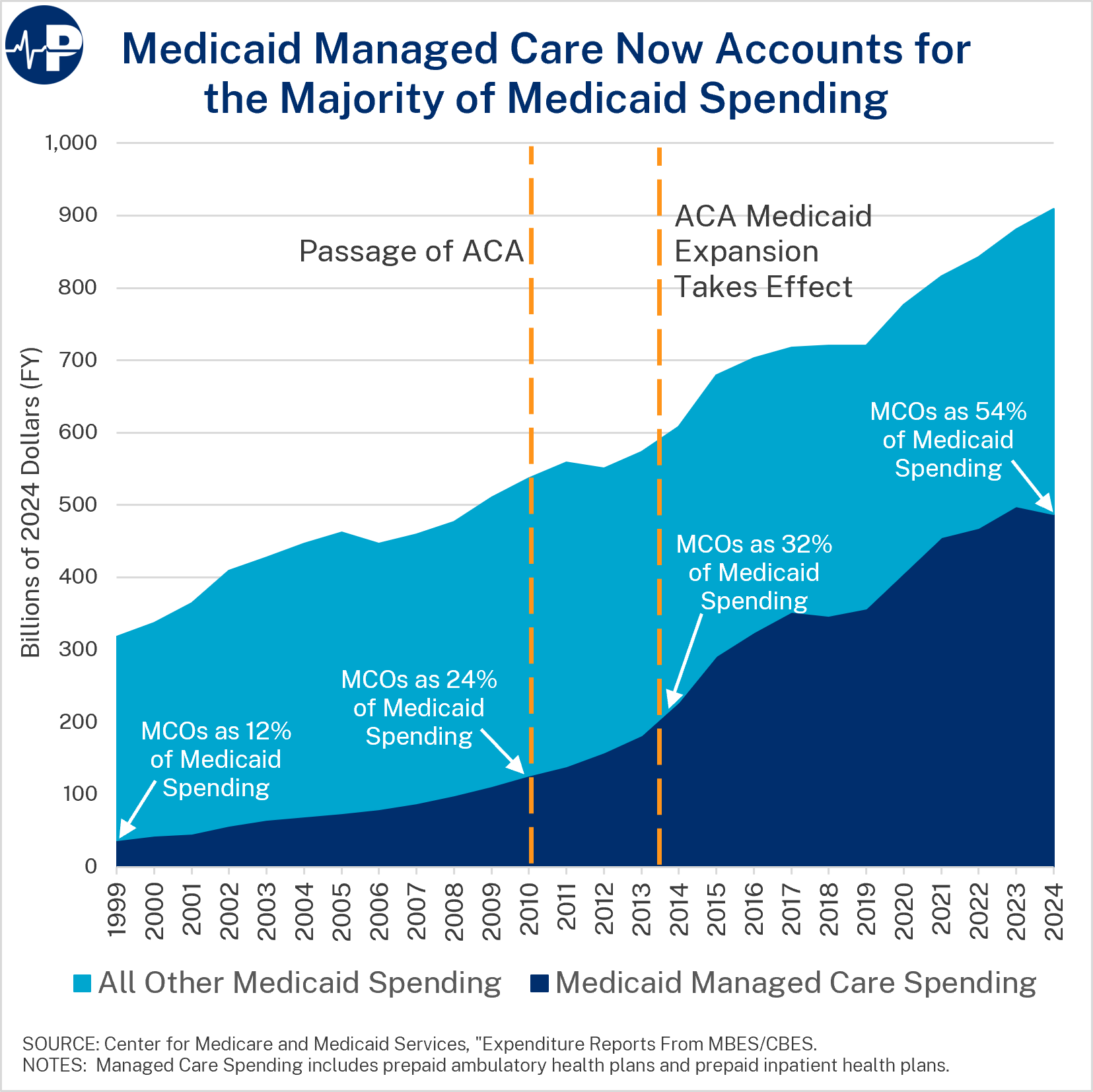
Much of this recent Medicaid spending growth reflects a surge in corporate welfare flowing to large hospital systems through managed care organizations, as well as the Affordable Care Act (ACA) expansion of Medicaid to able-bodied, working-age adults. Under the Biden administration, this type of corporate welfare exploded as Medicaid started paying hospital systems much higher rates than Medicare pays, in some cases two to three times as much for the same services. States financed these corporate welfare payments almost entirely with federal dollars—using financing gimmicks such as provider taxes. A new Paragon PIC shows the growth in managed care in Medicaid over the past 25 years.
Under provider tax schemes, states tax health care providers, use the tax revenue to claim additional federal Medicaid matching funds, and then return both the original tax payments and the new federal dollars to those same providers. The result is a financing arrangement that allows states to increase federal reimbursements with little or no net state spending. Joe Biden correctly described this financing arrangement as a scam and proposed eliminating it. And President Obama proposed limiting states’ ability to use this scheme in his 2012 and 2013 budgets.
Last year, Congress eliminated states’ ability to enact new or expanded provider taxes. Since the rate of return on Medicaid money laundering is nine-to-one for expansion enrollees, Congress also sensibly enacted President Obama’s proposed limits on provider taxes in states with the ACA Medicaid expansion.
Congress also limited the corporate welfare loop by capping Medicaid rates through managed care at no more than Medicare rates (and 110 percent of Medicare rates in non-expansion states). This also protects seniors’ access to health care by ensuring that Medicaid does not become a much better payer than Medicare. In essence, the federal government extended the existing payment limits on the fee-for-service side of Medicaid, under which rates cannot exceed Medicare, to the managed care side. More than 80 percent of American voters support capping Medicaid payments at no more than Medicare rates.
California provides perhaps the clearest example of why Congress needed to reform Medicaid financing. The Biden administration approved California’s Medicaid managed care tax as a pure federal money grab. Commercial insurers were held harmless from the tax, while Medicaid managed care plans were taxed in a manner that generated billions of dollars in additional federal matching payments without new state spending. Those federal dollars were then used to increase Medicaid payments through managed care. The following year, California expanded Medicaid to cover unauthorized immigrants, relying in part on the additional federal funding generated by this financing scheme. Other states copied California’s managed care tax scheme. The OBBB ended these particularly egregious provider tax scams.
Importantly, by limiting the provider-tax-to-corporate-welfare money flow, the OBBB was able to include a $10-billion-a-year fund aimed at transforming health care in rural parts of the country. Targeting dollars to areas where they are most needed is a much more efficient approach to financing the health care safety net.
Work, Not Welfare
One of the most perverse results of the ACA is that the Medicaid program now discriminates against the most vulnerable (children, pregnant women, seniors, and people with disabilities) in favor of able-bodied, working-age adults. On average across states, the federal government sends states seven times as much funding for every $1 of state spending on expansion enrollees as it does for traditional enrollees. As a result, the federal government finances the overwhelming share of spending on expansion enrollees and therefore has a much greater interest in how those dollars are spent.
The OBBB restores an important principle that has long enjoyed bipartisan support: work beats welfare for able-bodied, working-age adults. Beyond increasing income, employment improves long-term financial independence, builds skills, strengthens communities, and reduces reliance on government assistance. The work and community-engagement requirement will encourage employment, increase earnings over time, expand private coverage over welfare, and preserve more resources for the most vulnerable.
Ensuring Proper Eligibility and Protecting Program Integrity in Medicaid and the ACA Exchanges
A social safety net cannot function effectively if millions of people who are ineligible receive taxpayer-funded benefits. Unfortunately, program integrity has deteriorated significantly in both Medicaid and the ACA exchanges. Medicaid’s improper payment rate likely exceeds 25 percent—largely because of a lack of proper eligibility reviews. We conservatively estimate that roughly 27 percent of ACA exchange enrollees in 2026 were improperly enrolled, including millions of phantom enrollees who either never sought coverage or were enrolled without their knowledge. Similar problems almost certainly exist in Medicaid, although the lack of publicly available enrollment and utilization data makes it impossible to determine the full extent of improper and phantom Medicaid enrollment.
The OBBB and corresponding Trump administration regulations took important steps to restore ACA program integrity. Congress eliminated the year-round special enrollment period for individuals with incomes between 100 and 150 percent of the federal poverty level, strengthened income verification requirements, and required individuals who repeatedly fail to reconcile their advance premium tax credits to repay those subsidies before receiving additional taxpayer assistance. For Medicaid expansion enrollees, the OBBB improved eligibility verification and included more frequent reviews to better ensure that only eligible individuals receive taxpayer-funded benefits.
Early evidence suggests these reforms are already making a difference. HHS recently estimated that nearly 2.9 million improper ACA enrollments were removed between 2025 and 2026 and concluded that the decline in exchange enrollment was entirely the result of removing improper enrollments rather than eligible Americans losing coverage.
Greater Equity in Medicaid Financing
The OBBB makes Medicaid financing more equitable across states. Under prior law, states that aggressively exploited provider taxes, state-directed payments, and the enhanced ACA expansion match received substantially more federal funding than states that operated their programs more responsibly. By limiting these financing distortions, the law begins restoring the state-federal partnership on which Medicaid is predicated and provides a fairer distribution of federal Medicaid dollars while preserving generous support for vulnerable populations.
Overall Assessment
Federal health programs contain incentives that produce wasteful spending and tremendous fraud, and they require significant reform. Fortunately, the OBBB showed that federal policymakers could take on powerful special interests and improve programs for the general public. The OBBB marked an important shift away from financing gimmicks, dependency, and weak oversight and toward fiscal responsibility, stronger incentives, greater accountability, and better stewardship of taxpayer dollars. These reforms will help preserve America’s health care safety net for the people it was designed to serve while strengthening the nation’s long-term fiscal future.
Recent Newsletters


Subscribe
Sign up now for your health policy updates.