Paragon Health Institute Icon White

OBBB — Myths and Facts

Even though the health policy provisions of the One Big Beautiful Bill (OBBB) reverse the Biden administration’s reckless and inflationary policies while preserving federal health programs for the truly vulnerable, critics have been quick to launch unfair and dishonest attacks on the progress made by the bill. This collection of resources corrects the record.

OBBB — Myths and Facts

Even though the health policy provisions of the One Big Beautiful Bill (OBBB) reverse the Biden administration’s reckless and inflationary policies while preserving federal health programs for the truly vulnerable, critics have been quick to launch unfair and dishonest attacks on the progress made by the bill. This collection of resources corrects the record on the 2025 reconciliation bill.

What Made It Into Law: Health Provisions of the One Big Beautiful Bill

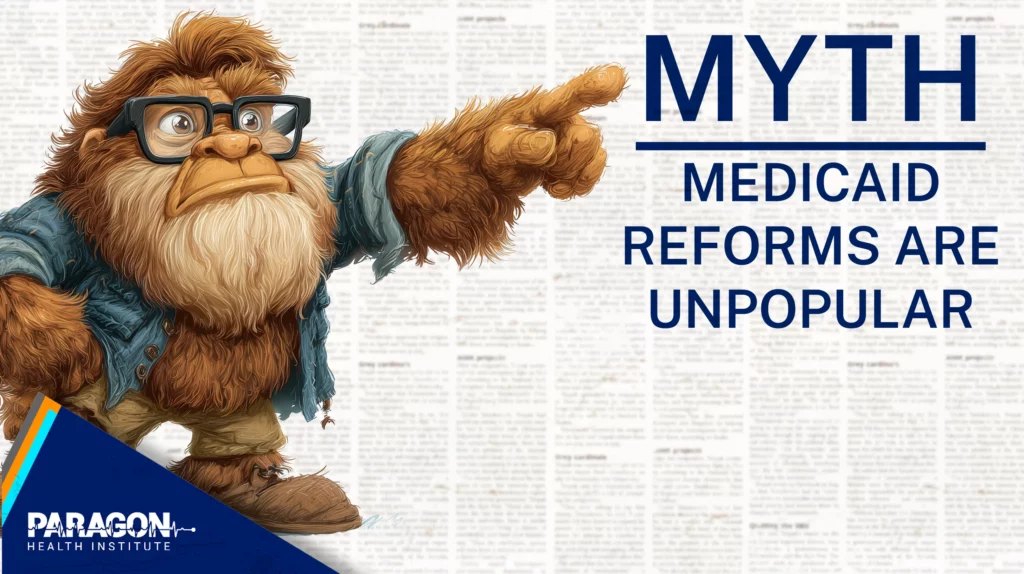
Myth: The OBBB Medicaid reforms are unpopular

Myth: The OBBB cuts Medicaid

Myth: The OBBB will result in large coverage losses

Myth: The OBBB’s Medicaid provisions will force nursing homes to close

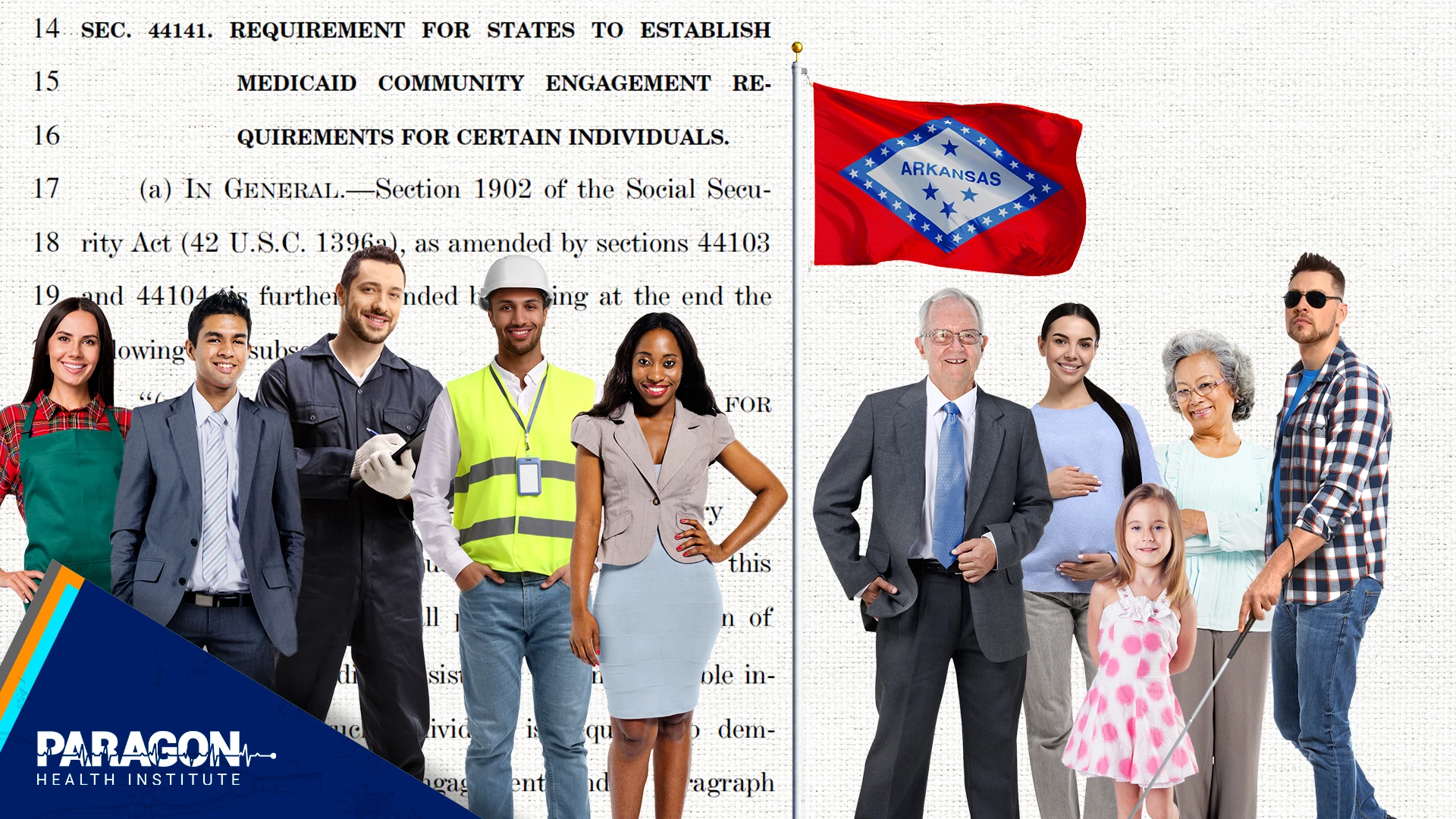
Correcting the Record on Community Engagement Requirements

Myth: States will not be able to cope with the limits on Medicaid money-laundering mechanisms

Myth: The OBBB largely repeals the Affordable Care Act

Myth: The OBBB will harm the most vulnerable Medicaid enrollees

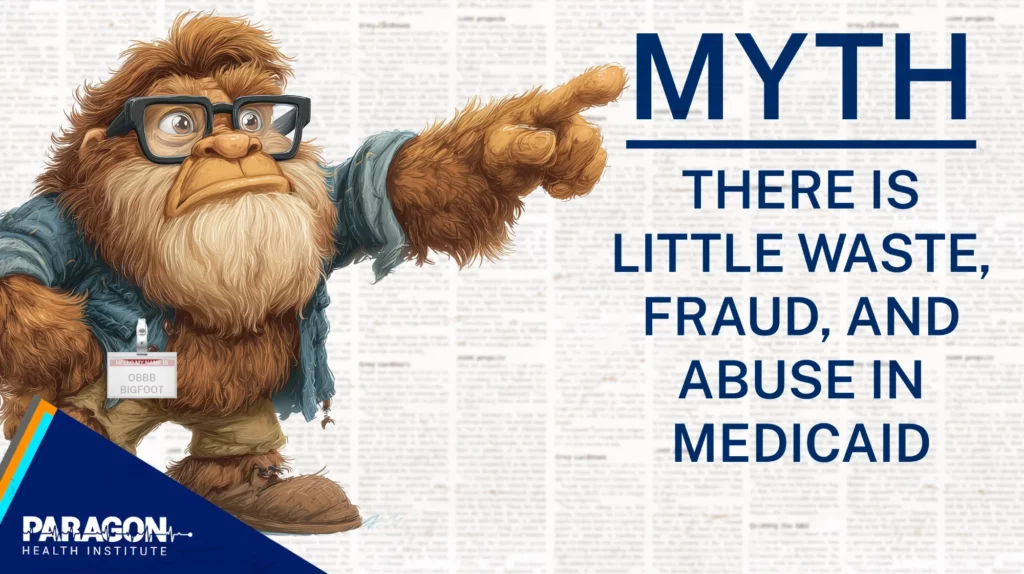
Myth: There is little waste, fraud, and abuse in Medicaid

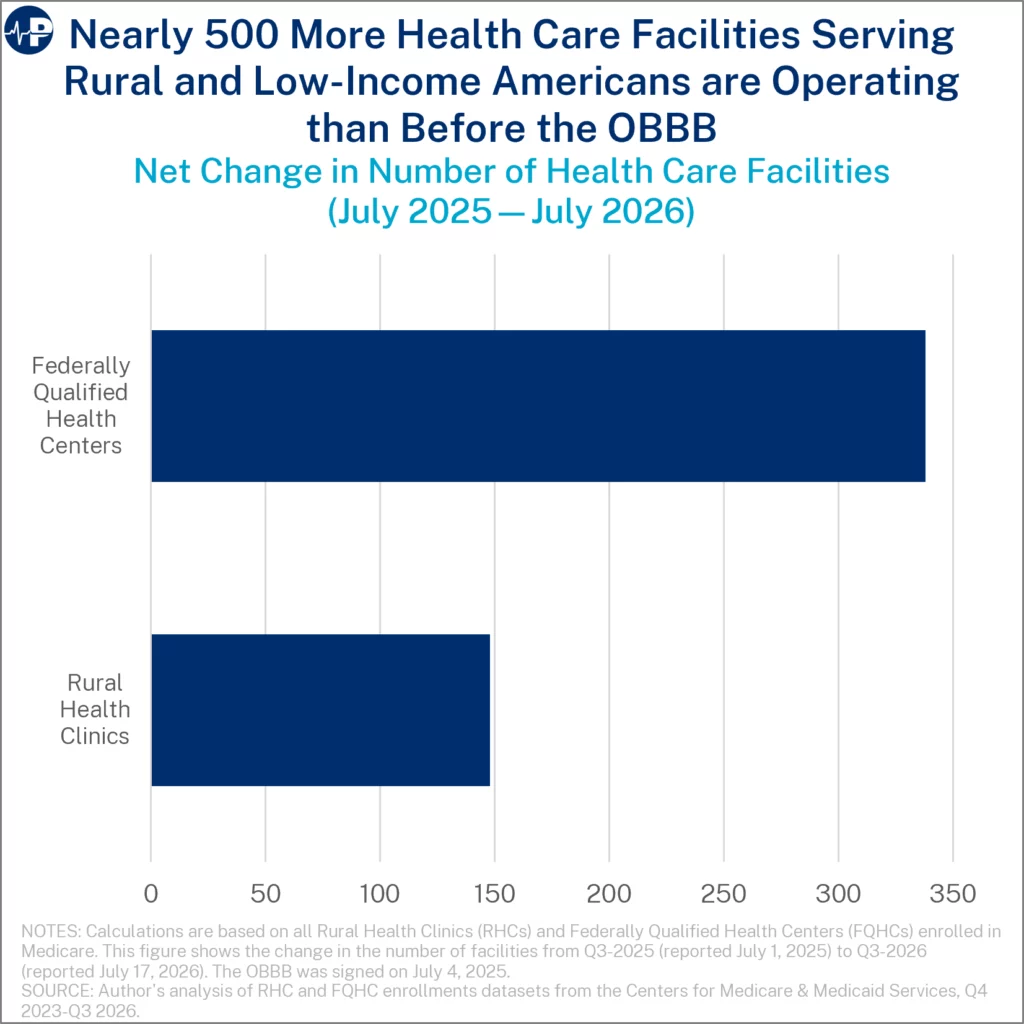
Myth: Rural hospitals will close because of the OBBB

Paragon Pics

8AW Federal Medicaid Spending CBO 2026 2036 A0wUU00000563UzYAI

CBO’s New Budget Baseline Confirms: One Big Beautiful Bill Did Not Cut Medicaid; Biden-Era Profligacy Even Higher Than First Thought

On February 11, the Congressional Budget Office released the latest Budget and Economic Outlook which incorporates technical changes and legislative changes from last year. For Medicaid, the main legislative changes were key provisions of the One Big Beautiful Bill Act, which President Trump signed last summer and which included work and community engagement requirements for able-bodied, working-age adults, increased eligibility reviews, and reductions in the legalized Medicaid money laundering mechanisms and corporate welfare. The technical changes are higher behavioral health, home health, and prescription drug spending that CBO projected the year before.

The new Medicaid baseline confirms significant projected savings to Medicaid spending from the CBO’s baseline forecast one year ago. The new baseline also confirms there are no “cuts” to Medicaid. Indeed, even by 2036, federal Medicaid spending remains above the trajectory projected in CBO’s 2021 baseline—prior to President Biden taking office.

Medicaid spending surged during the Biden administration. One of the prime reasons is that the administration relaxed eligibility rules, leading to millions of ineligible people being enrolled in Medicaid—many with other sources of coverage. The Biden administration also presided over a massive increase in money-laundering tactics and corporate welfare, with many states developing programs to pay hospital systems Medicaid rates at or near average commercial rates (ACR), which average 2.5 times Medicare rates.

The 2025 baseline projected $8.9 trillion in federal Medicaid spending over 10 years (2027-2036), up $1.2 trillion from the 2021 baseline of $7.7trillion over that period. (The 2021 baseline stops in 2031; and the 2025 baseline stops in 2035.  For consistency with the 2026 baseline, those baselines are extrapolated through 2036 according to a linear trend.) The 2026 federal Medicaid baseline is about $600 billion lower than last year’s projection. CBO estimates that technical updates increased projected spending by roughly $500 billion, but the OBBB reforms reduced projected spending by approximately $1.1 trillion—more than offsetting those upward revisions.

As a result, federal Medicaid spending in 2036 will still be about $20 billion higher than it would have been if the 2021 baseline had remained unchanged. In other words, even with the OBBB reforms, federal Medicaid spending is still on a higher baseline than it was at the start of the Biden administration.

Indeed, the 2026 baseline shows that even last year’s baseline underestimated the Biden-era spending binge. Two of the areas with higher-than-expected spending (behavioral health and home health) are highly susceptible to waste, fraud, and abuse. CBO now estimates that combined federal Medicaid spending in 2025 and 2026 will be $25 billion more than it estimated just one year ago.

Despite Post COVID Unwinding, Medicaid Spending Increased By $58 Billion In 2024 (1)

Despite Post-COVID Unwinding, Medicaid Spending Increased by $58 Billion in 2024

New data from 2024 shows that Medicaid spending continued to soar despite enrollment declining following the end of COVID-era continuous coverage requirements. This pattern is consistent with a program where spending is disconnected from serving enrollees, with prevalent waste, fraud, and abuse.

This Paragon PIC draws from the recent release of the 2024 National Health Expenditure Accounts (NHEA) data, the official government estimates of health care spending in the United States. Total Medicaid expenditures (federal and state shares combined) grew from $874 billion in 2023 to $932 billion in 2024—an increase of 6.6 percent. This surge in spending occurred despite a drop in enrollment of about 8 million people as states restarted eligibility verifications and removed ineligible individuals from the rolls. This divergence drove per-enrollee spending up by 16.6 percent in a single year—the fastest growth since at least the 1980s and more than five times the rate of overall inflation.

This latest data confirms what Paragon has long warned: Medicaid’s trajectory is unsustainable. The program’s structural flaws, including open-ended federal reimbursement of state spending, lax eligibility verification, corporate welfare through an increase in state-directed payments, and state financing gimmicks, are key contributors to the spending escalation.

Policymakers have taken important steps to address these problems. The One Big Beautiful Bill (OBBB), enacted in July 2025, includes provisions to curb wasteful spending, reduce welfare dependency, trim corporate welfare in the program, and improve state incentives to manage Medicaid funds responsibly.  Because the data shown here covers the 2024 calendar year, it captures the spending crisis prior to the OBBB, rather than the impact of the OBBB’s reforms. As the key OBBB reforms take effect over the next few years, we expect future data to begin reflecting the bill’s progress in stabilizing Medicaid’s finances and reducing waste, fraud, and abuse in the program.

10AW Paragon Pic State Spending Medicaid No Growth A0wUU000004K9uTYAS

As Medicaid Money Laundering Peaks in States, Reforms in the One Big Beautiful Bill Come to the Rescue

States are more reliant than ever on the federal government to pay for Medicaid. Federal taxpayers now cover nearly three-quarters of total Medicaid spending on a program originally designed to be a federal-state partnership with about a 60 percent federal share.

This imbalance is not accidental. States have exploited financing gimmicks such as provider taxes and intergovernmental transfers (IGTs) to inflate their reported expenditures and draw down more federal funds without any commensurate state cost. These schemes allow states to recycle dollars: health providers are “taxed” (with taxes they lobby in support of), and then those funds are funneled back to providers through higher Medicaid payments. This money laundering scheme effectively pads state budgets while shifting costs to the federal taxpayer.

In today’s Paragon Pic, we isolate Medicaid expenditures funded with laundered money using financial shell games from those funded with actual state dollars. The Pic also shows the proportion of Medicaid expenditures funded by the federal government.

The proportion of total federal spending on states’ Medicaid programs doubled in the last 30 years. Meanwhile, the state share of this spending with actual state dollars, meaning those not sourced through money laundering schemes, is flat over time. Today, money laundered funds from provider taxes and IGTs account for roughly 3 percent of all state spending. This amounts to a three-fold increase over the last three decades.

Paragon’s research finds that half of all states financed more than 30 percent of their share of Medicaid through provider tax revenue alone. These financing schemes distort Medicaid’s intent and erode fiscal accountability. Fortunately, in the One Big Beautiful Bill, Congress limited these financing gimmicks through critical reforms—which the Congressional Budget Office estimates will save $366 billion over the next decade. These provisions help restore integrity to the federal-state partnership and shield taxpayers from exploitation by these means.

32AW ACA And Medicaid Paragon Pic A0wUU000003q661YAA

The One Big Beautiful Bill Reverses Biden-Era Medicaid and Obamacare Spending Binge

Based on the Congressional Budget Office’s (CBO) most recent projections, baseline federal spending on Medicaid and Obamacare subsidies from 2025 to 2034 increased by $1.9 trillion—or 25 percent.

The One Big Beautiful Bill (OBBB) would significantly reduce waste, fraud, and abuse in these two programs. Contrary to what critics say, it does not cut spending. Rather, it would slow the rate of growth in these programs by largely reversing the Biden-era spending spree.

The OBBB includes a $50 billion fund for rural health care providers. Including the rural health fund, Medicaid and Obamacare spending through 2034 will be $703 billion—almost ten percent—more than forecast in 2021. As shown in first figure, the OBBB would not reduce Medicaid and Obamacare subsidy spending to the pre-Biden baseline levels until 2032.

The OBBB Would Reverse the Biden-Era ACA and Medicaid Spending Binge, Restoring Spending to the Pre-Biden Baseline by 2032
 

This estimate includes interactions between health provisions in the bill. Although CBO does not specify these interactions, we expect most of the interactions are attributable to Medicaid, which is much larger than Obamacare.

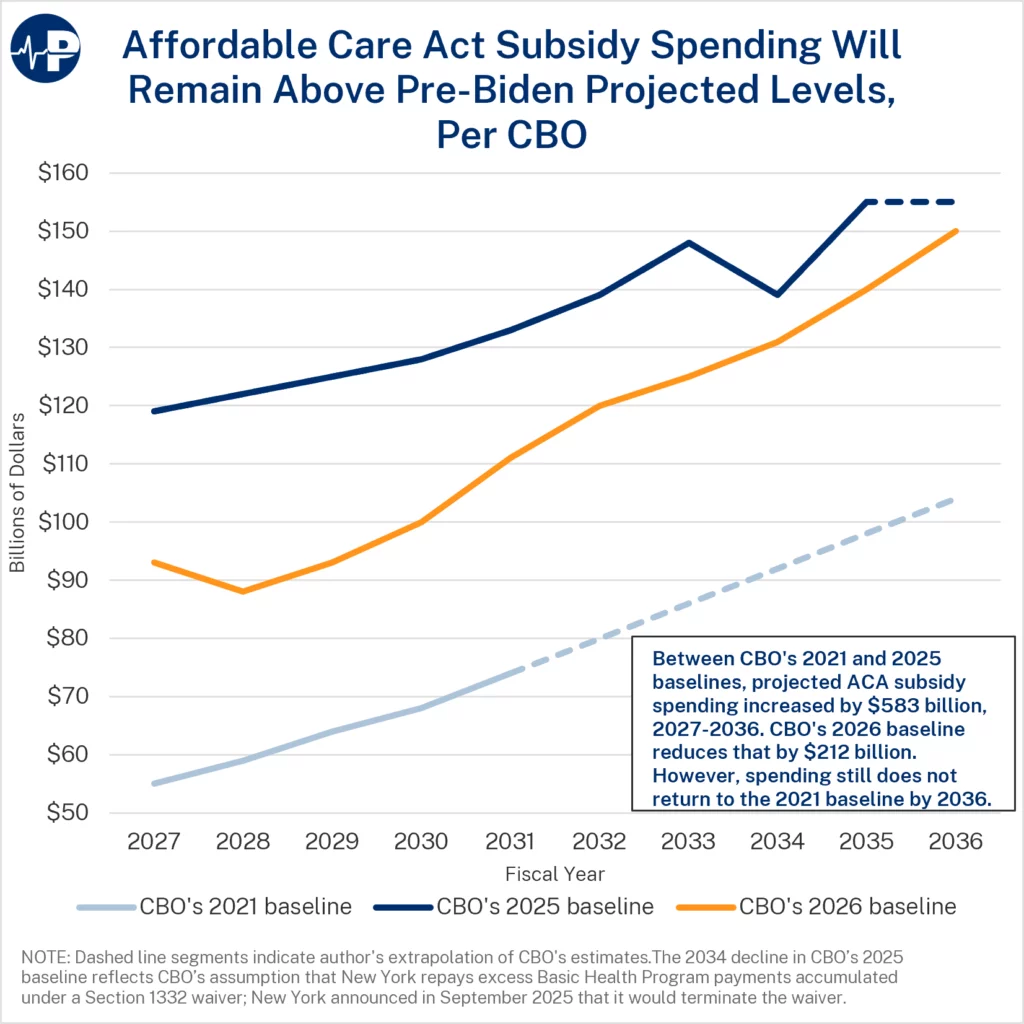
Including the interactions estimated by CBO, as well as the new rural health provider fund, Medicaid spending will be $450 billion higher—7 percent higher—over the 2025 to 2034 period than CBO forecast in 2021. Obamacare spending will be $317 billion higher—a whopping 44 percent higher—than CBO forecast in 2021. (The Obamacare figure has a kink in the baseline in 2034 showing a unique payback from New York, which has accumulated an excessive reserve in its Basic Health Program, which CBO expects it will remit to the federal government that year.) The OBBB’s significant reductions in fraud, waste, and abuse do not counter all Biden-era changes that increased Obamacare spending.

The OBBB Would Reduce the Biden-Era Medicaid Spending Binge, Restoring Spending to the Pre-Biden Baseline by 2031
The OBBB Would Reduce the Biden-Era Obamacare Spending Binge, Although Spending Will Remain Well Above the 2021 Baseline
 

The main driver of the Biden spending increase is a set of administration policies that prioritized enrollment at any cost in both the exchanges and in Medicaid expansion. In the exchanges, these policies weakened program integrity measures, stopped income verification for many enrollees, and essentially opened a year-round enrollment period. New Paragon research estimates improper exchange enrollment was 5.0 million people in 2024 and 6.4 million people in 2025. Based on CBO’s assessment, it will take a few years for the fraud to work its way out of the system.

The biggest winners from these policies were health insurers, who reaped massive profits from the flood of subsidies and improper enrollment, and unscrupulous brokers, who earn a commission for each month a person they signed up remains enrolled.

Medicaid increased much more than projected for three primary reasons. First, the Biden administration maintained the COVID public health emergency for much longer than expected—leaving a legacy of higher enrollment in the program. Second, the Biden administration took several actions that made it more difficult for states to remove ineligible enrollees. And third, the Biden administration exacerbated state Medicaid money laundering techniques. This led to a substantial increase in corporate welfare in the program, most notably escalating revenues through the provider tax scam so states could reward hospitals and insurers with excessive Medicaid rates through state-directed payments.

The OBBB takes several steps to reverse the Biden administration’s enrollment-at-any-cost policies, including by reinstituting commonsense eligibility reviews for both the exchanges and Medicaid expansion while adding a community engagement requirement for able-bodied, working-age adults enrolled through Obamacare’s Medicaid expansion. The OBBB would also limit state Medicaid money laundering schemes and reduce corporate welfare in the program. All these changes would still leave projected Medicaid and Obamacare subsidy spending one-third higher from 2025-2034 than CBO projected at the start of the Biden administration.

Other Related Content

Related Glossary Terms

Supplemental Payments
A Medicaid supplemental payment is a lump sum payment paid by the Medicaid program to a health care provider in addition to Medicaid payments for specific health care services that have been rendered. These payments are largely received by hospitals and include DSH payments, upper payment limit (UPL) payments, uncompensated care pool (UCP) payments, and delivery system reform incentive (DSRIP) payments. By 2019, these payments grew to 17.5 percent of total Medicaid spending and 27 percent of Medicaid spending on hospitals. The growth in supplemental payments increases lobbying with government officials having discretion to award large Medicaid payments, payments consisting mostly or entirely…
Medicaid Expansion
Medicaid expansion is the Affordable Care Act’s change to broaden Medicaid program eligibility and increase the number of people who qualify for the program. A major component of this expanded eligibility for state Medicaid programs was eligibility for a new category of people—able-bodied, working-age, and generally childless adults. The ACA created a much higher FMAP for this category—equal to 100 percent from 2014-2016, gradually declining until it reached 90 percent in 2020, where it is scheduled to remain. This FMAP policy incentivized states to expand Medicaid because most of the budgetary costs for the population of expanded enrollees were paid…
Federal Medical Assistance Percentage
The Federal Medical Assistance Percentage (FMAP) is the statutory percentage of Medicaid expenditures paid by the federal government. For traditional Medicaid enrollees (low-income pregnant women, children, seniors, and individuals with disabilities), the FMAP is largely a function of state per capita income as states with lower per capita income receive a higher FMAP. No state receives an FMAP below 50 percent. For Medicaid expansion enrollees, the FMAP is equal to 90 percent. The actual percentage of Medicaid expenditures paid by the federal government is substantially higher than the FMAP since states employ numerous accounting gimmicks and financial schemes to minimize…
Average Commercial Rate
The average commercial rate (ACR) refers to the mean payment amount for a medical service as determined by leading commercial insurers’ reimbursement rates for the same service. The ACR may be used to define the maximum limit of a state Medicaid program’s supplemental payments to health care providers that are in excess of the state’s Medicaid standard rates. HHS guidance on ACR payments states when provider payment “is made up to the ACR states must submit data from the top (generally five) third party payers and provide a full explanation of the data that was extracted from providers’ accounts receivable…

Issue Experts

Brian Blase
President at Paragon Health Institute

Brian Blase, Ph.D., is the President of Paragon Health Institute. Brian was Special Assistant to the President for Economic Policy at the White House’s National Economic Council (NEC) from 2017-2019, where he coordinated the development and execution of numerous health policies and advised the President, NEC director, and senior officials. After leaving the White House, Brian founded Blase Policy Strategies and served as its CEO.

1AW Ryan Long Headshot SMALLER
Ryan Long is the Director of Congressional Relations and a Senior Research Fellow at Paragon Health Institute. In this role he is the leading voice communicating Paragon’s research and proposals to Congress by connecting with and educating policymakers and their staffs and leading the Congressional Health Policy Education Program. As a researcher, Long produces original papers and policy briefs promoting consumer choice, market competition, and innovation in healthcare markets. These publications focus on regulatory and policy reforms to ensure a sustainable and innovative health care system.
Niklas Kleinworth Headshot SMALLER V2
Director, State Health Reform Initiative; and Policy Analyst

Niklas Kleinworth is the Director of the State Health Reform Initiative and a Policy Analyst at the Paragon Health Institute, focusing on Medicaid and state policy initiatives. He has served in state and federal policy roles since 2021.

ELLE KALISZ HEADSHOT SMALLER 186A6472 V2
Program Manager

Gabrielle “Elle” Kalisz is the Program Manager at Paragon Health Institute. Gabrielle has worked in federal health policy for over five years, advancing free-market principles and partnerships.

Liam Sigaud Headshot
Adjunct Scholar at Paragon Health Institute

Liam Sigaud is an Adjunct Scholar at the Paragon Health Institute and a Research Analyst at the Knee Regulatory Research Center at West Virginia University.

3AW SMALLER 240409 STHQ DH01 0112
Senior Policy Analyst

Jackson Hammond is a Senior Policy Analyst at Paragon Health Institute. He has been active in the federal and state health policy space since 2017.

Prior to joining Paragon, Jackson was a health care policy analyst for American Action Forum (AAF). While at AAF, his work focused on payer issues including private insurance, Medicare, and Medicare Advantage. Furthermore, Jackson wrote extensively about the 340B Program and contributed to AAF’s research on a variety of drug pricing issues.

Subscribe

Sign up now for your health policy updates.

This field is for validation purposes and should be left unchanged.
Name(Required)