

Brian Blase, Ph.D., is the President of Paragon Health Institute. Brian was Special Assistant to the President for Economic Policy at the White House’s National Economic Council (NEC) from 2017-2019, where he coordinated the development and execution of numerous health policies and advised the President, NEC director, and senior officials. After leaving the White House, Brian founded Blase Policy Strategies and served as its CEO.
Reversing the Curse: Rooting Out Waste and Fraud and Restoring the Dignity of Work — Testimony of Brian Blase

The below testimony was submitted June 25, 2025 to the United States House Committee on the Budget.
Download the written testimony here:
Thank you, Chairman Arrington and Ranking Member Boyle, for the invitation to testify before the Committee today on this important subject. I am the president of Paragon Health Institute. I am also a visiting fellow with the Foundation for Government Accountability. Today’s testimony reflects my views and not those of Paragon Health Institute or any other organization.
Under the Biden administration, projected federal spending on Medicaid and Affordable Care Act (ACA) subsidies from 2025 to 2034 surged by $1.9 trillion—a 25 percent increase—over Congressional Budget Office (CBO) estimates at the start of the Biden administration, as shown in Figure 1.1 (I provided a supplemental document with figures and tables.) The primary driver of this increase is the previous administration’s policy decisions that prioritized maximizing enrollments in both Medicaid expansion and the ACA exchanges regardless of enrollee eligibility. The Biden-era expansion of Medicaid financing schemes, which are essentially legalized money laundering, and state-directed payments also contributed to this rapid spending growth.

In the ACA exchanges, improper enrollment, weakened program integrity, weak income verification efforts in states using the federal exchange, and the creation of a year-round enrollment window have also driven subsidy growth. I coauthored a recent Paragon study finding that improper exchange enrollment rose from 5.0 million people in 2024 to 6.4 million people in 2025—benefiting health insurers, unscrupulous brokers, and lead-generator companies that profit from fraudulent enrollment.2 Improper enrollment in Medicaid expansion is likely of a similar magnitude.3
The One Big Beautiful Bill (OBBB) will reverse many of the previous administration’s enrollment-at-any-cost policies by restoring eligibility checks, reducing state Medicaid financing gimmicks, and instituting commonsense program integrity measures. Even with these necessary reforms, federal spending on ACA subsidies and Medicaid would likely exceed the levels projected by CBO in 2021 by at least $500 billion over the next decade.
Medicaid Spending Growth
At the heart of Medicaid’s fiscal challenges is the open-ended matching formula, which reimburses states for both real and artificial expenses—creating strong incentives for states to grow the program. In recent years, Medicaid has become the fastest-growing major government health program, both in terms of enrollment and spending. The Congressional Budget Office projects federal spending on Medicaid to be more than $1.3 trillion higher over the next decade (2025-2034) relative to its 2021 baseline, as shown in Figure 2.4

Federal Medicaid spending increased dramatically during the Biden administration—a result of policies that prioritized enrollment over eligibility, exacerbated state Medicaid money-laundering tactics, and produced excessive state payments to providers and insurers given states’ ability to disproportionately spend with federal money. Simply put, the historic federal-state financial partnership underpinning Medicaid is broken. The 90 percent federal reimbursement for the expansion population and the growth of state efforts to recycle funds used for Medicaid reimbursement has caused the federal share of Medicaid to soar from a historic 60 percent to 75 percent. Figure 3 illustrates the rising federal share over time—both the purported share that appears on paper and the actual share that accounts for the share of state financing that is artificial. Importantly, this dramatic spending growth has not translated into meaningful improvements in health outcomes.5

Goals of Medicaid Reform
To address these problems within Medicaid, I recommend policymakers focus on five core goals for Medicaid reforms:
- End discriminatory financing that favors Medicaid expansion adults over traditional enrollees.
- Transition able-bodied adults off Medicaid and into employer-sponsored or individual market coverage.
- Align incentives so states prioritize the outcomes of spending—not just maximizing federal matching funds.
- Curb money-laundering schemes that shift state costs onto federal taxpayers.
- Get federal spending under control to ensure Medicaid’s sustainability and reduce inflationary pressure.
Medicaid Money Laundering
The widespread use of state financing schemes that inflate federal payments—what I call Medicaid money-laundering—has harmed the integrity of the program. There is historic bipartisan concern about these state schemes as Vice-President Biden referred to them as scams that should be eliminated, Senator Dick Durbin referred to them as a “bit of a charade,” President Obama proposed to scale them down, and the Washington Post editorial board called phasing down states ability to use this scam “a much needed Medicaid reform” in an endorsement of President Obama’s proposal.6
Earlier this year, I coauthored a paper describing how state governments have deliberately developed financing schemes and accounting gimmicks to secure larger Medicaid payments from the federal government.7 In collaboration with health care providers and insurers, state governments have leveraged reimbursement arrangements that exploit the Medicaid financing system—allowing them to draw down substantial federal funds without a proportional increase in state expenditures.
States employ gimmicks such as provider taxes to generate revenue that they use to fund their share of Medicaid spending. These funds are then used to inflate payments to providers, enabling states to claim additional federal dollars. Although some of these federal funds flow back to providers, states often retain a portion for unrelated budget items. Providers, particularly hospitals, often help develop these schemes because states guarantee them higher—and often overly inflated—payment rates. These legally permissible financing schemes have shifted a growing share of Medicaid costs to the federal government. States’ use of provider taxes exploded during the Biden administration—with revenue increasing double or triple historic norms.
Let me offer one illustrative example from California, where the state employed a Medicaid tax scam to expand Medicaid in ways it likely never would have if it had borne at least a significant portion of the cost.8 In 2023, the state dramatically increased a tax on insurance companies, typically dubbed managed care organizations (MCOs) that participate in Medicaid. Through the MCO tax, the state collects revenue from Medicaid MCOs, receives a federal match, and then returns both the original tax amount as well as a portion of the federal funds obtained to those same MCOs in the form of higher Medicaid payments. This recycled flow of funds allows California to draw billions in additional federal funding without increasing its net contribution to Medicaid.
California used this influx of federal money to skirt federal restrictions and extend Medicaid coverage to undocumented immigrants. They also used this boost in revenue to eliminate an asset test for Medicaid long-term care, allowing wealthy heirs to shield inheritances while taxpayers absorb the cost. The Biden administration approved this California tax scam in 2023 and other states, including New York, had similar taxing schemes approved in the waning days of the administration.
States are increasingly using the federal funds obtained using provider taxes to make large payments to hospital systems through a mechanism known as state-directed payments (SDPs). Through SDPs, states require Medicaid MCOs to raise payment rates to hospitals and other providers to certain amounts.
The Medicaid and CHIP Payment and Access Commission (MACPAC) projects that spending on SDPs jumped from around $26 billion for payments approved as of December 2020 to over $110 billion for payments approved as of August 2024.9
Many states are setting Medicaid rates for providers through SDPs at or near average commercial rates (ACR), which are more than 2.5 times higher than Medicare rates. Higher Medicaid rates relative to Medicare rates will produce incentives for providers to favor Medicaid recipients over Medicare recipients and could threaten seniors’ access to care. Moreover, tying Medicaid payments to ACRs can inflate commercial rates over time—ultimately driving up premiums for individuals with private insurance.
The rise of SDPs that are funded through provider taxes and intergovernmental transfers (IGTs) has contributed to the federal government’s share of Medicaid increasing 15 percentage points over the past several decades. Through an IGT, a local government or government-owned provider transfers money to the state that the state then uses to make much higher Medicaid payments on providers, which are often the very same providers that make the IGT.
The erosion of state financial responsibility undermines the foundational federal-state Medicaid financial partnership. States pay a smaller share of GDP on Medicaid than they did in 2008. As their financial commitment shrinks, so does their incentive to ensure that spending delivers value for its intended beneficiaries—contributing to wasteful spending that provides limited benefit to patients. Figure 4 shows how the federal government has financed the entire economic cost of Medicaid’s rapid growth from 2008 to 2023.

Biden’s Prioritization of Enrollment Over Eligibility
The Biden administration pursued policies focused on aggressively expanding Medicaid enrollment. This included relaxing eligibility enforcement, including repeated extensions of the COVID-19 public health emergency, which prolonged the costly continuous coverage mandate of the Families First Coronavirus Response Act. I coauthored a 2023 report on this issue, highlighting projections that 18 million individuals remained enrolled in Medicaid long after they ceased to meet eligibility requirements, wasting precious resources on those who were not eligible at an annualized cost of more than $80 billion.10
The expansion of Medicaid, most notably the ACA expansion, as well as less attention on enforcing eligibility guidelines has led to steep enrollment growth. Moreover, the Medicaid program has shifted away from serving the poor. As Figure 5 shows, more than twice as many people are enrolled in Medicaid as there are Americans living in poverty. In other words, there are more Americans above the poverty line enrolled in in Medicaid than below it.

As able-bodied adults have been added to the Medicaid program, resources are increasingly directed away from the truly vulnerable. Able-bodied, working-age adults are now about 40 percent of program enrollment.11 Paragon policy expert Liam Sigaud estimated that 6.6 million people were improperly enrolled in the ACA Medicaid expansion in 2024 at an annual federal cost of $36.9 billion.12 Medicaid expansion is associated with declining levels of resources for children and people with disabilities in expansion states compared to non-expansion states.13 Medicaid expansion led to a significant increase in the use of emergency rooms for non-emergent health needs.14
In 2019 and 2020 (the only two years where full audits were conducted), CMS found that Medicaid improper payment rates averaged 27 percent.15 Over the past decade, CMS claims there have been $543 billion in improper federal Medicaid payments.16 However, research I conducted with EPIC’s Rachel Greszler shows that most of CMS’s reported improper payment rates are based on incomplete audits. CMS fully audited state Medicaid programs, by including eligibility reviews, in just two of the past 10 years. Assuming the years when CMS conducted complete audits are representative of improper payments in years when CMS did not, we estimate Medicaid’s improper payment rate was 25 percent over the past decade. This error rate translates into more than $1.1 trillion in improper federal spending since 2015.17 The majority of these errors result from failures to verify income or citizenship status, or from insufficient documentation of eligibility, which is a natural result of the misaligned incentives where states pay essentially nothing for Medicaid expansion enrollees and place a low priority on proper eligibility reviews.
As a result of the funding disparities between ACA expansion enrollees and traditional enrollees (discussed more below), states make money when they classify a traditional enrollee as an expansion enrollee. Moreover, states often bear no real cost at all for an expansion enrollee because they use financing gimmicks to fund the state’s 10 percent share of Medicaid spending for these enrollees.
The ACA’s Discrimination Against the Most Vulnerable on Medicaid
The Federal Medical Assistance Percentage (FMAP) determines the share of state Medicaid costs reimbursed by federal taxpayers. For traditional enrollees, that percentage is largely determined by a state’s per capita income. The FMAP has a statutory floor at 50 percent, meaning that even the wealthiest states receive at least half of their Medicaid spending financed by the federal government. This formula is designed to give poorer states additional support and wealthier states less assistance, with an aim of equitable federal support across the country. I coauthored a study last year that showed that despite these goals, wealthier states receive far more federal Medicaid financing per person in poverty than poorer states.18
The ACA created a new eligibility group—able-bodied, working-age, childless adults—and created a much higher federal reimbursement rate for them. During the first three years of the expansion (2014-2016), the federal government reimbursed 100 percent of state expenditures on expansion enrollees. Unsurprisingly, states responded by misclassifying people as expansion enrollees and setting extremely high payment rates to insurers for plans with expansion enrollees.
Starting in 2017, the expansion FMAP declined until it reached 90 percent in 2020, where it is scheduled to remain in perpetuity. As illustrated in Figure 6, for every $1 states spend on expansion enrollees, states receive $9 in federal funds. In contrast, on average, states only receive $1.33 for every dollar they spend on traditional enrollees. So, the average state receives seven times more federal funding for one dollar of state Medicaid spending on able-bodied, working-age, childless adults than it receives for spending on traditional enrollees. This immoral imbalance creates a powerful incentive for states to prioritize able-bodied, working-age adults over the most vulnerable.

Community-Engagement Requirements
Medicaid is a welfare program that was never intended to serve as a long-term support system for able-bodied, working-age adults. Yet by the end of 2021, Biden’s CMS had systematically revoked all previously approved state waivers that allowed for Medicaid work requirements. These waivers—granted under Section 1115 demonstration authority—were intended to encourage employment, education, or volunteerism as a condition of Medicaid eligibility for certain adults.
It is critical for Medicaid enrollees to have a stake in the taxpayer-subsidized benefits they receive. Community-engagement requirements promote personal independence among enrollees as they gain skills, experience, and productivity through the workplace or civic engagement. Work opens the door to independence, enabling individuals to support themselves without government assistance and to access private health coverage. Recent moves in Congress to expand community-engagement requirements in Medicaid are a positive reform for the benefit of enrollees, their neighbors, and taxpayers alike.
Americans Support Medicaid Reform
The American public opposes the status quo and supports Medicaid reform. A 2025 Paragon-commissioned public opinion survey found strong public support for specific changes.19
Nearly two-thirds of voters support aligning the FMAP for expansion adults with that of traditional enrollees.
83% of voters favor limiting Medicaid payments to providers at rates no higher than Medicare payments.
81% of voters support requiring able-bodied adults to work in order to continue receiving Medicaid benefits.
One Big Beautiful Bill Contains Important Medicaid Reforms
Fortunately, Congress is taking steps in the right direction. The One Big Beautiful Bill (OBBB) includes several key Medicaid reforms.
Reducing Medicaid Money Laundering
The OBBB targets states’ abuse of provider taxes and state-directed payments—mechanisms that allow states to inflate federal matching dollars without requiring real state contributions:
- Provider tax rates are frozen with no new ones permitted.
- New SDPs are capped at 100% of Medicare rates in Medicaid expansion states and 110% in non-expansion states.
- The bill codifies stricter standards for uniformity and redistribution, targeting tax schemes like California’s managed care provider tax, used almost exclusively on Medicaid plans, to extract federal funds to cover unauthorized immigrants.
Community-Engagement Requirements
The OBBB requires able-bodied adults, working-age without dependents to work, study, or volunteer for at least 80 hours per month to retain Medicaid coverage. This provision restores Medicaid’s role as a safety-net program, not a permanent welfare option for able-bodied individuals.
Verifying Eligibility and Reducing Improper Payments
To address improper payments and eligibility abuses, the OBBB takes several actions, including:
- Requiring semiannual eligibility re-determinations for ACA Medicaid expansion enrollees;
- Implementing real-time address verification to detect dual enrollment across states; and
- Limiting HHS’s discretion to waive penalties for excessive improper payments and strengthening requirements for Section 1115 waiver budget neutrality.
These measures address core structural flaws—namely, the lack of state accountability and the misalignment of federal incentives that reward overspending.
ACA Exchange Enrollment Fraud
I will now turn to problems in the ACA exchanges, where similar misaligned incentives have led to massive improper enrollment.
CBO’s most recent ACA subsidy baseline projection is 91 percent above its 2021 projection over the 2026 to 2033 period, as Figure 7 shows.20 This surge in spending reflects widespread fraud in the program and Biden administrative decisions that prioritized enrollment in the program over a host of other considerations, including eligibility and potential double enrollment in other programs.

During the annual open enrollment period, applicants estimate their household income for the following year, often with the assistance of brokers or navigators. Based on this reported income, the government sends monthly advance premium tax credits (APTC) to the insurer offering that plan. If an enrollee underestimates their income, they are required to repay some of the premium tax credit when they file their taxes. But the amount a taxpayer must repay is capped, providing an incentive to underestimate income.21
Figure 8 demonstrates the incentive to misstate income and how it varies by the applicant’s age. The figure includes an estimate of the cost to taxpayers when enrollees, or often unscrupulous brokers, misstate enrollee income to between 100 and 150 percent FPL to qualify for a fully subsidized plan with an actuarial value of 94 percent.22 People generally qualify for larger subsidies if they underestimate their income. This figure illustrates the benefits of income underestimation beginning at 200 percent FPL (the incentive to underestimate income for households below 200 percent FPL is minimal). The benefit of cheating gradually increases as household income increases until the benefit ceases at 400 percent FPL, where there is full subsidy recapture.

In a June 2025 paper that I co-authored,23 we found the amount of improper enrollment grew substantially between 2024 and 2025, with the number of ineligible enrollees rising from an estimated 5.0 million to 6.4 million. Under more expansive assumptions, the number of ineligible enrollees in 2025 could reach as high as 7.1 million. The estimated cost to taxpayers from this improper enrollment will likely exceed $27 billion in 2025 alone.
Four main forces drive the large-scale fraud and improper enrollment. First, pandemic-era legislation temporarily expanded the ACA’s premium subsidies. The expanded subsidies mean that taxpayers fully cover the cost of benchmark plans for individuals who report income between 100 and 150 percent of the federal poverty level (FPL). These enhanced subsidies—set to expire after 2025—have created strong financial incentives for applicants and those allegedly acting on their behalf to misstate income and enroll in this income category. Second, the Biden administration adopted policies that prioritized maximizing enrollment over verifying eligibility. These included relaxing documentation requirements and enabling broader use of automatic re-enrollment mechanisms. Third, the ACA limits the federal government’s ability to recapture excess subsidies when applicants misstate their income. Most enrollees who misreport income face only a modest repayment cap (and millions of enrollees face no repayment cap), even if they received thousands of dollars in excess subsidies. Fourth, automatic re-enrollment perpetuates improper coverage year after year. In 2025, nearly 11 million enrollees—45 percent of total exchange participants—were automatically re-enrolled, without having to update their eligibility information.24
A recent Bloomberg investigation highlighted how large-scale deception rings take advantage of these perverse incentives. Tactics include misleading advertising promising cash benefits as well as unscrupulous lead generators and brokers enrolling people without their knowledge and switching applicants into plans without their consent.25
Paragon’s new report explains how all the incentives lead to cheating and fraud on a mass scale. The most common tactic involves enrollees or brokers misrepresenting income in the 100 to 150 percent FPL range to qualify for fully subsidized insurance with extremely low deductibles and copayments. Under the ACA, in states that have not expanded Medicaid, people with income below 100 percent FPL are ineligible for subsidies.
Insurance brokers and carriers also benefit from this flawed structure. Brokers receive commissions per enrollment, creating strong financial incentives to maximize sign-ups by any means necessary. Enhanced Direct Enrollment (EDE) platforms have enabled unscrupulous brokers to bypass HealthCare.gov and enroll people without their knowledge or consent. Many of these EDE platforms lack basic safeguards—including omitting Social Security numbers. Despite the opportunities for fraud, the use of these platforms is widespread. EDE platforms accounted for 81 percent of all broker-assisted enrollments in 2023.26
CMS received more than 200,000 complaints about unauthorized plan switches in 2024 alone.27 In 2025, the Department of Justice brought charges against insurance executives accused of defrauding taxpayers out of more than $160 million.28 Additionally, a Florida-based brokerage executive pled guilty to a separate $133 million scheme that targeted homeless and mentally ill individuals to improperly enroll them in subsidized ACA plans.29
Figure 9 demonstrates the shift in overall enrollment to the lowest income category in the states that use HealthCare.gov. The first open enrollment period with fully subsidized plans was 2022. By 2025, 55 percent of people who signed up for coverage during open enrollment reported that their income was between 100 and 150 percent FPL. This figure shows only the federal exchange sign-ups, because not all states with state-based exchanges reported sign-ups by income grouping prior to 2022.

We estimate that 62 percent of individuals reporting income between 100 and 150 percent in HealthCare.gov states are not actually eligible, meaning that for every two eligible enrollees, there are more than three ineligible enrollees in this category. In total, 29 states had more reported enrollees in this income category than the number of eligible individuals in the population, based on our conservative methodology for determining improper enrollment.30 There are more than twice as many enrollees as eligible individuals in 15 states. Florida has exceptionally high improper enrollment, with nearly five times as many enrollees as eligible individuals. This pattern points to massive and deliberate income misrepresentation, often facilitated by unscrupulous lead generators and brokers and directly due to perverse incentives in the ACA and Biden administration mismanagement of the federal exchanges.
Table 1 shows 15 states with the most fraudulent enrollees in 2025.
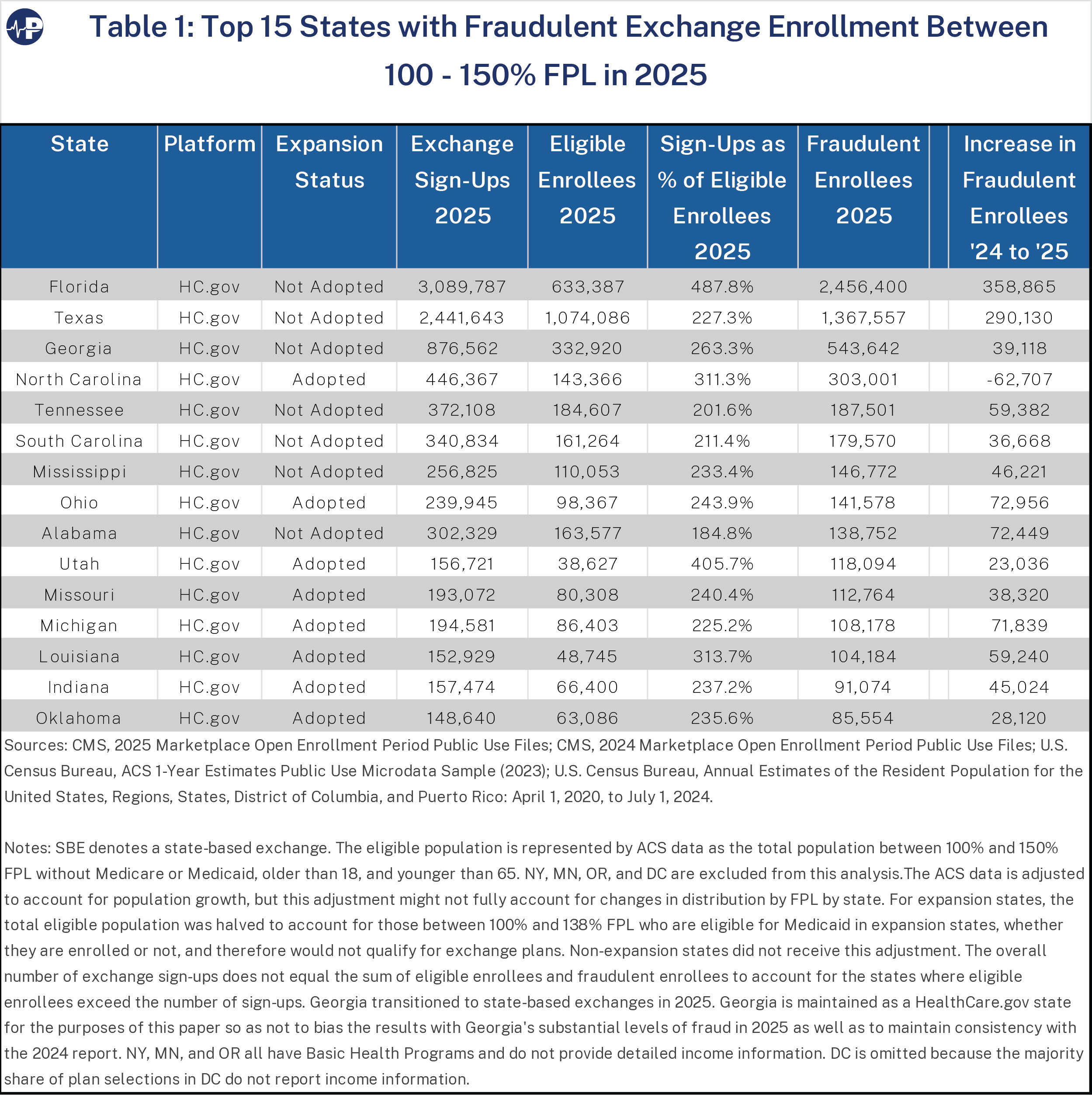
North Carolina’s improper enrollment stands out because the state expanded Medicaid in the fall of 2023. The state also added nearly 600,000 people to Medicaid through its expansion. Despite Medicaid expansion covering most of eligible exchange enrollees with income between 100 and 150 percent FPL, exchange enrollment for people claiming income between 100 and 150 percent FPL in North Carolina only dropped slightly. Under the extreme assumption that the state enrolled every eligible person with income below 150 percent FPL into Medicaid expansion or the fully subsidized exchange plan category, we estimate that there are still 161,269 more enrollees in both programs than potentially eligible.
Virginia stands out as the only success story in reducing fraudulent enrollment during this period. Virginia transitioned from a federal exchange to a state-based exchange in 2023, and the state’s ability to eschew Biden administration policies is likely the main reason for the reduction in fraud.
Bringing Integrity to the ACA: The One Big Beautiful Bill’s Anti-Fraud Provisions
The OBBB reverses many of the harmful policies of the Biden administration that exacerbated fraud and improper exchange enrollment. The OBBB would codify and expand upon the Trump administration’s Marketplace Integrity and Affordability Proposed Rule to better protect taxpayer dollars, reinforce program integrity, and help ensure that subsidies go only to eligible Americans.
First, one of the most consequential provisions in the OBBB is the restoration of basic eligibility verification by requiring ACA exchanges to verify eligibility for premium tax credits (PTCs) before enrolling applicants.31 This addresses rampant negligence under the Biden administration, which limited or delayed verification and even allowed enrollees who didn’t file taxes to self-attest income.32
The OBBB would restore a basic safeguard: requiring exchanges to verify income using trusted data sources and collect documentation when discrepancies arise—before coverage is approved.33 This simple step will close a massive loophole and significantly reduce improper enrollment and spending.
While some media outlets have characterized the documentation requirement as overly burdensome, HHS estimates that it takes individuals only about one hour to complete the process.34 The Biden administration similarly estimated that the process to fill out and submit the documents would take about 45 minutes.35 Applicants would have 90 days to complete the process, balancing administrative integrity with enrollee flexibility.36
Second, the OBBB would rein in abuse of enrollment periods by eliminating the income-based Special Enrollment Period (SEP) for individuals between 100 and 150 percent FPL.37 Originally intended for life events like job loss or marriage, the Biden administration essentially permitted SEPs to be used for year-round enrollment. The 100 to 150 percent FPL SEP became a magnet for abuse, leading to 50,000 complaints of improper enrollment and 40,000 unauthorized plan switches in just the first three months of 2024. Notably, Virginia is one of the few states that chose not to adopt this SEP.38
The 100 to 150 percent FPL SEP—along with Biden Administration’s expanded open enrollment period—degraded the ACA’s risk pool. CMS estimates that Biden’s year-round SEP alone is having this effect, raising premiums by as much as 0.5 to 3.6 percent per year.39 By ending this SEP, the OBBB restores the ACA’s original intent and protects the risk pool integrity, which is critical to reducing overall subsidies.
Third, and perhaps the most vital reform, the OBBB would end the harm of automatic re-enrollment into subsidized plans by requiring annual verification.40 While automatic re-enrollment may appear consumer-friendly, in practice it sustains outdated eligibility determinations, improper subsidy payments, and fraud. This happens because individuals with fully subsidized plans never receive a bill to pay a premium, leading many to remain enrolled for years without realizing it—even after securing other coverage. And without any financial stake in their coverage, they can have zero incentive to correct the situation, as doing so will take time and involve interacting with a bureaucracy.
Numerous cases—including individuals involuntarily enrolled and facing surprise tax bills—demonstrate how passive re-enrollment erodes accountability. A case in point is Crystal Bedford, who was improperly enrolled in the ACA even though she already had employer coverage. She only found out when she received a bill notifying her that she had been enrolled in coverage and would owe $7,500.41 Requiring annual re-enrollment would ensure up-to-date income and eligibility determinations, reduce fraud and consumer harm, and protect individuals from surprise tax bills—while strengthening the long-term stability of the exchanges.
The OBBB contains further provisions to reduce incentives for misstating income and eligibility criteria. In particular, the House-passed version eliminates subsidy repayment caps which removes a key incentive to misreport income, ensuring that individuals who receive excess subsidies must fully repay them when their estimated income is reconciled with their tax return.42 Notably, the Senate version differs with the House in that the Senate exempts individuals with incomes under 100 percent FPL from being subject to subsidy recapture. The OBBB also restores limits on premium payment grace periods, preventing insurers from keeping enrollees on the books—and receiving taxpayer subsidies—long after they’ve stopped receiving premium payments.43 Collectively, these provisions reinforce program integrity, combining administrative safeguards with data-driven enforcement strategies.
By codifying the most effective parts of the Trump administration’s Program Integrity Rule, while also taking important additional reforms, the OBBB would reduce improper enrollments and improper spending and help stabilize the individual market.
Conclusion
The ACA exchange and Medicaid expansion are plagued by structural flaws and policy misalignments that have fostered widespread abuse, inefficiency, and unsustainable federal spending growth. Weak eligibility checks, enhanced subsidies, and administrative negligence have transformed the exchanges into a haven for fraud—costing taxpayers tens of billions of dollars annually.
The Biden administration’s removal of key safeguards in Medicaid, coupled with the incentive for states to shift expenditures into the expansion category to access high federal reimbursements, have further plundered taxpayer dollars and diverted resources away from the most vulnerable populations.
To address these problems, I strongly support many of the reforms in the One Big Beautiful Bill. On the ACA, these include restoring robust applicant eligibility checks, prohibiting automatic re-enrollment, enforcing real-time income verification, and recapturing improperly paid advanced subsidies. I also recommend that Congress permit the temporary enhanced exchange subsidies to expire after 2025 as scheduled under the IRA and consider whether the advanced subsidies should be based on actual income rather than estimated income.
On Medicaid, I strongly support equalizing the federal reimbursement percentages between able-bodied, working-age expansion adults and children, pregnant women, seniors, and individuals with disabilities on the program—which would end the discrimination against the most vulnerable. Doing this would also realign state priorities by improving incentives for states to maximize value from the program and refocus Medicaid support on traditional Medicaid beneficiaries. I strongly support the provisions in OBBB to conduct more frequent eligibility reviews of ACA Medicaid expansion enrollees and requiring expansion enrollees to engage in work, education, or community service in order to maintain eligibility for Medicaid.
I also strongly support reforms previously proposed by then-President Obama and strongly endorsed by then-Vice-President Biden to reduce states’ ability to engage in legalized money-laundering tactics to shift costs to the federal government and that permit states to raise rates to politically powerful providers well above levels if they were sharing in the expenditure.44 This includes the provision to end states’ ability to charge much higher taxes to Medicaid providers and plans, the freeze of the provider tax safe harbor threshold, and the cap on new SDPs at Medicare or near Medicare levels. Furthermore, the Senate Finance Committee has released policies that would make further improvements in this area, including phasing down the provider tax safe harbor in states that have accepted Medicaid expansion and incorporating existing SDPs into a phase down to Medicare rates.
Restoring integrity and sustainability to federal health programs requires bold structural reforms that prioritize program value, eliminate incentives for abuse, and refocus assistance on truly eligible individuals. Only through decisive legislative action can Congress restore program integrity, protect taxpayers, and ensure Medicaid and the ACA serve those they were meant to help.
Footnotes
1↑ Paragon analysis of Congressional Budget Office (CBO) Medicaid Baseline Projections. CBO, "The Budget and Economic Outlook: 2021 to 2031," February 2021; and CBO, "The Budget and Economic Outlook: 2025 to 2035," January 2025, https://www.cbo.gov/publication/61172
2↑ Brian Blase, Chris Medrano, Niklas Kleinworth, and Jackson Hammond, "The Greater Obamacare Enrollment Fraud: The Fraud Got Much Worse in 2025," Paragon Health Institute, June 2025, https://paragoninstitute.org/private-health/the-greater-obamacare-enrollment-fraud/
3↑ Liam Sigaud, "Ineligible Enrollment in the ACA's Medicaid Expansion: Evidence, Costs, and Remedies," Paragon Health Institute, May 12, 2025, https://paragoninstitute.org/medicaid/ineligible-enrollment-in-the-acas-medicaid-expansion-evidence-costs-and-remedies/
4↑ CBO, "The Budget and Economic Outlook: 2025 to 2035," January 2025, https://www.cbo.gov/publication/60870; and CBO, "Baseline Projections: Medicaid," July 2021, https://www.cbo.gov/system/files/2021-07/51301-2021-07-medicaid.pdf
5↑ Dr. Joel Zinberg and Liam Sigaud, "What Matters for Health: Insurance is Less Important Than You Think," Paragon Health Institute, December 2024, https://paragoninstitute.org/public-health/what-matters-for-health-insurance-is-less-important-than-you-think/
6↑ Brian Blase, "Learning from Obama's Medicaid Reform Proposals," Paragon Health Institute, February 2025, https://paragoninstitute.org/newsletter/learning-from-obamas-medicaid-reform-proposals/
7↑ Brian Blase and Niklas Kleinworth, "Addressing Medicaid Money Laundering: The Lack of Integrity with Medicaid Financing and the Need for Reform," Paragon Health Institute, March 2025, https://paragoninstitute.org/medicaid/addressing-medicaid-money-laundering-the-lack-of-integrity-with-medicaid-financing-and-the-need-for-reform/
8↑ Paul Winfree and Brian Blase, "California's Insurance Tax Shuffle: How Federal Money Ends Up Paying for Medicaid for Illegal Immigrants," Paragon Health Institute, March 11, 2025, https://paragoninstitute.org/medicaid/californias-insurance-tax-shuffle-how-federal-money-ends-up-paying-for-medicaid-for-illegal-immigrants/
9↑ MACPAC, "Directed Payments in Medicaid Managed Care," June 2023, https://www.macpac.gov/wp-content/uploads/2023/06/DirectedPayments-in-Medicaid-Managed-Care.pdf; and MACPAC, "Directed Payments in Medicaid Managed Care," October 2024, https://www.macpac.gov/wp-content/uploads/2024/10/Directed-Payments-in-Medicaid-Managed-Care.pdf
10↑ Drew Gonshorowski, Brian Blase, and Niklas Kleinworth, "The Cost of Good Intentions: The Harm of Delaying the Disenrollment of Medicaid Ineligibles," Paragon Health Institute, July 2023, https://paragoninstitute.org/medicaid/the-cost-of-good-intentions/; and Matthew Buettgens and Andrew Green, "The Impact of the COVID-19 Public Health Emergency Expiration on All Types of Health Coverage," Urban Institute, December 2022, https://www.urban.org/sites/default/files/2022-12/The%20Impact%20of%20the%20COVID-19%20Public%20Health%20Emergency%20Expiration%20on%20All%20Types%20of%20Health%20Coverage_0.pdf
11↑ MACStats: Medicaid and CHIP Program Statistics, (March, 2013). Medicaid and CHIP Payment Access Commission (MACPAC). Table 2. https://www.macpac.gov/wp-content/uploads/2015/03/March-2013-MACStats.pdf; MACStats: Medicaid and CHIP Data Book, (December 2024). Medicaid and CHIP Payment Access Commission (MACPAC). Exhibit 14. https://www.macpac.gov/wp-content/uploads/2024/12/MACSTATS_Dec2024_WEB-508.pdf
12↑ Liam Sigaud, "Ineligible Enrollment in the ACA's Medicaid Expansion," Paragon Health Institute, May 13, 2025, https://paragoninstitute.org/medicaid/ineligible-enrollment-in-the-acas-medicaid-expansion-evidence-costs-and-remedies/
13↑ Sigaud, "Ineligible Enrollment in the ACA's Medicaid Expansion."
14↑ Sarah L. Taubman et al., "Medicaid Increases Emergency-Department Use: Evidence from Oregon's Health Insurance Experiment," Science, January 2, 2014,https://www.science.org/doi/10.1126/science.1246183; and Craig Garthwaite et al., "All Medicaid Expansions Are Not Created Equal: The Geography and Targeting of the Affordable Care Act," Brookings Institution, September 5, 2019, https://www.brookings.edu/wp-content/uploads/2020/10/Garthwaite-et-al-final-draft.pdf
15↑ CMS, 2021 Medicaid and CHIP Supplemental Improper Payment Data, Table 2A, November 2021, https://www.cms.gov/files/document/2021-medicaid-chipsupplemental-improper-payment-data.pdf-1
16↑ Office of Management and Budget, "Payment Accuracy," Annual Improper Payments Datasets, https://www.paymentaccuracy.gov/payment-accuracy-thenumbers/
17↑ Brian Blase and Rachel Greszler, "Medicaid's True Improper Payments Double Those Reported by CMS," Paragon Health Institute, March 3, 2025, https://paragoninstitute.org/medicaid/medicaids-true-improper-payments-likely-double-those-reported-by-cms/
18↑ Brian Blase and Drew Gonshorowski, "Medicaid Financing Reform Stopping Discrimination Against the Most Vulnerable and Reducing Bias Favoring Wealthy States," Figures 5 and 6, Paragon Health Institute, July 2024, https://paragoninstitute.org/medicaid/medicaid-financing-reform-stopping-discrimination-against-the-most-vulnerable-and-reducing-bias-favoring-wealthy-states/
19↑ Paragon Health Institute, "Paragon Health Policy Survey 2025," March 18, 2025, https://paragoninstitute.org/medicaid/paragon-health-policy-survey-2025/
20↑ The reason we show spending on the ACA subsidies only through 2033 is that CBO projects that spending on the subsidies will drop in 2034 because of repayment of excess BHP subsidies that New York state has accumulated.
21↑ For those below 100 percent of FPL, there is no penalty for misreporting income. There is no penalty for overestimating your income, meaning many enrollees who should have qualified for Medicaid were improperly enrolled in exchange plans. For those between 100 and 200 percent FPL, the repayment is capped at $375. For those between 200 and 300 percent FPL, it is $975. For those between 300 and 400 percent FPL, they must repay up to $1,625. Those above 400 percent FPL must replay the full subsidy.
22↑ According to CBO, the average actuarial value of a silver plan was 88 percent in 2024, so to reflect the value of the plan with the CSR subsidy, we multiplied by 94/88 as this is a benefit to those who claimed income between 100 and 150 percent FPL.
23↑ Brian Blase, Chris Medrano, Niklas Kleinworth, and Jackson Hammond, "The Greater Obamacare Enrollment Fraud: The Fraud Got Much Worse in 2025," Paragon Health Institute, June 2025, https://paragoninstitute.org/private-health/the-greater-obamacare-enrollment-fraud/
24↑ CMS, Health Insurance Exchanges 2025 Open Enrollment Report, https://www.cms.gov/files/document/health-insurance-exchanges-2025-open-enrollment-report.pdf
25↑ Zeke Faux and Zachary R Mider, "Chasing Big Money With the Health-Care Hustlers of South Florida," June 5, 2025, bloomberg.com/features/2025-deepfake-ads-fueled-florida-health-insurance-scheme/.
26↑ CMS, "Welcome to the 2023 Agent and Broker Summit," May 24, 2023, https://www.cms.gov/files/document/ab-summit-2023welcome-slides.pdf
27↑ Walker, "Americans Clicked Ads to Get Free Cash;" and Turner et al. v. Enhance Health, LLC et al., no. 0:24-cv-60591 (S.D. FL), https://litigationtracker.law.georgetown.edu/litigation/conswallo-turner-et-al-v-enhance-health-llc-et-al/
28↑ DOJ, "President of Insurance Brokerage Firm and CEO of Marketing Company Charged in $161M Affordable Care Act Enrollment Fraud Scheme," press release, February 19, 2025, https://www.justice.gov/opa/pr/president-insurance-brokerage-firm-and-ceo-marketing-company-charged-161m-affordable-care
29↑ DOJ, "Executive Vice President of Insurance Brokerage Pleads Guilty in $133M Affordable Care Act Fraud Scheme," press release, April 18, 2025, https://www.justice.gov/opa/pr/executive-vice-president-insurance-brokerage-pleads-guilty-133m-affordable-care-act-fraud
30↑ These states include: Alabama, Arizona, Arkansas, Delaware, Florida, Georgia, Illinois, Indiana, Iowa, Kansas, Louisiana, Massachusetts, Michigan, Mississippi, Missouri, Montana, Nebraska, New Hampshire, New Jersey, North Carolina, Ohio, Oklahoma, Pennsylvania, South Carolina, Tennessee, Texas, Utah, Virginia, and West Virginia.
31↑ Sec. 112201
32↑ This exception currently sits in 45 C.F.R. ? 155.320 (c)(5).
33↑ CMS, Proposed Rule, 12963.
34↑ CMS, Proposed Rule, 13002.
35↑ HHS, "Patient Protection and Affordable Care Act; HHS Notice of Benefit and Payment Parameters for 2022 and Pharmacy Benefit Manager Standards," 86 Fed. Reg. 24140, 24267 (May 5, 2021).
36↑ CMS, Proposed Rule, 13002.
37↑ Sec. 112202 and Sec. 44201.
38↑ Blase, Medrano, Kleinworth, and Hammond, "The Greater Obamacare Enrollment Fraud."
39↑ CMS, Proposed Rule, 12982.
40↑ Accomplished through Sec. 112201 and Sec. 44201.
41↑ Liza Lucas and Adrian P. Guerra, "She Had Insurance. A Stranger Enrolled Her in Another Plan — Leaving Her with a $7,500 Tax Bill," WCNC, April 30, 2025, https://www.wcnc.com/article/money/consumer/georgia-fake-acaenrollment/85-790e919d-815f-498a-a606-d3c5e7a475ac
42↑ Sec. 112203.
43↑ Sec. 112204.
44↑ President Obama's FY2013 budget proposal proposed reducing the safe harbor threshold from 6 percent to 3.5 percent. Office of Management and Budget, "Budget of the U.S. Government: Fiscal Year 2013", p. 36, and Bob Woodward, The Price of Politics (New York: Simon and Schuster, 2012), p. 141 https://obamawhitehouse.archives.gov/sites/default/files/omb/budget/fy2013/assets/budget.pdf;
Related Content
Subscribe
Sign up now for your health policy updates.