


Brian Blase, Ph.D., is the President of Paragon Health Institute. Brian was Special Assistant to the President for Economic Policy at the White House’s National Economic Council (NEC) from 2017-2019, where he coordinated the development and execution of numerous health policies and advised the President, NEC director, and senior officials. After leaving the White House, Brian founded Blase Policy Strategies and served as its CEO.
Over-Subsidized Obamacare Exchanges Consumed by Fraud + Debunking the Claim of Premiums Doubling
In today’s packed newsletter, I first review Democrats’ costly health care demands to end the shutdown. I then highlight a new op-ed by Chris Jacobs that debunks KFF’s claim that Obamacare plan premiums will double if the COVID credits expire, and a new and related Paragon Pic that shows only 3.3 percent of 2026 premiums are related to the expiring COVID credits. I then discuss a Chris Pope article on massive Obamacare fraud in South Florida and a new Paragon brief on the CMS Innovation Center.
Costs of the Democratic Demands
Senate Democrats have now voted 11 times to keep the federal government shuttered—demanding the repeal of health care reforms in the One Big Beautiful Bill (OBBB) as well as their own previous expiration date for the COVID-era Obamacare add-on subsidies to insurers. Democrats claim that they are fighting to lower health care costs, but the results of these policies would increase costs. Repealing the OBBB health reforms will increase federal health spending by $1.2 trillion over 10 years. And making permanent the COVID-era subsidy add-ons would raise deficits by more than $400 billion over the next decade.
- Extending Biden’s COVID credits would entrench the inflationary subsidy machinery that has already raised prices and premiums while fueling waste and fraud. (Here is a 20-minute explainer video that I put together last week to explain the structure of Obamacare subsidies and the COVID credits as well as the explosion of improper and zero-claim enrollment over the past few years. Yesterday, I participated in a Cato event on the COVID credits and potential reforms.)
- Repealing OBBB’s immigration reforms would expand spending on non-citizens and unauthorized immigrants by $20 billion a year—crowding out care for Americans.
- OBBB’s Medicaid reforms will reduce corporate welfare payments that result in Medicaid payments for many hospitals up to average commercial rates—rates much higher than Medicare rates. Reversing these reforms would increase commercial prices as well as federal spending.
- OBBB put in place work and community-engagement requirements for able-bodied, working-age adults in Medicaid—policy meant to incentivize work, job training, and community service while preserving public resources for the most vulnerable Medicaid enrollees.
Lobbyists for insurers and hospital systems are pushing to extend enhanced ACA tax credits and roll back the OBBB’s reforms to secure higher subsidies and prices. Although congressional Democrats claim to fight for lower premiums and costs, their policies would drive up spending, prices, debt, taxes, and interest rates.
Debunking KFF’s Premium Increase Canard
Chris Jacobs’s Wall Street Journal op-ed exposes a false claim of Obamacare plan premiums doubling if Biden’s COVID credits expire. This claim emerged based on a misleading and inaccurate KFF piece, as Chris documents. KFF’s argument is flawed in three ways: it ignores the continuing federal subsidies most enrollees will receive, exaggerates the impact on households, and conflates total premiums with out-of-pocket payments. Chris highlights a previous KFF analysis that found the enhanced subsidies covered an average of 88 percent of overall premiums in 2024, compared to 78 percent if the enhanced credits ended. Chris cites an Urban Institute study that households with incomes below 250 percent of the poverty level—who receive the richest subsidies and represent roughly three-quarters of all exchange enrollees—would see premiums rise only about $62.50 a month.
Only 3.3 Percent of 2026 Obamacare Premium is from Expiring COVID Credits
This week’s Paragon Pic shows 96.7 percent of 2026 Obamacare premiums are unrelated to the expiring COVID credits.
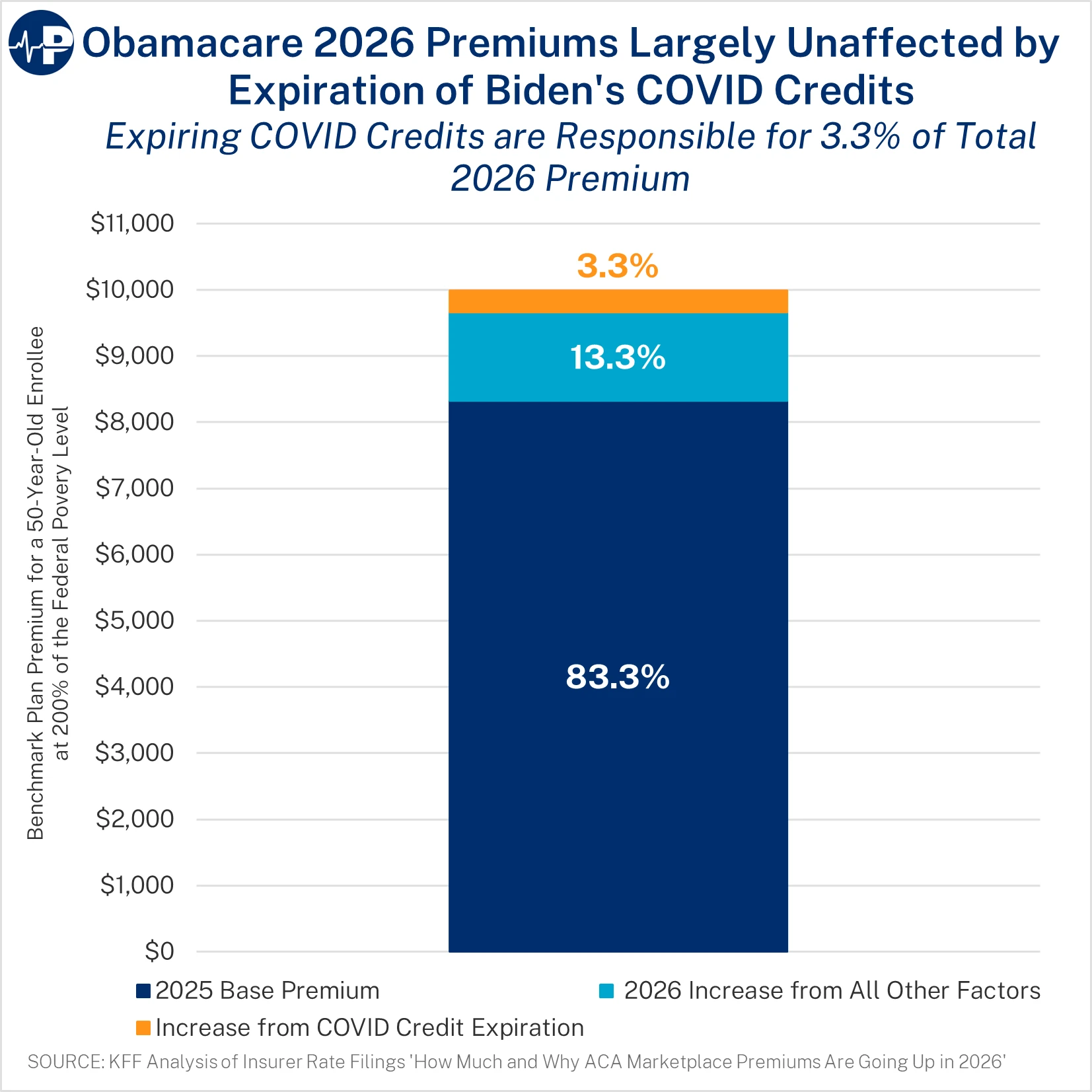
Insurer filings show that just 4 percent of the projected 20 percent premium increase for 2026 stems from the COVID credits’ expiration. The main causes are structural flaws in Obamacare and surging medical costs tied to inflation, consolidation, and expensive new drugs like GLP-1s. The enhanced subsidies temporarily masked these problems by inflating enrollment with zero-claim and ineligible individuals, creating the illusion of affordability. Their expiration simply exposes the underlying weaknesses of the law—not a sudden or catastrophic loss of assistance.
South Florida—The Epicenter of Obamacare Fraud
As I’ve documented over the past year and a half, Biden’s COVID credits have fueled rampant Obamacare exchange fraud. This year, there were more than 6.4 million people improperly enrolled in fully subsidized plans. And last year, 40 percent of enrollees in fully subsidized plans had no claims during the period they were covered.
Manhattan Institute scholar Chris Pope has a must-read new piece, “Florida’s Obamacare Fraud Boom,” detailing the problems at the epicenter of this fraud: South Florida. In Miami-Dade County, subsidized Obamacare enrollment reached 1.03 million people in 2025—36 percent of the county’s population and six times the national average. The number of subsidized enrollees exceeds the number of eligible low-income residents, suggesting large-scale manipulation. Here are key excerpts from Chris’s piece:
- In May 2025, Florida’s chief financial officer wrote to Congress protesting that ACA subsidies were being entrusted to insurance brokers “based on fraudulently entered information.”
- In 2024, the federal government received over 200,000 complaints from people who found themselves signed up or switched to other Obamacare plans without their permission. Many were enrolled after clicking Facebook ads promising $6,400 cards in return for participating. Similar ads were viewed over 195 million times on YouTube before being taken down.
- This February, the Department of Justice charged a South Florida insurance broker with conspiracy to defraud the United States by deceptively marketing plans to claim nearly $162 million in ACA subsidies. The indictment alleges that the man targeted homeless, unemployed, and mentally ill Floridians, bribing them to enroll in Obamacare plans, misreporting their addresses and Social Security numbers, and seeking to maximize their receipt of subsidies. In April, another defendant pled guilty to participating in the scheme.
- One homeless person in Miami, interviewed on the street, reported that she had been paid five times by brokers to sign up for ACA plans.
A Bloomberg expose, “Chasing Big Money With the Health-Care Hustlers of South Florida,” provides a detailed account of the manipulative schemes used by some brokers. The article quoted a customer retention worker for Enhance Health, “Half the time [enrollees] didn’t even know they were signing up for insurance.” Some brokers made $6,000 a day in commissions—profits made possible by reckless federal policy.
Restoring the Promise of the Innovation Center
The CMS Innovation Center has potential to improve Medicare and Medicaid policy—if it returns to its original purpose: to conduct limited tests of innovative ideas that aim to save taxpayer dollars while maintaining or improving quality. As Jackson Hammond explains in Paragon’s latest brief, the Innovation Center’s record to date has fallen far short of that promise. While it was projected to generate billions in savings, its models have instead increased federal spending by more than $5 billion in its first decade.
Still, recent changes are reason for optimism. The Innovation Center’s new strategy—focused on evidence-based prevention, patient empowerment, and expanding choice and competition—offers a promising framework to realign its work with taxpayers’ and patients’ interests. Paragon’s analysis identifies what went wrong and how to fix it.
Past failures stemmed largely from voluntary models that let participants choose only profitable demonstrations, prospective benchmarks that distorted results, and quality metrics detached from meaningful control groups. Together, these features rewarded participation rather than savings and made it nearly impossible to tell whether models truly worked.
To ensure the Innovation Center finally delivers on its potential, Jackson outlines several key reforms:
- Design true demonstrations that actually test whether a policy saves money and improves quality.
- Keep models limited in size, scope, and duration to avoid de facto policymaking.
- Prioritize mandatory models that eliminate favorable selection and reflect real-world behavior.
- Require savings throughout a model’s lifespan, ending those that fail to deliver.
- Default to market-based approaches that strengthen choice and competition rather than government control.
If Congress and CMS adopt these recommendations, the Innovation Center could finally fulfill its mission and become a true laboratory for improving Medicare and Medicaid. If the Innovation Center fails to improve its record, Hammond concludes, policymakers should consider ending it.
Recent Newsletters
Subscribe
Sign up now for your health policy updates.