

Paragon Health Institute Icon White
Paragon Pic

Obamacare 2026 Premiums Largely Unaffected by Expiration of Biden’s COVID Credits

7AW Covid Credit Premium A0wUU000004eKwzYAE
Click the Pic to expand the image
ELLE KALISZ HEADSHOT SMALLER 186A6472 V2
Program Manager

Gabrielle “Elle” Kalisz is the Program Manager at Paragon Health Institute. Gabrielle has worked in federal health policy for over five years, advancing free-market principles and partnerships.

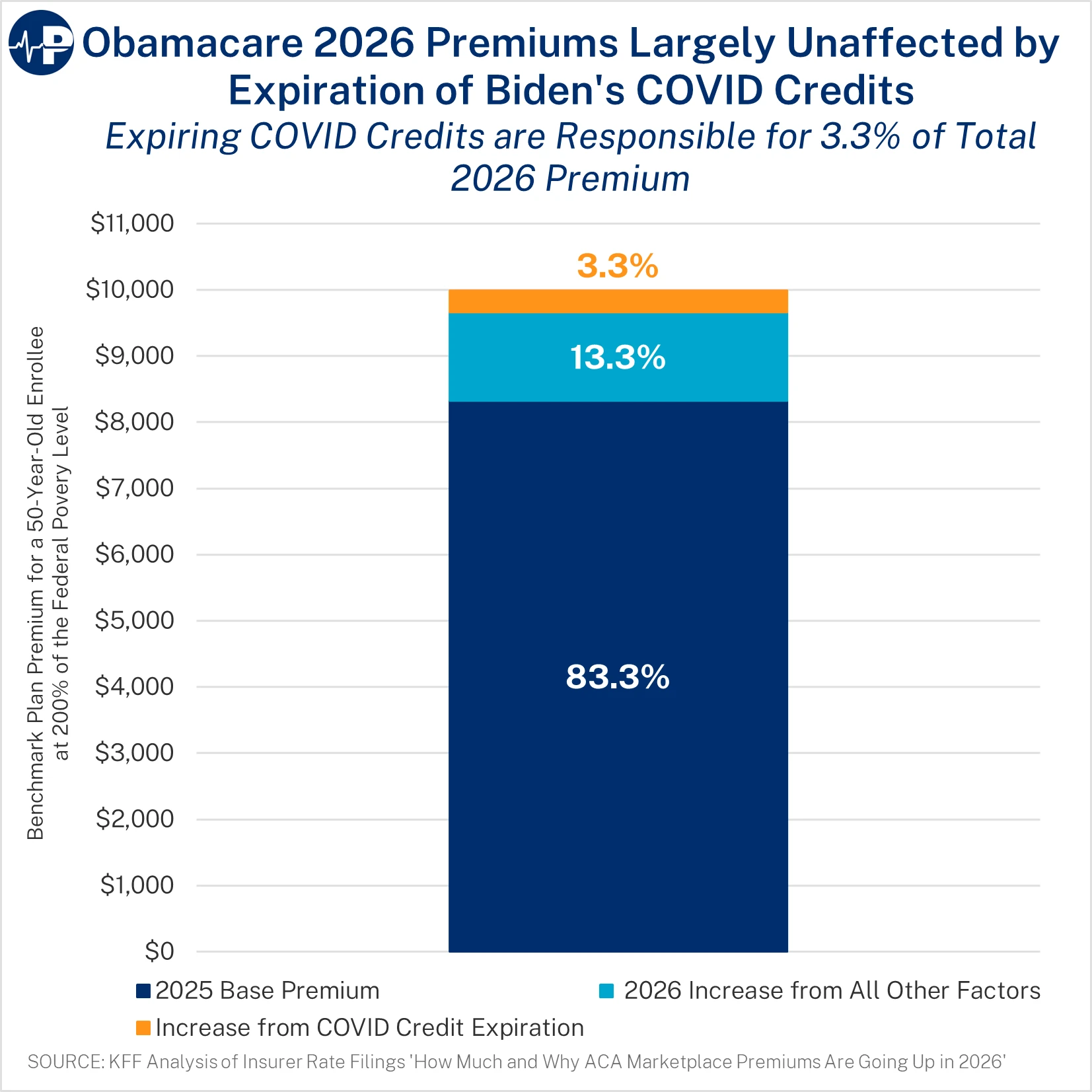
Expiring COVID Credits are Responsible for 3.3% of Total 2026 Premium

Expiration of the Biden COVID Credits is not the primary driver of skyrocketing ACA plan premiums and overall unaffordability, according to the insurers themselves.  Preliminary 2026 benchmark rate filings reveal that the expiration of Biden’s COVID Credits, a temporary pandemic measure enhancing subsidies for ACA enrollees, accounts for only 4 percent of the expected 20 percent average premium increase next year. In other words, the sharp jump in premiums cannot be blamed on the phase-out of the enhanced subsidies. The real drivers are the same structural flaws that have plagued Obamacare since 2014 and rising health care costs.

The navy portion represents the 2025 benchmark premium of $8,326 for a representative of the average ACA enrollee—a 50-year-old with income at 200 percent of the federal poverty level. In 2026, premiums are projected to increase on average by 20 percent, raising the benchmark premium to $9,991. Of that $1,665 total increase, $333 (4 percent) is attributable to the expiration of the Biden-era COVID credits, shown in orange. The remaining $1,332 (16 percent)—illustrated in light blue—is due to all other factors driving higher premiums in 2026. As the figure shows, of the 2026 premium, 83.3 percent is the 2025 base, 13.3 percent is from other factors, and just 3.3 percent is from the expiration of the COVID credits.

The COVID-era enhanced subsidies contribute to “lower average premiums” because they keep more improper, fraudulent, and zero-claim enrollees in the market. Spurred by the wide availability of $0 plans, this enrollment-at-any-cost policy inflates enrollment with individuals who file few or no claims—many of whom are not even eligible—so the risk pool appears healthier, artificially driving down premiums and creating windfalls for insurers.

In their filings, insurers attribute the premium increase to higher medical utilization, inflation, health care consolidation (which the ACA contributed to), and surging costs for expensive drugs—especially GLP-1 weight-loss and diabetes medications, specialty drugs, and biologics (including new gene therapies). Insurers also cite workforce shortages, price transparency measures, and tariffs as nominal contributors to increasing premiums.

The question now is not whether premiums are rising—they are—but why and who pays the bill. Under the COVID credits, the federal government has been paying 93 percent of the premium for the typical enrollee. Even after the COVID Credits expire, the federal government will still cover more than 80 percent of the typical enrollee’s premium through the regular subsidy. Taxpayers, not consumers, will remain the overwhelming source of revenue for insurers selling ACA exchange plans.

7AW Covid Credit Premium A0wUU000004eKwzYAE

Expiring COVID Credits are Responsible for 3.3% of Total 2026 Premium

Expiration of the Biden COVID Credits is not the primary driver of skyrocketing ACA plan premiums and overall unaffordability, according to the insurers themselves.  Preliminary 2026 benchmark rate filings reveal that the expiration of Biden’s COVID Credits, a temporary pandemic measure enhancing subsidies for ACA enrollees, accounts for only 4 percent of the expected 20 percent average premium increase next year. In other words, the sharp jump in premiums cannot be blamed on the phase-out of the enhanced subsidies. The real drivers are the same structural flaws that have plagued Obamacare since 2014 and rising health care costs.

The navy portion represents the 2025 benchmark premium of $8,326 for a representative of the average ACA enrollee—a 50-year-old with income at 200 percent of the federal poverty level. In 2026, premiums are projected to increase on average by 20 percent, raising the benchmark premium to $9,991. Of that $1,665 total increase, $333 (4 percent) is attributable to the expiration of the Biden-era COVID credits, shown in orange. The remaining $1,332 (16 percent)—illustrated in light blue—is due to all other factors driving higher premiums in 2026. As the figure shows, of the 2026 premium, 83.3 percent is the 2025 base, 13.3 percent is from other factors, and just 3.3 percent is from the expiration of the COVID credits.

The COVID-era enhanced subsidies contribute to “lower average premiums” because they keep more improper, fraudulent, and zero-claim enrollees in the market. Spurred by the wide availability of $0 plans, this enrollment-at-any-cost policy inflates enrollment with individuals who file few or no claims—many of whom are not even eligible—so the risk pool appears healthier, artificially driving down premiums and creating windfalls for insurers.

In their filings, insurers attribute the premium increase to higher medical utilization, inflation, health care consolidation (which the ACA contributed to), and surging costs for expensive drugs—especially GLP-1 weight-loss and diabetes medications, specialty drugs, and biologics (including new gene therapies). Insurers also cite workforce shortages, price transparency measures, and tariffs as nominal contributors to increasing premiums.

The question now is not whether premiums are rising—they are—but why and who pays the bill. Under the COVID credits, the federal government has been paying 93 percent of the premium for the typical enrollee. Even after the COVID Credits expire, the federal government will still cover more than 80 percent of the typical enrollee’s premium through the regular subsidy. Taxpayers, not consumers, will remain the overwhelming source of revenue for insurers selling ACA exchange plans.
Related Research

ELLE KALISZ HEADSHOT SMALLER 186A6472 V2
Program Manager

Gabrielle “Elle” Kalisz is the Program Manager at Paragon Health Institute. Gabrielle has worked in federal health policy for over five years, advancing free-market principles and partnerships.