
Reforming Government. Empowering Patients.
Navigation
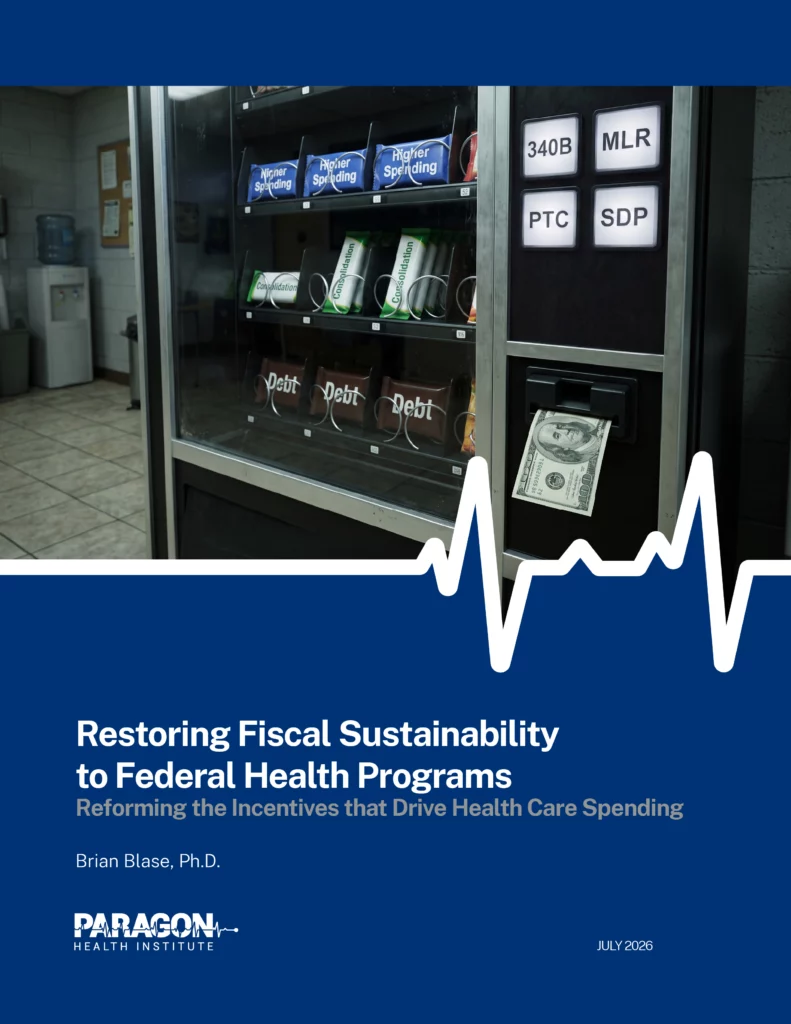
Restoring Fiscal Sustainability to Federal Health Programs
Reforming the Incentives that Drive Health Care Spending

The Paper
Executive Summary
What This Paper Covers
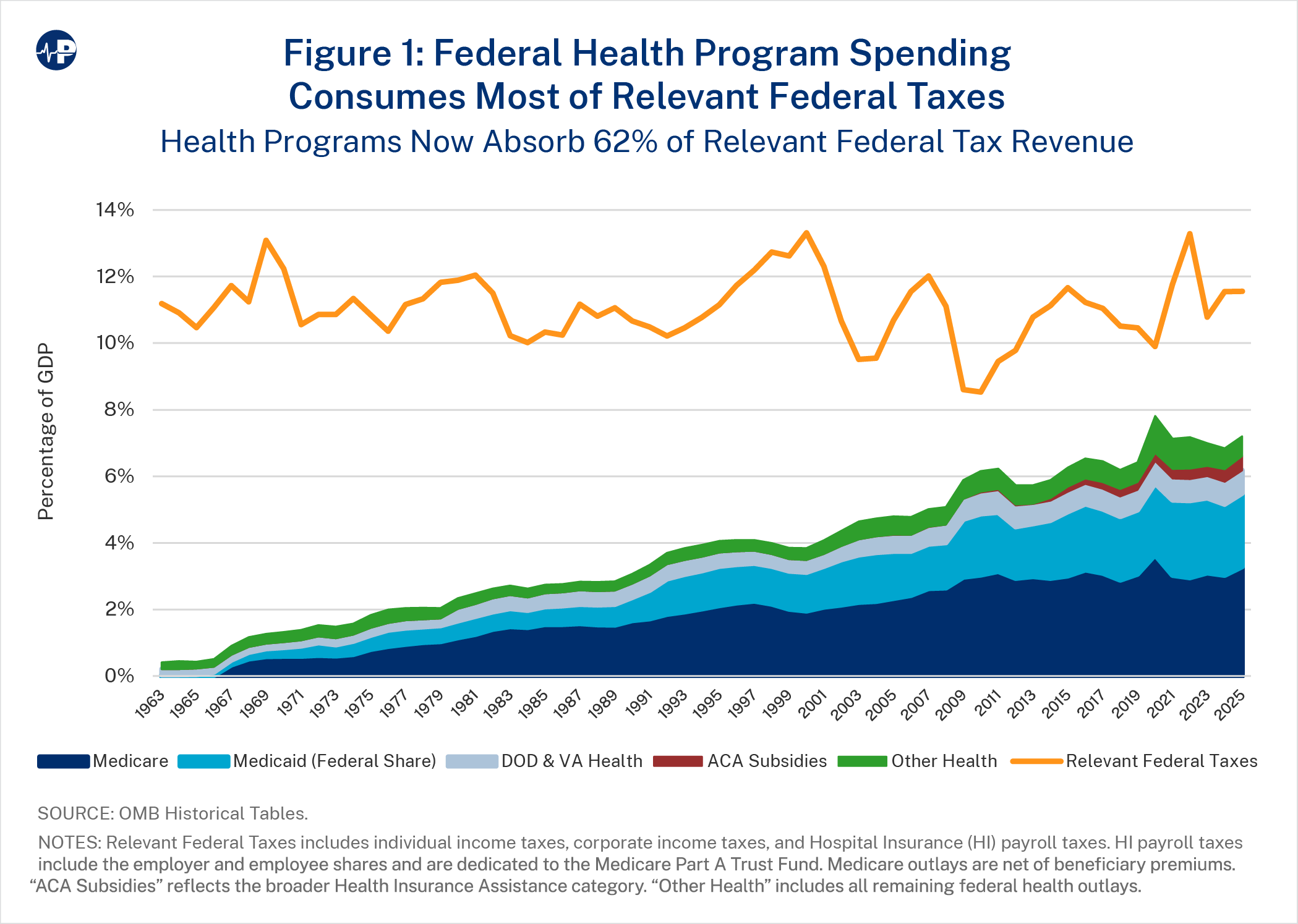
Federal health programs are the nation’s largest fiscal challenge. In 2025, Medicare, Medicaid, Affordable Care Act (ACA) subsidies, and other federal health programs consumed roughly 62 percent of all individual income taxes, corporate income taxes, and Medicare payroll taxes—more than double their share in 2000. Despite this extraordinary growth, health outcomes have not improved commensurately, while the federal government has become increasingly reliant on borrowing to finance health care spending.
This paper examines the structural problems driving federal health spending, with a particular focus on Medicare, Medicaid, and the ACA exchanges. Although these programs differ in many respects, they share a common flaw: their financing structures drive higher spending rather than greater value. The paper also discusses how the tax exclusion for employer-sponsored insurance, the 340B program, and the ACA’s medical loss ratio (MLR) requirements further increase health care spending. Finally, the paper outlines reforms that would improve incentives, strengthen program integrity, promote competition, and place federal health programs on a more sustainable fiscal trajectory.
What We Found
Medicare, Medicaid, and the ACA exchanges each contain structural incentives that increase federal spending while weakening accountability.
Medicare is increasingly financed through general revenues rather than dedicated payroll taxes and premiums. Government payment policies often reward higher-cost sites of care, contribute to provider consolidation, and distort payment systems throughout the broader health care market. The Inflation Reduction Act’s redesign of Medicare Part D has significantly increased plan premiums and subsidies—making Medicare even more reliant on general revenues.
Medicaid increasingly rewards states for maximizing federal reimbursements rather than obtaining value for taxpayers or patients. Provider taxes and intergovernmental transfers (IGTs) allow states to shift Medicaid costs to the federal government, while state-directed payments (SDPs) have enabled states to raise Medicaid rates to hospitals well above Medicare rates for payments through managed care companies, with payment rates approaching average commercial rates in many states. Fortunately, the One Big Beautiful Bill (OBBB) enacted the most significant reforms to Medicaid financing in the program’s history by addressing the Medicaid money laundering apparatus—limiting provider tax schemes and capping most Medicaid managed care payments at Medicare rates, consistent with fee-for-service Medicaid.
The ACA’s enhanced federal matching rate provides states with roughly seven times more federal funding for every state dollar spent on able-bodied, working-age adults than for children, pregnant women, seniors, and people with disabilities, creating incentives that discriminate against the program’s most vulnerable enrollees. The program’s financing formula also produces the inequitable result that wealthier states generally receive more federal Medicaid funding per person in poverty than poorer states. Together, these incentives have made states increasingly dependent on Washington while weakening incentives to reduce waste, fraud, and improper payments.
The ACA exchanges contain an open-ended subsidy structure that automatically increases federal spending as premiums rise, making the subsidy structure inherently inflationary by shifting premium increases onto taxpayers. Weak eligibility verification, automatic reenrollment, and generous COVID-era subsidy expansions contributed to widespread improper enrollment, phantom enrollment, and rapidly increasing federal subsidy costs. The exchanges increasingly reward enrollment volume instead of accurate eligibility determinations and cost control.
Additional federal policies also contribute to higher spending and greater consolidation. The tax exclusion for employer-sponsored insurance encourages excessively comprehensive coverage and higher health care utilization. The 340B program rewards higher drug prices, larger reimbursement spreads, and provider consolidation rather than directing assistance to vulnerable patients. The ACA’s medical loss ratio requirement weakens insurers’ incentives to reduce medical spending while encouraging vertical integration throughout the health care sector.
Taken together, these policies reward higher expenditures rather than better outcomes, contributing to rising deficits, greater provider consolidation, weaker competition, and increasing dependence on federal financing.
What We Recommend
Congress should build on recent reforms in the OBBB by continuing to improve the incentives embedded throughout federal health programs rather than expanding open-ended federal commitments that reward higher spending and produce excessive waste and fiscal unsustainability.
For Medicare, Congress should reduce payment distortions through site-neutral payment reforms, reverse the costly Part D redesign enacted in the Inflation Reduction Act, better target hospital subsidies, implement a package of well-developed Medicare Advantage reforms, strengthen program integrity, and better align beneficiary incentives with program sustainability.
For Medicaid, Congress should build on the historic financing reforms enacted in the One Big Beautiful Bill by further dismantling the Medicaid money laundering apparatus, equalizing federal matching rates across eligibility groups, improving the equity of the federal financing formula, strengthening accountability for improper payments, and restoring states’ incentives to obtain value rather than maximize federal reimbursements.
For the ACA exchanges, Congress should restore program integrity by strengthening eligibility verification, requiring meaningful premium contributions, ending automatic reenrollment, reforming premium subsidies, increasing accountability for insurers and brokers, and eliminating silver loading through direct appropriation of cost-sharing reduction subsidies.
Congress should also complement these reforms by capping the tax exclusion for employer-sponsored insurance, redesigning the 340B program so that assistance is transparent and directly benefits vulnerable patients, and repealing the ACA’s medical loss ratio requirements so insurers are rewarded for reducing costs rather than overseeing higher levels of medical spending.
The objective of these reforms is not simply to reduce federal spending. It is to redesign federal health programs so that they reward value instead of volume, competition instead of consolidation, accountability instead of cost shifting, and sustainable financing instead of ever-growing federal commitments. Improving the nation’s fiscal outlook will require replacing financing structures that drive inefficient and wasteful federal health spending with incentives that reward value, competition, accountability, and efficiency.
Introduction
Improving the United States’ fiscal outlook will not succeed without reforming federal health programs. The three largest contributors to unsustainable federal health spending are Medicare’s increasing reliance on general revenues, Medicaid’s distorted federal-state financing structure, and escalating Affordable Care Act (ACA) subsidy costs.
Figure 1 shows that federal health care programs consumed roughly 62 percent of all individual federal income, corporate federal income, and Medicare payroll tax revenue in 2025—up from 29 percent in 2000.1 The figure excludes Social Security revenue since that money is earmarked for Social Security benefits. The growth in federal health care spending is one of the greatest threats to future U.S. prosperity because it contributes to greater inflationary pressure, higher interest rates, the need for higher future taxes, and the crowding out of other public priorities. It also contributes to larger federal deficits and a growing national debt, with annual interest payments on the national debt now exceeding annual national defense spending. Moreover, despite the surge in federal health care spending, improvements in American health outcomes have severely lagged.
Putting Medicare on a Sustainable Trajectory
No program is more responsible for the unsustainable U.S. fiscal trajectory than Medicare.
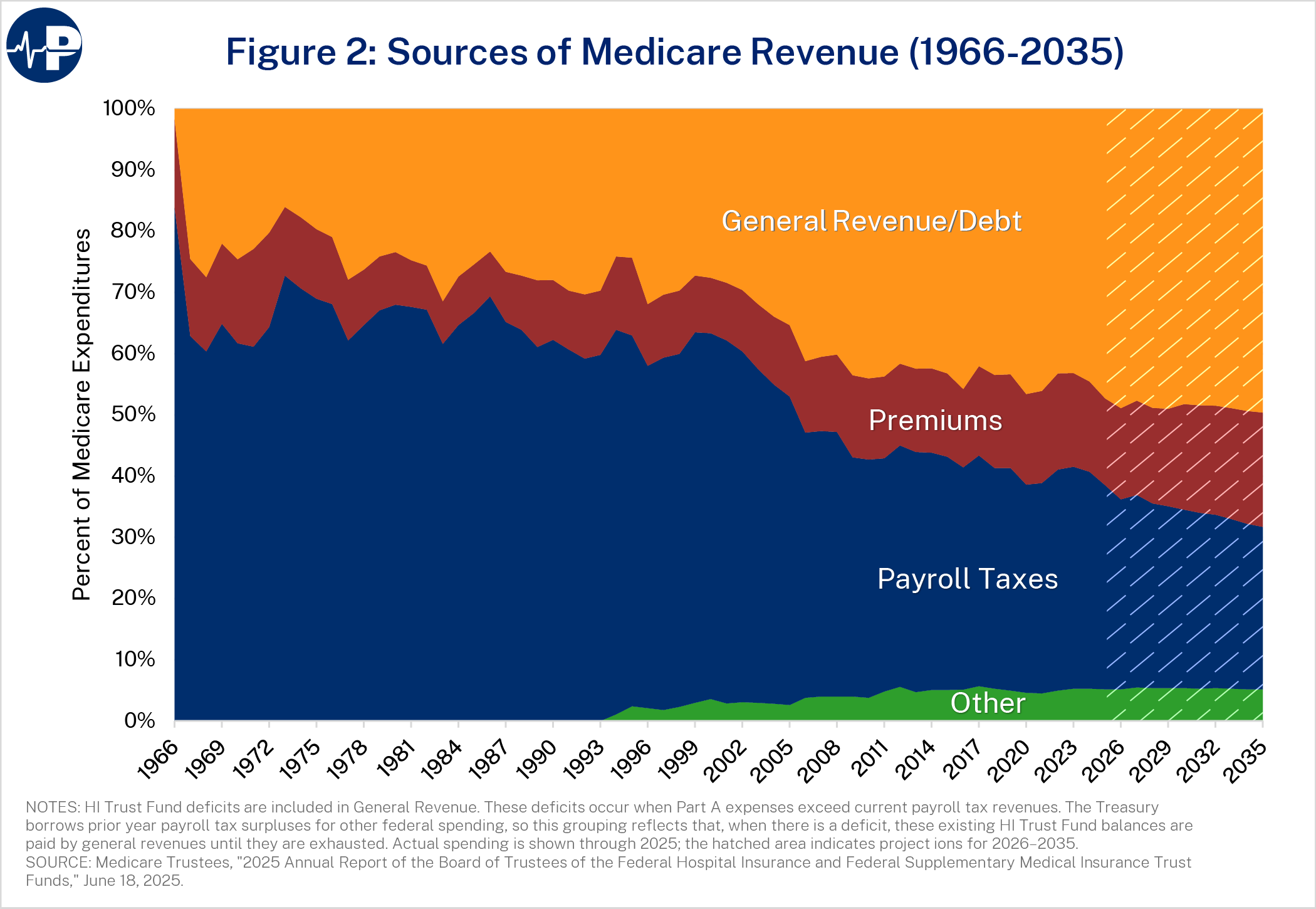
Medicare is increasingly financed by general revenues and debt, not dedicated payroll taxes and enrollee premiums. As more baby boomers reach Medicare age at the same time fertility rates have fallen to historic lows, the program’s finances are deteriorating, leaving fewer workers to support a growing retired population. Medicare also has an outsized role throughout the entire health sector because, due to the size and inertia of Medicare, commercial plans typically set payments as a function of Medicare rates. Unfortunately, Medicare payments are determined through a political process that rewards lobbying efforts and higher costs—factors that make the program inefficient and amplify those inefficiencies throughout the entire health sector.
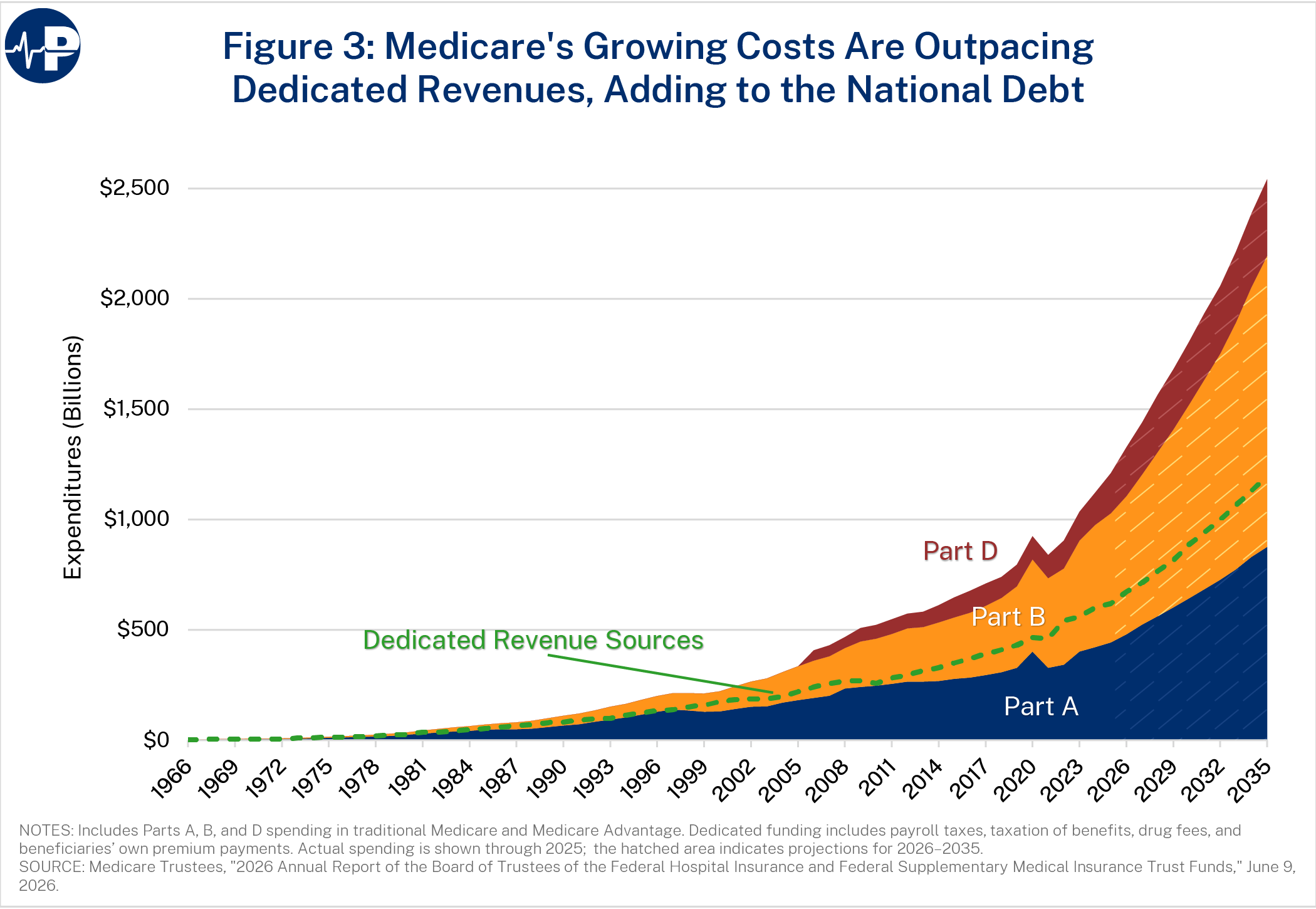
Figures 2 and 3 show why Medicare sits at the center of the federal government’s fiscal problem. Figure 2 traces the sources of Medicare revenue since 1966 and illustrates the program’s growing dependence on general revenues: general revenue funded roughly 28 percent of Medicare in 2000 but covered 47 percent in 2025. Figure 3 shows how total Medicare spending is outpacing the dedicated revenues meant to support it. Combined Part A, Part B, and Part D expenditures are projected to roughly double from about $1.2 trillion in 2025 to roughly $2.5 trillion in 2035, while dedicated funding covers only about half of that amount.2 The widening gap between total spending and dedicated revenues is financed by general revenues and borrowing, adding directly to the national debt.
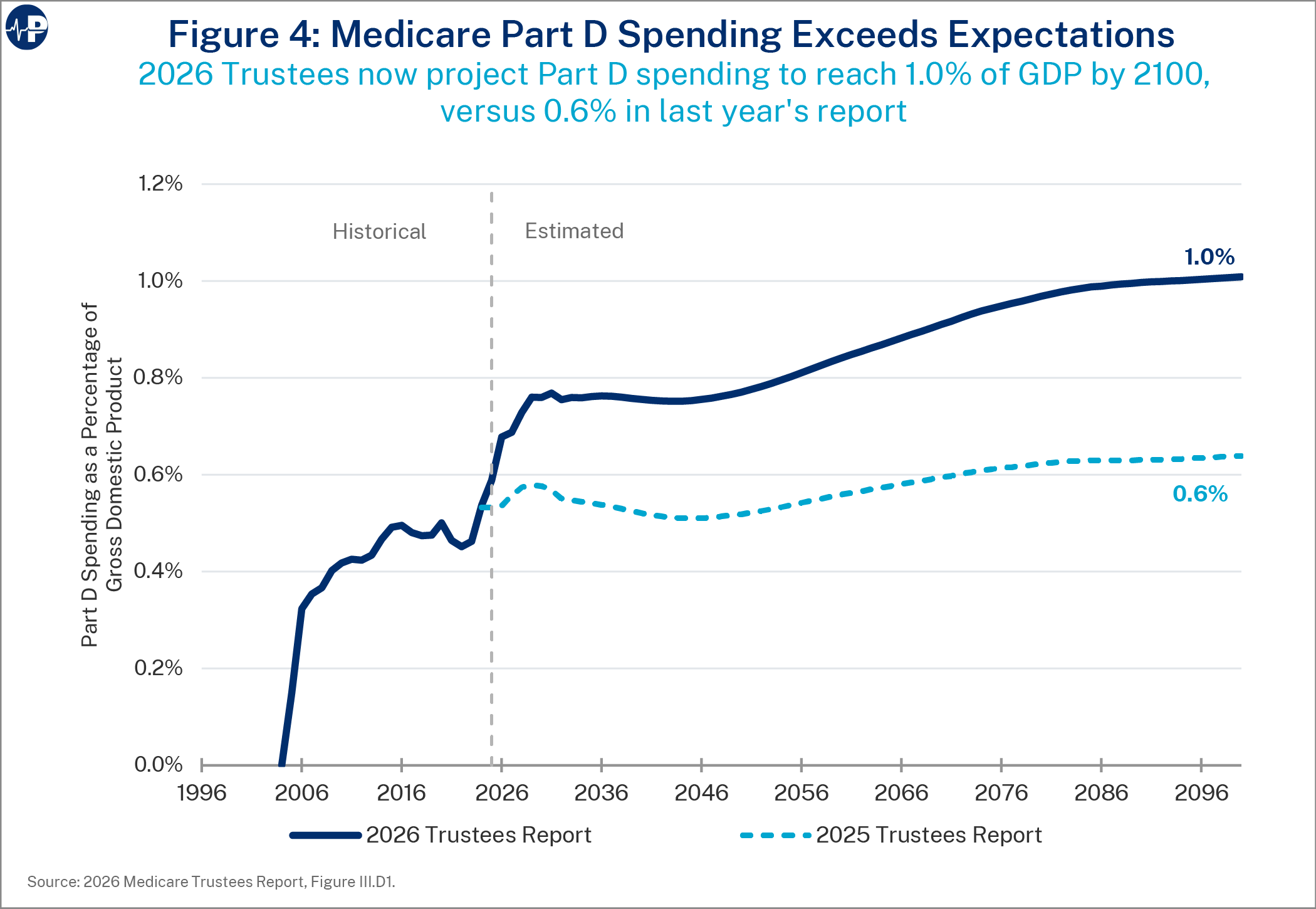
Unfortunately, a recent policy change from Congress has significantly increased Medicare’s reliance on general revenues. The Inflation Reduction Act (IRA)’s misguided Part D redesign, which contained a much lower out-of-pocket cap, has dramatically worsened Medicare’s outlook by leading to much higher Part D premiums and federal spending since taxpayer subsidies cover roughly 75 percent of the Part D premium. The Congressional Budget Office (CBO) estimates that the IRA’s changes to Part D will cost $600 billion more than originally estimated over the next 10 years.3 Figure 4, from the recent Medicare Trustees report, shows the significant increase in projected Part D costs over the next decade—an increase in costs of more than one-third.4 The changes in the IRA have also significantly reduced the number of participating plans, decreasing competition and putting more pressure on premium increases. The Part D redesign illustrates the broader problem addressed throughout this paper: federal health programs increasingly insulate participants from the cost of additional spending while shifting ever-larger liabilities onto taxpayers.
Policy solutions
- Equalize payments across care sites when the same service is delivered. Differing payments between different sites of service directly increase costs for Medicare enrollees and taxpayers—and contribute to government-driven provider consolidation, fueling ever-larger hospital systems at the expense of independent physician practices and increasing premiums for people with commercial insurance. Making payments site-neutral across Medicare will save up to an estimated $190 billion for taxpayers and enrollees over 10 years.5
- Reform the IRA’s Part D redesign to reverse the stunning increase in Part D costs. Perhaps most importantly, Congress should increase the out-of-pocket maximum and ensure that it is real.6 The current $2,000 out-of-pocket maximum is not the real amount an enrollee has to spend before catastrophic coverage kicks in. Due to how the statute was worded and subsequently implemented by the Biden administration, enrollees can hit the cap with spending as little as $500 because any cost-sharing the plan takes on for the enrollee as part of supplemental Part D benefits is counted as enrollee spending.
- Reduce Medicare’s special subsidies for hospitals.7 Medicare provides hospitals with tens of billions of dollars annually through special payment programs that are unavailable to most other providers. These include Disproportionate Share Hospital (DSH) payments, graduate medical education payments, special geographic payment adjustments, and minimum payment guarantees that prevent payments from reflecting local market conditions. Many of these subsidies are poorly targeted and increasingly flow to large hospital systems with strong financial positions. Congress should review these subsidies and phase down those that no longer serve a clear public purpose.8
- Adopt Paragon’s recommendations in Improving Medicare Through Medicare Advantage,9 which would improve Medicare Advantage by addressing problems with risk adjustment, benchmark setting, and the quality bonus programs while advancing competitive forces in the program. The package of recommendations would save the federal government at least $250 billion over 10 years.
- Reform Medigap to reduce distortions that lead to higher costs. Policymakers should end first-dollar coverage of fee-for-service (FFS) cost sharing in Medigap plans. These plans are typically used by wealthier and healthier enrollees, and first-dollar coverage makes them insensitive to the cost of care. Studies show that Medigap coverage increases FFS spending by 22 to 27 percent.
- Stop payments for suspicious billing patterns or for outlier providers before the money goes out the door. Conduct proper data analysis and investigation before restarting payments.
- Gradually increase wealthier enrollees’ share of Medicare premiums and related cost-sharing.10
Improve States’ Incentives to Obtain Value from the Medicaid Program and Reduce Inequities with Federal Medicaid Funding
Through Medicaid, the federal government provides states with an open-ended reimbursement for Medicaid expenditures—including artificial state expenditures generated through financing schemes—without limit. As the federal government has assumed a growing share of Medicaid costs, states have become increasingly reliant on Washington to finance their programs and increasingly focused on maximizing federal reimbursements rather than obtaining value for taxpayers and patients. The result is a financing system that drives higher spending, larger federal deficits, and lax accountability.
In Figure 5, the top line represents the actual share of federal Medicaid spending, accounting for the state financing gimmicks that result in illusory state expenditures that are nonetheless reimbursed by the federal government. The bottom line represents the federal share as it appears on paper (but includes the illusory state spending as actual state spending).
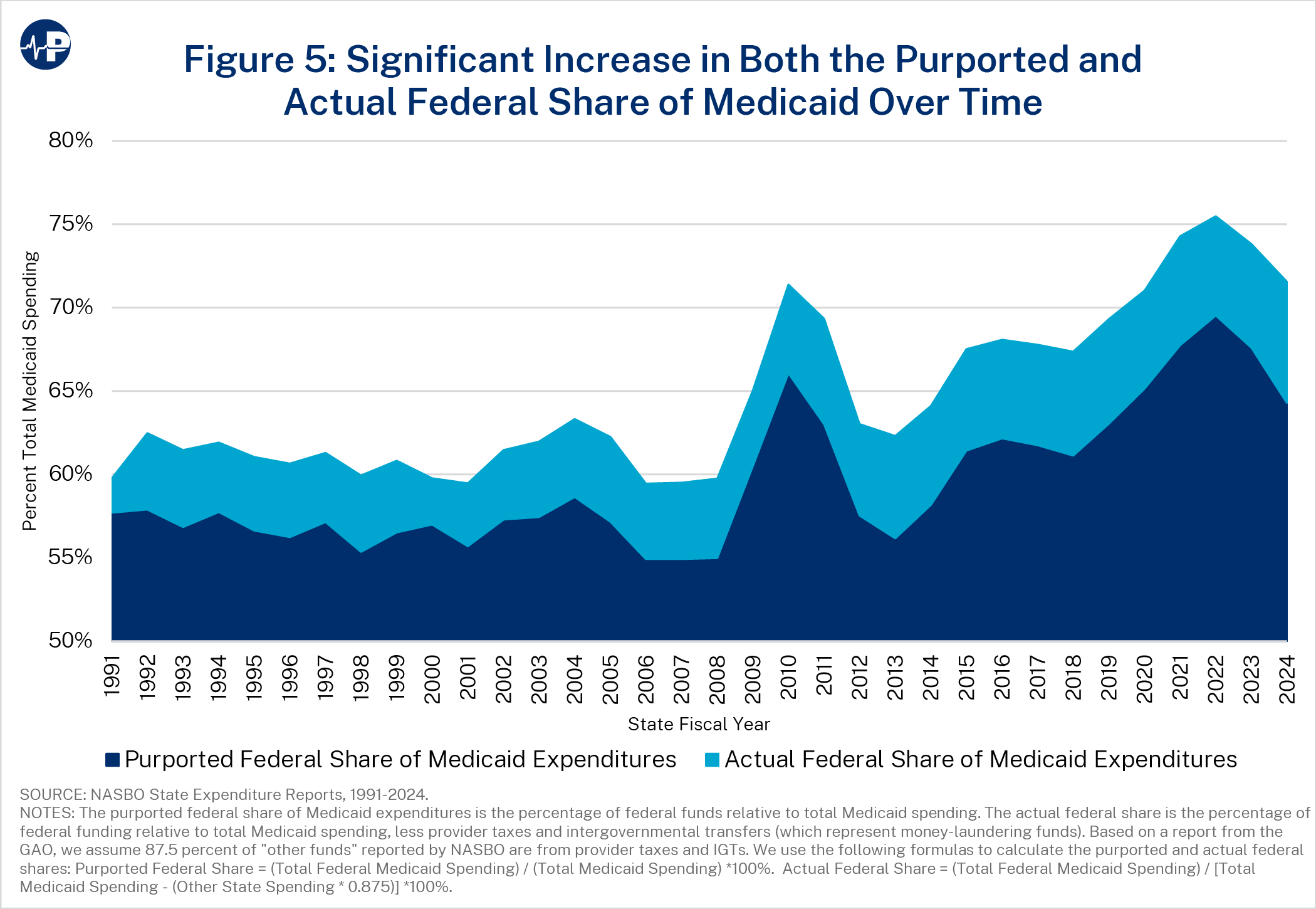
For most of Medicaid’s history through 2008, the actual share of Medicaid spending was split between the federal government and states at about a 60-40 share. In the financial crisis of 2008-2009, the federal government sent aid to states through an elevated federal Medicaid reimbursement. That increased the federal share for a brief period. But the main dynamics that have altered the historic ratio were the ACA’s Medicaid expansion (and the much higher rate for able-bodied, working-age adults) and states’ increased use of legalized money laundering tactics (such as provider taxes and intergovernmental transfers). These changes have significantly increased the federal share of Medicaid to over 70 percent.
This shift means that states finance a steadily shrinking share of Medicaid expenditures while becoming increasingly dependent on federal taxpayers to support program growth. As states bear less of the financial consequences of additional Medicaid spending, they have correspondingly weaker incentives to scrutinize costs, reduce waste, and maximize value. As a result of states having poor incentives to obtain value from their Medicaid programs, our research suggests that improper payments represent about one-quarter of total program expenditures.11 The main drivers of improper payments are incorrect or incomplete eligibility determinations.
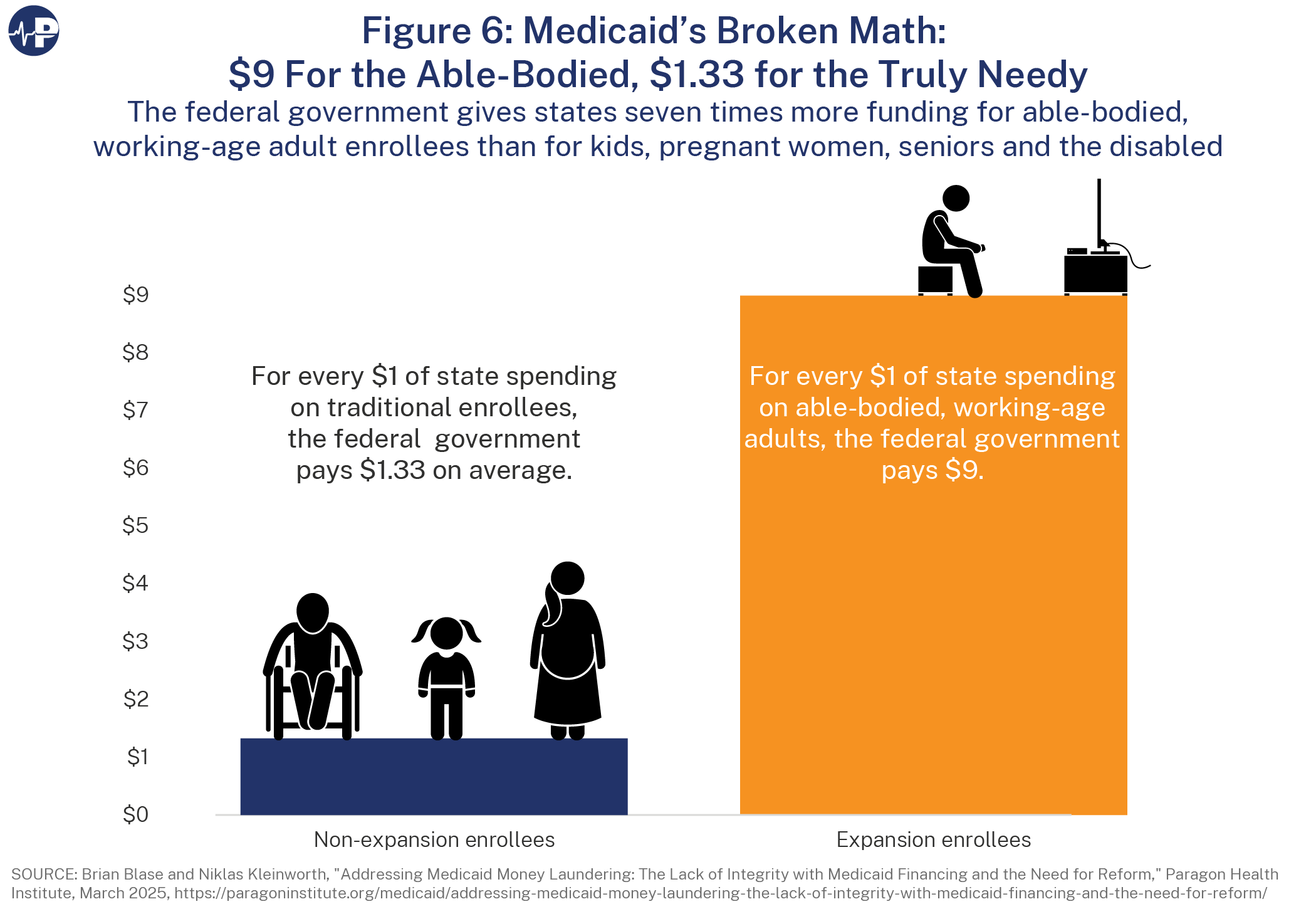
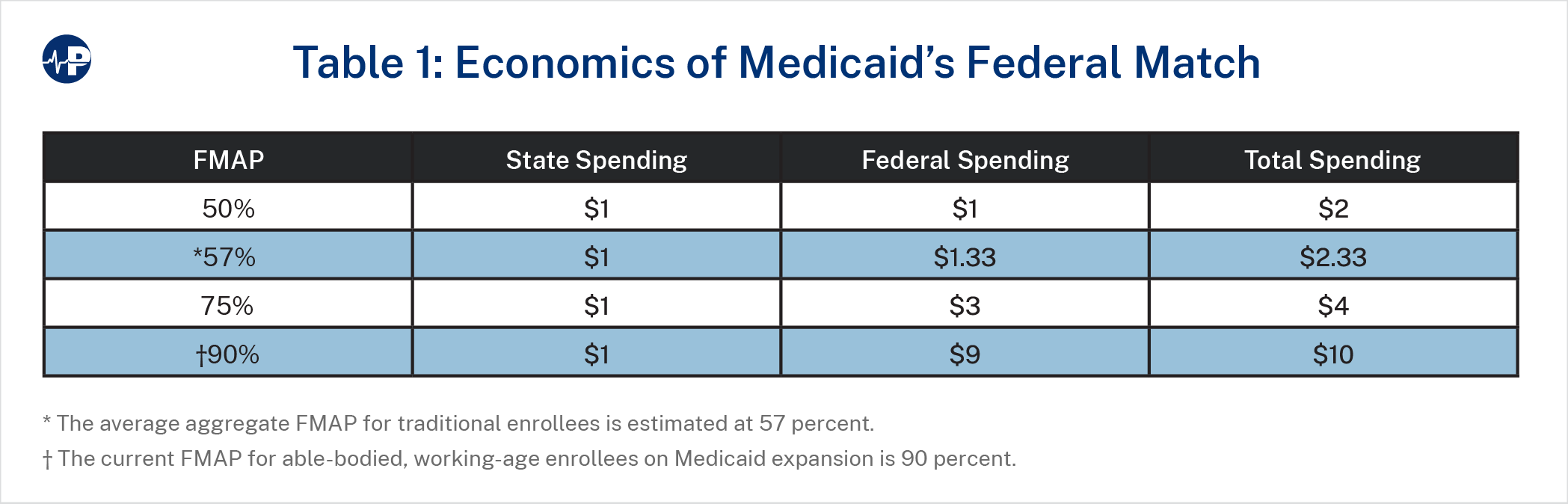
Figure 6 illustrates one of Medicaid’s most fundamental financing distortions. On average, for every $1 that a state spends on traditional Medicaid populations—children, pregnant women, seniors, and people with disabilities—the federal government contributes about $1.33, reflecting the program’s average 57 percent federal matching rate for traditional recipients. By contrast, for every $1 that a state spends on able-bodied, working-age adults covered through the ACA’s Medicaid expansion, the federal government contributes $9 because it pays 90 percent of the cost. In other words, states receive roughly seven times more federal funding for each state dollar devoted to expansion adults than for the program’s most vulnerable populations. These dramatically different matching rates encourage states to prioritize spending that maximizes federal reimbursements, including incorrectly categorizing traditional enrollees as expansion enrollees, rather than spending that delivers the greatest value or best serves the most vulnerable. Table 1 illustrates the math behind the numbers.
The fiscal partnership between the states and Washington needs to be improved so that states have incentives to obtain value from their spending, not just maximizing incoming federal dollars.
Federal Medicaid spending exploded during the Biden administration—both from a surge of enrollees during the pandemic and increased corporate welfare. As a result of continuous coverage requirements, nearly 18 million enrollees were on the program by the spring of 2023 who were no longer eligible.12 The unwinding of the excessive enrollments has taken much longer than expected.
In addition, starting in the Biden administration, many states aggressively turned to state-directed payments (SDPs) to raise federal spending to make much larger Medicaid payments to providers, particularly hospital systems. Using SDPs, states recycle provider tax money to obtain additional federal funds that states direct insurers to make to providers, mostly hospital systems. A recent KFF analysis estimates that federal SDP spending now totals roughly $93 billion annually across 40 states and the District of Columbia, with 84 percent flowing to hospitals.13 A new Paragon study shows how provider taxes raise commercial hospital prices, with a California hospital provider tax raising prices by approximately 4 percent.14 Higher hospital prices almost certainly translate into higher health insurance premiums and lower worker wages.
Loopholes in the rules governing these taxes permitted states like California to design taxes on Medicaid insurers at more than 100 times the tax rate on commercial insurers. In a circular fashion, California spent this tax money on insurers—and then claimed federal reimbursement. California has received more than $10 billion through this financial chicanery—money that no doubt enabled it to expand Medicaid coverage to unauthorized immigrants in the state the year after the Biden administration approved this scheme.15
The One Big Beautiful Bill (OBBB) contained the most consequential reforms to the Medicaid financing structure in history. These reforms are particularly important given the rise in both the legalized money laundering techniques, such as provider taxes and intergovernmental transfers, and the payoffs, increasingly through SDPs. The OBBB prevented new or expanded provider taxes, lowered the provider tax safe harbor threshold in Medicaid expansion states from 6 percent to 3.5 percent over the 2028-2032 period, and capped payments for most services through Medicaid managed care organizations at 110 percent of Medicare rates in non-expansion states and 100 percent of Medicare rates in expansion states. CMS estimates that its proposed rule implementing and modestly extending these SDP limits will reduce federal Medicaid spending by $510.1 billion from 2026 through 2035.16 The law sensibly distinguished between expansion and non-expansion states because the money laundering schemes are amplified under the nine-to-one ACA match rate.
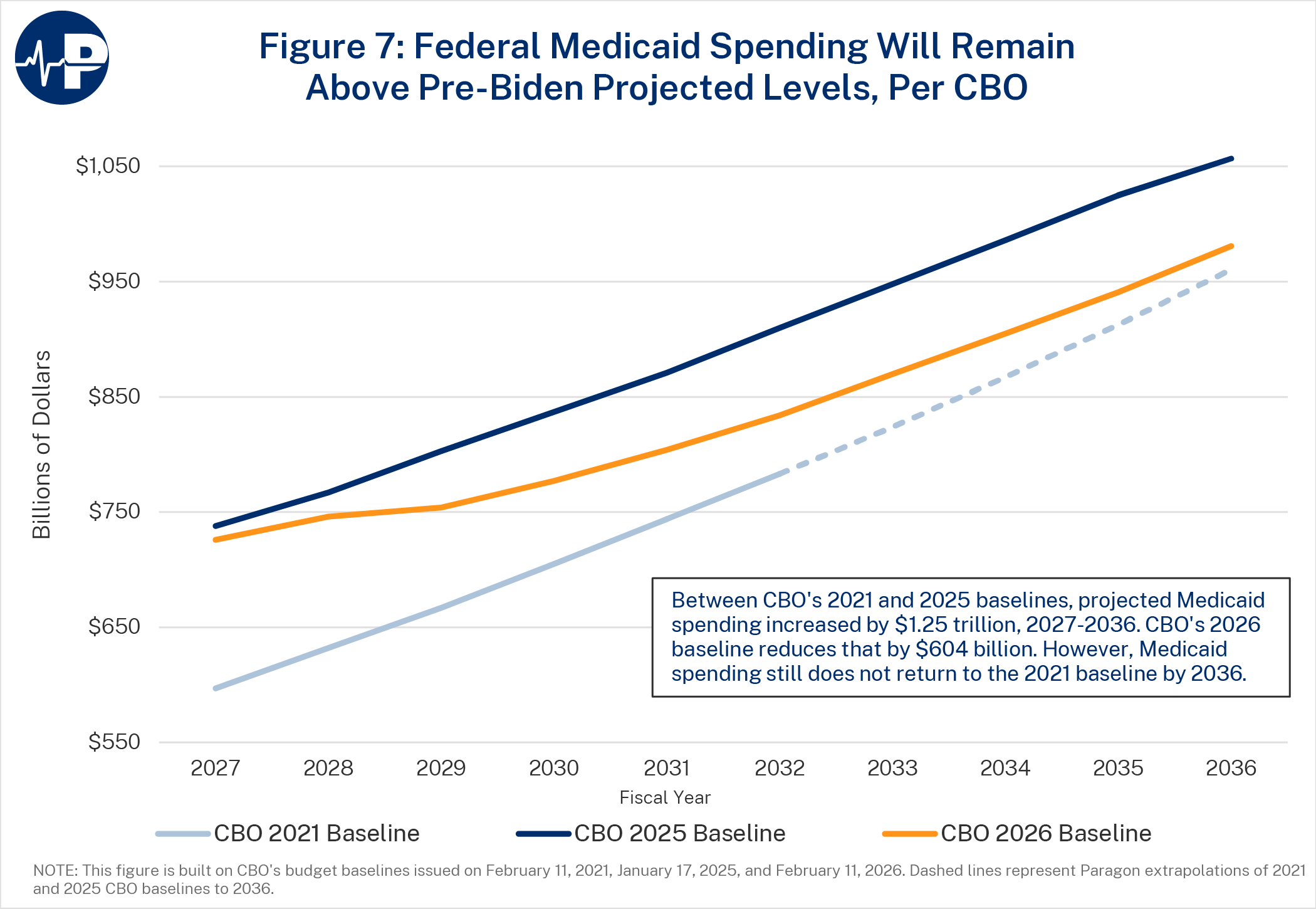
Despite these reforms, along with other reforms like the community engagement requirements for able-bodied, working-age adults and more frequent eligibility reviews, federal Medicaid spending is still projected to exceed the levels anticipated at the beginning of the Biden administration (when federal Medicaid spending was on an unsustainable trajectory). Figure 7 contrasts the pre-Biden baseline (2021), with the post-Biden/pre-OBBB baseline (2025) with the post-OBBB baseline (2026) to illustrate both the tremendous growth of federal Medicaid spending during the Biden administration and how CBO estimates the impact of the OBBB reforms on future federal Medicaid spending. In essence, the OBBB reforms are projected to eventually return federal Medicaid spending to the levels projected at the start of the Biden administration.
Medicaid Financing Formula Should Better Reflect State Fiscal Need
Medicaid’s financing structure is inequitable not only across eligibility groups but also across states. The current formula for traditional enrollees was designed to provide greater federal assistance to states with lower per capita income. Under that formula, the wealthiest states receive $1 in federal funds for every $1 in state funds and the poorest states receive $3 in federal funds for every $1 in state funds. However, as Figures 8 and 9 show, higher-income states tend to receive more federal Medicaid funding per person in poverty because they have larger and more expansive programs. If the Medicaid formula was working as intended, the correlation line would be negative, not positive. Figure 8 includes spending on ACA Medicaid expansion enrollees and Figure 9 excludes that spending—showing that this makes very little difference in the overall trend of greater federal Medicaid support in wealthier states.
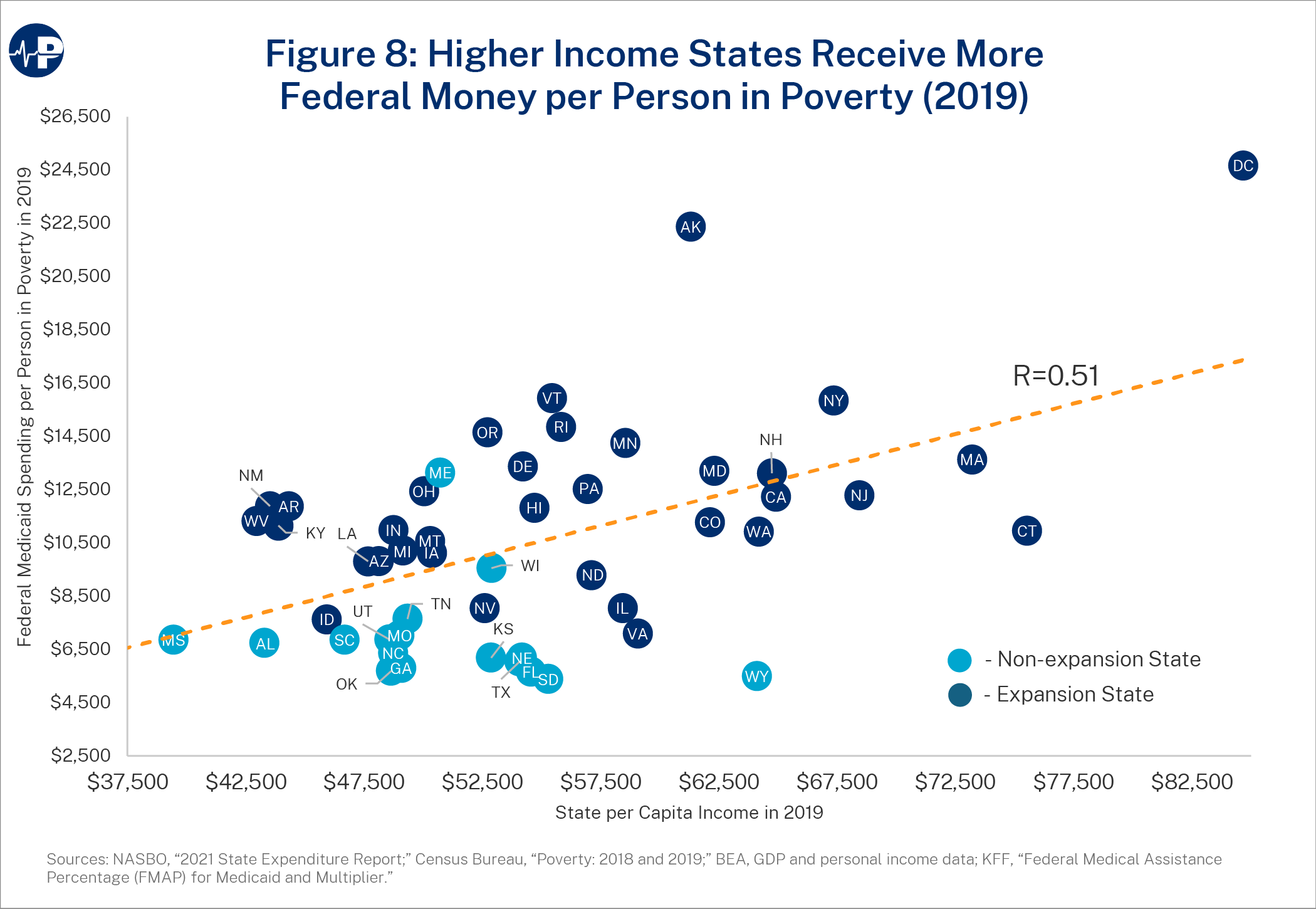

One reason that the formula creates an inequity that favors wealthier states is that there is an arbitrary floor on the federal reimbursement percentage at 50 percent. Lowering that floor would result in greater equity in federal funds across the country.
Policy solutions
- Equalize the federal matching rates between the ACA expansion enrollees and traditional enrollees to eliminate discrimination against the most vulnerable and eliminate the incentive for states to shift enrollees and expenditures into the ACA expansion category.
Paragon’s Proposal to End Medicaid’s Discrimination Against the Most Vulnerable17
In 2024, we released a policy proposal that would have gradually lowered the 90 percent federal reimbursement rate for able-bodied, working-age adults to the rate that states receive for traditional Medicaid enrollees over an eight-year period. Our proposal permits states to keep Medicaid expansion and reduce eligibility to only households below the poverty level while households earning above the poverty level would be eligible for tax credits for ACA exchange plans. In essence, this would migrate enrollees with income above 100 percent of the federal poverty level (FPL) into the exchanges with a very large premium tax credit.
This policy would better protect services for traditional enrollees, better align state incentives to get value from expenditures and eliminate states’ incentive to maximize expansion enrollment, and significantly increase enrollment in the exchanges relative to Medicaid. It would also eliminate the current federal financing bias that favors able-bodied, working-age adults over children, pregnant women, seniors, and people with disabilities.
Assuming all states maintain their expansion and all individuals in households with income between 100 and 138 percent FPL maintain coverage with the switch from Medicaid to the subsidized exchanges, we estimated that the federal government would save roughly $250 billion from our proposal. Based on conversations with CBO and other experts, we estimate that CBO would expect about a quarter of people in current expansion states to live in a state that pulls back its expansion and about one in five expansion enrollees with income between 100 and 138 percent FPL not to enroll in a subsidized exchange plan. We estimate that the federal savings from these two factors would total another $275 billion.
- Preserve and strengthen the OBBB’s reforms to provider taxes and SDPs. The main way to strengthen the reforms would be to further reduce the provider tax safe harbor and ensure that existing SDPs are brought into compliance with the OBBB limits.18
- Take further steps to limit states’ ability to shift costs to the federal government, including limits on intergovernmental transfers so states do not pay public providers more than private providers. (Figure 10 illustrates how states shift costs to the federal government using IGTs.) Some states like California have programs that pay government providers multiples more than they pay private providers.

- Lower the statutory FMAP floor from 50 percent to 40 percent while preserving the existing sliding-scale formula.19 This reform would better align federal assistance with fiscal capacity, improve equity among states, and reduce federal Medicaid spending. Paragon previously estimated that gradually lowering the FMAP floor would reduce federal spending by roughly $60 billion over the budget window.
- Penalize states for excessive improper payment rates. States currently have very little incentive to reduce waste, fraud, and abuse. Every dollar of waste and improper spending that they reduce only accrues 30 cents of savings on average to the state—and only 10 cents for misspending on expansion enrollees. The OBBB contained some reforms to penalize states with high error rates, but more could be done to strengthen that provision and realign states’ incentives to care about the integrity of their programs.
- Require greater integrity in state Medicaid managed care rates by ensuring that clear fraud and impossible billing patterns are removed from capitated payment rates so that this fraud and abuse does not persist from one year to the next.
Restore Integrity and Fiscal Sustainability to the ACA Exchanges
The Affordable Care Act’s core structural design flaws drive up deficits by incentivizing insurers to raise premiums and seek even higher subsidies. The ACA’s regulations made health insurance much more expensive, particularly for the healthy. As a result of those regulations, subsidies are necessary for the vast majority of enrollees to afford coverage. The subsidies have grown on autopilot over time as they effectively cap the amount that households must pay for a benchmark plan.20 Because taxpayers absorb most premium increases through larger premium tax credits, insurers face substantially weaker incentives to restrain premium growth than they would in a non-distorted market. Figure 11 shows that as premiums have risen, federal subsidies have masked 90 percent of the premium increase. Figure 11 illustrates how the ACA’s subsidy structure is inherently inflationary and transfers the cost of higher premiums from enrollees to taxpayers.

The subsidies are almost always advanced to health insurers. An enrollee estimates their income, qualifies for an advanced subsidy, and that amount is forwarded to the health insurance company that enrollee chose. When the individual files their income tax return, the advanced amount is reconciled with the amount to which the enrollee was entitled. If the government sent too much to the health insurance company during the year, there are significant limits on the amounts that can be recaptured.21 The result is a clear loss for federal taxpayers.
In 2021, Congress enacted a temporary two-year increase of the ACA insurer subsidies as a pandemic relief measure. Those subsidy add-ons were extended through 2025. The subsidy add-ons resulted in fully subsidized plans with a 94 percent actuarial value (extremely low deductibles and copayments) for people claiming income between 100 and 150 percent of the FPL. Figure 12 shows the surge in ACA enrollment and subsidy spending by comparing CBO’s pre-subsidy-boost baseline from 2021 with its 2025 and 2026 baselines. None of these projections assumed that the enhanced COVID-era subsidies would continue beyond 2025, since Congress scheduled those subsidies to expire after 2025. The reduction from 2025 to 2026 reflects ACA program integrity improvements contained in the OBBB to better ensure subsidies go to people who are eligible for them.

Paragon studies have found that much of this enrollment was improper, meaning that people were enrolled in fully subsidized plans for which they did not qualify. We estimate that improper enrollment equaled 5.0 million people in 2024, 6.5 million people in 2025, and 6.2 million people in 2026.22 In each of the last two years, improper enrollment equaled 27 percent of total exchange enrollment.
The widespread availability of fully subsidized plans led to large incentives for insurers and brokers to have applicants submit applications that would qualify them for fully subsidized plans. Insurers benefit when taxpayers pay the full premium. In those circumstances, they do not need to actually provide enrollees with any value in the plan in order to maintain enrollment. And brokers receive a monthly commission for every month in which an enrollee is enrolled. Brokers at enrollment factories earned upwards of $6,000 a day in commissions, with one customer service agent admitting that half of all enrollees had no idea they were enrolled in coverage.23
The rise of improper enrollment and schemes to enroll as many people as possible, regardless of their eligibility, led to a surge in phantom enrollees. In 2024, 35 percent of all ACA enrollees—and 40 percent of enrollees in a fully subsidized plan—did not use their health plan a single time. We estimate between 3 and 4 million phantom enrollees (on an annualized basis) in 2024. The Government Accountability Office (GAO) has confirmed the vulnerabilities of the exchanges. GAO created 24 fictitious applications in 2024 and 2025 with incomplete and missing information—and successfully enrolled 23 into a fully subsidized exchange plan.
There are other major problems from the ACA’s subsidy structure that were worsened by the COVID-era subsidy boosts.
- As Figure 13 shows, the subsidies, particularly with the COVID-era boost, discriminate against people with employer-provided coverage as the subsidies tend to be much greater than the budgetary impact of the employer-provided tax exclusion, which is a loss in federal tax revenue.

- By tying the government benefit to the absence of an employer-based health insurance plan, the government discourages people from working for employers who offer health coverage.
- Unlike employer-based benefits, which employers use to attract workers and have greater tax benefits when income increases, the ACA tax credits punish enrollees who increase their income, because earning higher income cuts their subsidies. By contrast, there is no disincentive to a worker with employer coverage who seeks to increase his pay by becoming more productive or working more.
- The expanded subsidies made it much more attractive for small employers not to offer health coverage, as workers who receive coverage at work do not qualify for ACA subsidies. Extending the COVID-era subsidy boosts would reduce employer-based coverage by nearly 4 million people according to CBO, and it would impose a substantial deadweight loss on economic activity.24
- The ACA and its subsidies led many cities, including Chicago and Detroit, to offload public sector retiree health care costs to the federal government.25 The COVID-era subsidies made wealthy early retirees eligible for large taxpayer-financed subsidies for their health care, adding to the incentive for state and local governments to move those retirees into the exchanges.
Congress should significantly reform the ACA—permit people to buy plans that they want, permit insurers to provide favorable pricing terms for people who are healthy or who engage in healthy behaviors, and reform the subsidies to reduce their size, inflationary structure, and complexity. Short of such comprehensive reforms, Congress could take several actions to meaningfully reduce improper enrollment and excessive subsidy expenses.
Policy solutions
- Require all exchange enrollees to make a meaningful premium contribution toward their coverage. Congress should prohibit zero-premium plans and require a minimum monthly premium contribution. A modest premium contribution—approximately $25 per month—would significantly reduce incentives for unauthorized enrollments by unscrupulous agents and brokers, improve consumer engagement, and ensure that coverage provides at least a modicum of value to the people enrolled in it.
- End automatic re-enrollment into exchange coverage. Automatic re-enrollment has become one of the largest contributors to improper enrollment and phantom enrollment. Enrollees should be required to actively confirm their eligibility, household information, and plan selection each year before receiving taxpayer-financed subsidies.
- Reform advance premium tax credits by basing subsidies on actual income rather than estimated future income. The current system invites gaming because eligibility is determined by self-reported income projections that are often inaccurate and difficult to verify. Advance subsidies should generally be based on actual income information, with a process that would allow individuals to demonstrate a significant change in circumstances when appropriate.
- Establish meaningful financial accountability for brokers, enrollment entities, and insurers that facilitate improper enrollment. Congress should authorize substantial civil monetary penalties for entities with significant rates of unauthorized or improper enrollment and require insurers to implement stronger safeguards to verify the legitimacy of enrollments for which they receive taxpayer-financed subsidies.
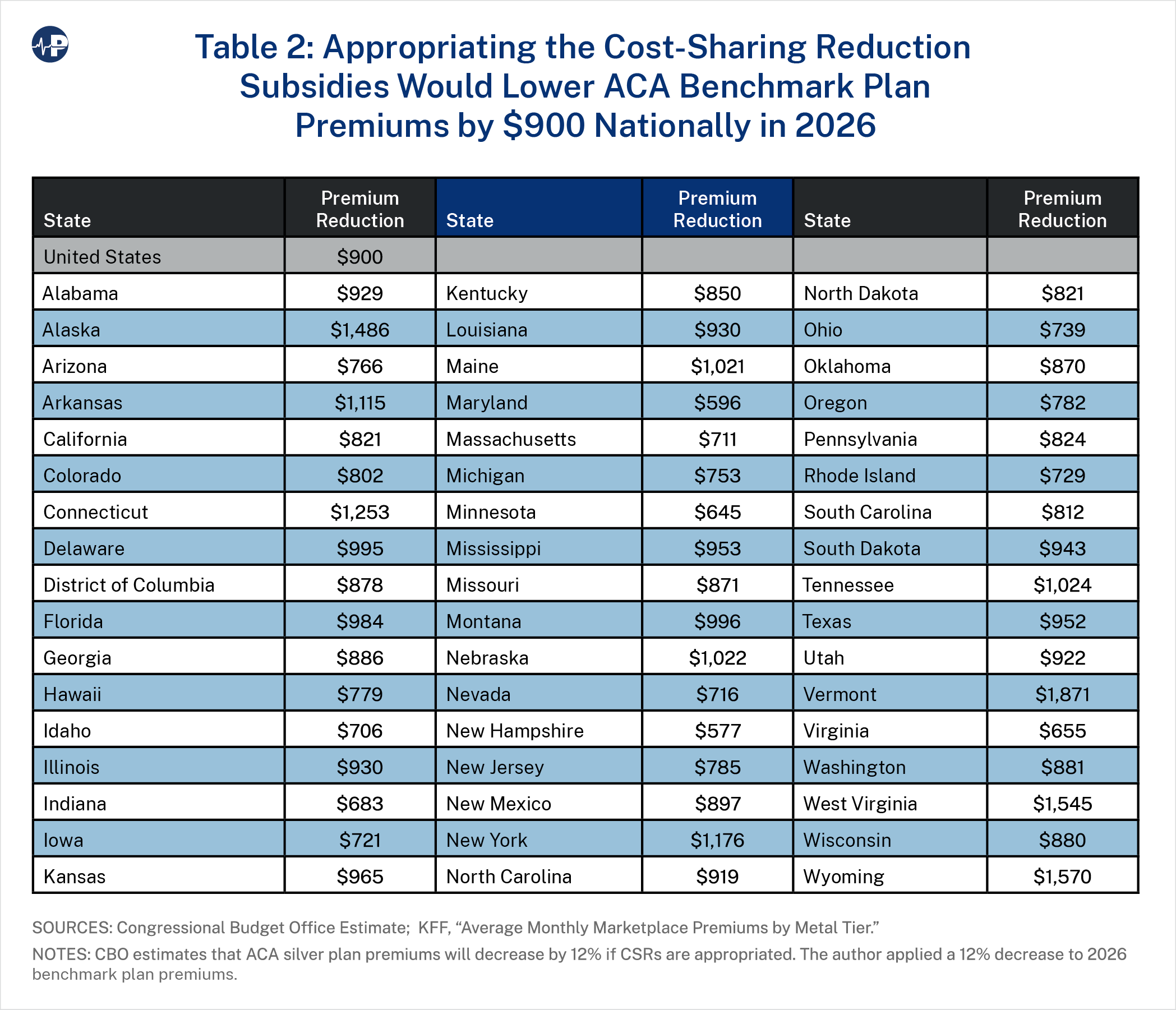
- End silver loading and directly appropriate cost-sharing reduction subsidies. The current silver-loading system artificially inflates premiums, increases federal spending, and distorts consumer plan selection. Congress should appropriate cost-sharing reduction payments directly and eliminate silver loading, lowering premiums for unsubsidized consumers while reducing unnecessary federal subsidy expenditures.26 Table 2 shows the estimated 2026 premium reduction from a CSR appropriation by state.
The objective of these reforms is not to reduce coverage for eligible individuals. The objective is to ensure that exchange enrollment reflects people who are eligible for subsidies, actively choose coverage, and maintain coverage because they place at least a modicum of value on it rather than because government programs permit passive or improper enrollment.
Capping the Exclusion for Employer-Sponsored Health Insurance
Federal tax policy also heavily influences employer-sponsored coverage. The exclusion for employer-sponsored health insurance is the largest tax preference in the federal tax code and one of the largest drivers of excessive health care spending. Workers do not pay income or payroll taxes on employer contributions toward health insurance premiums. As a result, the federal government effectively subsidizes more comprehensive and more expensive health insurance coverage. Because the tax preference increases with a worker’s tax rate and the cost of the insurance plan, higher-income households with more generous coverage receive greater benefit. The exclusion also contributes to higher health care spending by encouraging compensation to be paid in the form of health benefits rather than wages and by reducing consumers’ sensitivity to the cost of medical care.
This tax preference contributes to excessive insurance coverage, higher health care utilization, and upward pressure on provider prices. The result is higher federal deficits, lower taxable wages, and a health care system that is more expensive than it otherwise would be.
Congress should address these distortions as part of a broader tax reform effort. Rather than providing an open-ended exclusion, policymakers should cap the amount of employer-sponsored health insurance eligible for favorable tax treatment. In a 2024 paper that I co-authored, we suggested a cap at 125 percent of the average employer-sponsored insurance premium.27 This approach would preserve the exclusion for the overwhelming majority of workers while gradually limiting subsidies for the most expensive plans. Over time, this reform would reduce incentives for excessive health spending, increase wage transparency, and improve the nation’s long-term fiscal outlook.
340B Reform
The 340B program was created to help safety-net providers stretch limited resources and serve vulnerable patients. Over time, however, it has evolved into one of the largest and least accountable subsidy programs in American health care. Covered entities are permitted to purchase outpatient drugs at substantial discounts while receiving reimbursement from Medicare, Medicaid, and commercial insurers at much higher rates. The difference between acquisition costs and reimbursement—the spread—has become the program’s central financial incentive. As a result, 340B purchases have grown from roughly $4 billion in 2009 to more than $80 billion in 2024.28 Yet there is remarkably little evidence that this extraordinary growth has translated into proportional benefits for low-income patients but ample evidence demonstrating that the current structure provides greater benefit to wealthier entities while poorer rural and safety-net hospitals get comparatively less assistance from the program.
The program increasingly rewards behavior that is unrelated to the care of vulnerable patients. Because the largest spreads are often generated from commercially insured patients, the wealthiest hospital systems frequently derive the greatest financial benefit. The structure of the program encourages the use of higher-cost branded drugs over lower-cost generics and biosimilars, increases overall drug spending, and creates strong incentives for hospitals to acquire physician practices in order to expand the volume of 340B-eligible prescriptions. These incentives contribute to provider consolidation, reduced competition, and higher health care costs.
Congress should reform 340B by eliminating the link between provider profits and drug prices. Covered entities should be required to disclose the amount of 340B revenue they receive and demonstrate how those resources are used to benefit low-income patients. Policymakers should redesign the program so that subsidies are not tied to drug prices, reimbursement spreads, or prescription volume. Any federal support should be transparent, targeted, and directly linked to the provision of care for vulnerable populations rather than arbitrage opportunities created by the current reimbursement system.
Problems with the MLR
The ACA’s medical loss ratio (MLR) requirements have also contributed to higher health care spending and greater consolidation. Under the ACA, insurers generally must spend at least 80 to 85 percent of premium revenue on medical claims and quality improvement activities, limiting the share that can be retained for administration and profit. While intended to protect consumers, the MLR effectively ties insurer profits to the level of medical spending. As health care expenditures rise, insurers are permitted to retain larger dollar amounts of administrative expenses and profits, reducing incentives to aggressively constrain spending. Many economists and health care investors have concluded that the MLR has likely increased overall health care spending by weakening insurers’ incentives to negotiate lower prices and more effectively manage utilization.
The MLR has also encouraged greater vertical integration throughout the health care sector. Because medical claims paid to affiliated physician groups, pharmacies, and other providers generally count toward satisfying the MLR requirement, insurers have stronger incentives to acquire physician practices, pharmacy benefit managers, specialty pharmacies, and other health care businesses. This vertical consolidation can reduce competition, increase commercial prices, and make health care markets less competitive. Policymakers should repeal the MLR requirement so that insurers are rewarded for delivering greater value—not for overseeing higher levels of medical spending—and to reduce incentives for vertical consolidation.
Conclusion
The federal government’s fiscal outlook cannot be improved without addressing health care spending. Medicare, Medicaid, ACA subsidies, and other federal health programs now consume roughly 62 percent of all individual income tax revenue, corporate income tax revenue, and Medicare payroll tax revenue. Twenty-five years ago, that figure was just 29 percent. The growth of federal health spending is not merely a health policy challenge—it is the central fiscal challenge facing the country.
The fundamental problem is that policymakers have repeatedly designed programs around open-ended federal commitments and open-ended federal reimbursement structures that reward higher spending rather than higher value. Medicare often pays more when care is delivered in higher-cost settings, and the IRA’s Part D redesign has led to explosive federal spending increases. Medicaid rewards states for maximizing federal transfers rather than obtaining value for taxpayers and patients, with a perverse discrimination against the most vulnerable. The ACA’s subsidy structure rewards enrollment without sufficient regard to eligibility and creates incentives that drive up federal costs. The tax exclusion for employer-sponsored insurance increases health care spending while reducing wages. The 340B program rewards higher drug prices, greater volume, and provider consolidation rather than better care for vulnerable patients.
The result is predictable. Federal health spending grows faster than the economy, faster than tax revenue, and faster than policymakers anticipated. Every additional dollar devoted to waste, improper payments, excessive subsidies, or poorly designed incentives is a dollar that cannot be used for other priorities or left in the hands of taxpayers. Increasingly, it is a dollar that must be borrowed from future generations. Medicare’s contribution to the nation’s fiscal challenge is becoming more severe as fertility declines and fewer workers are available to support a growing retired population.
The longer Congress waits to address these problems, the more painful the eventual policies that Congress is forced to adopt. Every year of delay means higher spending, larger deficits, greater interest costs, and fewer options for policymakers. To the extent this Congress fails to enact needed reforms, it will leave future Congresses with a more difficult set of choices involving larger tax increases, more abrupt spending reductions, and greater economic disruption. It is time for Congress to begin seriously addressing the structural drivers of federal health spending.
There is some encouraging news. The reforms contained in the One Big Beautiful Bill demonstrated that Congress can improve incentives, strengthen program integrity, reduce wasteful spending, and better align federal resources with those who need assistance most. But the OBBB should be viewed as the beginning of the process, not the end.
If Congress is serious about improving America’s long-term fiscal outlook, health care reform must remain at the center of the discussion. The objective should not simply be to lower federal health spendingIt should be to create programs that reward value, encourage efficiency, strengthen accountability, promote competition, and improve outcomes for patients. The nation’s fiscal future, economic growth, and ability to meet future obligations depend on it.
Footnotes
1↑ Mark Howell, "Federal Health Program Spending Consumes 62 Percent of Relevant Federal Taxes," Paragon Health Institute, April 15, 2026, https://paragoninstitute.org/paragon-pic/federal-health-program-spending-consumes-62-percent-of-relevant-federal-taxes/
2↑ Medicare Advantage (Part C) spending is included within the other categories.
3↑ Congressional Budget Office, "The Budget and Economic Outlook: 2026 to 2036," February 2026, https://www.cbo.gov/publication/62105
4↑ Medicare Trustees, "2026 Annual Report of the Board of Trustees of the Federal Hospital Insurance and Federal Supplementary Medical Insurance Trust Funds," June 9, 2026, https://www.cms.gov/oact/tr/2026
5↑ Committee for a Responsible Federal Budget, "Equalizing Medicare Payments Regardless of Site-of-Care," February 23, 2021, https://www.crfb.org/papers/equalizing-medicare-payments-regardless-site-care
6↑ Jackson Hammond and Ryan Long, "What's Killing Part D: The Policy Failures of the IRA," Paragon Health Institute, February 24, 2026, https://paragoninstitute.org/paragon-prognosis/whats-killing-part-d-the-policy-failures-of-the-ira/
7↑ Brian Blase and Joe Albanese, "Turning the Tide on Red Ink: Commonsense Policies to Make Federal Health Programs More Sustainable", Paragon Health Institute, March 2023, https://paragoninstitute.org/medicare/turning-the-tide-on-red-ink/
8↑ John R. Graham, "The Hospital Cost Crisis: How Government Policies Drive Consolidation, Undermine Competition, and Fuel Soaring Prices," Paragon Health Institute, April 2026, https://paragoninstitute.org/private-health/the-hospital-cost-crisis-how-government-policies-drive-consolidation-undermine-competition-and-fuel-soaring-prices/
9↑ Joe Albanese, "Improving Medicare Through Medicare Advantage," Paragon Health Institute, February 2024, https://paragoninstitute.org/medicare/improving-medicare-through-medicare-advantage/
10↑ Joe Albanese, "Reducing Government Subsidies for Wealthier Medicare Enrollees," Paragon Health Institute, May 2024, https://paragoninstitute.org/medicare/reducing-government-subsidies-for-wealthier-medicare-enrollees/
11↑ Brian Blase and Rachel Greszler, "Medicaid's True Improper Payments Double Those Reported by CMS," Paragon Health Institute, March 2025, https://paragoninstitute.org/medicaid/medicaids-true-improper-payments-likely-double-those-reported-by-cms/
12↑ Brian Blase, Drew Gonshorowski, and Niklas Kleinworth, "The Cost of Good Intentions: The Harm of Delaying the Disenrollment of Medicaid Ineligibles," Paragon Health Institute, July 2023, https://paragoninstitute.org/state-health-reform/the-cost-of-good-intentions/
13↑ Alice Burns, Scott Hulver, Jessica Mathers, Robin Rudowitz, and Patrick Drake, "Spending on Medicaid State Directed Payments Before New Limits Take Effect," KFF, June 2026, https://www.kff.org/medicaid/spending-on-medicaid-state-directed-payments-before-new-limits-take-effect/
14↑ Liam Sigaud and Eric Sun, "The Hidden Cost of Medicaid Provider Taxes: Higher Prices in the Commercial Market," Paragon Health Institute, June 2026, https://paragoninstitute.org/medicaid/the-hidden-cost-of-medicaid-provider-taxes-higher-prices-in-the-commercial-market/
15↑ Paul Winfree and Brian Blase, "California's Insurance-Tax Shuffle: How Federal Money Ends Up Paying for Medicaid for Illegal Immigrants," Paragon Health Institute and Economic Policy Innovation Center, March 2025, https://paragoninstitute.org/medicaid/californias-insurance-tax-shuffle-how-federal-money-ends-up-paying-for-medicaid-for-illegal-immigrants/
16↑ Centers for Medicare & Medicaid Services, "Medicaid Program; Medicaid Managed Care State Directed Payments and Medicaid Fee-for-Service Targeted Medicaid Practitioner Payments," proposed rule, Federal Register, May 22, 2026, https://www.federalregister.gov/documents/2026/05/22/2026-10292/medicaid-program-medicaid-managed-care-state-directed-payments-and-medicaid-fee-for-service-targeted
17↑ Brian Blase and Drew Gonshorowski, "Medicaid Financing Reform: Stopping Discrimination Against the Most Vulnerable and Reducing Bias Favoring Wealthy States," Paragon Health Institute, July 2023, https://paragoninstitute.org/medicaid/medicaid-financing-reform-stopping-discrimination-against-the-most-vulnerable-and-reducing-bias-favoring-wealthy-states/
18↑ The Medicaid provider-tax "safe harbor" refers to the indirect hold-harmless threshold under federal provider tax rules. Before the OBBB, this threshold generally allowed states to use provider tax revenues to draw down federal Medicaid matching funds so long as the tax did not exceed 6 percent of a provider's net patient revenue. Taxes above that threshold could trigger the federal hold harmless test, which is intended to prevent states from taxing providers and then guaranteeing that those same providers are repaid through higher Medicaid payments. The OBBB lowered the safe harbor threshold for Medicaid expansion states by 0.5 percentage points per year beginning in fiscal year (FY) 2028, reaching 3.5 percent in FY 2032 and thereafter, while generally freezing existing provider taxes and preventing new or increased provider taxes above the new thresholds.
19↑ Under the proposal we modeled, the FMAP floor would decline in ten states and the District of Columbia. It would be: 40.0 percent in the District of Columbia, 45.0 percent in Massachusetts, 45.4 percent in Connecticut, 47.4 percent in California, 47.4 percent in New Jersey, 47.8 percent in New York, 48.0 percent in Washington, 48.2 percent in Colorado, 48.6 percent in New Hampshire, 48.8 percent in Wyoming, and 49.6 percent in Maryland.
20↑ Mark Howell, "Almost Entire Obamacare Premium Increases Paid for By Taxpayers," Paragon Health Institute, September 2025, https://paragoninstitute.org/paragon-pic/almost-entire-obamacare-premium-increases-paid-for-by-taxpayers/
21↑ Before 2026, federal law significantly limited how much excess subsidy could be recaptured from many households with income below 400 percent of the federal poverty level. For tax year 2025, repayment was capped at $375 for single filers and $750 for other filers with income below 200 percent of FPL; $975 and $1,950, respectively, for those between 200 and 300 percent of FPL; and $1,625 and $3,250, respectively, for those between 300 and 400 percent of FPL. There was no repayment cap for households with income at or above 400 percent of FPL. Beginning with tax year 2026, however, the OBBB eliminated these repayment caps, requiring enrollees to repay the full amount by which advance payments exceed their allowable premium tax credit.
22↑ See Brian Blase, Gabrielle Minarik, Niklas Kleinworth, Mark Howell, and Liam Sigaud, "The Persistent Obamacare Enrollment Fraud," Paragon Health Institute, June 2026, https://paragoninstitute.org/private-health/the-persistent-obamacare-enrollment-fraud/; Brian Blase, Chris Medrano, Niklas Kleinworth, and Jackson Hammond, "The Greater Obamacare Enrollment Fraud," Paragon Health Institute, June 2025, https://paragoninstitute.org/private-health/the-greater-obamacare-enrollment-fraud/; Brian Blase and Drew Gonshorowski, "The Great Obamacare Enrollment Fraud," Paragon Health Institute, June 2024, https://paragoninstitute.org/private-health/the-great-obamacare-enrollment-fraud/
23↑ Zeke Faux and Zachary Mider, "Chasing Big Money with the Health-Care Hustlers of South Florida," Bloomberg, June 5, 2025, https://www.bloomberg.com/features/2025-deepfake-ads-fueled-florida-health-insurance-scheme/
24↑ Congressional Budget Office, "The Effects of Permanently Extending the Expansion of the Premium Tax Credit and the Costs of that Credit for Deferred Action for Childhood Arrivals Recipients," June 24, 2024, https://www.cbo.gov/system/files/2024-06/60437-Arrington-Smith-Letter.pdf
25↑ Allysia Finley, "The ObamaCare Blue-City Bailout: Federal Taxpayers Pay as Municipalities Save Billions by Dumping Their Retirees onto the Government Exchanges," Wall Street Journal, November 2, 2025, https://www.wsj.com/opinion/the-obamacare-blue-city-bailout-e7d72bee
26↑ Brian Blase, "Reducing Premiums and Expanding Patient Control: Why Congress Should Appropriate CSRs and Enact the HSA Option," Paragon Health Institute, November 2025, https://paragoninstitute.org/private-health/reducing-premiums-and-expanding-patient-control-why-congress-should-appropriate-csrs-and-enact-the-hsa-option/
27↑ Theo Merkel and Brian Blase, "Follow the Money: How Tax Policy Shapes Health Care," Paragon Health Institute, May 2024, https://paragoninstitute.org/newsletter/follow-the-money-how-tax-policy-shapes-health-care/
28↑ Adam J. Fein, "340B Hit $81 Billion in 2024 (+23%): Why CMS and the IRA Are Poised to Cool the Program's Runaway Growth," Drug Channels, December 2025, https://www.drugchannels.net/2025/12/340b-hit-81-billion-in-2024-23-why-cms.html
Author

Acknowledgements
The author is grateful to Doug Badger, Mark Howell, Ryan Long, and the Paragon team for their exceptional comments and work in review of the paper.