


Brian Blase, Ph.D., is the President of Paragon Health Institute. Brian was Special Assistant to the President for Economic Policy at the White House’s National Economic Council (NEC) from 2017-2019, where he coordinated the development and execution of numerous health policies and advised the President, NEC director, and senior officials. After leaving the White House, Brian founded Blase Policy Strategies and served as its CEO.
Reducing Premiums and Expanding Patient Control: Why Congress Should Appropriate CSRs and Enact the HSA Option


The Affordable Care Act (ACA) was originally written to have a funded Cost-Sharing Reduction (CSR) program. Under the CSR program, the U.S. Treasury pays insurers to reduce plan deductibles, cost-sharing amounts, and out-of-pocket limits for ACA exchange enrollees who select a silver plan and have income below 250 percent of the federal poverty level (FPL).
But the ACA was written in a sloppy manner and failed to continue a valid appropriation for the CSR. A federal judge held that the Obama administration violated the Appropriations Clause by making CSR payments without congressional authorization. The Trump administration complied with the federal court ruling and stopped the payments to insurers.
When CSRs went unfunded, insurers—which still had the obligation to lower cost-sharing amounts for individuals below 250 percent of FPL—responded by inflating silver-plan premiums—a practice called “silver loading.” This distortion increased premiums for unsubsidized households and made plan pricing less accurate. Because the premium subsidy is linked to the second-lowest-cost silver plan premium, silver-loading increased the average subsidy. And total subsidization in the market increased as the premium subsidies grew by more than the CSR cost.
With CSRs funded:
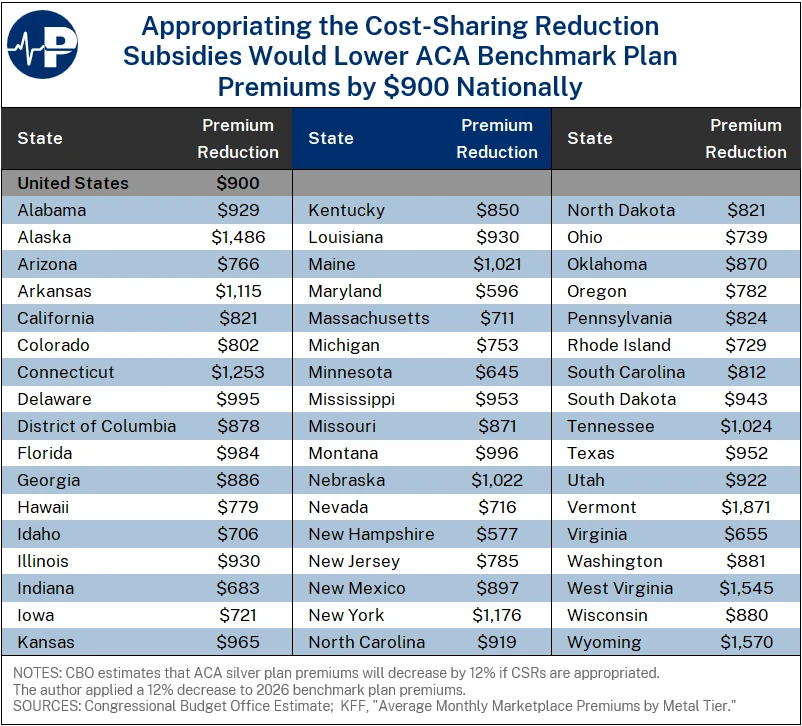
1) Silver loading ends, improving affordability for unsubsidized enrollees with a 12 percent premium reduction for silver plans. This translates to $900 in premium savings nationally.
2) Premium subsidies still apply—with the typical CSR enrollee having the government pay between 80 to 90 percent of the premium.
3) Overall federal spending would be reduced by more than $30 billion over the next decade.
Putting Money in People’s Hands with the Access Act
The Access Act—authored by Reps. Kat Cammack and Greg Steube—creates the “HSA Option,” allowing eligible enrollees the option to receive the value of their CSR subsidy as a deposit into a Health Savings Account (HSA).
Who qualifies?
Enrollees with incomes below 250 percent of FPL, which is nearly 75 percent of exchange enrollees. (250 percent of FPL would be about $40,000 a year for a single and $82,000 a year for a family of four.)
How much is in the HSA contribution, and what’s the overall benefit?
According to modeling by the actuarial firm Milliman, the average HSA contribution for a single person under the option would exceed $2,000 per year, with most individuals saving $1,500 annually—building health care wealth for the future. Nearly 70 percent of all enrollees would be better off taking the HSA Option.
How does the HSA Option work? What are some additional benefits?
1) The HSA Option shifts subsidy dollars away from insurers and toward people, consistent with President Trump’s policy preference.
2) The government payment would accrue on a debit card that could only be used for qualified medical expenses.
3) The HSA Option gives enrollees more choices and purchasing power because they can use their debit card for out-of-network services and for services not covered by the plan, such as vision and dental care.
4) The HSA Option would draw in healthier people who want to manage their own health care dollars, making the insurance pool stronger and lowering rates for everyone.
5) The HSA Option appeals to healthier enrollees because they often do not use enough services to benefit from CSR cost-sharing reductions, but under the HSA Option they keep unused funds year after year, making coverage a better value.
Related Content

Subscribe
Sign up now for your health policy updates.