

Brian Blase, Ph.D., is the President of Paragon Health Institute. Brian was Special Assistant to the President for Economic Policy at the White House’s National Economic Council (NEC) from 2017-2019, where he coordinated the development and execution of numerous health policies and advised the President, NEC director, and senior officials. After leaving the White House, Brian founded Blase Policy Strategies and served as its CEO.
Testimony of Brian Blase before the Joint Economic Committee — Protecting Patients and Taxpayers: Combating Healthcare Fraud and Leakage to Strengthen Program Integrity
Full Hearing Video
Oral Testimony
Chairman Schweikert, Ranking Member Hassan, and members of the Committee:
Thank you for the opportunity to testify today. I am Brian Blase, the founder and president of Paragon Health Institute.
This week, the Trump administration conducted the largest health care fraud takedown in history and launched a major investigation into New York’s troubled Medicaid personal care program. These actions are vitally important.
Yet these cases are symptoms of a broader disease. Federal health programs create many incentives that reward excessive spending, tolerate abuse, and invite fraud.
I will review three examples.
First, the Persistent Obamacare Enrollment Fraud.
We estimate more than 6 million improperly enrolled exchange enrollees—
more than one-in-four enrollees. Improper subsidy expenditures will likely exceed $25 billion this year.
Congress made Obamacare subsidies larger during the pandemic—creating zero-premium plans for enrollees claiming income between 100 and 150 percent of the poverty line.
Insurers prefer enrollees whose premiums are fully paid by taxpayers.
Brokers receive monthly commissions as long as an enrollee remains enrolled. Many understood that zero-premium plans were the best way to increase commissions.
Brokers operating in high-volume enrollment operations earned $6,000 a day or more in commissions. Millions of people were misled into enrollment or enrolled without their consent.
The schemes to enroll as many people as possible led to a surge in phantom enrollees. One customer service agent for a high-volume enrollment operation said half of the people enrolled had no idea of their coverage.
In 2024, 35 percent of all ACA enrollees—and 40 percent of enrollees in a fully subsidized plan—did not make use of their health plan a single time—double what is expected in a normal health insurance market.
Second, Medicaid.
Under Medicaid, the more states spend, the more Washington reimburses—with no limit.
Overall, the federal government underwrites about 70 percent of total program spending.
Obamacare made this problem worse by providing a much higher federal reimbursement rate for able-bodied, working-age adults than states receive for traditional enrollees—people with disabilities, children, seniors, and pregnant women.
Medicaid accounts for more improper payments than any other federal program, with roughly one-quarter of expenditures improper.
Medicaid is increasingly paying for nonclinical services that are difficult to verify, particularly home- and community-based services. Programs that pay family members, friends, and neighbors to provide services are often motivated by good intentions. Yet they create significant program integrity challenges. The recent New York Consumer Directed Personal Assistance Program scandal illustrates these challenges.
Third, Medicare.
Original Medicare operates through a pay-and-chase model that pays claims first and investigates questionable spending later. Fraud remains a major problem, including schemes involving hospice services, durable medical equipment, and other products.
But many of Medicare’s biggest problems are not criminal. They occur when Medicare creates payment policies that make certain activities enormously profitable. Providers respond to those incentives, utilization explodes, and spending skyrockets. Before long, taxpayers have already absorbed billions, if not tens of billions, in wasteful costs.
The recent experience involving skin substitutes provides an excellent example. Medicare reimbursement policies created extraordinary financial incentives surrounding certain skin substitute products used in wound care. Providers responded rationally to those incentives. Utilization and spending exploded.
Under the leadership of Dr. Oz, CMS is taking important actions to address Medicare overpayments, waste, and fraud. CMS recently restricted payments for skin substitutes, with the Congressional Budget Office estimating CMS’s actions will save $250 billion over the next decade and premiums for seniors by $130 annually.
CMS is also now using advanced data analytics to identify unusual billing patterns. It should expand these efforts and stop suspect payments before they go out the door.
More vigilance and stronger enforcement are imperative, but lasting reform requires better program design. Congress should reform programs so that states, insurers, providers, and beneficiaries have incentives to maximize value.
If we improve those incentives, we will reduce fraud and waste, improve program performance, and put the nation’s largest spending programs on a more sustainable path—protecting future generations from crushing debt and a lower standard of living.
Thank you, and I look forward to your questions.
Written Testimony
Chairman Schweikert, Ranking Member Hassan, and members of the Committee:
Thank you for the opportunity to testify today on fraud, waste, and abuse in federal health programs. Fraud, waste, and abuse are often portrayed as the product of a few bad actors. While bad actors certainly exist, the much larger problem is that federal health programs create numerous incentives that reward waste, tolerate abuse, and invite fraud.
Policymakers have created programs with open-ended federal commitments and open-ended federal reimbursement structures that reward spending more than value. When states, insurers, providers, and enrollees are given incentives that prioritize maximizing federal payments, waste, abuse, and fraud become predictable outcomes.
This issue is important for at least three reasons.
First, honest and hard-working American families are increasingly financing improper payments, fraudulent schemes, and spending arrangements that would not survive scrutiny in any private business. Americans who work, pay taxes, and follow the rules increasingly find themselves financing improper payments, abusive financing schemes, and fraudulent activities that divert resources away from other important priorities and that benefit entities with political power or the acumen to exploit federal health care programs rather than entities that create better health care or that lower health care costs.
Second, many of these programs were created to serve vulnerable populations. Fraud and abuse do not merely harm taxpayers. They divert resources from the very people these programs were intended to help. Every dollar spent on improper enrollment, phantom enrollees and services, inflated payments, or fraudulent claims is a dollar unavailable for individuals who genuinely need assistance.
Third, federal health care spending has become the central fiscal challenge facing the nation. Federal health programs consumed roughly 62 percent of all individual income tax revenue, corporate income tax revenue, and Medicare payroll tax revenue in 2025, up from 29 percent in 2000.1
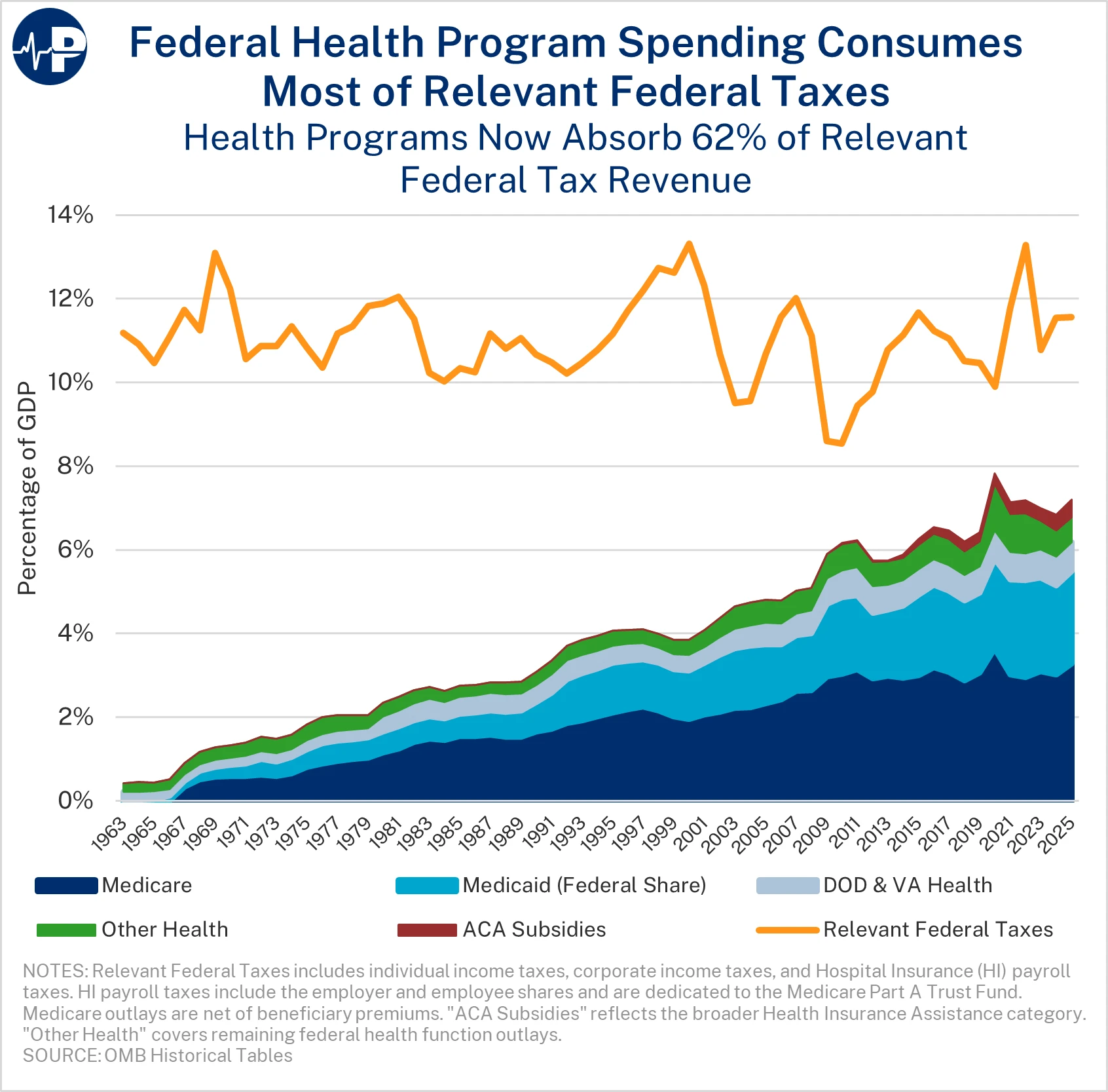
Federal health care spending is the primary driver of persistent deficits, rising debt, and escalating interest costs. The federal government now spends more on net interest payments than on national defense. Every billion dollars lost to fraud, abuse, and poorly designed incentives is financed through higher taxes, additional borrowing, or reductions in other national priorities. Every dollar lost to fraud, waste, abuse, or poorly designed incentives contributes to a fiscal trajectory that is increasingly unsustainable.
The purpose of this testimony is not to identify individual examples of fraud. It is to explain the core reasons why waste, fraud, and abuse are so prevalent and what policymakers can do to reduce them. Across the Affordable Care Act exchanges, Medicaid, and Medicare, a common pattern emerges. Policymakers create open-ended federal commitments. States, insurers, providers, brokers, and enrollees respond to the incentives created from these programs. Spending increases rapidly. Fraud and abuse follow. Enforcement agencies attempt to catch up after the fact. The cycle repeats itself.
The best solution begins with better program design with incentives that focus on value and accountability rather than just maximizing expenditures. While Congress needs to change program design, federal agencies can take actions to minimize waste, fraud, and abuse. The main principle for legislative reform should be to ensure that federal subsidy programs do not reward inflationary expenditures and instead incorporate incentives for cost-conscious behavior.
On Medicaid, the Centers for Medicare and Medicaid Services (CMS) can withhold funds from states—and make disallowances—when fraud and abuse results from negligent state actions. CMS should also ensure that it recovers funds from states that have excessive improper payment rates. Over the past few months, CMS has taken appropriate steps in Minnesota and California in response to egregious Medicaid fraud in those states. Hopefully, this is just the start of the process and CMS deploys such strategies in many more states.
Congress should also strengthen financial penalties on states with persistently excessive improper payment rates. States currently bear only a fraction of the cost of improper Medicaid spending, which weakens incentives to improve eligibility verification and program integrity—a problem made worse by Medicaid money laundering schemes designed to minimize the state share of program spending.2 Fortunately, the One Big Beautiful Bill (OBBB) placed some limits on states’ ability to shift costs to the federal government that future Congresses could build on.
On the Affordable Care Act, the program needs significant reform to improve the quality of plans and lower the cost of plans to enrollees and taxpayers. Congress should reform the subsidy structure so that it does not incentivize higher costs, and Congress should prohibit fully-subsidized plans—which have been a driver of much of the improper and phantom enrollment. OBBB took some important steps to improve enrollment integrity, including eliminating an abused special enrollment period, requiring income verification, and requiring that enrollees who underestimate their income to receive more advanced subsidy must repay that amount back when they file their income taxes.
There are additional steps that would reduce improper and phantom enrollment. Congress or CMS should tighten automatic re-enrollment procedures and require stronger periodic eligibility re-verification, impose tighter oversight on enrollment intermediaries, and aggressively investigate and suspend unscrupulous brokers and intermediaries involved in unauthorized enrollment activity.
On Medicare, CMS should scrutinize claims for outlier providers and billing patterns that are impossible or almost certainly impossible. Paragon recommends a variety of additional reforms to reduce distortions emanating from Medicare payment policies and that lead to wasteful expenditures.3
Open-Ended Federal Commitments Create Incentives for Waste, Fraud, and Abuse
Federal health programs differ in many respects, but they share a common structural problem.
The Affordable Care Act exchanges provide open-ended subsidies that increase automatically as premiums rise. Medicaid provides open-ended federal reimbursement of state expenditures. Medicare frequently operates through a pay-and-chase model that pays claims first and investigates questionable spending later.
These structures create incentives that raise spending—often with little or no corresponding improvement in health outcomes—while weakening accountability for how taxpayer dollars are spent. When insurers know that higher premiums generate larger federal subsidies, they face weaker incentives to control costs. When states can increase Medicaid expenditures while bearing only a fraction of the cost, they have incentives to maximize federal transfers rather than maximize value. When Medicare pays claims before identifying suspicious billing patterns, providers can exploit vulnerabilities for years before enforcement actions occur.
Fraud, waste, and abuse are the symptoms. The underlying disease is a financing structure that rewards spending more than value and accountability and creates large incentives for widespread improper spending.
The Persistent Obamacare Enrollment Fraud
The ACA exchanges provide a recent and significant example of how open-ended federal subsidies can create opportunities for fraud and resulting improper and phantom enrollment. Earlier this month, Paragon released The Persistent Obamacare Enrollment Fraud.4 We estimate that approximately 6.2 million exchange enrollees in 2026 were improperly enrolled, representing roughly 27 percent of total exchange enrollment. This follows our estimates of 5.0 million improper enrollees in 2024 and 6.5 million improper enrollees in 2025.5
The subsidies are almost always advanced to health insurers. An applicant estimates future income (often many months before that income is earned), qualifies for an advanced subsidy, and that amount is forwarded to the health insurance company that enrollee chose. When the individual files their income return, the advanced amount is supposed to be reconciled with the amount to which the enrollee was entitled. However, if the government sent the health insurance company too much during the year, there are significant limits on the amounts that could be recaptured.6 The result is a clear loss for federal taxpayers. Another problem is that many enrollees simply do not appropriately file their tax return and reconcile the advanced amount with the amount they were lawfully entitled to receive. The Government Accountability Office recently found that more than $21 billion in advanced premium tax credit payments tied to plan year 2023 enrollees could not be identified as reconciled through tax filings.7
In 2021, Congress enacted a temporary two-year increase of the ACA insurer subsidies as a pandemic relief measure. Those subsidy add-ons were extended through 2025. The subsidy add-ons resulted in fully subsidized plans with a 94 percent actuarial value (extremely low deductibles and copayments) for people claiming income between 100 and 150 percent of the FPL. This led to a surge of enrollment, much of it improper, and massive growth in subsidy spending.
The widespread availability of fully subsidized plans created strong incentives for insurers and brokers to have applicants submit applications that would qualify them for fully subsidized plans. Insurers strongly prefer enrollees whose premiums are fully paid by taxpayers because those enrollees are less likely to terminate coverage over cost concerns. In those circumstances, they do not need to actually provide enrollees with any value in the plan to maintain enrollment. And brokers receive a monthly commission for every month in which an enrollee is enrolled. Individual brokers operating in high-volume enrollment operations earned upwards of $6,000 a day in commissions, with one customer service agent admitting that half of all enrollees had no idea they were enrolled in coverage.8
The rise of large-scale schemes to enroll as many people as possible, regardless of their eligibility, led to a surge in phantom enrollees. In 2024, 35 percent of all ACA enrollees—and 40 percent of enrollees in a fully subsidized plan—did not make use of their health plan a single time.9 Phantom enrollees—those unaware of their enrollment, enrolled in other coverage, or fictional—likely totaled between 3 and 4 million enrollees (on an annualized basis) in 2024. The Government Accountability Office (GAO) has confirmed the vulnerabilities of the exchanges. GAO recently tested exchange safeguards using fictitious applicants and successfully obtained fully subsidized coverage for 23 of 24 applications despite incomplete or missing information.10
The roots of the problem are not difficult to identify. Congress created a system that provides extremely generous subsidies based largely on self-reported estimates of future income—estimates that could be massaged by unscrupulous agents and brokers. During the pandemic, Congress made those subsidies even larger, which made fully subsidized plans widely available. The federal government advances those subsidies directly to insurers. For several years, eligibility verification was weakened, enrollment periods were expanded, and automatic re-enrollment became a dominant feature of the exchanges.
The result was a system that increasingly rewarded enrollment volume while placing less emphasis on enrollment integrity. The Department of Justice has obtained multiple convictions involving unauthorized enrollments, broker misconduct, identity misuse, and fraudulent applications.11 These cases demonstrate that the vulnerabilities identified are not theoretical. Bad actors recognized these opportunities and exploited them.
Congress should restore exchange integrity by requiring every enrollee to make a meaningful premium contribution, ending automatic re-enrollment, strengthening income verification, basing subsidies on actual income, and imposing significant penalties on entities that facilitate improper enrollment. The objective is to ensure that taxpayer subsidies support legitimate enrollment with lawful subsidy amounts rather than improper enrollment with inflated subsidies.
Medicaid: Open-Ended Federal Reimbursement and Large Incentive for States to Grow Spending
Medicaid provides perhaps the clearest example of how open-ended federal reimbursement distorts incentives for state policymakers. Medicaid allows states to increase federal spending while often bearing only a fraction of the cost—and states even create artificial expenditures to draw down more federal dollars. This incentive structure has existed for decades, but it became substantially worse following the ACA.
For most of Medicaid’s history through 2008, the actual share of Medicaid spending was split between the federal government and states at about a 60-40 share. In the financial crisis of 2008-2009, the federal government sent aid to states through an elevated federal Medicaid reimbursement. That increased the federal share for a brief period. But the main dynamics which have altered the historic ratio were the ACA’s Medicaid expansion (and the much higher federal matching rate for able-bodied, working-age adults in the program) and states’ increased use of financing arrangements that effectively recycle money through providers and insurers in order to maximize federal money coming in to states.
The growing reliance on Medicaid managed care has not solved these incentive problems. In many states, managed care organizations increasingly function as pass-through entities for state financing arrangements rather than organizations meaningfully managing care. States collect provider taxes, obtain additional federal matching funds, direct managed care plans to make higher payments to providers through state-directed payments, and then claim that these transactions represent managed care. In practice, Medicaid managed care has increasingly become a vehicle for channeling additional federal dollars to providers and insurers. This arrangement generates substantial corporate welfare while doing little to improve accountability, value, or program integrity.
As a result of the ACA enhanced reimbursement rate for the expansion population and increased states’ use of legalized money laundering schemes, the federal share of Medicaid has increased to over 70 percent. In the figure below, the top line represents the actual share of federal Medicaid spending, accounting for the state financing gimmicks which result in illusionary state expenditures that are nonetheless reimbursed by the federal government.12

The fiscal partnership between the states and Washington needs to be reformed so that states have incentives to care about the value of the spending, not just maximizing incoming federal dollars.
As a result of states having poor incentives to obtain value from their Medicaid programs, properly accounted improper payments in Medicaid likely represent one-quarter of total program expenditures, making Medicaid the largest source of improper payments for the federal government.13 The main drivers of improper payments are incorrect or incomplete eligibility determinations. The Office of Inspector General at the Department of Health and Human Services (HHS) has repeatedly documented eligibility errors, payment errors, and oversight failures throughout Medicaid.14
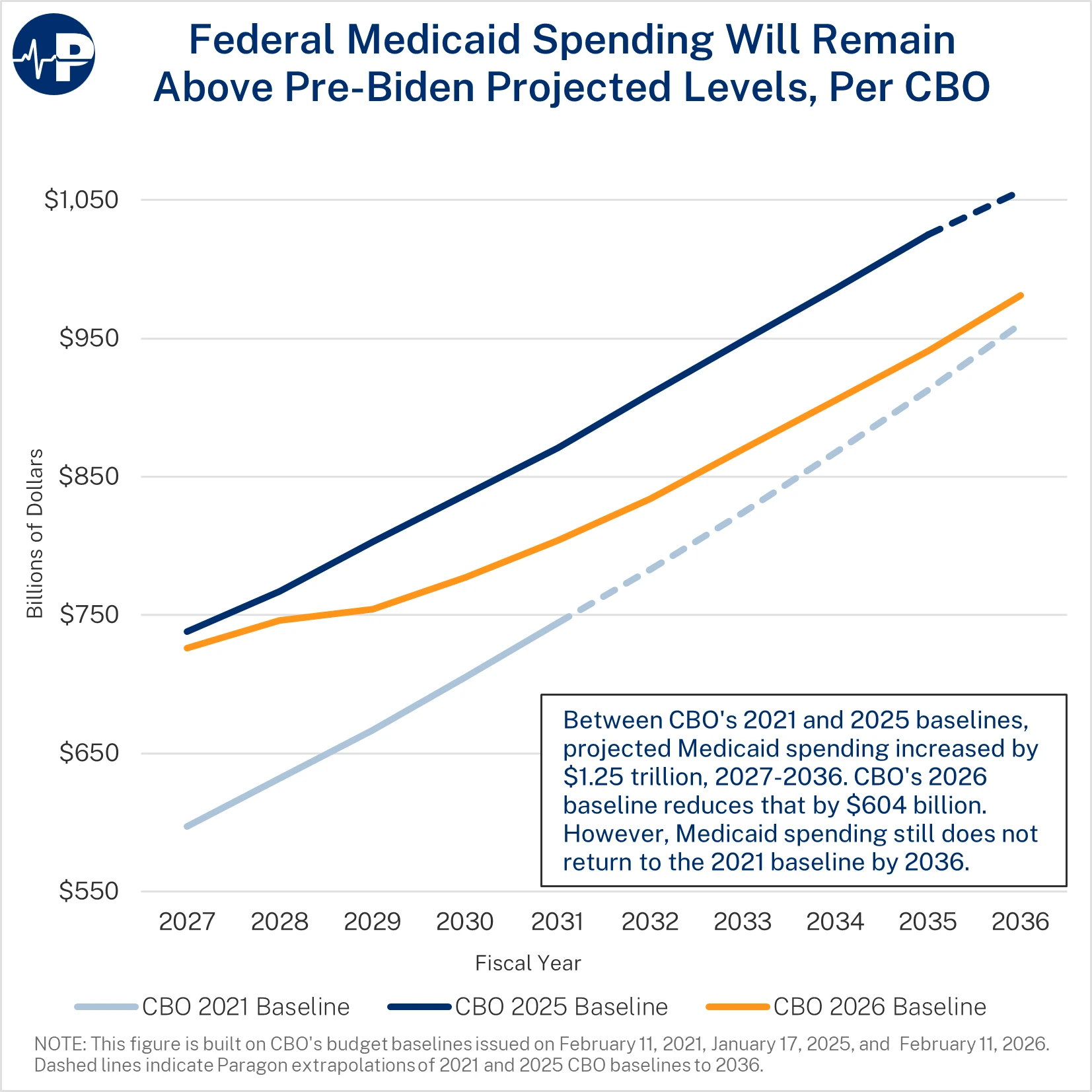
Federal Medicaid spending exploded during the Biden administration—both from a surge of enrollees during the COVID public health emergency (which the Biden administration extended until the spring of 2023) and increased corporate welfare. As a result of continuous coverage requirements, nearly 18 million enrollees were on the program by the spring of 2023 who were no longer eligible.15 The unwinding of the excessive enrollments has taken much longer than expected. In addition, starting in the Biden administration, many states aggressively turned to state-directed payments (SDPs) to increase federal spending to make much larger Medicaid payments to providers, particularly hospital systems. Using SDPs, states recycle provider tax money to obtain additional federal monies that states direct insurers to make to providers, mostly hospital systems.16 A new Paragon study shows how provider taxes raise commercial hospital prices, with a California hospital provider tax raising prices by approximately 4 percent.17 Higher hospital prices almost certainly translate into higher health insurance premiums and lower worker wages.
Loopholes in these taxes permitted states like California to design taxes on Medicaid insurers more than 100 times the tax rate on commercial insurers. In a circular fashion, California spent this tax money on insurers—and then claimed federal reimbursement. Without using any actual state dollars, California has received more than $10 billion in federal funding through this financial maneuvering that exploited federal reimbursement rules—money that no doubt enabled it to expand Medicaid coverage to unauthorized immigrants in the state.18
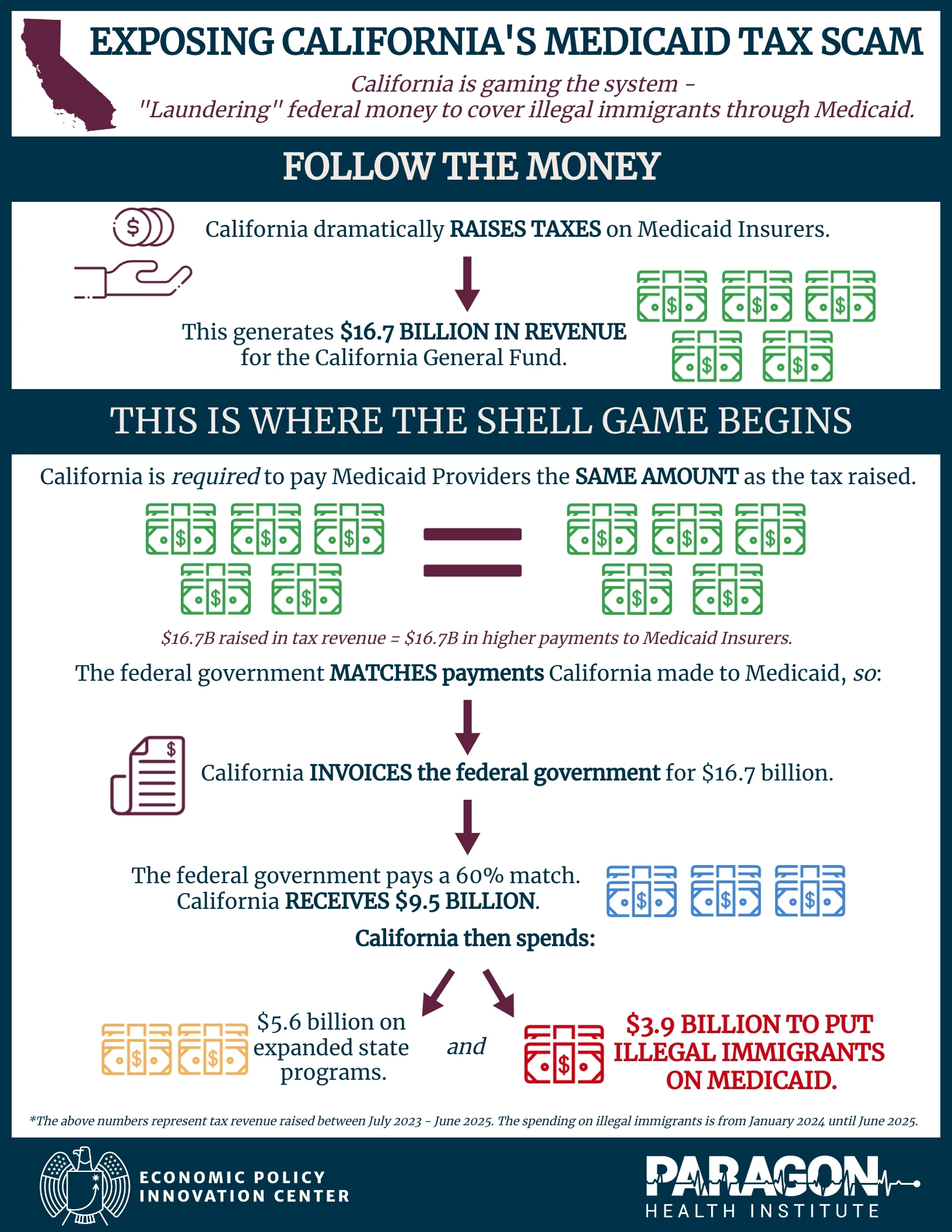
Federal taxpayers were effectively reimbursing California for expenditures that California itself had engineered solely to increase federal payments. Congress should further limit intergovernmental transfer arrangements and other financing mechanisms that allow states to inflate Medicaid expenditures and shift costs to federal taxpayers without contributing meaningful state resources.19
The OBBB contained the most consequential reforms to the Medicaid financing structure in history. These reforms are particularly important given the growth of legalized money laundering techniques, particularly provider taxes, and the growing payoffs from those schemes, increasingly through SDPs. The OBBB prevented new or expanded provider taxes, lowered the provider tax safe harbor threshold in Medicaid expansion states from 6 percent to 3.5 percent over the 2028-2032 period.20 The Obama administration had proposed a reduction in the provider tax safe harbor threshold to 3.5 percent in its 2012 budget proposal—the exact level adopted by the OBBB.21
The OBBB also capped payment rates for most services through Medicaid managed care organizations at 110 percent of Medicare rates in non-expansion states and 100 percent of Medicare rates in expansion states. In essence, these limits on Medicaid managed care payments would bring parity with the Medicaid fee-for-service side, which has long had an aggregate upper payment limit at Medicare rates. CMS estimates that its proposed rule implementing and modestly extending these SDP limits to new categories will reduce federal Medicaid spending by $510 billion from 2026 through 2035.22
The law sensibly distinguished between ACA expansion and non-expansion states because the money laundering schemes are amplified under the nine-to-one ACA Medicaid expansion match rate. More broadly, Congress should reconsider why the federal government reimburses states at dramatically higher rates for able-bodied, working-age adults than for children, pregnant women, seniors, and the disabled. This disparity distorts state priorities and encourages states to maximize federal payments for able-bodied, working-age adult enrollees rather than focus resources on the most vulnerable populations.
Despite these reforms, along with other reforms like the community engagement requirements for able-bodied, working-age adults and more frequent eligibility reviews, federal Medicaid spending is still projected to be above levels projected at the beginning of the Biden administration.23 In essence, the OBBB reforms are projected to eventually return federal Medicaid spending to the levels projected at the start of the Biden administration.
An emerging area of vulnerability is the result of Medicaid increasingly financing services that are difficult to observe, measure, and verify. Home- and community-based services have grown rapidly across many states. Programs that pay family members, friends, and neighbors to provide services are often motivated by good intentions. But they also create significant program integrity challenges. Every expansion of Medicaid into non-clinical activities creates new opportunities for waste, abuse, and fraud.
Verifying whether a surgery occurred is relatively straightforward. Verifying whether thousands of hours of personal assistance services were actually delivered inside private residences is virtually impossible. Whenever government finances services that are difficult to verify, opportunities for waste, abuse, and fraud increase.
The recent New York Consumer Directed Personal Assistance Program scandal illustrates these challenges.24 The program expanded dramatically in recent years and became one of the largest personal care programs in the country. Investigations identified widespread concerns involving oversight, billing practices, eligibility determinations, and program administration. Federal and state authorities have also pursued numerous fraud cases involving home-based services, including schemes involving phantom caregivers, inflated hours, and services that were never provided.
Congress should recognize that states respond rationally to incentives. If policymakers want states to maximize value rather than federal dollars, the financing structure must change so that states cannot pass most higher costs to people outside their jurisdiction.
Congress should continue reforming Medicaid financing by ending the discrimination against the most vulnerable and equalizing matching rates for able-bodied adults on the program and traditional Medicaid recipients (originally an Obama administration proposal)25, further reducing provider tax abuses, limiting intergovernmental transfer schemes, strengthening oversight of SDPs and ensuring the OBBB limits take effect, improving transparency, increasing state accountability for improper payments, and ensuring that clear fraud, abuse, and impossible billing patterns are removed from Medicaid managed care rate setting so that improper spending is not built into future capitated payments.
Medicare: The Problems with Pay and Chase
Original Medicare pays claims first and investigates questionable spending later. This approach creates obvious vulnerabilities. Over the years, federal authorities have uncovered major fraud schemes involving durable medical equipment, hospice services, genetic testing, urinary catheters, and numerous other products and services. These schemes often persist for years because the government pays claims first and investigates later. By the time enforcement actions occur, the funds have frequently been spent and become difficult or impossible to recover.
Many of Medicare’s biggest problems are not criminal. They occur when Medicare creates payment policies that make certain activities enormously profitable. Providers respond to those incentives, utilization explodes, spending skyrockets, and only years later do policymakers recognize the extent of the problem. By then, taxpayers have already absorbed billions of dollars in unnecessary costs.
The recent experience involving skin substitutes provides an excellent example. Medicare reimbursement policies created extraordinary financial incentives surrounding certain skin substitute products used in wound care. Providers responded rationally to those incentives. Utilization increased dramatically. Spending exploded. Medicare expenditures increased far beyond anything policymakers anticipated.
Importantly, much of this activity was legal. Providers were responding to the reimbursement system that Medicare created. This distinction matters because policymakers often view fraud, waste, and abuse primarily through a law-enforcement lens. The skin substitute example demonstrates that poorly designed incentives can produce outcomes that might be considered legalized fraud. Similar incentives exist throughout Medicare. For example, Medicare frequently pays dramatically different amounts for the same service depending on where it is delivered. These payment differentials encourage provider consolidation, increase costs for taxpayers and beneficiaries, and reward organizations that structure themselves to maximize reimbursement rather than value.
The same pattern has repeated itself throughout Medicare’s history. Problems emerge. Spending accelerates. Investigators eventually identify suspicious activity. Corrective action occurs years later. Taxpayers absorb the losses. Congress should increasingly focus on prevention rather than recovery.
Under the leadership of Dr. Oz, CMS is taking important actions to address Medicare overpayments, waste, and fraud. CMS recently restricted payments for skin substitutes, with the Congressional Budget Office estimating substantial federal savings over the next decade.26 CMS is also now using advanced data analytics to identify unusual billing patterns. It should expand these efforts and stop suspicious payments before they go out the door.
Congress should consider granting CMS strong authorities to pause payments when clear anomalies emerge. Congress should also continue moving toward site-neutral payments when identical services are delivered in different settings. Reducing opportunities to game reimbursement rules is one of the most effective ways to prevent waste before it occurs. Importantly, incorporating prior authorization into original Medicare in areas that are highly susceptible to waste, fraud, and abuse—such as the WISeR model now being implemented by CMS’s Innovation Center—should likely be expanded.
It is important to distinguish these problems from Medicare Advantage. While Medicare Advantage can and should be improved—including through stronger oversight of risk adjustment and coding intensity—many of the most notorious examples of Medicare waste and abuse have occurred in traditional fee-for-service Medicare.27 Schemes involving skin substitutes, urinary catheters, genetic testing, and other products have generally flourished in the pay-and-chase environment of original Medicare rather than in Medicare Advantage plans. Because Medicare Advantage plans bear financial risk for spending, they have stronger incentives to identify questionable utilization and prevent unnecessary expenditures before they occur.
Medicare: The Problems with Pay and Chase
Fraud, waste, and abuse are often treated as enforcement problems. In reality, they are driven by incentives created by the government programs that reward excessive spending. When federal programs reward spending rather than value, participants predictably respond by maximizing spending. Better audits and stronger enforcement are important, but they are limited by resource constraints. Lasting reform requires better program design. Congress should focus on reforming programs so that taxpayers, states, insurers, providers, and beneficiaries have incentives to maximize value and make cost-conscious decisions. If core program incentives are improved, we will reduce fraud, improve program performance, and put the nation’s largest spending programs on a more sustainable path, protecting future generations from crushing debt and a lower standard of living.
I thank the Committee for its attention to these issues and look forward to your questions.
Footnotes
1↑ Mark Howell, "Federal Health Program Spending Consumes 62 Percent of Relevant Federal Taxes," Paragon Health Institute, April 2026, https://paragoninstitute.org/paragon-pic/federal-health-program-spending-consumes-62-percent-of-relevant-federal-taxes/. Note that Social Security revenue is excluded because that revenue is dedicated to finance Social Security benefits
2↑ Brian Blase and Niklas Kleinworth, "Addressing Medicaid Money Laundering: The Lack of Integrity with Medicaid Financing and the Need for Reform," Paragon Health Institute, March 2025, https://paragoninstitute.org/medicaid/addressing-medicaid-money-laundering-the-lack-of-integrity-with-medicaid-financing-and-the-need-for-reform/
3↑ Demetrios Kouzoukas and Jackson Hammond, "Advancing Choice, Competition, and Fiscal Sustainability in Medicare: A Roadmap for CMS," Paragon Health Institute, February 2026, https://paragoninstitute.org/medicare/advancing-choice-competition-and-fiscal-sustainability-in-medicare-a-roadmap-for-cms/
4↑ Brian Blase, Gabrielle Minarik, Niklas Kleinworth, Mark Howell, and Liam Sigaud, "The Persistent Obamacare Enrollment Fraud," Paragon Health Institute, June 2026, https://paragoninstitute.org/private-health/the-persistent-obamacare-enrollment-fraud/
5↑ Brian Blase, Chris Medrano, Niklas Kleinworth, and Jackson Hammond, "The Greater Obamacare Enrollment Fraud," Paragon Health Institute, June 2025, https://paragoninstitute.org/private-health/the-greater-obamacare-enrollment-fraud/; Brian Blase and Drew Gonshorowski, "The Great Obamacare Enrollment Fraud," Paragon Health Institute, June 2024, https://paragoninstitute.org/private-health/the-great-obamacare-enrollment-fraud/
6↑ Before 2026, federal law significantly limited how much excess subsidy could be recaptured from many households with income below 400 percent of the federal poverty level. For tax year 2025, repayment was capped at $375 for single filers and $750 for other filers with income below 200 percent of FPL; $975 and $1,950, respectively, for those between 200 and 300 percent of FPL; and $1,625 and $3,250, respectively, for those between 300 and 400 percent of FPL. There was no repayment cap for households with income at or above 400 percent of FPL. Beginning with tax year 2026, however, the OBBB eliminated these repayment caps, requiring enrollees to repay the full amount by which advance payments exceed their allowable premium tax credit.
7↑ U.S. Government Accountability Office, "Patient Protection and Affordable Care Act: Preliminary Results from Ongoing Review Suggest Fraud Risks in the Advance Premium Tax Credit Persist," GAO-26-108742, December 2025, https://www.gao.gov/products/gao-26-108742
8↑ Zeke Faux and Zachary Mider, "Chasing Big Money with the Health-Care Hustlers of South Florida," Bloomberg, June 5, 2025, https://www.bloomberg.com/features/2025-deepfake-ads-fueled-florida-health-insurance-scheme/
9↑ Brian Blase, "Explaining the Rise of Phantom ACA Patients," Paragon Health Institute, August 2025, https://paragoninstitute.org/private-health/explaining-the-rise-of-phantom-aca-patients/
10↑ Seto Bagdoyan and John Dicken, "Patient Protection and Affordable Care Act: Preliminary Results from Ongoing Review Suggest Fraud Risks in the Advance Premium Tax Credit Persist," U.S. Government Accountability Office, Letter to the House Committee on Energy and Commerce, House Committee on the Judiciary, and House Committee on Ways and Means, December 3, 2025, https://www.gao.gov/assets/gao-26-108742.pdf
11↑ Brian Blase, Gabrielle Minarik, Niklas Kleinworth, Mark Howell, and Liam Sigaud, "The Persistent Obamacare Enrollment Fraud," Paragon Health Institute, June 2026, https://paragoninstitute.org/private-health/the-persistent-obamacare-enrollment-fraud/
12↑ Brian Blase and Niklas Kleinworth, "Addressing Medicaid Money Laundering: The Lack of Integrity with Medicaid Financing and the Need for Reform," Paragon Health Institute, March 2025, https://paragoninstitute.org/medicaid/addressing-medicaid-money-laundering-the-lack-of-integrity-with-medicaid-financing-and-the-need-for-reform/
13↑ Brian Blase and Rachel Greszler, "Medicaid's True Improper Payments Double Those Reported by CMS," Paragon Health Institute, March 2025, https://paragoninstitute.org/medicaid/medicaids-true-improper-payments-likely-double-those-reported-by-cms/
14↑ Chris Medrano and Brian Blase, "Medicaid Waste, Fraud, and Abuse: Why CMS's Improper Payment Rate Can't Be Trusted," Paragon Health Institute, April 2026, https://paragoninstitute.org/medicaid/medicaid-waste-fraud-and-abuse-why-cms-improper-payment-rate-cant-be-trusted/
15↑ Brian Blase, Drew Gonshorowski, and Niklas Kleinworth, "The Cost of Good Intentions: The Harm of Delaying the Disenrollment of Medicaid Ineligibles," Paragon Health Institute, July 2023, https://paragoninstitute.org/state-health-reform/the-cost-of-good-intentions/
16↑ Alice Burns, Scott Hulver, Jessica Mathers, Robin Rudowitz, and Patrick Drake, "Spending on Medicaid State Directed Payments Before New Limits Take Effect," KFF, June 2026, https://www.kff.org/medicaid/spending-on-medicaid-state-directed-payments-before-new-limits-take-effect/
17↑ Liam Sigaud and Eric Sun, "The Hidden Cost of Medicaid Provider Taxes: Higher Prices in the Commercial Market," Paragon Health Institute, June 2026, https://paragoninstitute.org/medicaid/the-hidden-cost-of-medicaid-provider-taxes-higher-prices-in-the-commercial-market/
18↑ Paul Winfree and Brian Blase, "California's Insurance-Tax Shuffle: How Federal Money Ends Up Paying for Medicaid for Illegal Immigrants," Paragon Health Institute and Economic Policy Innovation Center, March 2025, https://paragoninstitute.org/medicaid/californias-insurance-tax-shuffle-how-federal-money-ends-up-paying-for-medicaid-for-illegal-immigrants/
19↑ Chris Medrano and Brian Blase, "The Local Loop: How States Turn Medicaid into a Government Provider Payday Scheme," Paragon Health Institute, December 15, 2025, https://paragoninstitute.org/state-health-reform/the-local-loop-how-states-turn-medicaid-into-a-government-provider-payday-scheme/
20↑ The Medicaid provider-tax "safe harbor" refers to the indirect hold-harmless threshold under federal provider tax rules. Before the OBBB, this threshold generally allowed states to use provider tax revenues to draw down federal Medicaid matching funds so long as the tax did not exceed 6 percent of a provider's net patient revenue. Taxes above that threshold could trigger the federal hold harmless test, which is intended to prevent states from taxing providers and then guaranteeing that those same providers are repaid through higher Medicaid payments. The OBBB lowered the safe harbor threshold for Medicaid expansion states by 0.5 percentage points per year beginning in fiscal year (FY) 2028, reaching 3.5 percent in FY 2032 and thereafter, while generally freezing existing provider taxes and preventing new or increased provider taxes above the new thresholds.
21↑ Office of Management and Budget, Fiscal Year 2013 Budget of the U.S. Government, February 2012, https://obamawhitehouse.archives.gov/sites/default/files/omb/budget/fy2013/assets/budget.pdf; See also Brian Blase, "Learning from Obama's Medicaid Reform Proposals," Paragon Health Institute, February 19, 2025, https://paragoninstitute.org/newsletter/learning-from-obamas-medicaid-reform-proposals/
22↑ Centers for Medicare & Medicaid Services, "Medicaid Program; Medicaid Managed Care State Directed Payments and Medicaid Fee-for-Service Targeted Medicaid Practitioner Payments," proposed rule, Federal Register, May 22, 2026, https://www.federalregister.gov/documents/2026/05/22/2026-10292/medicaid-program-medicaid-managed-care-state-directed-payments-and-medicaid-fee-for-service-targeted
23↑ John R. Graham, "CBO's New Budget Baseline Confirms: One Big Beautiful Bill Did Not Cut Medicaid; Biden-Era Profligacy Even Higher Than First Thought ," Paragon Health Institute, February 2026, https://paragoninstitute.org/paragon-pic/cbos-new-budget-baseline-confirms-one-big-beautiful-bill-did-not-cut-medicaid-biden-era-profligacy-even-higher-than-first-thought/
24↑ U.S. Department of Justice, "Department of Justice Files Suit to Stop Ongoing Medicaid Fraud Related to New York's $10 Billion Home-Care Program," press release, June 16, 2026, https://www.justice.gov/opa/pr/department-justice-files-suit-stop-ongoing-medicaid-fraud-related-new-yorks-10-billion-home
25↑ Brian Blase, "Learning from Obama's Medicaid Reform Proposals," Paragon Health Institute, February 19, 2025, https://paragoninstitute.org/newsletter/learning-from-obamas-medicaid-reform-proposals/
26↑ CBO, "The Budget and Economic Outlook: 2026 to 2036," February 2026, https://www.cbo.gov/publication/62105
27↑ Joe Albanese, "Improving Medicare Through Medicare Advantage," Paragon Health Institute, February 2024, https://paragoninstitute.org/medicare/improving-medicare-through-medicare-advantage/
Subscribe
Sign up now for your health policy updates.