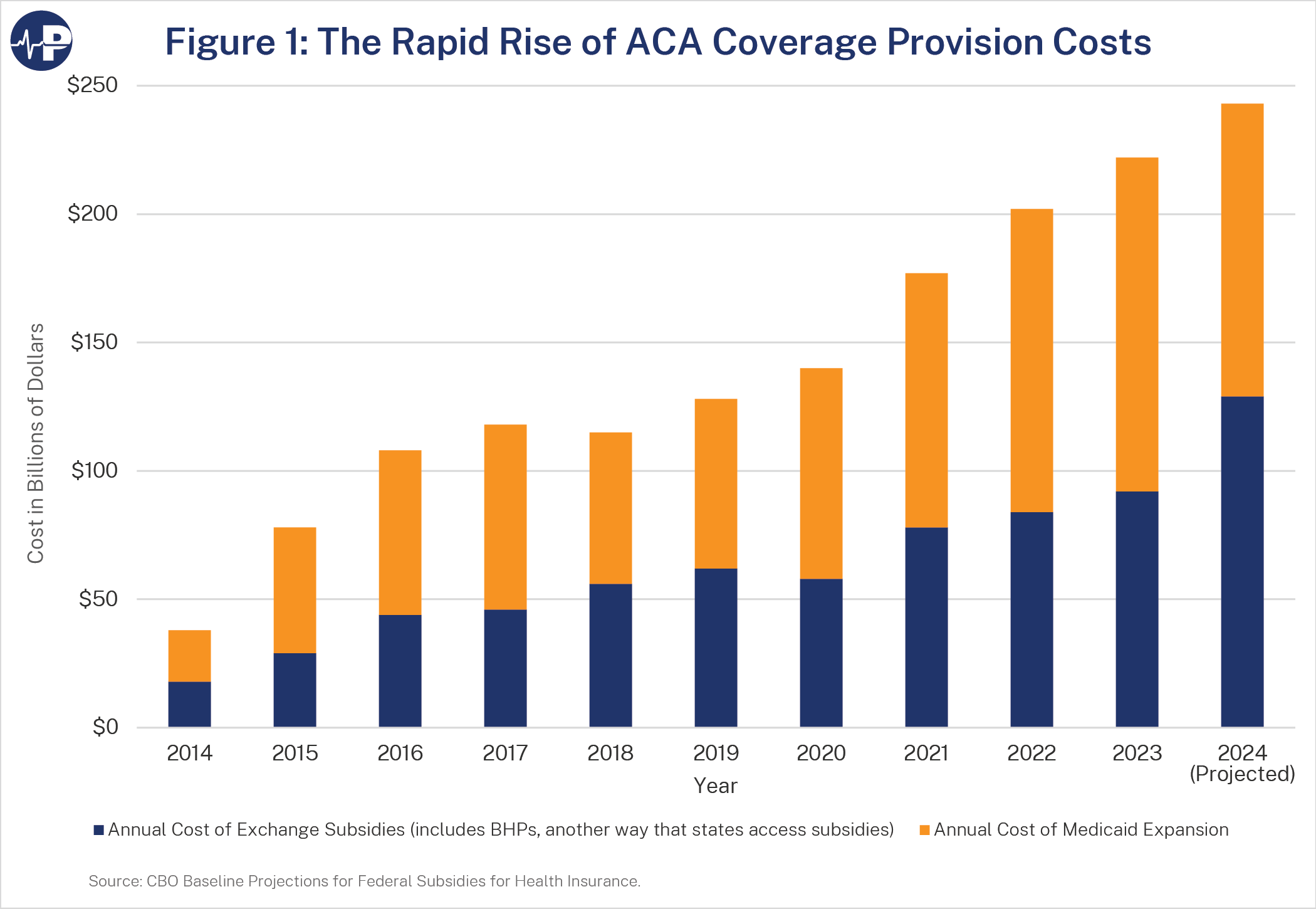
In eight days, the nation will decide on a new president. Regardless of who wins the election, they will have to deal with a serious and growing fiscal crisis. The national debt is over $35.8 trillion, and annual interest payments on that debt have overtaken defense spending. Contributing to this massive debt are the coverage provisions of the Affordable Care Act (ACA). Over the last 10 years, federal costs for these provisions have exceeded $1.5 trillion – a combination of the exchange subsidies, the Basic Health Plan (BHP), and Medicaid expansion. Between 2014-2024, the Medicaid expansion has cost around $873 billion, while the exchange subsidies and BHPs have cost a combined $694 billion. As the figure below shows, the cost of the ACA spiked during the Biden administration.
 ACA Exchange Costs
The exchange subsidies have cost $694 billion over the 2014-2024 period. Interestingly, this was well below the nearly $1 trillion estimate CBO had originally projected in 2014. Most of this has to do with the fact that there has been significantly less enrollment in ACA exchange plans than predicted. For most of the years over the past decade, exchange enrollment was only half of what CBO projected.
In its 2014 estimate, CBO projected that, by 2024, there would be 25 million insured in the exchanges. This year, there are only about 21.3 million individuals enrolled in exchange plans – and that is a significant jump from the 14.7 million that were enrolled in 2023, which was 10 million enrollees below CBO’s 2014 projections for that year. The recent surge in exchange in enrollment, and the consequential stark increase in costs, has been a direct result of two things: Significant amounts of fraud in the exchanges and the massive enhanced subsidies enacted by congressional Democrats from 2021-2025.
Despite both a shockingly high tolerance for fraud as well as huge subsidies (to the point that nearly half of exchange participants have fully subsidized plans), enrollment projections have still fallen short for one simple reason: exchange plans are simply not good coverage. As Daniel Cruz and Greg Fann explored in their Paragon report It’s Not Just the Prices, the quality of exchange plans has declined markedly since their creation. Only 17 percent of exchange enrollees are in broad-network plans, a significant decline from 50 percent in 2014. One KFF analysis reported that “34 percent of Marketplace enrollees in fair or poor health reported that a particular doctor or hospital they needed was not covered by their plan, nearly two times more than those with an employer plan (16 percent).” Adding to the problems are dramatically increasing prices for unsubsidized exchange enrollees: Cruz and Fann note that “from 2014 to 2023, the average unsubsidized premium has increased by 62 percent compared to 40 percent for ESI coverage.”
Medicaid Expansion Costs
Unlike the exchange costs, Medicaid expansion costs are significantly higher than expected. CBO projected in 2014 that from 2014-2024, only 13 million people would be enrolled in Medicaid due to the ACA expansion at a cost of $802 billion. Through the ACA, the federal government pays virtually the entire tab for state spending on expansion enrollees. Perhaps unsurprisingly, this has led to huge amounts of spending. My colleagues Brian Blase and Drew Gonshorowski found that Medicaid expansion spending exceeded expectations by about a third. Per enrollee expenditures in Medicaid were also much higher than expected – 56 percent greater in 2018 than what the actuaries at the Centers for Medicare and Medicaid Services had projected prior to the law taking effect.
What those projections couldn’t have accounted for were the pandemic and the continuous coverage provisions (and its associated six percentage point increase to states’ federal Medicaid funding) of the Families First Corona Virus Response Act. Medicaid expansion enrollment spiked to a height of 17.7 million in 2023 at an annual cost of $130 billion. Of note, CBO’s data on 2023 expansion enrollment and spending is significantly less than information reported by the Centers for Medicare and Medicaid Services. Enrollment in 2024 is projected to decrease to 13.3 million in 2024 (roughly in line with the 2014 projections) due to states finally being able to disenroll ineligible people from their Medicaid program.
Conclusion
From 2023 to 2025, Medicaid expansion spending is projected to decline to some degree because of disenrollment of ineligible individuals. In part the decline in Medicaid will be captured by higher spending on the exchanges as some newly-disenrolled Medicaid beneficiaries likely qualify for ACA subsidies, and—along with ACA exchange enrollment fraud—that’s already being reflected in the sharp spike in ACA subsidies.
There is a chance to start bending this cost curve though: Congress simply has to let the enhanced exchange subsidies expire at the end of 2025. This would begin to rein in the program and help return ACA spending closer to original projections. When the ACA became law, no one envisioned that half of enrollees would receive fully-subsidized taxpayer coverage. Fiscal sanity and good public policy very much favors this action; we can only hope policymakers have the political will to let it happen.