

Brian Blase, Ph.D., is the President of Paragon Health Institute. Brian was Special Assistant to the President for Economic Policy at the White House’s National Economic Council (NEC) from 2017-2019, where he coordinated the development and execution of numerous health policies and advised the President, NEC director, and senior officials. After leaving the White House, Brian founded Blase Policy Strategies and served as its CEO.
Tomorrow’s Event with Dr. Oz, New Policy Briefs, and Tracking Health Care Fraud

The Trump administration continues its significant efforts to combat waste, fraud, and abuse in federal health programs. On Thursday, Centers for Medicare and Medicaid Services (CMS) Administrator Dr. Oz sent a letter to all 50 governors asking them “to undertake a swift revalidation of Medicaid providers of services at high risk of waste, fraud, abuse, and corruption as part of each state’s program integrity obligations under federal law. … [and] to provide a broader strategy on provider revalidations within 30 days.”
Tomorrow, at Paragon’s event at the National Press Club, I will ask Dr. Oz about these efforts. The event will also feature Senator Ron Johnson and Representative John Joyce discussing their efforts to combat waste, fraud, and abuse in federal health programs. You can still register here, but registration will close today at 2 p.m. and walk-ins will not be permitted.
On Friday, I appeared on CSPAN’s Washington Journal to discuss The Hospital Cost Crisis: How Government Policies Drive Consolidation, Undermine Competition, and Fuel Soaring Prices. You can view my appearance here.
Today’s newsletter highlights two new policy briefs, a new Paragon PIC, and our new dashboard tracking fraud in government health care programs. The first policy brief explains why CMS’s official Medicaid improper payment rate dramatically understates the extent of waste, fraud, and abuse and is not a reliable measure. The second policy brief reviews a new Medicaid financing scheme in Oregon that combines provider taxes and intergovernmental transfers (IGTs) to maximize federal matching funds without meaningful state contributions—violating the spirit, if not the letter, of the law. The PIC highlights hospice fraud in Los Angeles County, where the overwhelming majority of providers show warning signs of potential abuse.
CMS’s (Literally) Unbelievable Medicaid Improper Payment Rates
CMS reports that Medicaid’s official improper payment rate is just over 6 percent. That figure is often cited as evidence that waste, fraud, and abuse are limited. It is not. The estimate is produced by the Payment Error Rate Measurement (PERM) program—a narrow compliance tool not designed to measure the full scope of improper spending.
As Chris Medrano and I discuss in a new policy brief, PERM largely captures documentation and administrative errors, not fraud or systemic misspending. More importantly, it fails to measure the two largest sources of improper payments: eligibility errors and managed care spending. Eligibility error rates soared with the implementation of the Affordable Care Act (ACA) as the federal government provides states far higher matching funds for able-bodied expansion enrollees than traditional Medicaid enrollees. In the years when eligibility reviews were conducted, improper payment rates averaged 27 percent. Yet those reviews have been suspended or severely weakened in recent years.
PERM also does not meaningfully examine managed care spending, which now accounts for most of Medicaid expenditures. Instead of auditing provider-level payments, PERM primarily reviews whether states made correct capitation payments to insurers. As a result, managed care error rates appear artificially low, even as more targeted audits continue to uncover significant problems.
The result is a deeply misleading metric. By understating the scale of improper payments, PERM creates a false sense of program integrity and weakens incentives for states to invest in oversight. PERM is not an accurate measure of problems in the Medicaid program. The reality is that Medicaid’s improper payments are far larger than reported since PERM is so limited, particularly due to the lack of eligibility and managed care reviews. Waste, fraud, and abuse are higher still.
Policymakers should treat the current figures with skepticism and focus instead on strengthening program integrity, improving measurement, and addressing the structural incentives that drive waste, fraud, and abuse. And CMS should work to make PERM a meaningful measurement tool.
Oregon’s New Medicaid Financing Scheme: Combining Provider Taxes and IGTs to Maximize Federal Funds
A new policy brief from Chris Medrano and me explains how Oregon has developed a Medicaid financing scheme that combines provider taxes and intergovernmental transfers (IGTs) to generate additional federal funding without meaningful state contribution. While each mechanism has long existed, Oregon’s integration scheme represents a more aggressive approach that CMS should shut down.
On the provider tax side, Oregon exempts a large public hospital system from paying the tax while still including its revenues in the tax base. This inflates the denominator used to calculate compliance with the federal safe harbor, allowing the state to impose higher effective tax rates on other hospitals while appearing to stay within federal limits. The result pushes beyond the intent—and potentially the requirements—of federal law.
Oregon uses state-directed payments to return those tax revenues, along with federal matching funds, to hospitals. In parallel, the state employs an IGT arrangement in which a public hospital system transfers funds to the state, which the state uses as the nonfederal share of Medicaid payments that flow back to the system. The close alignment between the size of the transfers and the resulting payments suggests a circular financing arrangement.
Together, these mechanisms create a loop: providers supply funds, the state uses those funds to draw down federal dollars, and the combined payments are returned to the same providers. This inflates Medicaid spending and increases federal costs without a commensurate state contribution.
These arrangements raise serious legal and policy concerns and highlight broader vulnerabilities in Medicaid financing. Without federal scrutiny, they risk becoming a model for other states seeking to maximize federal funds while minimizing their own fiscal exposure.
Hospice Fraud in Los Angeles County: A System Under Strain
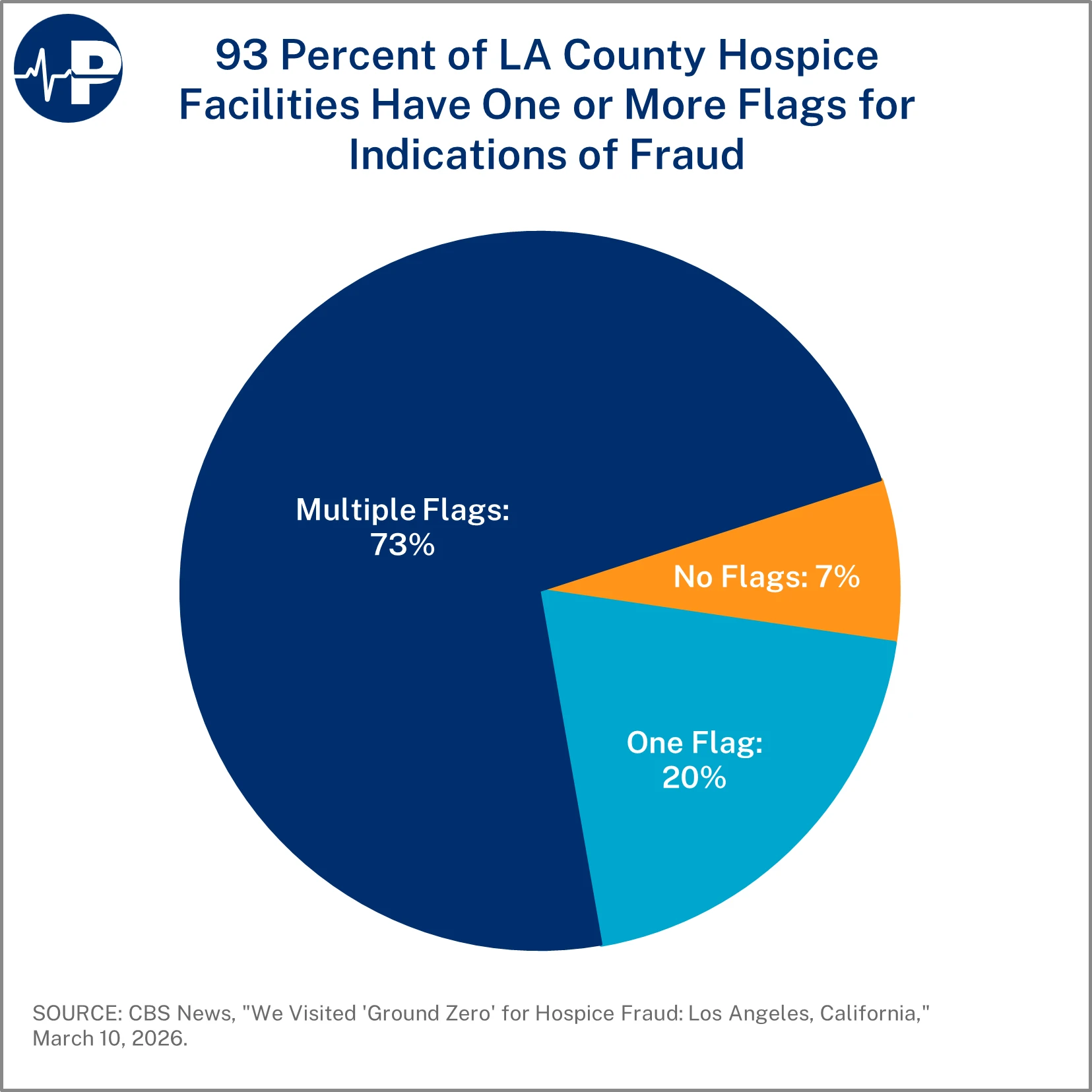
New reporting highlights the scale of fraud risk in hospice care. In Los Angeles County, 93 percent of hospice providers show at least one indicator of potential fraud, and nearly three-quarters show multiple warning signs.
Launching Our Health Care Fraud Dashboard
Today, we launched the Health Care Fraud Dashboard, a resource compiling hundreds of fraud cases and tracking this administration’s unprecedented actions to combat widespread waste, fraud, and abuse. The dashboard covers actions beginning in January 2025 and will be updated regularly.
The scale is striking. The dashboard catalogs more than 500 fraud cases prosecuted by the Department of Justice, often following investigations by the Department of Health and Human Services Office of Inspector General (HHS-OIG), including a $233 million ACA fraud scheme in Florida, a $328 million Medicare fraud scheme in Texas, and a $270 million Medicaid fraud scheme in California.
Beyond prosecutions, the dashboard tracks more than 100 federal actions. These include initiatives like the White House Task Force to Eliminate Fraud and CMS’s Fraud Defense Operations Center; HHS-OIG audits spanning improper Applied Behavior Analysis (ABA) Medicaid payments in Colorado to hospice overpayments in Texas; and CMS investigations into allegations of Medicaid fraud in Minnesota and New York.
The dashboard also highlights investigative reporting exposing fraud, including The Wall Street Journal reporting on autism therapy billing fraud in Indiana and CBS News reporting on hospice fraud in California.
You can use the dashboard to explore fraud by state, program, vulnerable area (such as autism services, durable medical equipment, or skin substitutes), or time period.
We will continue updating the dashboard frequently.
Recent Newsletters


Subscribe
Sign up now for your health policy updates.