

Brian Blase, Ph.D., is the President of Paragon Health Institute. Brian was Special Assistant to the President for Economic Policy at the White House’s National Economic Council (NEC) from 2017-2019, where he coordinated the development and execution of numerous health policies and advised the President, NEC director, and senior officials. After leaving the White House, Brian founded Blase Policy Strategies and served as its CEO.
Properly Regulating AI in Health Care

Coinciding with President-elect Trump’s announcement of tech executive David Sacks as his czar for artificial intelligence, Paragon is out with a new paper from Kev Coleman, our resident expert on the topic. As lawmakers grapple with AI’s impact on the health sector, this paper will serve as an important model for how policymakers can balance progress with patient protections.
But first: Paragon’s most recent paper, What Matters for Health: Insurance is Less Important Than You Think, has attracted significant attention, with references by both Axios and The Wall Street Journal.
Insurance Does Not Lead to Better Health Outcomes
Paragon’s extensive review of the literature by Dr. Joel Zinberg and Liam Sigaud finds overwhelming evidence that health insurance does not produce better health outcomes. This research is crucial to keep in mind as insurers pressure Congress to extend Affordable Care Act (ACA) subsidies that go directly to them and that have been associated with substantial wasteful spending and fraud. This research makes it clear that policymakers should not expect health improvements from extending those expiring subsidies. As this week’s Paragon Pic shows (below), mortality rates from major medical causes have risen despite the ACA’s enormous new federal spending that expanded insurance coverage.
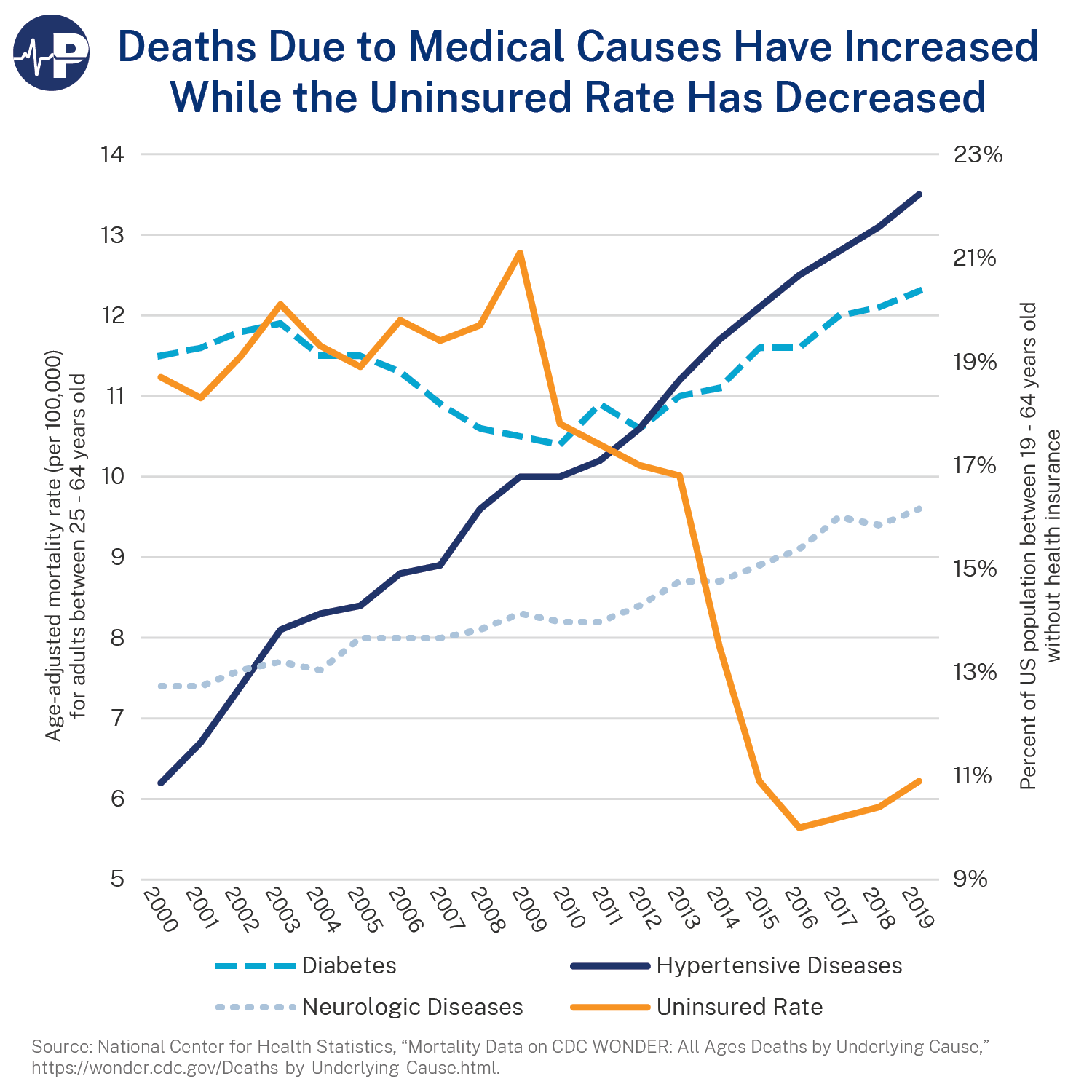
From 2014, the year the ACA’s coverage provisions were implemented, through 2019, the final year before the Covid-19 pandemic, the uninsured rate among adults ages 25-64 declined from 17 percent to 11 percent. The ACA expanded coverage primarily through Medicaid and, to a much lesser extent, through exchange plan subsidies. Yet mortality rates from major medical causes such as diabetes, hypertensive diseases, and neurologic diseases—as opposed to deaths from intentional or unintentional injuries such as drug overdoses, alcohol-related deaths, suicides, accidents, and homicides—increased.
As Paragon’s new paper makes clear, health insurance delivers few – if any – health benefits for most people. The most persuasive evidence from randomized controlled trials indicates that expanding government-financed health coverage has little effect on measurable health outcomes such as high blood pressure, cholesterol levels, diabetes control, or mortality. Estimates suggest that medical care is responsible for only about 10 to 20 percent of the variation in health. Health behaviors such as smoking, drug and alcohol use, diet, and physical activity—areas that are part of the Make America Healthy Again movement—play a much larger role in determining health outcomes. Moreover, the uninsured receive about 80 percent as much health care as similar people with insurance.
After citing Paragon’s paper, Allysia Finley of The Wall Street Journal wrote the following:
Bigger government has benefited the health-industrial complex but not Americans.
One problem is that simply having insurance doesn’t change people’s behavior. It does, however, cause them to use more care. This is a particular problem in Medicaid, since beneficiaries often rush to the emergency room for nonemergencies because they don’t have deductibles or co-pays.
Another problem: The nearly 100 million Americans on Medicaid or tightly regulated and generously subsidized exchange plans struggle to find doctors to treat them. …
A 2019 study found that patients were only half as likely to get an appointment with a doctor compared with privately insured patients before the law passed. Post-ObamaCare, they were less than one-third as likely. Medicaid is insurance in name only.
Patients with exchange plans hardly fare better. Affordable Care Act plan networks include on average only 40% of local physicians and 21% of those employed by hospitals. …
They are also hiking deductibles, which this year averaged $5,241 for a typical plan. That’s up from $2,425 in 2014. Although subsidies reduce how much people with ObamaCare plans pay toward their premiums, they are stuck paying out of pocket until they hit their deductible.
Understanding AI and Avoiding Misregulation
Kev Coleman’s new paper, Healthcare AI Regulation: Guidelines for Maintaining Public Safety & Innovation, highlights how to avoid potential pitfalls in AI policy.
There have been exciting AI advances in recent years and AI holds the potential to both improve health care quality and lower costs. Adopting overly broad rules may impose higher compliance costs and distort future AI developments.
Kev’s paper also offers background on current FDA policies for software-as-a-medical-device that provide policymakers a framework to work within, rather than necessitating that they create a new, duplicative agency to oversee AI.
The paper offers the following guidelines, simplified by AI, for regulating health care AI:
- Clear Identification of AI Technology: Regulations should clearly define what types of AI they apply to, explaining how AI systems differ from regular non-AI systems.
- Context and Risk Assessment: Regulations should specify the situations in which they apply, using existing regulatory agencies. They should also assess the risks based on the type of AI and how it is being used.
- Safety and Testing Standards: AI systems in health care should follow existing safety rules and show proof of their capabilities and risks. Policymakers should recognize that it’s difficult to monitor every recommendation made by AI, especially when there are uncertainties in AI or medical science. They should also allow for testing new AI products on a small scale before they are used widely.
- Protecting Patient Information: New rules about AI and patient data should only be introduced if existing regulations are not enough. These rules should align with current standards for medical software and account for the differences between AI systems that work with fixed data and those that change based on new information.
- Anti-Discrimination Measures: Anti-discrimination rules for AI should show that current policies are not already sufficient and should consider the challenges AI faces when dealing with rare or unique medical conditions. Regulations should not require AI to make decisions that ignore medical research or data.
- Encouraging AI Improvement: Regulations should encourage the development of better software, including offering a clear process for getting approval from the FDA for updated AI systems that have the same core functionality but with improvements or more autonomy.
The new administration and Congress will have to grapple with the promises and perils of fast-moving AI technology. Kev’s principles offer a reasonable and targeted approach to maximizing AI benefits while avoiding potential harms.
All the best,
Brian Blase
President
Paragon Health Institute
Recent Newsletters

Subscribe
Sign up now for your health policy updates.